 By The Epoch Times | Created at 2026-07-29 20:37:05 | Updated at 2026-07-29 21:36:27
1 hour ago
By The Epoch Times | Created at 2026-07-29 20:37:05 | Updated at 2026-07-29 21:36:27
1 hour ago
Dr. Anthony Fauci, who became one of the most visible government officials during the COVID-19 pandemic, spent time most days outlining his thoughts on what was transpiring at the time.
Fauci’s diary was collected by the Department of Health and Human Services and released by Sen. Rand Paul (R-Ky.) ahead of a hearing with Fauci on July 29.
Fauci wrote in the diary about his time as head of the National Institute of Allergy and Infectious Diseases when COVID-19 was detected in early 2020, and as officials across the country took unprecedented steps—including forcing the closure of schools—in response.
Here are some takeaways from his diary.
Detailed Interactions With Trump
Fauci regularly wrote about speaking with President Donald Trump, with early interactions largely positive.
During a Jan. 29, 2020, meeting, Fauci recalled how Trump entered and said, “Anthony you are really a famous guy.” Trump said his friend Lou Dobbs, a radio host, had conveyed that Fauci was smart and knowledgeable.
Trump “then stayed for 20 minutes and asked most of his questions of me,” Fauci wrote. “I was surprised and very pleased and the Deputies were clearly stunned and impressed.”
Trump, Fauci, and other top officials in early 2020 called on Americans to stay at home for 15 days to stop the spread of COVID-19, a time period that was repeatedly extended throughout the year.
The relationship between Trump and Fauci began to sour over time as Trump pushed for reopening the country and Fauci favored keeping heavy restrictions in place.
“Tony, I really like you, and you know that, but what the [expletive] are you doing?” Fauci quoted Trump as telling him in November 2020. “You constantly drop bombs on me. Everybody wants me to fire you, but I am not going to fire you, you have too illustrious a career, but you have to be positive. The country cannot stay locked down.”
Trump wrote on Truth Social on July 29 that Fauci had “crazy ideas” and “made too many bad calls, like on MASKS.” He added: “In any event I didn’t let him shut the Country down, although he wanted to. I went the Federalist way, and let the governors decide.”
Acknowledged ‘Unintended Consequences’
Fauci was primarily focused on health, while Trump has said he was also taking into account economic and other factors.
Fauci wrote in one entry on May 6, 2020, that Trump was only focused on “opening and saving the economy for the election in November,” when the presidential election was scheduled. Fauci added, “To be fair, we should consider that there are unintended consequences in my area of health.” He said he’d recently spoken to the director of the Centers for Disease Control and Prevention and that they estimated more than one million children across the world may have missed receiving a measles vaccine due to the shutdowns.
“This is terrible and needs to be addressed since on that basis alone, there would be far, far more excess deaths from measles among children than coronavirus deaths among children,” Fauci said. “I need to bring this up at [the task force] meeting.”
“Did you ever have an opportunity to bring up the potential of measles deaths among children … based on the fact that so many children would not get their measles vaccine because of the shutdown?” Sen. James Lankford (R-Okla.) asked Fauci during a Senate hearing on July 29.
Fauci refused to answer that and all other questions.
Diary Undercuts Some Public Comments
Fauci said in a 2022 interview that he had “nothing to do” with schools being closed.
In diary entries, though, Fauci said he recommended closing schools.
“I spoke with Bill de Blasio (Mayor – NYC) and convinced him based on what I was saying publicly and my conversation tonight to close the NYC schools (he had already decided based on what I was saying on TV),” Fauci wrote on March 15, 2020.
“I went on to tell him he should close the bars and restaurants in NYC. He said that he would base this on my recommendation.”
Fauci said that Gavin Newsom, the governor of California, also shut down schools based on Fauci’s comments during television appearances, citing a conversation between himself and Newsom’s chief of staff.
Fauci declined to answer questions about the disconnect during the hearing on Wednesday.

Director of the National Institute of Allergy and Infectious Diseases Anthony Fauci, left, speaks as then-President Donald Trump listens, at the White House in Washington on April 13, 2020. Mandel Ngan/AFP via Getty Images
Wrote About Fame, Media Appearances
Fauci wrote that he had become famous to a level that was “really unimaginable.”
“It is not hyoperbole [sic] to say that today I am the most famous and talked about person in the country and one of the most recognizable peson [sic] in the world,” Fauci wrote on May 21, 2020.
Fauci’s diary included clippings of multiple profiles and articles, including an article that called him “America’s most famous doctor.”
He regularly appeared on television and in press conferences, and spoke to other media, as the pandemic went on, including as President Joe Biden’s chief medical adviser.
Fauci wrote in August 2021 that he had “evolved into something that would have been unimaginable to me just a few years ago.”
“I am now probably one of the most recognizable faces in the world,” he said. “Millions of people idolize me and the far right radical group absolutely hate me.”
His position kept him in touch with a number of celebrities and media workers, including actress Julia Roberts and CNN host Jake Tapper, according to the diary. Fauci even dined at Tapper’s home in Washington in mid-2020, during the lockdowns, according to one entry.
Discussed Gain-of-Function Research
Fauci has long favored the idea that COVID-19 came from nature, but in one of his first calls on the subject, only two of 11 scientists said that deliberate insertion of a feature called the furin cleavage site was not possible, Fauci wrote.
“The rest felt that deliberate insertion was possible,” Fauci said, partially given how Dr. Zheng-Li Shi at the University of Wuhan had been conducting gain-of-function experiments on coronaviruses for years “to allow adaptation of the spike protein to bind to the human ACE2 receptor.”
A previously unknown proposal to conduct risky research, released in 2021 by a group called the Decentralized Radical Autonomous Search Team Investigating COVID-19, suggested that American and Chinese scientists insert a furin cleavage site into coronavirus clones.
“It really isn’t beyond plausibility that someone went ahead and tried some of this stuff,” Andrew Rambaut, a biology professor at the University of Edinburgh, said after the proposal emerged.
Rambaut and others in 2021, in a paper backed by Fauci, said that it was implausible that COVID-19 came from a lab.
“There is no question in my mind based on so many factors including history, molecular makeup with the virus, among others that this virus naturally emerged from an animal reservoir,” Fauci wrote in his diary on Aug. 15, 2021.
Fauci has said publicly that he kept an open mind on the origins of COVID-19 but that evidence such as the paper supports a natural origin. Sen. Rand Paul (R-Ky.) said that the diary entries, and messages from the paper’s authors that have since been released, show Fauci “did not tell the American people the full story.”
Privately Dismissed Wet Market Theory
Besides promoting a natural origin, Fauci has said that so-called wet markets, or markets where live animals were sold, in Wuhan could be the source of COVID-19.
Fauci wrote in his diary on Jan. 26, 2020, that epidemiological and genomic data showed the first COVID-19 infection was in early December 2020 and not connected to a market. “Now we know the market was not the source, it was the amplifie,” he wrote. “Having said that, somewhere the virus jumped from animals to humans.”
But in public, Fauci kept pointing to wet markets.
That included on Jan. 27, 2020, when Fauci said in a discussion with the Journal of the American Medical Association’s editor that the new coronavarirus jumped from an animal to humans “probably in a wet market.”
Fauci said on CBS’ “60 Minutes” in late 2021: “There were wet markets in Wuhan that are ample opportunity for a virus to jump from an animal that gets brought in from all parts of China that are very closely related physically to bat enclaves in caves and come to the market. So I don’t think anyone can say that it didn’t come from here or it did come from here.”
Paul played clips of Fauci talking about the wet markets during the July 29 hearing.
“For years, Anthony Fauci has been the public face of saying this is likely from nature,” he said. Paul added later, “But what we find is that what he was saying in public was different from what he was saying in private.”
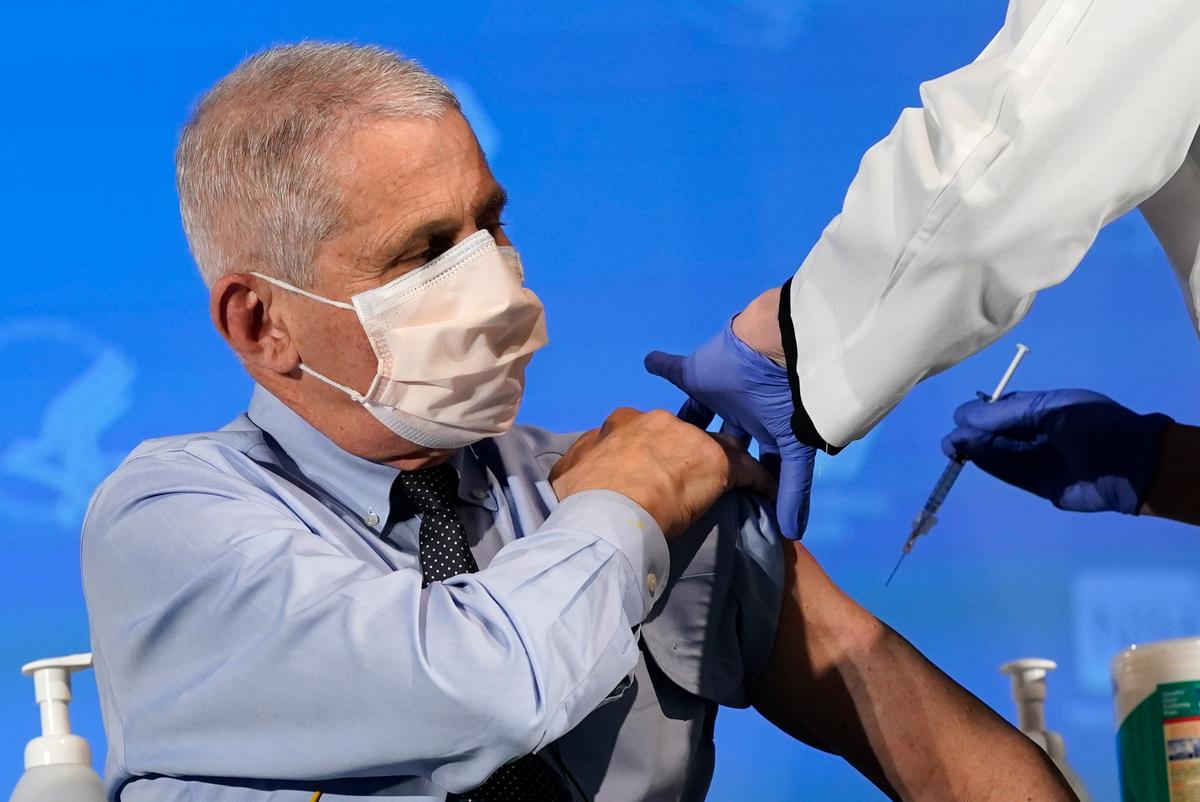
Dr. Anthony Fauci, director of the National Institute of Allergy and Infectious Diseases, receives a COVID-19 vaccine, at the National Institutes of Health in Bethesda, Md., on Dec. 22, 2020. Patrick Semansky/Pool/AFP via Getty Images
Suffered Pulmonary Infarction
Fauci in mid-2021 was diagnosed with pulmonary infarction, or the death of part of the lung, according to a diary entry that has since been redacted.
The condition typically results from blood clotting in the lung. Doctors have reported in studies that some patients have suffered blood clots following receipt of Moderna’s COVID-19 vaccine, which Fauci had received six months prior.
Fauci’s doctors had feared lung cancer but ultimately determined it was benign.
Fauci began taking a blood thinner and planned to have a followup scan in three months.
Although there was no evidence in the diary that the vaccine caused Fauci’s infarction, Health Secretary Robert F. Kennedy Jr. on Fox News pointed out the timeline. “He got vaccinated at a very, very public press conference … and then five months later, this is the first time we knew this, from the diary, he had a pulmonary infarction—which is one of the adverse events [health agencies] said are expected from the vaccine,” Kennedy said. “He never told anybody.”
Pushed to Override Advisory Panel
Fauci pushed the director of the Centers for Disease Control (CDC) to override the agency’s vaccine advisory panel when it came to COVID-19 vaccine boosters, according to the diary.
The panel in September 2021 said that the CDC should approve booster shots in a bid to combat waning effectiveness, but only for the elderly and younger people with underlying conditions.
Fauci said he texted CDC Director Rochelle Walensky and she eventually called him.
“I finally got a chance to speak with Rochelle and literally begged her to override that decision,” Fauci wrote. He said later, “I explained to Rochelle that if she does not do that she would be forever branded as someone with no leadership capabilities at all and if she did overrule them she could turn lemons into lemonade because she could reclaim her role as a leader since her reputation is one of unfortunately being a very weak leader.”
Walensky ultimately overruled the panel and said many more people could receive a COVID-19 vaccine booster. Walensky said she made the call based on scientific data.
Fauci had written in July 2021 that Walensky “does not seem to have control” over the CDC and that she was “somewhat unaware of what her own CDC people were doing.”
Isolated Deputy Who Opposed Vaccine Mandates
Few officials in government spoke out in 2021 against the COVID-19 mandates imposed on government workers and others. One who did was Dr. Matthew Memoli, at the time a unit director within the National Institute of Allergy and Infectious Diseases.
Memoli warned Fauci in an email that “coercing or forcing people to take a vaccine can have negative consequences from a biological, sociological, psychological, economical, and ethical standpoint and is not worth the cost even if the vaccine is 100% safe,” and said in a public forum he disagreed with the mandates.
Fauci said in a diary entry that Memoli “is turning into a real problem” because he had sent a copy of his email to congressional committees and the press.
Fauci initially said that he directed officials not to interfere with Memoli to avoid accusations of censorship, but later wrote that Memoli had “gone completely rogue.”
“Not only does he think that we should not be vaccinating people, he believes that mandating is unethical because it’s going to make matters worse vis-à-vis the immune response,” Fauci said. Fauci took issue with Memoli taking estimates of deaths following influenza and comparing them with deaths following COVID-19, because he said actual case numbers should be used.
“He’s an infectious disease person who doesn’t want to vaccinate people, who thinks mandates are unethical, and who is now telling me that I need to retract statements that I’ve made,” Fauci wrote. “He’s a junior member of the institute and he is telling the institute director that I need to retract the statement based on information that he thinks is incorrect, but is correct. Unbelievable what I have to deal with! We have decided that we are not going to do anything with him; w[e] are not going to approach him; we are not going to even talk to him about this since I know from my experience that if we do anything, he will say that we were trying to muzzle him.”
“As far as I am concerned he could say whatever he wants to say, as crazy as it is, whatever he wants to say. Also he said that he is refusing to get vaccinated The problem with this is that the new rule from the federal government is that if he does not get vaccinated he is going to get fired unless he has a religious exemption. If it turns out that he winds up getting fired, he will almost certainly say that it is retaliation.”
Memoli, who is now the National Institutes of Health’s principal deputy director, did not respond to a request for comment.