By The Rio Times | Created at 2026-06-25 17:48:21 | Updated at 2026-06-25 19:01:55
1 hour ago
By The Rio Times | Created at 2026-06-25 17:48:21 | Updated at 2026-06-25 19:01:55
1 hour ago
Mining
Key Facts
—The plant. A semi-industrial unit is under construction inside Hydro’s Alunorte refinery in Barcaréna, Pará, with operation planned for July 2026.
—The cost. The developer, New Wave, is investing about R$240m ($46m) in the demonstration plant.
—The output. It is designed to process 50,000 tonnes of residue a year into up to 9,000 tonnes of iron plus 22,000 tonnes of construction co-product.
—The method. The process uses microwaves and charcoal to strip oxygen from the iron in the waste at close to 1,400 degrees Celsius.
—The backers. New Wave has raised more than $120m, including from Orion Resource Partners and Al Gore’s Just Climate, plus a R$221m credit line from Brazil’s development bank.
—The prize. If scaled to 4m tonnes a year, the route could consume all of Alunorte’s annual residue and avoid mining fresh iron ore.
A plant rising inside Brazil’s biggest alumina refinery is betting that red mud, one of the world’s largest industrial wastes, can be turned into low-carbon iron rather than stored forever.
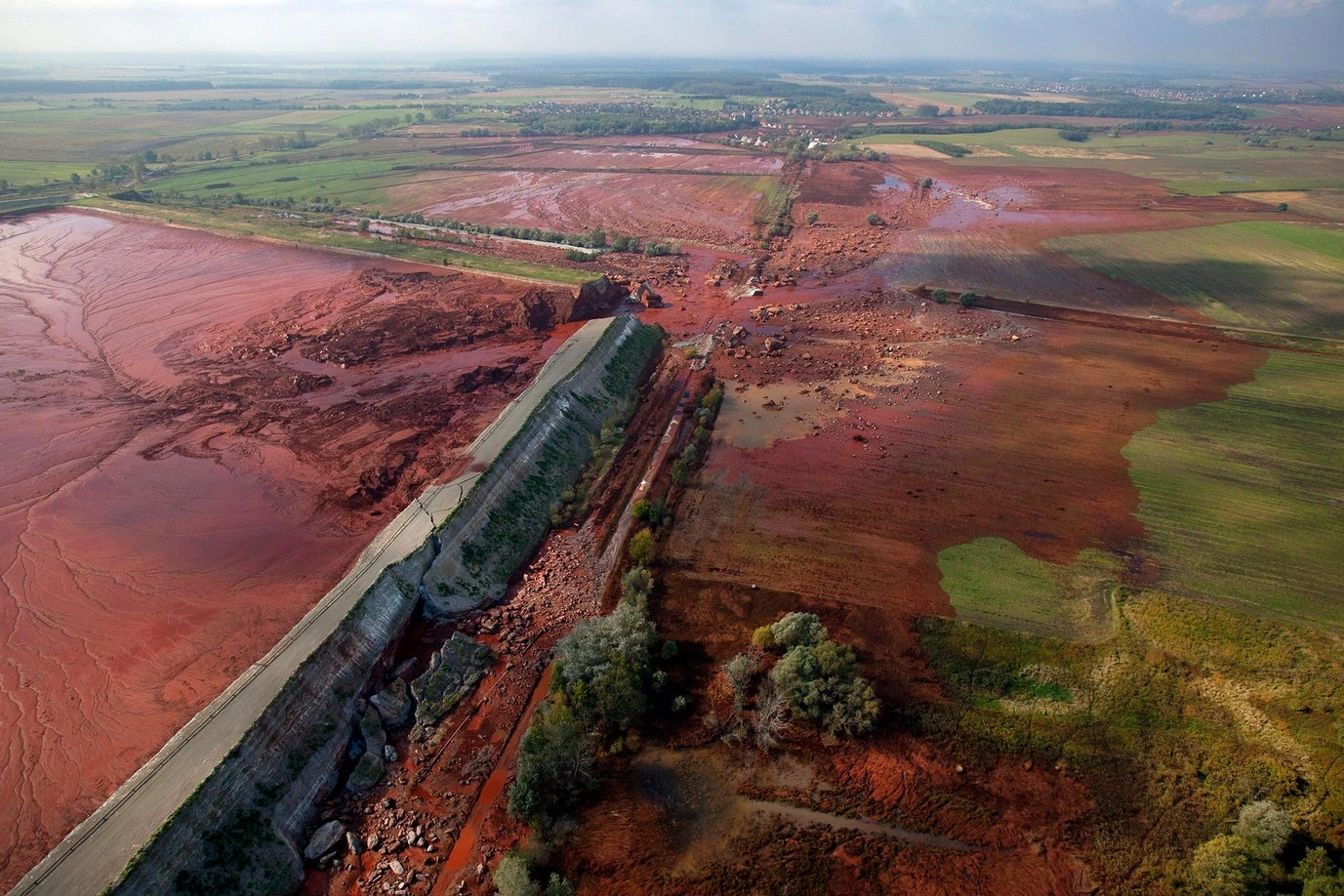
Make aluminium and you make a problem. For every tonne of alumina refined from bauxite ore, the process leaves behind a caustic red sludge that the industry has spent decades simply storing behind dams, an unglamorous by-product known as red mud.
A Brazilian technology company thinks it can turn that liability into a product. New Wave, through its Wave Aluminium arm, is building a demonstration plant inside Hydro’s Alunorte refinery in the northern state of Pará, the largest single alumina plant on the planet, to convert the waste into metallic iron.
Why red mud has defeated the industry
The scale of the waste is the reason this matters beyond one refinery. Roughly 180m tonnes of bauxite residue are generated worldwide each year, making it the second-largest industrial waste stream by volume, and the pile grows by about six percent annually as aluminium demand climbs with the energy transition.
It is also dangerous when mishandled, as Barcaréna itself learned from a 2003 spill that fouled a local river. Storing the stuff is costly and risky, yet almost none of it has ever been turned back into something useful, which is what makes a working conversion plant notable rather than routine.
A microwave route out of the dam
The technology is unusual. According to Hydro’s account of the partnership, the plant uses microwaves combined with charcoal to heat the residue to nearly 1,400 degrees Celsius and chemically reduce the iron oxide it contains into metal, alongside co-products bound for civil construction.
The numbers are deliberately modest at this stage: about R$240m, equivalent to roughly forty-six million dollars, for a unit sized at 50,000 tonnes of residue a year, producing up to nine thousand tonnes of iron and twenty-two thousand tonnes of construction material. Operation is planned for the middle of 2026.
The plant is explicitly a demonstration, built to gather the engineering and cost data needed before anyone commits to a full-scale version. That staged approach is standard for unproven industrial processes, where laboratory success says little about whether the economics survive at commercial volume.
It also dovetails with Hydro’s own targets to reuse a tenth of its residue generation by 2030 and to stop building new permanent storage by 2050. For Pará, a state at the centre of Brazil’s Amazon mining boom, the project promises construction jobs now and a test of whether heavy industry can clean up after itself rather than leaving the bill for later.
Live Market IntelligenceBrazil — Live Market BoardInside: market breadth, the sector heatmap, currencies & rates, the Latin America scoreboard and the full instrument board.Rio Times · Live Market Intelligence
Brazil — Live Market Board
B3 · São Paulo
Jun 25, 2026 · 14:40
Ibovespa · benchmark
172,294
+1.05%
L 170,508day rangeH 173,277
+26.90% over 12 months
Market breadth · 15 names
67% advancing
10 ▲ advancing5 declining ▼
Currencies, rates & key inputs
Sector heatmap · average move today
Consumer Disc.
+2.59%
AZZA3
Financials
+1.06%
ITUB4, BBDC4, BBAS3, B3SA3
Industrials
+0.81%
WEGE3, RENT3
Energy
+0.01%
PETR4, PRIO3
Consumer Staples
-0.24%
ABEV3
Mining
-0.67%
VALE3, CSNA3, GGBR4
Latin America scoreboard
IndexLastTodayStrength
IbovespaBrazil
172,294
+1.05%
S&P/BMV IPCMexico
67,207
+1.40%
S&P IPSAChile
10,675
-0.88%
S&P MERVALArgentina
3,110,801
+0.01%
MSCI COLCAPColombia
2,283.79
+0.56%
BVL S&P PerúPeru
54,833.60
-1.48%
Full instrument board
| IBOV | 172,294 | +1.05% | +26.90% | 170,507 | 173,277 | 170,508 | — |
| USD/BRL | 5.18 | -0.39% | -6.09% | 5.20 | 5.22 | 5.17 | — |
| SELIC | 14.25% | — | — | — | — | — | |
| PETR4 | 38.49 | +0.52% | +23.36% | 38.29 | 38.67 | 37.92 | 16,199,200 |
| VALE3 | 78.53 | +1.03% | +55.47% | 77.73 | 78.75 | 77.42 | 6,295,400 |
| ITUB4 | 41.78 | +1.98% | +17.53% | 40.97 | 42.11 | 41.22 | 11,206,000 |
| BBDC4 | 17.91 | +1.47% | +8.84% | 17.65 | 18.07 | 17.69 | 29,278,100 |
| BBAS3 | 20.12 | +1.98% | -5.74% | 19.73 | 20.25 | 19.83 | 10,093,600 |
| B3SA3 | 14.85 | -1.20% | +8.74% | 15.03 | 15.07 | 14.65 | 25,169,900 |
| ABEV3 | 16.34 | -0.24% | +24.03% | 16.38 | 16.49 | 16.23 | 10,355,700 |
| WEGE3 | 46.63 | +0.04% | +11.07% | 46.61 | 47.37 | 46.48 | 4,124,000 |
| PRIO3 | 53.83 | -0.50% | +30.76% | 54.10 | 54.57 | 53.36 | 14,940,300 |
| SUZB3 | 42.13 | -0.17% | -18.28% | 42.20 | 42.67 | 41.89 | 2,691,500 |
| RENT3 | 42.42 | +1.58% | -1.67% | 41.76 | 42.86 | 41.82 | 4,822,400 |
| AZZA3 | 19.81 | +2.59% | -48.57% | 19.31 | 20.10 | 19.33 | 1,079,800 |
| CSNA3 | 4.85 | -4.15% | -32.97% | 5.06 | 5.13 | 4.85 | 13,129,200 |
| GGBR4 | 21.62 | +1.12% | +36.00% | 21.38 | 21.88 | 21.43 | 4,700,900 |
| ENEV3 | 26.32 | +1.46% | +90.36% | 25.94 | 26.49 | 25.99 | 3,279,200 |
Largest moves today
CSNA3
4.85
-4.15%
AZZA3
19.81
+2.59%
ITUB4
41.78
+1.98%
BBAS3
20.12
+1.98%
RENT3
42.42
+1.58%
BBDC4
17.91
+1.47%
ENEV3
26.32
+1.46%
B3SA3
14.85
-1.20%
The session read
The Ibovespa rose 1.05%, with breadth positive — 10 of 15 names higher. Consumer Disc. led, while Mining lagged.
From The Rio Times
Related coverage · 25 Jun 2026
Macron and Meloni Are Opposites. They Just Found Reasons to Agree.
Read →
What a London or Munich desk should watch
For an investor the appeal is twofold: a decarbonisation story and a critical-minerals story sharing one plant. The capital backing it is serious, with New Wave having raised more than a hundred and twenty million dollars from names including the critical-minerals fund Orion Resource Partners and Al Gore’s Just Climate, plus a development-bank credit line of about two hundred and twenty-one million reais.
The forward signal is whether the demonstration scales: the company wants to license the technology and collect royalties, targeting a full unit that would process four million tonnes a year and swallow all of Alunorte’s residue. Until the pilot proves its costs, this remains a promising experiment rather than a settled industry, but it is the kind of frontier bet that could reset how the aluminium chain handles its dirtiest leftover.
What is red mud and why is it a problem?
Red mud is the caustic residue left after bauxite ore is refined into alumina, the raw material for aluminium. About 180m tonnes are produced worldwide each year and most is stored permanently behind dams, posing environmental and safety risks that the industry has struggled for decades to resolve.
How does the new plant work?
The plant uses microwaves and charcoal to heat the residue to nearly 1,400 degrees Celsius and reduce the iron oxide it contains into metallic iron, while generating co-products for civil construction. The demonstration unit is designed to process 50,000 tonnes of residue a year.
Who is behind the project?
The Brazilian technology company New Wave, through its Wave Aluminium subsidiary, is building the plant inside Hydro’s Alunorte refinery in Pará. It has raised more than a hundred and twenty million dollars from investors including Orion Resource Partners and Al Gore’s Just Climate.
Connected Coverage
· Para Mining Investment Hits $14.7bn as Bioeconomy Grows
· US Firms Eye Guyana Alumina Refinery in Push Beyond Oil
· EU Brazil Rare Earths: First Deals Take Shape 2026
The Rio Times · Power Map
See who really holds power in Latin America
Click to open the Power Map →