By The Straits Times | Created at 2026-06-17 07:28:22 | Updated at 2026-06-17 15:44:00
8 hours ago
By The Straits Times | Created at 2026-06-17 07:28:22 | Updated at 2026-06-17 15:44:00
8 hours ago
HONG KONG — A firefighter who gave his life saving others during Hong Kong’s deadliest blaze in decades is continuing his journey far beyond Earth – his name metaphorically etched in a cosmic rock for centuries to come.
An asteroid discovered more than two decades ago has been named after Ho Wai-ho, a 37-year-old firefighter killed while rescuing residents during a 43-hour inferno that gutted the Wang Fuk Court residential complex in Tai Po district in November 2025.
The decision, approved by the International Astronomical Union (IAU), gives Ho’s name a permanent memorial among the stars.
The asteroid – officially designated 34871 Howaiho – was named by Hong Kong-born astronomer William Yeung Kwong-yu, one of the world’s most prolific discoverers of minor planets.
Yeung discovered the asteroid in 2001 from his privately built observatory in the United States.
Ho’s fiancee, Kiki, wrote in a social media post: “My beloved 34871 Ho Wai-ho, as a star you will forever watch over us.”
She said Yeung personally informed her of the decision.
According to Kiki, the astronomer told her: “This asteroid may not be visible to the naked eye, but its meaning is real and eternal. Ho Wai-ho’s name will remain in the solar system, and his courage, sacrifice and spirit of saving lives will stay in Hongkongers’ memory.”
The tribute follows one of Hong Kong’s deadliest disasters in recent years.
Ho died in November while responding to a massive fire at Wang Fuk Court in Tai Po district. As flames and smoke engulfed the building, he helped evacuate residents trapped inside.
He never made it out.
The 43-hour inferno became Hong Kong’s deadliest blaze in decades, killing 168 people and displacing about 5,000 residents.
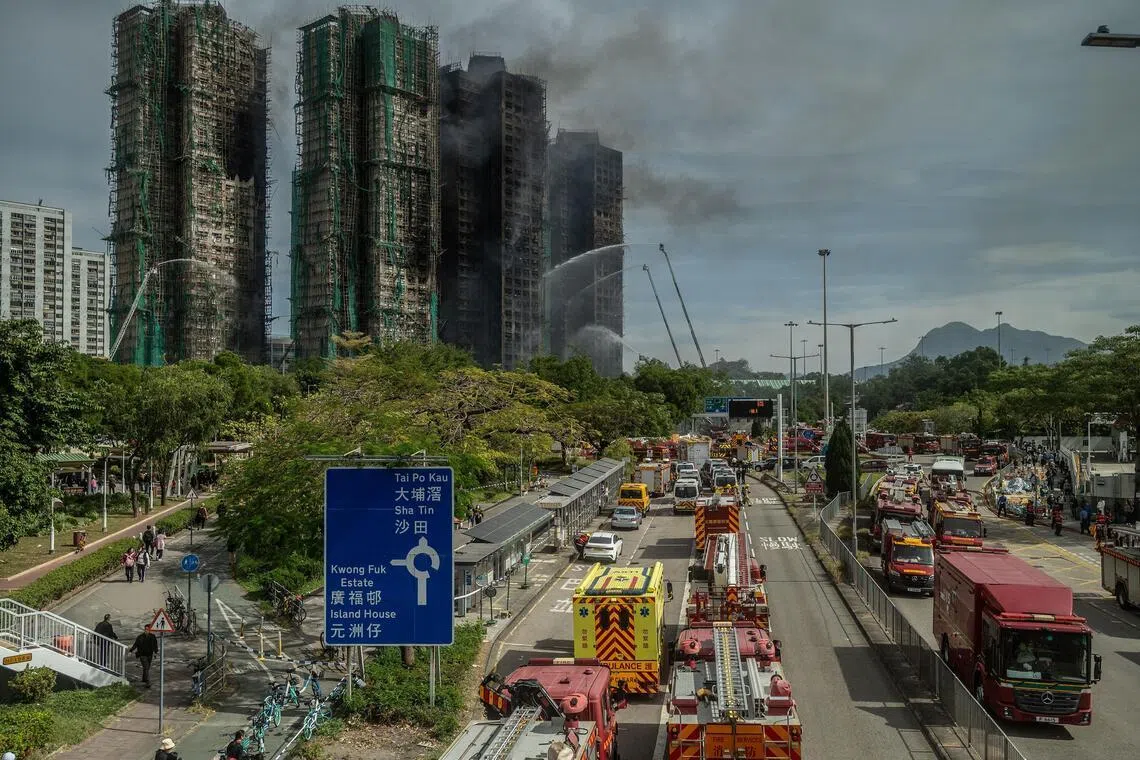
The 43-hour fire that gutted the Wang Fuk Court complex in November 2025 killed at least 168 people.
PHOTO: LAM YIK FEI/NYTIMES
Ho was later posthumously awarded the honorary rank of senior fireman.
In its official citation, the IAU said Ho “served with courage in fire and rescue operations, assisting in the evacuation of residents during emergencies”.
The asteroid is estimated to be between 2km and 4km wide, roughly the size of a small mountain. It circles the Sun once every four years and is too faint to be seen without specialised equipment.