By Literary Hub | Created at 2026-10-09 09:42:04 | Updated at 2026-10-09 14:27:48
5 hours ago
By Literary Hub | Created at 2026-10-09 09:42:04 | Updated at 2026-10-09 14:27:48
5 hours ago
It began when I heard a sentence: “He wanted to talk again, suddenly.” The words cut sharply into the jumble of to-do lists, fantasies, snippets of possible writing, worry, and leftover traces of postpartum depression that constituted my mind in the early months of 1993. Who wants to talk, I wondered?
Article continues after advertisement
Instantly, the laughing face of my beloved friend—I’ll call him Ian—appeared in my mind. He’d died seven years earlier of AIDS.
I had mementos of him, photos of us together at Studio 54 and glamorous parties, but he was gone, and no tokens could bring him back. He was resistant to being a memory, too; Ian had been the definition of presence, and handsomeness, and elegance, and high spirits. When he was with you, he was there completely, his attention and wit undivided, so that when you and he sashayed past the velvet rope into a nightclub, or plopped down on the Sheep Meadow in Central Park, or took a walk on dark downtown streets at three in the morning, you felt the world coalesce around you, and you were at its white-hot center.
The scene in In the Gloaming where Laird pretends to be from I.R.S. outreach and gets a whole bus of New Yorkers laughing and chatting was typical of how Ian engaged with the world. I had many such happy memories, but I avoided them; they hurt too much. I had learned earlier in life that the only way I could cope with devastating loss was to slough off the version of myself that loved the person or the place and become someone else. During Ian’s illness, I’d stopped going out and staying up all night; it wasn’t fun without him.
The words were inside of me, and I was being called to compose a story.
After he died, I got married, wrote a book, had a baby. He knew nothing of this version of me. The Al (as he called me) who smoked incessantly, loved putting wild outfits together, and never turned down an opportunity to go dancing—she no longer existed. In a sense, my old self died with him.
Then “He wanted to talk again, suddenly.” I experienced that sentence as coming from a separate consciousness than mine. I was quite anxious at that time, worried about my aging grandparents, worried about my toddler, who’d spent the first days of his life in a plastic box in the NICU. My writing was stalled by perfectionism; my holographic pages looked more like heavily redacted government documents than stories. Underneath it all, I was grieving for Ian.
Suddenly, here he was. What did he want to talk about? Was this an episode of esprit de l’escalier, the moment when you are on the stairs after a jagged and unresolved interaction and are struck with a sudden clarity about what you wish you’d said? Had Ian realized what it was he’d wanted to say in life and come to tell me now? To be clear, this wasn’t a ghost, and I didn’t hear an actual voice. The words were inside of me, and I was being called to compose a story. Yet I was also in touch with Ian in a way I hadn’t been for years, and willing to write toward why he’d returned to speak to me.
By all rights I should have demurred and told him to come back later when I knew more about composing short stories. Although I’d written and published a book, I didn’t have a method yet, nor could I have explained what I was doing. Every new story was a high-wire act. I was teetering without a safety net of craft and technique. I’d been a poet until my late twenties and came into stories when minimalism held sway, and I began by trying that.
I had energy. I had words. Back to the little desk for me.
Minimalism is hard to do well—I found that out. For every one Raymond Carver, there were hundreds like me who wrote stripped-down sentences that ached to shimmer with meaning but came out underwritten and thin. Anyway, I didn’t have an affinity for the style. It wasn’t the literature that had formed my ideas of what fiction could be. Soon enough I shifted over to my natural writing and sentences, but I had yet to understand the algebra of a story, how character + setting / plot = meaning. Also, I was writing stories that came from my head, my opinions, my experiences, not from where I now believe good stories are found.
Where might that be? I don’t know for certain, but over the years I have developed a sense that good stories—stories that make contact with the universal, that transcend the ego and limitations of the writer—exist in the ether around us. They are not yet complete; they need an earthly author to give them life and form. Yet even while being inchoate creatures, they have a will of their own and insist on the writer taking the time and care to do them justice. If they are bullied or overrun by thinking—as opposed to conjuring—they will balk and retreat. To create a story has much in common with building a close friendship or a marriage. You do well to understand its nature, that a good deal of it exists outside of you.
You must be sensitive to what it wants and needs, to its skittishness, to its heart of hearts. You and the page face each other and have a conversation that can go in many directions, but always with the aim of coming closer and finding meaning. I carry an image of the atmosphere packed with stories, and every so often I or another writer will run into one in the right place at the right time to become its partner.
Recently someone told me she loved the story.
“Yes, it’s good,” I said. I might have qualified the claim by pointing out that I didn’t mean I was good.
I might have explained the story was good before it came my way, that all I did was surrender to its existence and help it take an earthly shape. I didn’t demur, though; I do think it’s good, and I do think the wisdom of the universe deserves half the credit.
I began the story seeing an image of the young man named Laird sitting up in bed, his sister Anne—it occurred to me that she was a lawyer—in a chair by his side. They were making his will. He made a game of it, calling himself Queen for a Day after the TV show. “Except I’m a queen who gives her things away,” he said. He was capricious and magnanimous, one day leaving everything, including his apartment, to the Gay Men’s Health Crisis, the next poring over photos of the items in his collections and earmarking them for friends. Their mother, Janet, heard their laughter and popped into the room—the downstairs den, refitted with a hospital bed—and asked what was so funny. Janet! For there she was, as Virginia Woolf wrote at the end of Mrs. Dalloway. This was meant to be her story. Laird wanted to talk again, suddenly, to Janet, just as Ian wanted to talk again, to me. Janet would be the character affected by the story, the person who’d catch a glimpse of the moral world.
Poor Anne got relegated to a mere walk-on part, but I have made up for that by giving her a prominent role in a new novel, Wherever You Are. Once I had the mother-son dynamic at the center of the piece, the story flowed from my pen each afternoon, when I sat down on my toddler’s futon to write while he was at the park with a babysitter. I wrote scene by scene, focusing on the conversations between Janet and Laird that occurred in the evenings, in the gloaming.
One night I read a scene aloud to my husband about Laird giving a handful of lilies of the valley to Janet. Is this cloying, is this corny? I asked. It felt corny to me. I wasn’t used to writing in the tone the story had taken, which was vulnerable and tender, quite unlike the wry stance that characterized many of my other stories. He said no, just the opposite, it was moving but not mawkish—keep going. I learned a lesson that I now impart to my Rutgers-Newark MFA students: if you think you are overdoing it, remember that the emotional upheaval is in your body, likely not in the words on the page.
It was March 1993. We were living in a rent-stabilized apartment on West 97th Street in Manhattan. The living room and bedrooms faced 96th, a crosstown corridor over which ambulances and police cars sped day and night, their sirens howling.
Directly below was an alley populated by feral cats that I fed by lowering or tossing cat food out the window. Other people threw french fries and chicken bones; the cats got by. (I did manage to catch two and bring them into our lives.) Beyond the alley was a gas station, and across the street, P.S. 75. In the bedroom, I had a small table perpendicular to the window that served as a desk. We had a computer by then, but I was still typing on my old Olivetti manual. I was and still am a two-index-finger typist. I had typed in the whole story, or almost all of it. It still needed an ending. I tried a few pages and ripped them out of the platen as if I were a lady journalist on a deadline in a screwball comedy. Instead of to an editor, I walked them in to my husband and paced as he read.
I’d ended on a line that had a weighty resonance, a dun-dun! like the indelible notes that signal a Law & Order episode. It sounded good to me!
He shook his head. “Sorry. This isn’t right.”
How irritating: I thought I had it. But okay, okay.
I had energy. I had words. Back to the little desk for me.
This set of actions was repeated several times. I wrote, he read, he rejected, I went back to the drawing board. Did I start to hate him? Yes. Did I become more and more frustrated? Yes. Was I tempted to hurl the typewriter out the window? Indeed, and I may have if it weren’t for the cats. My limits and stupidity had never been clearer to me. I kept returning to the end of the last scene and moving Janet into different rooms in the house, at different times of day. Finally, I got her into Laird’s old bedroom. She was still by herself, thinking and feeling, facing life without him.
A story moves toward an authentic reversal when, at the moment of critical choice, a character rises above their usual way of responding to stress and instead consciously chooses to do something for the sake of another person.
The writing was decent, but not dramatic. What would make it so? Then—Martin entered the room, lay down on the other bed, and something began to happen. Janet, subdued until now, suddenly freaked out! She raged! It made me nervous, but I stuck with her. Miraculously, so did Martin. Until that scene, he’d been a nonentity in the story, mostly offstage and uninvolved. The story, my partner in this venture, wouldn’t let me finish it without offering him a meaningful role. He was a walk-on, but significant—Laird’s father. Now what? What would he do? I kept going. I had already set up the ending. It was time to let it fulfill its promise.
Much later I realized that in the final pages I had stumbled on a mechanism used in many classic endings—a sacrifice made for the sake of the well-being of another person or society as a whole. All through a story, the protagonist attempts to achieve a goal or solve a problem, yet a central trait of their constructed personality causes them to repeat the same stuck pattern over and over, preventing them from realizing their desire. The pressure mounts, and toward the end the protagonist must make a last-ditch effort to achieve their goal. In this case, Janet breaks through her restraint and has an outburst, during which she says to Martin how she is feeling. She is speaking her true feelings—the work she has wanted all her life.
Yet if the story ended there, would it be satisfying?
Janet would have achieved her goal, but she wouldn’t have learned anything or changed fundamentally.
Realizing her desire still leaves her short of being in touch with what I think of as the world as it should be—a world of justice, peaceful repose, love and kindness, equality, abundance, and self-actualization.
Stories can put us in contact with that good world by showing how a person can bridge the gap between it and daily life. When a character stops acting on behalf of himself and instead makes a choice to act on behalf of the welfare of another person, the story suddenly evokes a sheaf of nobler feelings. I wish there were more words for this choice than “sacrifice,” which connotes deprivation. I am talking about a choice of forgoing a self-centered option in favor of acting on a comprehension of the reality of another person, a fullhearted acknowledgment that they are as important as the self. This sounds like something we all know.
Yet we go through our days setting this aside, navigating around other people rather than standing beside them, shoulder to shoulder, and seeing the world as they do. A story moves toward an authentic reversal when, at the moment of critical choice, a character rises above their usual way of responding to stress and instead consciously chooses to do something for the sake of another person. I think of this as seeing through a mirror past the reflected, limited self to the other side, where the world rolls out in all its glory.
Janet gave fully to Laird, but that didn’t require a sacrifice on her part. He was her beloved child, and she wanted to care for him and be with him.
Her test comes when she is alone with Martin in the bedroom. Martin has been an outsider to the events of the story, habitually disappearing into the maw of his study, and Janet has given him little thought.
Here he is now, though, suddenly on the scene. It wouldn’t be surprising or unjustified if she were to resent his intrusion; he hasn’t been much of a help or helpmeet. Yet when he makes his tentative offering, the suggestion of bagpipes for the funeral service, she has the grace to hear him; she accepts his grief is as real as her own and acknowledges his right to full participation in the moment by ratifying his idea. This is, at last, what she has truly longed for: communion.
As I said, I did not know what I was doing when I wrote this ending.
Now, by making a climactic choice on behalf of another rather than continuing to pursue her stated goal in the story, Janet is privileged with a reversal. This is the magic of sacrifice. The crust of the tangible world peels away, and hidden spiritual and moral realities become prominent and unmistakable. The protagonist who makes a sacrifice for the sake of another receives an unforeseeable benefit on the other side. Often in literature the sacrifice leads to the character’s death, so how could they receive a benefit? They may earn a life that transcends death as a person remembered with great love and admiration.
You could say that Laird’s death gave new life to his parents, and you wouldn’t be wrong.
Janet sacrifices her judgment of Martin and accepts his offering with an open heart. This gives him the leeway to be vulnerable and ask her a question that reveals the depth of his loss and estrangement: “Please, Janet, tell me—what else did my boy like?”
We trust Janet is ready to answer.
I carried this ending into the living room. Mr. Dark gave it the thumbs-up.
I should say that having a story end when characters reach this peak of human potential for grace in no way means that everything is resolved. People often ask me if Janet and Martin continue to be close after the final scene, and my answer is nope. What did happen is that they both felt what it is like to be bighearted, and they won’t be able to forget that going forward. That bighearted, generous feeling is their new knowledge.
When we do something good, we discover how that feels. It doesn’t automatically make us good, but it may subtly guide us to steer our rickety ships toward more peaceful seas.
As I said, I did not know what I was doing when I wrote this ending. Identifying and intellectually understanding the mechanism I have described here came later, with much effort and thought. At the time, the only way I could get to the mechanism was by enacting it; I had to sacrifice my drive to be right, to be finished, to be smart, to write a killer kicker, for the sake of truly moving my husband. The ending is a version of what was going on in my apartment. I had to push past the logic of the story and surrender to the mystery of the moral universe—for him, for the story, for Ian—which required setting myself and my ideas aside.
As for what Ian wanted to say to me when he reappeared and tapped me on the shoulder with the opening words of the story, I believe he came back to tell me two things: that the truth is something discovered within a relationship, and not as a result of our solitary thinking. And he wanted me to know that our dead are at our sides all the time, and to connect with them, all we need to do is to rise above ourselves.
__________________________________
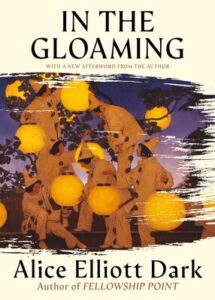
From In the Gloaming. Used with the permission of the publisher, Scribner. Copyright © 2026 by Alice Elliott Dark