By The Straits Times | Created at 2026-09-20 21:06:41 | Updated at 2026-09-20 22:20:29
1 hour ago
By The Straits Times | Created at 2026-09-20 21:06:41 | Updated at 2026-09-20 22:20:29
1 hour ago
KATHMANDU – The cold, nondescript laboratory in the Khumaltar neighbourhood in Lalitpur has never been busier. But its softly beeping machines, frayed sofas and hushed hallways betray no sign that it holds the key to one of the world’s largest and most complex disaster victim identification projects.
The massive Aug 26 flood in Nepal has thrown the tiny forensic lab in the Himalayan country into the centre of global attention.
The flood along the Bhotekoshi and Trishuli rivers triggered by a rock ice avalanche devastated many villages in northern Nepal. More than 1,400 bodies have been recovered and 6,150 people are still reported missing, including 589 foreigners from 30 countries.
Nine Singaporeans are missing, along with 189 Indians, 65 Americans, 55 Malaysians, 54 Ukrainians, 37 Chinese, 33 Australians, 33 Latvians, 32 Britons, 30 Canadians, eight Germans, nine South Koreans and five Japanese, among others.
After three weeks of rescue efforts, the country’s focus is now shifting to identifying unknown victims.
A country that usually deals with only a few hundred DNA cases a year must now handle several times that workload within weeks, in a high-stakes situation where thousands of relatives in Nepal and beyond await news of their missing loved ones.
In response to Nepal’s appeal for support in this task that exceeds its institutional capacity, forensic teams with their equipment from several countries have been here to help in this work, including from Singapore.
When the Nepal government realised that visual identification of the recovered victims was difficult because of decomposition and mutilation hastened by flood waters, it decided to adopt a global disaster protocol in which found bodies are temporarily buried in marked graves. This is being done after collecting DNA samples from the bodies or human remains, to be matched with relatives later. The bodies can be returned to their relatives once they are identified, as the family chooses.
DNA is now the chief way to identify at least 1,400 bodily remains, which include around 500 partial remains.
Nepal’s DNA matching strategy
From Sept 9, the Nepal police have been collecting DNA samples from relatives of locals missing in the flood. Many countries have also shared the analysis of DNA samples from relatives of their missing nationals with the Nepal authorities.
“As (Nepal is) the site of the disaster, international protocol states that Nepal must be the one to match the DNAs of missing foreigners as well,” Eugene Wang, the commander of the Singapore Police Force’s disaster victim identification team in Nepal, told The Straits Times.
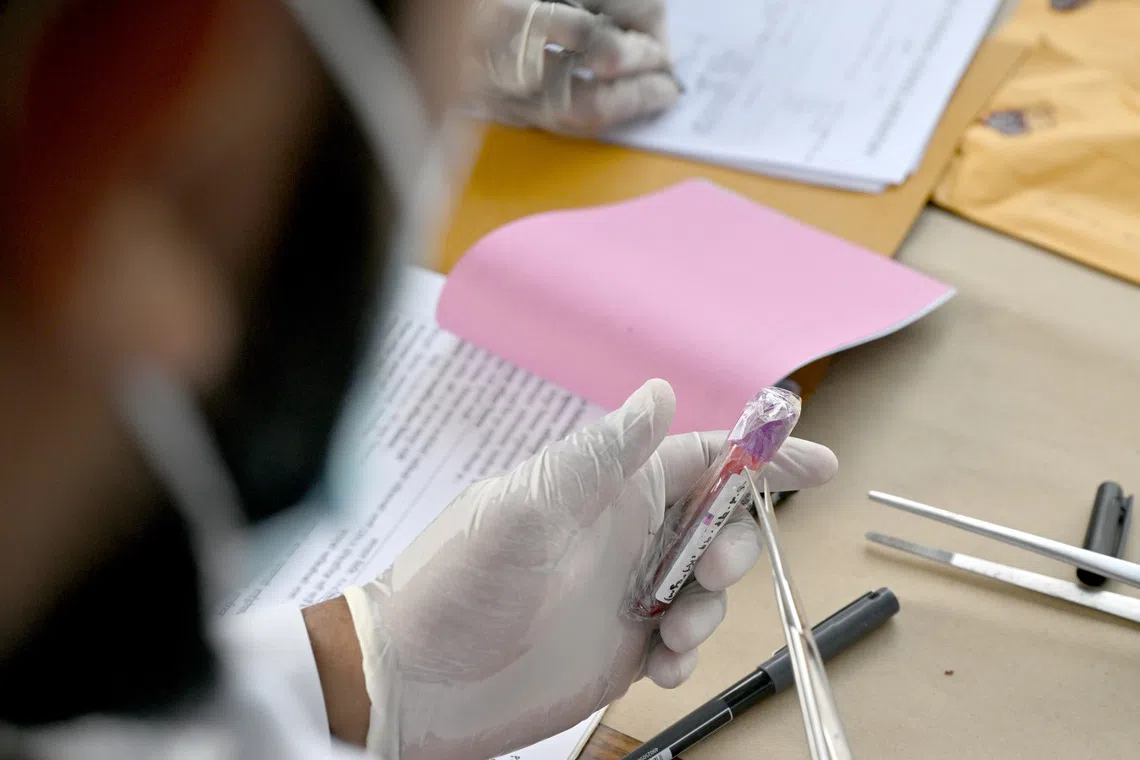
Many countries have also shared the analysis of DNA samples from relatives of their missing nationals with the Nepal authorities.
ST PHOTO: DESMOND FOO
As at Sept 13, 1,230 bodies were buried under the soil after DNA sample collection for identification. A total of 3,132 DNA samples were collected, including 1,286 samples from deceased persons and 1,846 from relatives of missing persons.
These samples now have to be analysed and matched by two forensic facilities in Nepal: the National Forensic Science Laboratory (NFSL) and the Nepal Police Central Forensic Science Laboratory.
Together, the labs have never analysed more than 1,500 samples a year, said Nirajan Thapa, the head of department at the NFSL.
“Most of the DNA analysis we handled were for paternity and maternity litigation, immigration cases, and some crimes. This is quite different from disaster victim identification,” Thapa told ST.
The almost 1,400 samples from flood victims are from whole bodies as well as fragments.
Fingerprints are being taken from the victims where possible and DNA extracted from bone or teeth, as these are more intact than blood or soft tissue that degrade fast after death and decomposition, Central Police spokesman Abi Narayan Kafle told reporters.
Bone or teeth samples, however, require more time and expertise to collect, store and process, with the whole procedure taking up to four days compared with a few hours for blood samples from relatives, said Thapa. The bones and teeth are first ground into powder, which is then placed in specialised chemicals for 72 hours before further processing. Some samples, especially if degraded or stored improperly, may need to be tested again.
The 1,400 or so samples are “a very large workload for us”, Thapa said, given the limited number of specialised forensic experts, instruments and test kits in the country.
The NFSL’s annual budget is around 90 million Nepalese rupees (S$750,000), he added, recalling that the last DNA analyser it purchased was perhaps in 2014. The lab’s technicians who have analysed about 100 bone samples in the past, must now handle at least 14 times that.
A dozen Nepali forensic analysts are now working through holidays and weekends, trying to manage the huge technical and logistical challenge of identifying thousands of victims.
The NFSL experts are testing around 60 samples a day, Thapa said.
The police forensic laboratory, which has an annual capacity to conduct around 400 DNA tests, is currently testing 25 to 30 samples each day, Kafle told the local press on Sept 11.
Global support is key
Without the equipment and manpower shared by other countries, Nepal’s own capacity would not be able to cope with the enormous task, Thapa admitted.
Nepal is supported by teams, equipment and test kits from India, China, South Korea, Japan and Singapore – all countries whose nationals are also missing in the flood.
Two officers from Singapore’s Health Sciences Authority’s (HSA) Forensic Medicine Division were in Nepal, with the SPF contingent.
HSA forensic pathologist Benjamin Kuek and forensic technical officer Camy Tay have been involved in the post-mortem examination of the victims at the mortuary of the Tribhuvan University Teaching Hospital in Kathmandu, a spokesperson for HSA told ST.
They have extracted teeth and bone specimens from victims as well as noted distinguishing features that can be matched with descriptions collected from relatives as well as their DNA samples.
The Singapore police have also obtained DNA samples from the next-of-kin of the nine missing Singaporeans and shared them with the Nepali authorities for reconciliation against victims’ DNA profiles.
On Aug 29, India sent a 19-member contingent of six forensic teams along with forensic laboratory equipment, DNA kits and reagents for testing, according to a statement from India’s Ministry of External Affairs.
South Korea’s forensic experts who came to Nepal’s assistance brought Rapid DNA systems, which are automated machines that generate DNA profiles in 90 minutes, with only a few minutes of hands-on technician time, said Thapa.
China and Japan have also sent forensic teams to assist in the analysis of DNA samples.
On Sept 15, the United States approved US$1 million (S$1.27 million) in additional funding to strengthen Nepal’s forensic analysis capacity.
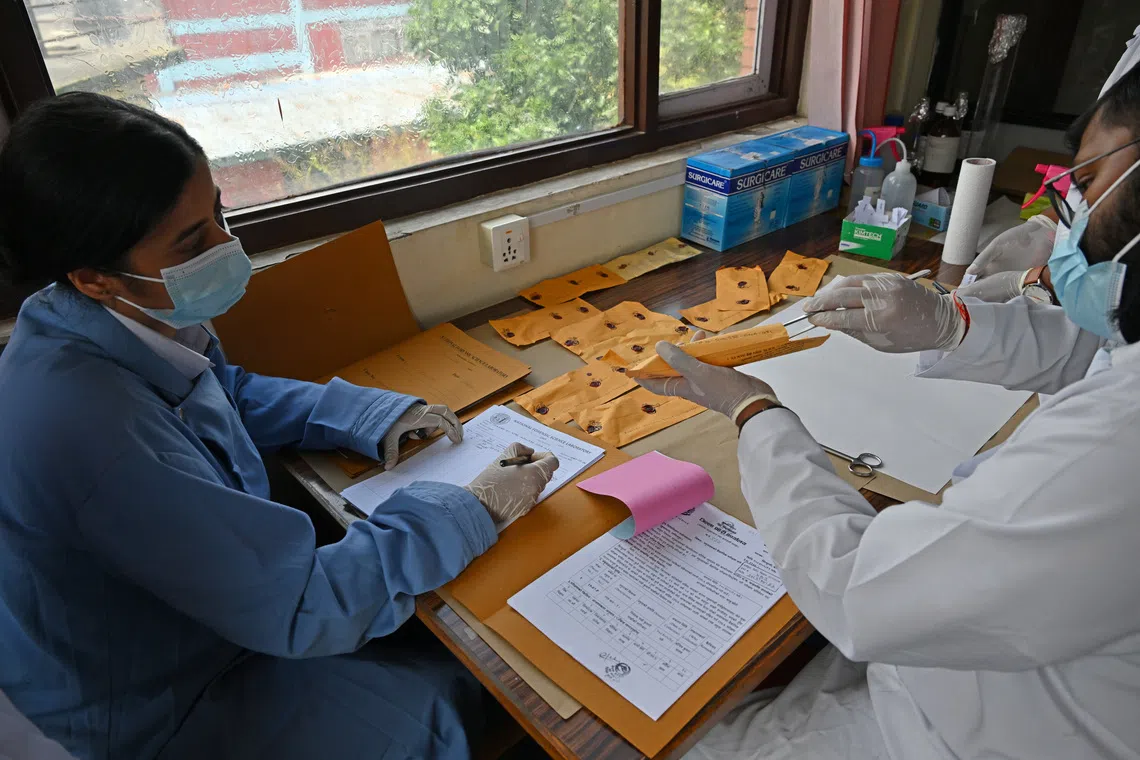
Nepal is supported by teams, equipment and test kits from India, China, South Korea, Japan and Singapore – all countries whose nationals are also missing in the flood.
ST PHOTO: DESMOND FOO
In August 2025, the US Embassy donated a Combined DNA Index System software to the Nepal Police Central Forensic Science Lab to bolster crime fighting. Serendipitously almost exactly a year later, this software is likely to be used to cross-match the thousands of DNA profiles of flood victims.
“The DNA of the deceased and relatives is extracted and (the profiles) entered into the software, which then carries out the matching,” Kafle told The Kathmandu Post.
Cognisant of the “huge responsibility” Nepal has, Thapa admitted that while their effort is for “everybody missing to be recovered and everyone to be identified, practically and scientifically, I don’t know how much is possible”.
“If there are 5,000 missing people, there should be 20,000 to 25,000 samples, because of (body) fragmentation (in the flood’s force). But we have only 1,400 samples,” he said.
Some victims buried deep under the flood’s silt might never be recovered – or their bones may show up years later.
Admitting that it was unclear how long “the Nepal government’s priority or our resources” would allow Nepal to continue disaster victim identification, Thapa said that every effort was being made to provide closure to relatives the world over. “If we can process 80 to 85 per cent of DNA samples when the international teams are here, we should be able to handle the rest by ourselves,” said Thapa.