 By The Epoch Times | Created at 2026-08-03 23:50:27 | Updated at 2026-08-04 06:43:57
6 hours ago
By The Epoch Times | Created at 2026-08-03 23:50:27 | Updated at 2026-08-04 06:43:57
6 hours ago
NEW YORK—World War II-era planes, modern military aircraft, and acrobatic show planes soared over thousands of people during an air show at the Orange County Airport on Aug. 1 and 2.
Families, visitors, and aviation enthusiasts braved the soggy fields of the airport and sunny, hot, and humid weather to see one of Orange County’s largest annual events, the New York Air Dot Show.
This year’s Air Dot Show Tour featured such classics as Placid Lassie the C-47 Skytrain and Panchito the B-25 J Mitchell bomber, as well as newcomers RJ Gritter and the U.S. Air Force Thunderbirds.
The event began with the Black Knights West Point Parachute Team jumping from a UH-72 Lakota Helicopter far above the runway. One of the six jumpers carried an American flag, and the national anthem was sung as the flag descended with the jumpers. The flag jumper landed last, with the other Black Knights running to catch the flag so it didn’t touch the ground.
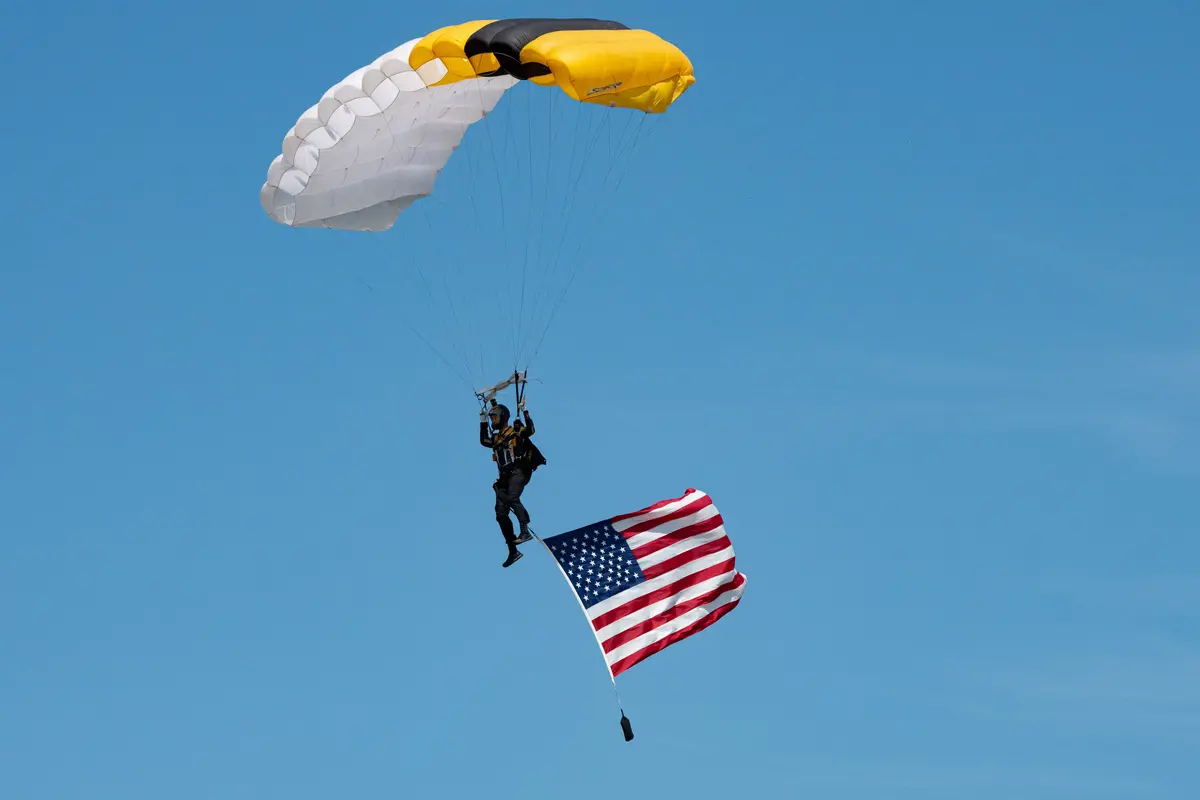
One of the six Black Knight jumpers brings an American flag on Aug. 1, 2026. Larry Dye/The Epoch Times
As soon as the jumpers were off the field, Placid Lassie, the World War II-era C-47 Skytrain, was off the ground and up in the air. This model of airplane was used extensively during the war for military airlifts, transport, and paratrooper operations. She’s 64 feet long and 96 feet wide, and carries a crew of four.
Placid Lassie was used on D-Day during the Allied invasion of Normandy in 1944, and carried paratroopers who jumped behind enemy lines. Its current paint job includes the invasion stripes common on D-Day planes. The white and black stripes cover her tail and the center of each wing so she could be identified as a friendly aircraft during the battle.
The carrier plane swooped and soared for the crowd, proudly showing its stripes. It was like a beautiful, gray flying bus against the white clouds and blue sky.
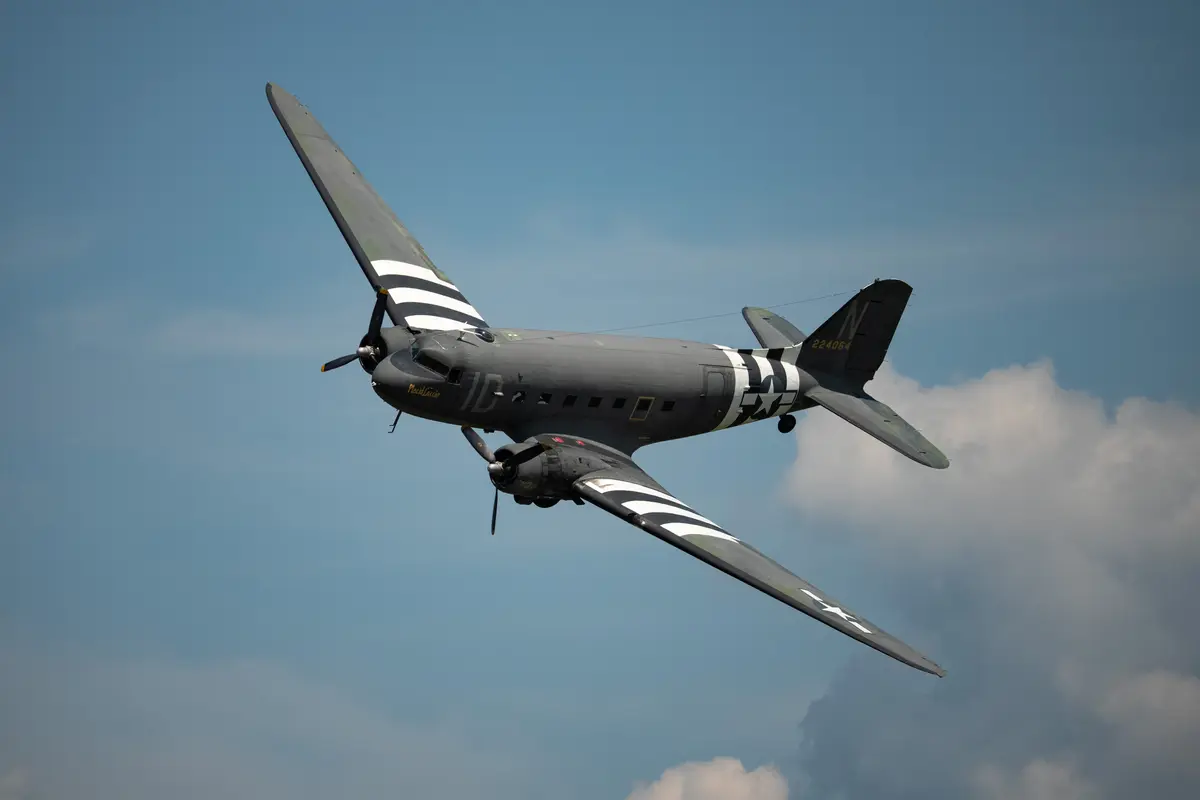
Placid Lassie's paint job includes the invasion stripes common on D-Day planes on Aug. 1, 2026. Larry Dye/The Epoch Times
Soon after, the C-17 Globemaster III, a modern transport plane, flew in from the nearby Stewart Air National Guard Base. The aircraft serves many of the same purposes as the C-47, but on a larger and modern scale.
The C-17 is the U.S. Air Force’s transport plane of choice, capable of carrying 85.5 tons and transporting an M1 Abrams main battle tank. It is 174 feet long and has a wingspan of 169 feet, and is operated by three crewmembers. Several C-17s are stationed with the 105th Airlift Wing at Stewart.
The C-17 roared over the airport, passing fast, passing slow, making wide turns over the distant hills. The audience could hear the radio chatter of the pilots over the speakers.
Next up was Hammerhead, a Van’s RV-8 flown by Galen Killam, a 30-year piloting veteran. His show plane is painted a memorable blue and light green, with a shark pattern at the front.
His performance consisted of quick arching dives and ascensions, loops, and stalling dives. The plane was followed by a trail of smoke, bubbling from its belly, tracing the rollercoaster-like movements.
With the smoke he traced a big heart in the sky for his wife, who bought him the plane years ago.
Killam’s performance ended with a race against the Cyberbeast, a top trim Tesla Cybertruck. The Hammerhead flew in low over the runway while the Cyberbeast ran its best under it. The Hammerhead won the first race down the track, and lost the second two.
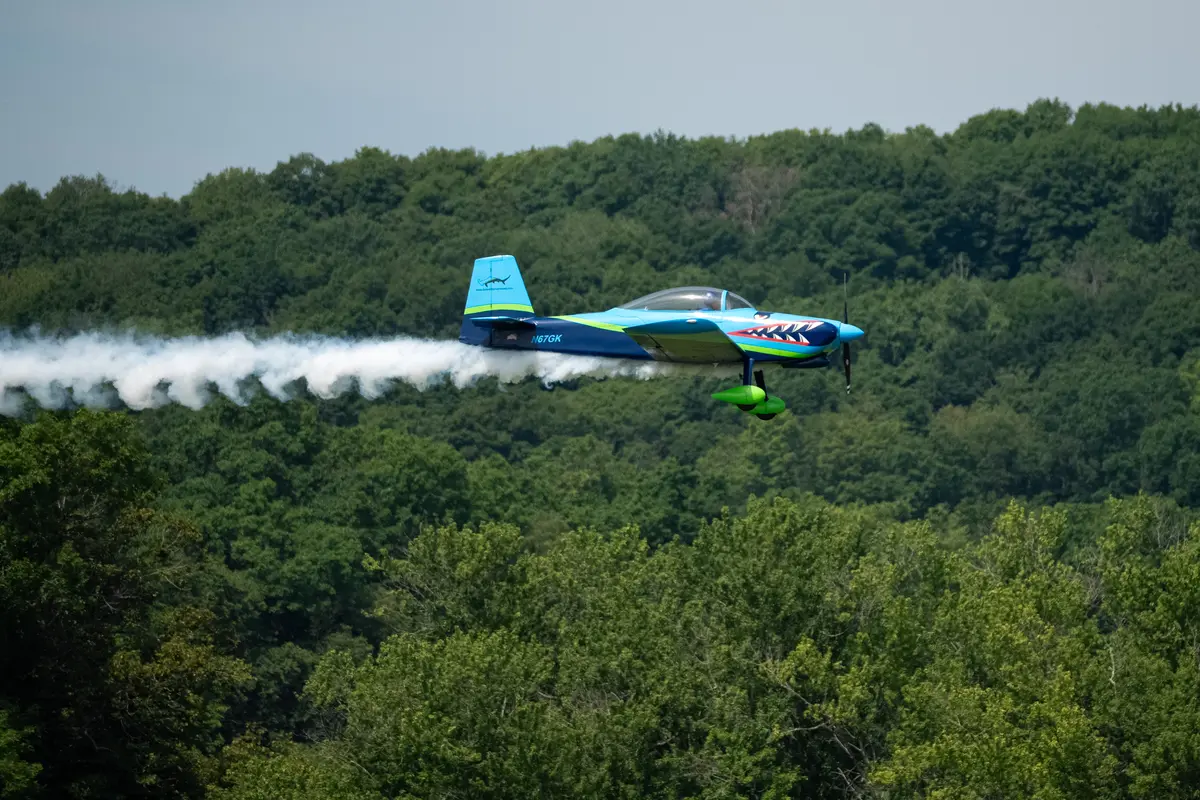
The Hammerhead is followed by a trail of smoke, bubbling from its belly on Aug. 1, 2026. Larry Dye/The Epoch Times
After the Hammerhead, the historic B-25 J Mitchell Panchito took off from the runway. The restored World War II medium bomber shone bright silver, a picturesque war machine of another age. It flew past several times, making sure the audience saw every side of it, top and bottom. Through the open bomb bay, the observant could see a mock bomb, as it would have been carried in the war.
Panchito performed several mock bombing runs, reenacting attacks on Japanese ships in the Pacific, flying low and fast, then pulling up and away from its target.
The hosts told the history of the B-25’s most famous exploit, the Doolittle Raid. While the United States was facing a morale crisis in 1942 due to a wave of strategic losses. Lt. Col. James Doolittle and his 16 B-25 bombers launched from aircraft carriers in enemy waters for a surprise attack on the Japanese capital, Tokyo.
The bombers were running low on fuel and made straight for the Soviet Union. Only one bomber made it; the rest ran out of gas over China, and their crews ditched them. The mission had 80 participants: 69 returned to the United States by the end of the war. Many of them were helped by local Chinese civilians, and in retribution, the Japanese army killed an estimated 250,000 people in the Zhejiang and Jiangxi provinces of China.
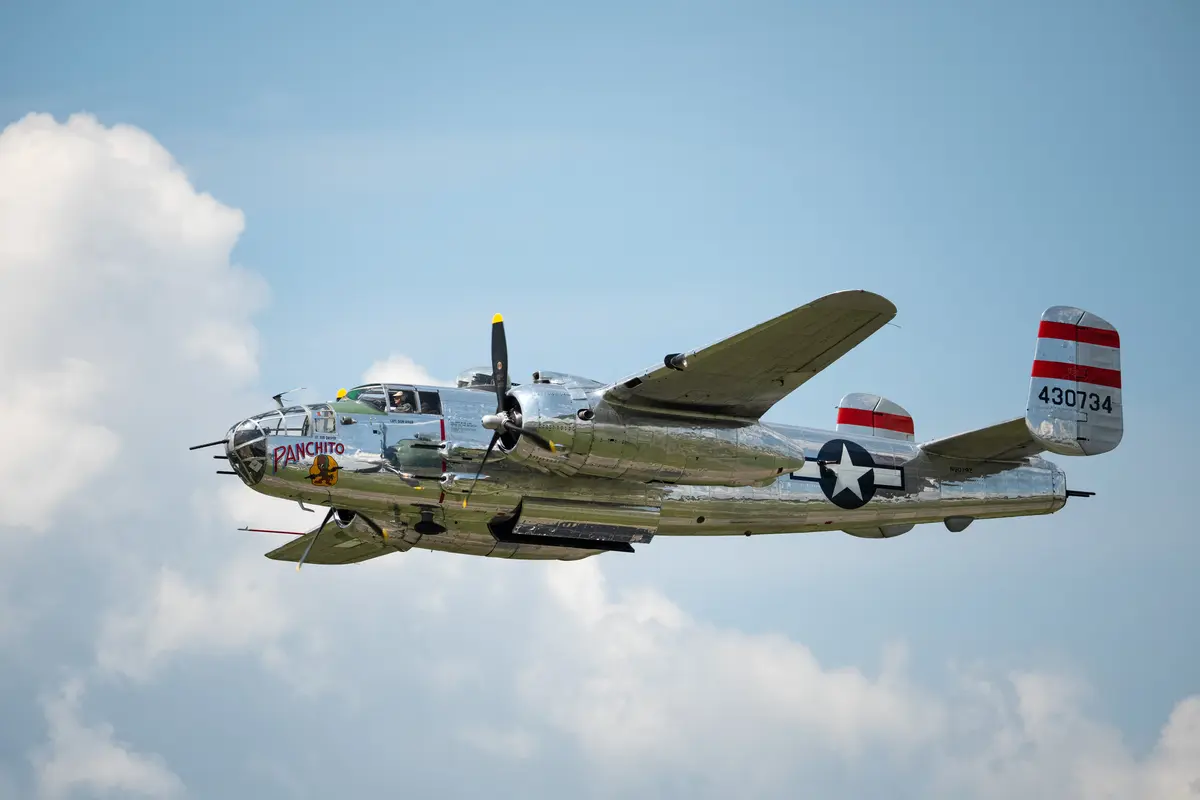
The historic B-25 J Mitchell Panchito performs a mock bombing run on Aug. 1, 2026. Larry Dye/The Epoch Times
The second-to-last demonstration was by RJ Gritter, an experienced air show performer and stunt pilot. His stars-and-stripes-detailed plane was exceptionally nimble, able to spin itself upside down and right-side up in a second.
Gritter performed complex turns and twists, leaving a smoke trail like cursive in the sky. He would fly straight up, stall out, and fall back down nose first into a long, almost ground-grazing dip. He also performed a slow roll, flying straight over the field and slowly rotating his plane 360 degrees, considered a difficult aerobatic maneuver.
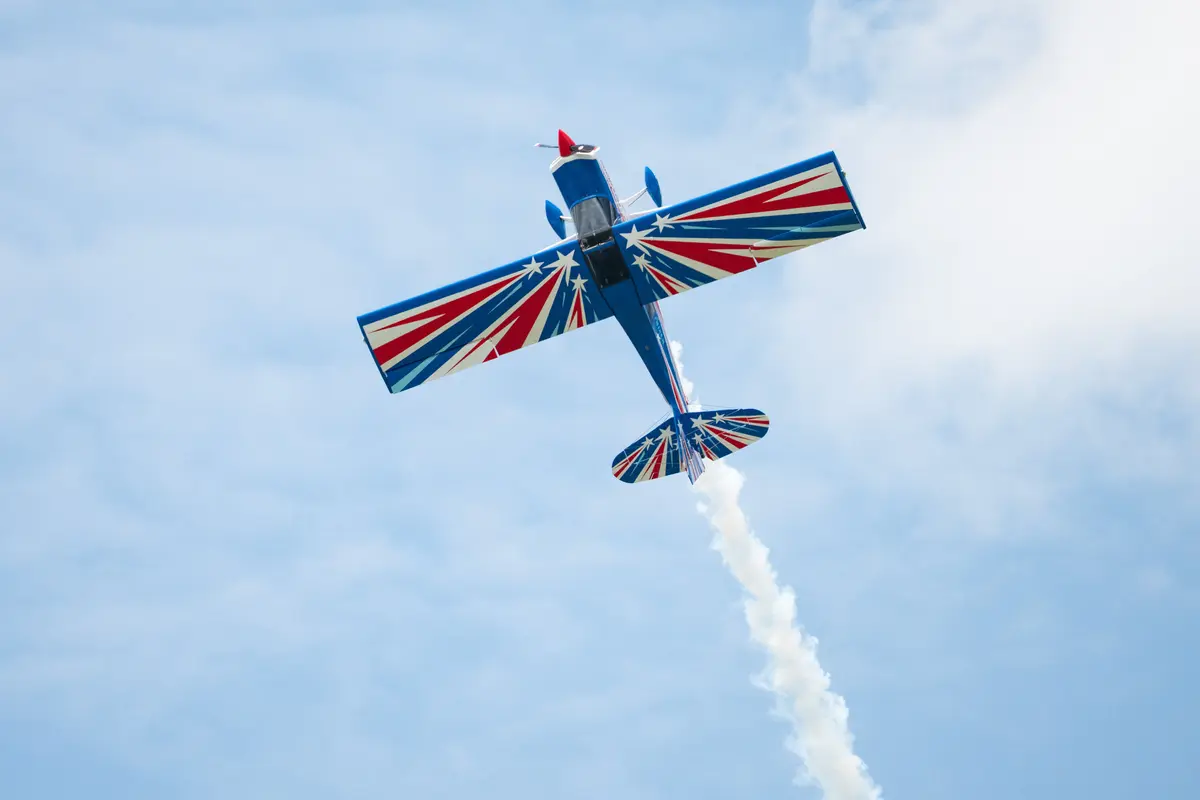
Stunt pilot RJ Gritter leaves a smoke trail on Aug. 1, 2026. Larry Dye/The Epoch Times
The final performers were the U.S. Air Force Thunderbirds, one of America’s top military flight demonstration teams. They fly red, white, and blue F-16 Fighting Falcons, combining extreme speed with extreme precision. The bottoms of the craft are detailed with the thunderbird, a mythological creature from Native American mythology.
The six F-16s performed many tight formation maneuvers, such as the Diamond Roll, where four jets in a tight diamond formation, just feet apart, initiate a slow roll. They did the same with all six flying in formation.
During much of the show, four of the jets stayed in formation, while two acted independently, each allowing for the other group to reposition for the next demonstration, while never letting the audience get bored.
The two independent F-16s showed what the jet fighters were capable of, flying past on the sides, flying by at a steep angle so they could travel slowly, and passing each other precisely, with one flying right-side up and the other passing underneath, upside down.
In demonstrations of precision, four of the jet fighters flew in at hundreds of miles an hour from four directions and passed each other, stacked like pancakes, at the same spot at the same time.
At the airfield were many vehicles from the 417th Engineer Company, located nearby at the SSG Frederick J. Ill Jr. U.S. Army Reserve Center in Montgomery, N.Y.
Vehicles including armored personnel carriers, huge motor scrapers, heavy vehicle transports, and giant bulldozers were available for visitors to interact with, climb in, and learn about.
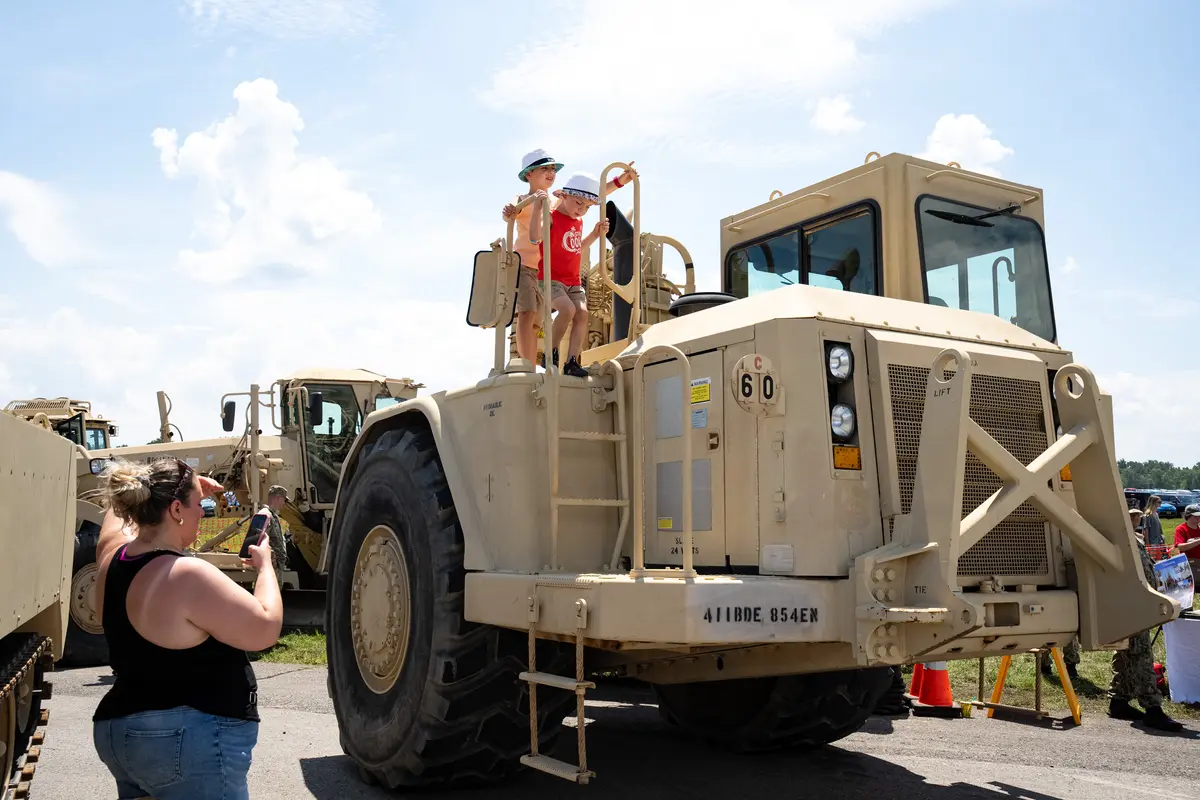
Fans climb on vehicles from the 417th Engineer Company at the U.S. Army Reserve Center in Montgomery, N.Y., on Aug. 1, 2026. Larry Dye/The Epoch Times