By Literary Hub | Created at 2026-09-18 10:05:27 | Updated at 2026-09-18 20:29:37
11 hours ago
By Literary Hub | Created at 2026-09-18 10:05:27 | Updated at 2026-09-18 20:29:37
11 hours ago
"Its true grace is in the balance it achieves between big, choral moments and smaller, more intimate ones."
Toward the end of 2023, I was approached to translate Roberta Recchia’s debut novel All That is Left of Life. The book was still a few months away from publication in Italy, and Recchia’s name wasn’t on anyone’s radar yet, so receiving the manuscript felt a little like being let in on a secret. Intrigued, I agreed to read it over the holidays.
Article continues after advertisement
Set in and around Rome during the 1980s, All That is Left of Life is a choral novel that follows three generations of the Ansaldo family as they grapple with the aftermath of Betta’s murder at just sixteen. It’s the peak of summer, and Betta and her cousin Miriam sneak out of the house one night to go to a bonfire party on the beach, but only Miriam makes it back home alive. Marisa and Stelvio, Betta’s parents, are plunged into the emotional mayhem of their senseless loss, but it is Miriam who carries the heaviest burden as she hides from everyone that she, too, was on the beach that night.
When the memory of the violence becomes too difficult to bear, she turns to the sweet oblivion of drugs and quickly develops an addiction. Only when she hits rock bottom does she cross paths with Leo, a small-time drug dealer who will prove to be her salvation. With a story arc that spans three decades and a cast of unforgettable characters, All That is Left of Life took Italy by storm and, with over 200,000 copies sold domestically so far, it’s still on the bestseller list two and a half years after its original publication.
All That is Left of Life is a virtuoso study of how different people respond to grief and trauma, ultimately finding ways to overcome what feels like it should be impossible to overcome.
One of my most vivid memories of my time with All That is Left of Life is not a translation memory at all, but of reading it for the very first time. I was in the middle seat, flanked by total strangers, flying back to Italy for Christmas, full of the anticipation and tension that going home at that time of year always stirs, and there I was—crying my eyes out over Marisa’s grief. I was only about a quarter of the way in (those who’ve read the book will know the exact passage), but I already knew that I wanted to translate the novel. I finished it the following day, and it took all the professionalism I could muster not to write to the commissioning editor on Christmas Day to say that I was in.
All That is Left of Life is a virtuoso study of how different people respond to grief and trauma, ultimately finding ways to overcome what feels like it should be impossible to overcome. The excerpt on Lit Hub, which comes immediately after Marisa’s pietà-like scene that still makes me cry inconsolably, is a wonderful example of Roberta Recchia’s craft: in fewer than a thousand words, we witness the reactions to the murder from Betta’s closest family, the police, and the town at large. New characters are introduced, many interesting details are offered, yet the narration never loses its focus, every sentence adding to the characters’ mounting sense of powerlessness in the face of such a tragic death. This was one of the biggest challenges I had to face—translations “physiologically” tend to expand, but for me it was very important to keep the tautness of Recchia’s propulsive storytelling intact.
This was my second full-length translation, and it taught me many important lessons about my own process. It was by working on it that I learned that, for me, the first draft is really just a fact-finding mission about the challenges that each book is going to throw my way, and that those problems will only find their solutions over the course of many drafts, as the tone and the voice of the novel in English hopefully crystallize into a coherent whole.
Readers might think that once all the words are on the page, the translation is basically done, and the translator only needs to go through it once or twice to make sure that everything reads well. That might be the case for other translators—we are all different and work in different ways!—but for me, a first draft is just a chance to slow down and really read the book, and that is especially important in a pacy page-turner like All That is Left of Life, where appreciation for the more delicate nuances can be overlooked in our yearning to know what happens next.
Translations “physiologically” tend to expand, but for me it was very important to keep the tautness of Recchia’s propulsive storytelling intact.
On finishing my first draft, I realized that I could implicitly trust the novel’s unstoppable drive forward to render well in English, and that it was the small details that I had to pay most attention to instead: the word-level repetitions from one chapter to the next that shape the characters into existence, the details of a tiny gesture or expression that speak volumes to the emotional landscape of the protagonists, the connotations of social class and privilege in the dialogue that reveal the speakers’ implicit biases. Thanks to this focus, and over my many re-readings and drafts, I’ve come to love some minor scenes in the book perhaps more than its pivotal plot points: Stelvio and Marisa in the dairy, Leo in the library, Marisa’s jealousy of Maria Grazia…On a first read, All That is Left of Life tears your heart apart with its sweeping emotions, but its true grace is in the balance it achieves between big, choral moments and smaller, more intimate ones.
All That is Left of Life came out in Italy while I was still elbow-deep in its inner workings, and watching its first readers react to it was thrilling, as well as filling me with a sense of responsibility towards a book that it soon became clear was going to be a smashing success. With this novel, Roberta Recchia has earned an army of die-hard fans: booksellers keep recommending it, book clubs love it, social media is abuzz, and word-of-mouth is as strong as ever. Recchia’s second novel, Io che ti ho voluto così bene (I, who loved you so much), came out in Italy last year. I don’t want to say too much about it, but readers who have loved All That is Left of Life will be interested to know that it revisits some of the same events from the perspectives of a different set of characters. I am so excited that readers in North America, too, now have the chance to read one of Italy’s biggest publishing successes of recent years, and so honored to have had the privilege of acting as the go-between.
_______________________________
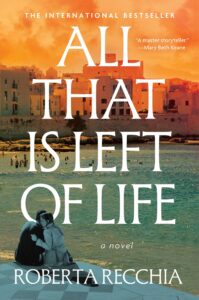
All That Is Left of Life by Roberta Recchia, translated by Antonella Lettieri, is available from Scribner, an imprint of Simon & Schuster.