By The Straits Times | Created at 2026-10-13 11:52:21 | Updated at 2026-10-13 13:19:55
1 hour ago
By The Straits Times | Created at 2026-10-13 11:52:21 | Updated at 2026-10-13 13:19:55
1 hour ago
SINGAPORE - Chinese entrepreneur Monica Lin said she first understood the importance of child car seats during a business trip to Israel in 2000, when she witnessed a car accident in which an infant was protected by a safety seat.
Three years later, she founded Ningbo-based Welldon, which now produces more than 1.8 million child car seats a year, with only a third meant for the domestic market. China included child safety seats in national legislation that took effect in June 2021, although the law sets no specific penalty for failing to use them.
Lin estimated that only about 10 per cent of parents with young children use safety seats. Some bought the seats without understanding their function, then stopped using them when their children resisted, she told The Straits Times.
“That is painful to see,” she said. “People do not understand the purpose of the product and the risks involved.”
When Washington announced plans for tariff relief on Chinese-made child seats in September, Lin saw an opening to grow her business in the US.
China manufactures around 80 per cent of the world’s child safety restraint systems, according to the World Health Organization. The US is the largest market globally, with child-restraint laws in all 50 states and the District of Columbia, but tariffs on Chinese goods raised concerns about the affordability of such safety essentials.
After a bruising trade war in 2025 that pushed tariffs into triple digits, Washington and Beijing are now seeking to preserve bilateral trade in US$30 billion (S$38 billion) worth of goods they each consider “non-sensitive”. For China, the export list includes baby gear, toys, small appliances and holiday decorations.
The “30-for-30” framework was developed through a trade mechanism announced in May at the Beijing summit between Chinese President Xi Jinping and US President Donald Trump, and advanced after their subsequent meeting in Washington in September. It is viewed as a limited opening rather than an end to their broader trade dispute.
Gains for all
The reprieve is a rare point of agreement: Baby gear is costly for American parents, and few countries other than China can make it at scale.
“I understood why the US side was doing it, and I had anticipated this outcome for some time,” said Lin of Welldon, adding that one of her worried US customers tried to manufacture outside of China but gave up on the idea. “For child safety seats, it is very difficult for other countries to replicate what China has.”
Chinese companies had started out as original equipment manufacturers before venturing into product design and research. Some went as far as acquiring established baby brands overseas. Market leader Goodbaby International, for one, bought Germany’s Cybex and US-based Evenflo in 2014.
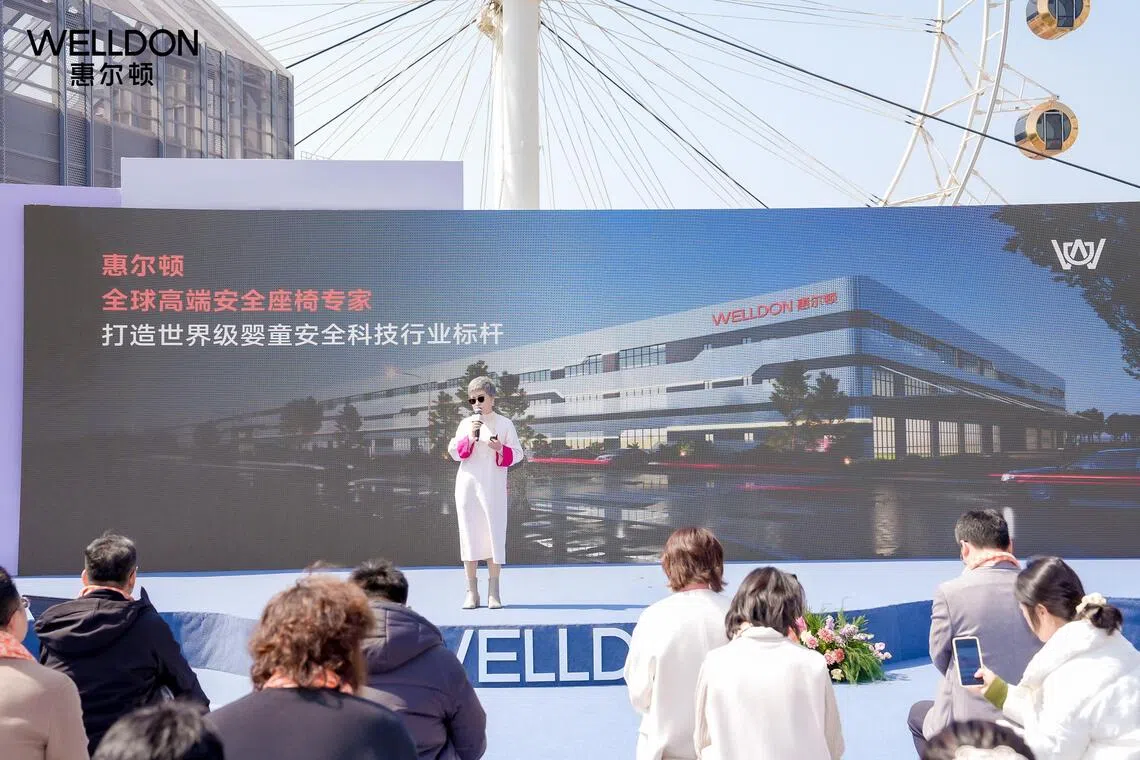
Welldon founder Monica Lin speaking on stage at the launch of the company’s new child safety car seats in Ningbo, China, in March 2026.
PHOTO: WELLDON
The Trump administration, meanwhile, faced pressure to relook tariffs for baby essentials. In a May 2025 letter urging tariff exemption, US Senator Kirsten Gillibrand noted an average price increase of 30 per cent for baby products and said that “families cannot absorb this ‘baby tax’”.
Alison Jacobson, executive director of The Baby Safety Alliance, a trade group based in Mount Laurel, New Jersey, said “affordability is not separate from safety” when it comes to baby products.
“When the cost of essential baby products increases significantly, families may delay purchases, keep children in products longer than appropriate, or turn to second-hand or unverified alternatives,” she told ST.
Beijing also sees gains. China’s Commerce Ministry said in a Sept 28 statement that it would help stabilise bilateral economic ties and create more favourable conditions for exports of the covered Chinese products to the US.
The arrangement remains preliminary as neither government has specified the extent of tariff reduction or when they will take effect.
About three quarters of the 1,619 product categories on Beijing’s list are food, livestock and other farm products, from beef and seafood to dairy, fruit and tea. Washington’s 77 categories, on the other hand, cover mainly household goods and small appliances, such as bed linens, curtains and microwave ovens.
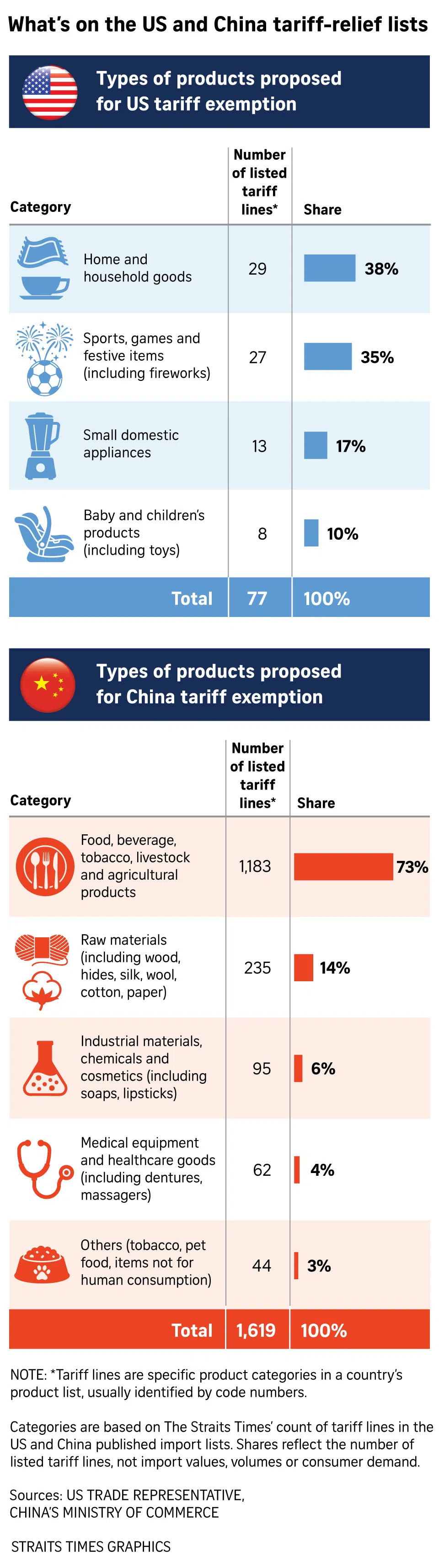
China has a much longer list as it breaks products down into much more specific tariff lines, such as individual types of animals and plants.
By ST’s count, baby and children’s gear, including toys, highchairs, booster seats, play yards and car seats, makes up about 10 per cent of Washington’s list. But on Beijing’s list, baby food and formula account for just 0.1%.
Professor Matilde Bombardini of the University of California, Berkeley’s Haas School of Business, said the latest “30-for-30” deal focuses on consumer goods that could ease Americans’ cost-of-living pressures while avoiding strategic sectors such as semiconductors and dual-use technologies.
“This is an initiative that is trying to relieve tariff-induced tensions,” she told ST.
How much relief reaches consumers will depend on the eventual cuts and companies’ pricing decisions.
Based on Bombardini’s research that a one-percentage-point increase in tariff raised consumer prices by an average of 0.25%, a hypothetical 20-percentage-point tariff cut could bring prices down by 5%, she said.
Few alternatives
Several goods on Washington’s list had few alternatives to “made in China”, such as fireworks, vacuum flasks, artificial flowers and baby gear.
Gillibrand wrote in a May 2025 letter to US Trade Representative Jamieson Greer that 98% of car seats and 97% of strollers are imported from China, citing US Census Bureau data. Calling for tariff exemption, she said: “Parents should not be forced to choose between safety and making ends meet.”
US tariffs on most Chinese imports reached 145% in April 2025. A Geneva truce the following month cut the rate to 30%, while China lowered its duties on US goods to 10%. The truce was later extended.
Some Chinese companies bore the brunt of tariffs as US customers cut back on spending and sought options elsewhere. Hong Kong-listed Goodbaby said in its interim results release in August 2025 that US tariffs had raised input costs and, alongside regulatory compliance costs and heavier promotional spending, put pressure on profitability. In March 2026, it reported a 38.7% fall in net profit for 2025 to HK$218.4 million (S$35.6 million).
US-based manufacturers that tried to expand their supply chain beyond China faced challenges. Child safety seats, for example, require specialised materials, testing, certification and quality-control processes that cannot be transferred to another factory overnight, said Jacobson of Baby Safety Alliance.
“The juvenile-products industry has built extensive manufacturing expertise and supplier networks over many years, including a substantial support structure in China,” she added. “Diversifying supply chains can be part of long-term resilience, but moving production of regulated baby products cannot happen overnight.”
The global baby car-seat market was worth an estimated US$5.1 billion in 2025 and is forecast to reach US$8.5 billion by 2035, growing at a compound annual rate of 5.2 per cent from 2026, according to research firm Global Market Insights. The US is the largest market, accounting for US$1.4 billion in 2025 and projected to reach US$2.2 billion by 2035.
While the tariff relief would offer Chinese firms an opening, those trying to launch their own brands in the US would be more directly affected by local policies compared to manufacturers who can rely on their US customers to help mitigate risks, said Guo Shan, a partner at Shanghai-based consultancy Hutong Research. “Overall, there remains considerable uncertainty,” she told ST.
Welldon first ventured into the US market around 2020 and now manufactures for “a few” high-end US customers, which Lin declined to identify, citing commercial confidentiality.
Roughly two-thirds of the company’s revenue comes from overseas markets, mainly Europe and Asia. Its own brand, Jovikids, has reached Japan, Malaysia, and the Middle East.
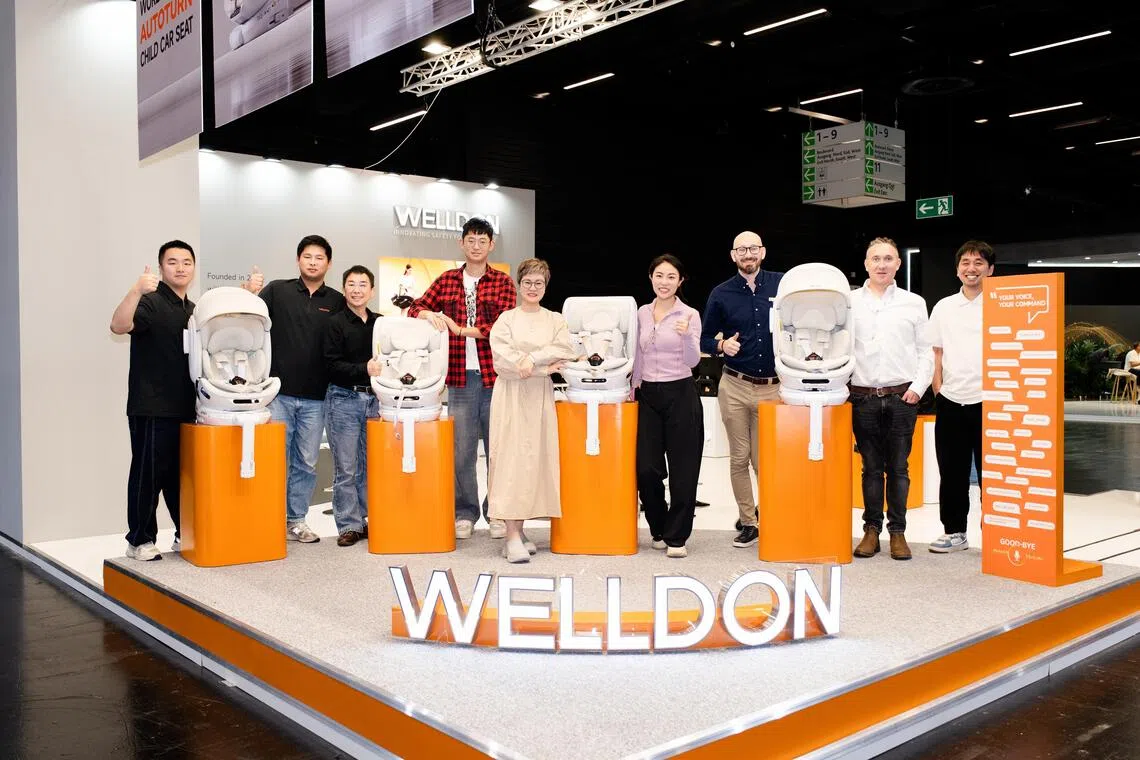
Welldon founder Monica Lin (centre) with her colleagues at the company’s booth at a baby and toddler products trade fair in Cologne, Germany, in Sept 2026.
PHOTO: WELLDON
Lin now hopes to make the US their single largest market, accounting for 30% of their revenue by 2028.
She considers the US an attractive market for its market potential and more safety-conscious consumers, but she is aware of the challenges, too. The US has its own motor vehicle safety standards with strict oversight and quality failures can be costly, she said.
But she is undeterred, already planning more US trips to meet prospective customers and deepen cooperation with existing ones. “This tariff arrangement has created a good opportunity for us,” she said.