 By The Epoch Times | Created at 2026-10-10 09:12:11 | Updated at 2026-10-10 10:09:13
1 hour ago
By The Epoch Times | Created at 2026-10-10 09:12:11 | Updated at 2026-10-10 10:09:13
1 hour ago
Gun Owners of America (GOA) and members of Congress are renewing their call for the Bureau of Alcohol, Tobacco, Firearms and Explosives (ATF) to destroy approximately 1.4 billion ATF records that they call an illegal gun registry.
ATF Director Robert Cekada and President Donald Trump say ATF databases comply with federal law while providing an important crime-fighting tool.
Cekada tells a story about the widow of a former ATF employee who wanted the agency to generate a list of her husband’s firearms so she could account for them.
“I said, ‘Ma'am, I’m sorry, we can’t do that.’ And she was shocked because she thought, like everyone thinks, that we have this ability. We just don’t,” Cekada told The Epoch Times.
In a 2022 report, GOA’s Director of Federal Affairs Aidan Johnston wrote that the ATF has a database ready to be converted into an “illegal gun owner registry.”
In 2021, GOA revealed an ATF internal document that showed the Biden administration had processed and digitized more than 50 million “out of business” records from Federal Firearms Licensees (FFLs) that had closed.
1.4 Billion Records Stored, GOA Estimates
Combining those with the files the agency already had, plus files surrendered since, makes the current total about 1.4 billion, GOA stated.
The documents are ATF Transaction Record 4473 forms completed by customers during firearms transactions with FFLs, such as retailers or manufacturers. The 4473 contains customer identity information necessary for legally mandated criminal background checks by the FBI.
ATF also holds completed Acquisition and Disposition records. The Acquisition and Disposition record, commonly known among FFLs as the bound book, traces the life of a firearm from its manufacture to a wholesaler, then on to its first retailer and first purchaser.

A customer fills out his federal background check paperwork as he purchases a handgun in Delray Beach, Fla., on Jan. 5, 2016. Joe Raedle/Getty Images
FFLs are typically required to hold records for 20 years or turn them over to the ATF if the retailer goes out of business before the 20-year deadline.
GOA posits that there should be no retention period because there should be no records. A GOA spokesperson said the danger to Americans’ constitutional rights outweighs any benefit claimed by the government.
“This is a ticking time bomb for the Second Amendment,” Ben Hyun Sanderson, GOA’s deputy director of federal affairs, told The Epoch Times. “Allowing a government to know exactly who owns firearms and how many they have, where they live, is the complete opposite of what the Second Amendment was intended by the founders to be.”
But Cekada said the files serve an important law enforcement function.
Thousands of Traces Requested
The ATF director said more than 660,000 traces were requested by U.S. law enforcement in 2026. It’s unclear which traces played a significant role in criminal investigations. The ATF is actively involved in relatively few cases, and each law enforcement agency has policies and laws regulating how they release case information.
“I can tell you the anecdotal evidence is there. They depend on what we call crime gun intelligence tracing,” Cekada said.
Still, there are concerns. On Nov. 22, 2021, 52 members of Congress wrote to Marvin G. Richardson, then ATF’s acting director.
“This gives us serious cause for concern that the Biden administration is intent on creating a federal gun registry by circumventing the legislative process,” the letter states.
On Sept. 29, 2026, U.S. Rep. Michael Cloud (R-Texas) and Rep. Andrew Clyde (R-Ga.) sent a letter to Trump and Vice President JD Vance, requesting an investigation into the tracing program.
“We ask for your decisive leadership to end this registry and prevent its expansion,” the letter states.
But the Trump White House stands firmly by the ATF.

President Donald Trump in Suffern, New York, on May 22, 2026. Brendan Smialowski/AFP via Getty Images
In an email to The Epoch Times, a White House spokesperson stated the records retention program was inspected by the Government Accountability Office (GAO) and found to be in compliance.
“Every step is governed—and limited—by federal law,” the email states.
GAO reviewed four of the 16 ATF programs that contain transaction data in 2016. Inspectors found issues in four programs, which the ATF addressed at that time.
The Firearms Owners Protection Act (FOPA) and the Tiahrt Amendment set limits on how data gleaned from the files can be stored, who can access it, and why.
Legal Limits
FOPA prohibits the consolidation of transaction data in a government-controlled device or facility as well as the registration of firearms.
An FFL’s transaction records stay with the FFL for 20 years, unless the business closes. Then the records are turned over to the ATF’s Out of Business Records Imaging System.
Federal agents can access a dealer’s records only during criminal investigations.
In 2003, U.S. Rep. Todd Tiahrt (R-Kan.) introduced the Tiahrt Amendment, and its provisions have been attached to Department of Justice appropriations bills ever since. They restrict the release of gun trace data to law enforcement for criminal investigations.

The Gun Lady store in downtown Port Jervis, N.Y., on Oct. 10, 2022. Cara Ding/The Epoch Times
The records can be searched only by serial numbers, make and model, and manufacturer.
Cekada said the prohibitions protect individuals’ rights while providing information that law enforcement can use. The White House stands by the ATF.
“ATF trace information solves thousands of crimes per year while obeying strict legal boundaries to protect gun owners’ privacy,” the email states.
In the Gun Owners of America report, Johnston described a system in which paper records were first converted to microfilm and microfiche records. Computer technology enabled the paper records to be stored as digital PDF files.
Security Is a Concern
Cekada said the files are stored as pictures, not readable documents.
When an ATF agent begins a trace, it first must be determined which FFL handled the first sale of the gun in question. This is done by checking the Acquisition and Disposition files. Once the first retailer is found, the agent must call or visit the FFL and ask them to check their files.
If the retailer is out of business, the agent must check the Out of Business records. If the record hasn’t been digitized, this means manually searching paper files.
The GOA report noted that hundreds of ATF employees have access to the data, as well as many state-level agencies that also keep the data. The report states that even the files that have been digitized are not completely safe.
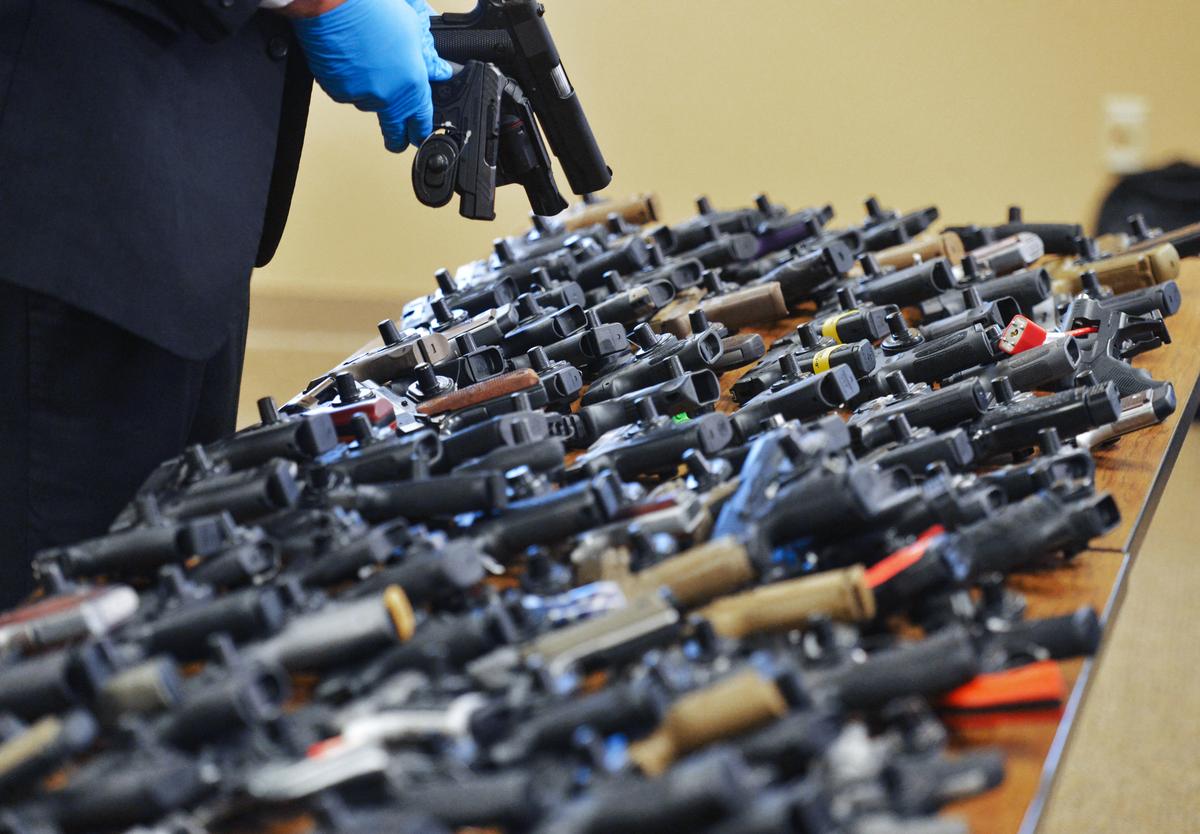
Dozens of recovered stolen handguns displayed during a press conference in Benton Township, Mich., on Nov. 21, 2023. Don Campbell/AP Photo
In 2017, hackers stole the names of about 16,000 concealed weapon permit holders from the Florida Department of Agriculture and Consumer Services’ online registration program. But hackers aren’t the Second Amendment advocates’ biggest concern.
In 2012—during Barack Obama’s presidency—The Journal News of Westchester, New York, published an interactive map on its website with the names and addresses of all handgun permit holders in Westchester and Rockland counties.
The paper got the information in response to a Freedom of Information Act request, despite the Tiahrt Amendment restrictions.
North Carolina’s WRAL-TV published an article in July 2012 sharing a database of gun owners searchable by address. At the time, station management defended the story, saying the information was part of the public record.
The story is still available on the station’s website, though the database has since been scrubbed. A note states the information was removed because it is not public information under a state law that took effect after the story’s publication.
Gun control proponents say the information should be public. Everytown for Gun Safety and the Giffords Law Center to Prevent Gun Violence say access enables law enforcement, researchers, journalists, and educators to keep the public informed about violent crime involving guns.
“These records are most useful when they are collected in a central database and retained permanently. In California … handgun sales records are permanently retained. As a result, law enforcement agencies in the state are able to quickly trace the ownership of handguns recovered in crime,” the Giffords website reads.

Former ATF agent and Giffords Law Center senior policy adviser David Chipman (R) testifies on Capitol Hill on Sept. 25, 2019. He was President Joe Biden’s nominee to head the ATF, but his nomination was withdrawn. Chip Somodevilla/Getty Images
Everytown has taken a similar position and calls for repeal of the Tiahrt Amendment.
“Blocking this data from disclosure protects corrupt gun dealers and hinders localities from enacting effective, targeted gun crime solutions. Repealing the Tiahrt Rider would help address gun violence nationwide,” the Everytown website states.
Sanderson says making the data public would make the Second Amendment a “second class” right by infringing on the rights of law-abiding Americans.
Cekada acknowledges there are those who want to see the data used to build a registry. While steadfastly denying this is a Trump administration plan, he said concerns about future administrations are valid.
“Congress needs to strengthen Tiahrt, and frankly, they need to ensure that the Firearms Owners Protection Act covers any potential gap that somebody could find in the future,” Cekada said.
“Depending upon what happens in the years to come, there could be an administration that would be helping Congress, who has control to make new laws, to try and develop a registry.”