 By The War Zone | Created at 2026-08-13 21:01:03 | Updated at 2026-08-13 22:01:23
1 hour ago
By The War Zone | Created at 2026-08-13 21:01:03 | Updated at 2026-08-13 22:01:23
1 hour ago
The TWZ Newsletter
Weekly insights and analysis on the latest developments in military technology, strategy, and foreign policy.
The Royal Australian Air Force’s (RAAF) recently delivered and extremely capable MC-55A Peregrine airborne intelligence, surveillance, reconnaissance, and electronic warfare (AISREW) aircraft has begun its first overseas deployment. Publicly available flight tracking data shows that the aircraft has been operating out of Clark Air Base in the Philippines, from where it has ventured out into the highly strategic and tense South China Sea on several occasions.
Flight tracking data from Flightradar24 indicates that MC-55 serial A51-004 flew from its home base at RAAF Base Edinburgh in South Australia to Clark, close to the Philippine capital Manila, on July 28. Data compiled by Australian Defense Magazine reveals seven missions flown out of Clark between July 30 and August 7.
First overseas deployment. An Australian MC-55A Peregrine ISREW aircraft has been flying missions out of Clark AB in the Philippines since end-July. Missions are 4-8 hours in duration and has on occasion gone further into the South China Sea. https://t.co/YWRWF4ucxW pic.twitter.com/x8qOs3XMCZ
— Mike Yeo 杨启铭 (@TheBaseLeg) August 13, 2026With missions typically lasting between four and nine hours, the MC-55 primarily flew in or close to Philippine airspace near Mindoro and Palawan islands. However, on four occasions, according to available data, it flew further west into the South China Sea. For those parts of the mission, its transponder was switched off for periods of between three and four hours.
The Australian Defense Forces (ADF) told Australian Defense Magazine that the deployment is part of its longstanding engagements in the Indo-Pacific region but provided no further operational details.
Based on the length of time that the MC-55 ‘went dark’ on flight tracking aggregators, its areas of interest could have included various disputed reefs and other features in the South China Sea, including the Spratly Islands and Scarborough Shoal.
China, Malaysia, the Philippines, Taiwan, and Vietnam all claim the Spratly Islands, which are largely uninhabited but may have significant reserves of natural resources around them. The Spratly Islands are home to a significant Chinese military presence, most notably in the form of artificial islands featuring long runways and aircraft hangars, among other infrastructure. They are also heavily defended with missiles, radar stations, and more.
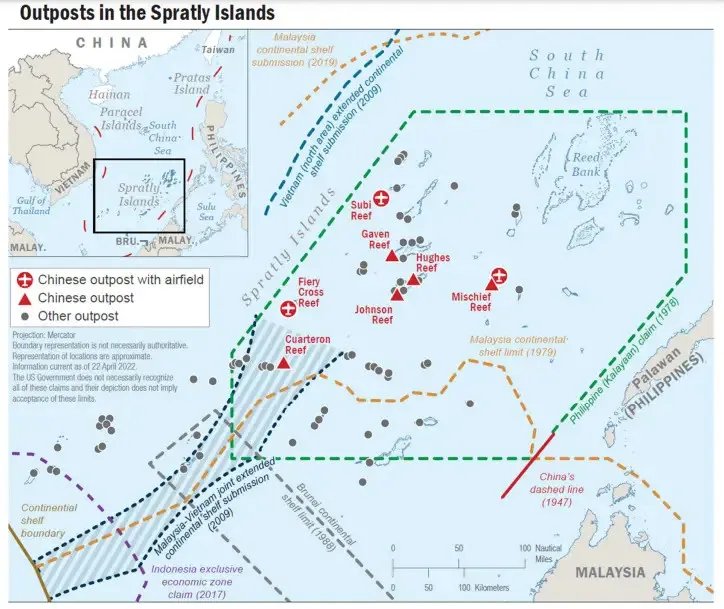 A U.S. Department of Defense map showing island outposts belonging to China and other countries, as well as the boundaries of various competing territorial claims, just in the Spratly Islands chain at the southern end of the South China Sea. U.S. Department of Defense
 Both China and the Philippines also lay claim to the Scarborough Shoal (known as Huangyan Island in China), which is little more than 100 miles from the Philippines and 500 miles from China.
Overall, China’s sovereignty claims over the South China Sea, including islands, other features and adjacent waters, are the most sweeping and have led to high tensions with competing claimants.
China routinely backs up its expansive claims with naval patrols, in the air and at sea.
Meanwhile, the United States says it does not take sides in these disputes but sends warships and military aircraft close to the disputed islands as part of its ‘freedom of navigation’ operations.
The same kinds of operations are also conducted by the ADF, with the RAAF responsible for missions into the South China Sea. These have previously been flown from Clark Air Base, as well as from Butterworth in Malaysia and out of Singapore. The RAAF uses the P-8A Poseidon maritime patrol aircraft for these missions, and previously also the AP-3C (EW) Orion.
Looks like it was a low-key retirement on Tuesday as the final two @AusAirForce Royal Australian Air Force (#RAAF) Lockheed AP-3C #Orion (EW) aircraft A9-657 and A9-660 looked to take their final flights out of and back to RAAF Base Edinburgh in South Australia.
(Defence image) pic.twitter.com/mdFXXQI5W6
The specially equipped AP-3C (EW), the secretive electronic warfare version of the RAAF Orion, was formerly flown by No. 10 Squadron, which is now responsible for the MC-55 fleet at RAAF Edinburgh.
Since we reported on the arrival of the first MC-55 at Edinburgh in January of this year, a second and third aircraft have been delivered to Australia, arriving at the same base in March and in June. The fourth aircraft is still to be delivered.
As we have described in depth previously, the MC-55 — based on a highly modified version of the Gulfstream G550 business jet — is equipped with a variety of sensors to combine electronic warfare (EW), signals intelligence (SIGINT), and intelligence, surveillance, and reconnaissance (ISR) missions in a single airframe. These capabilities would be in extreme need during any kind of crisis in the Indo-Pacific region.
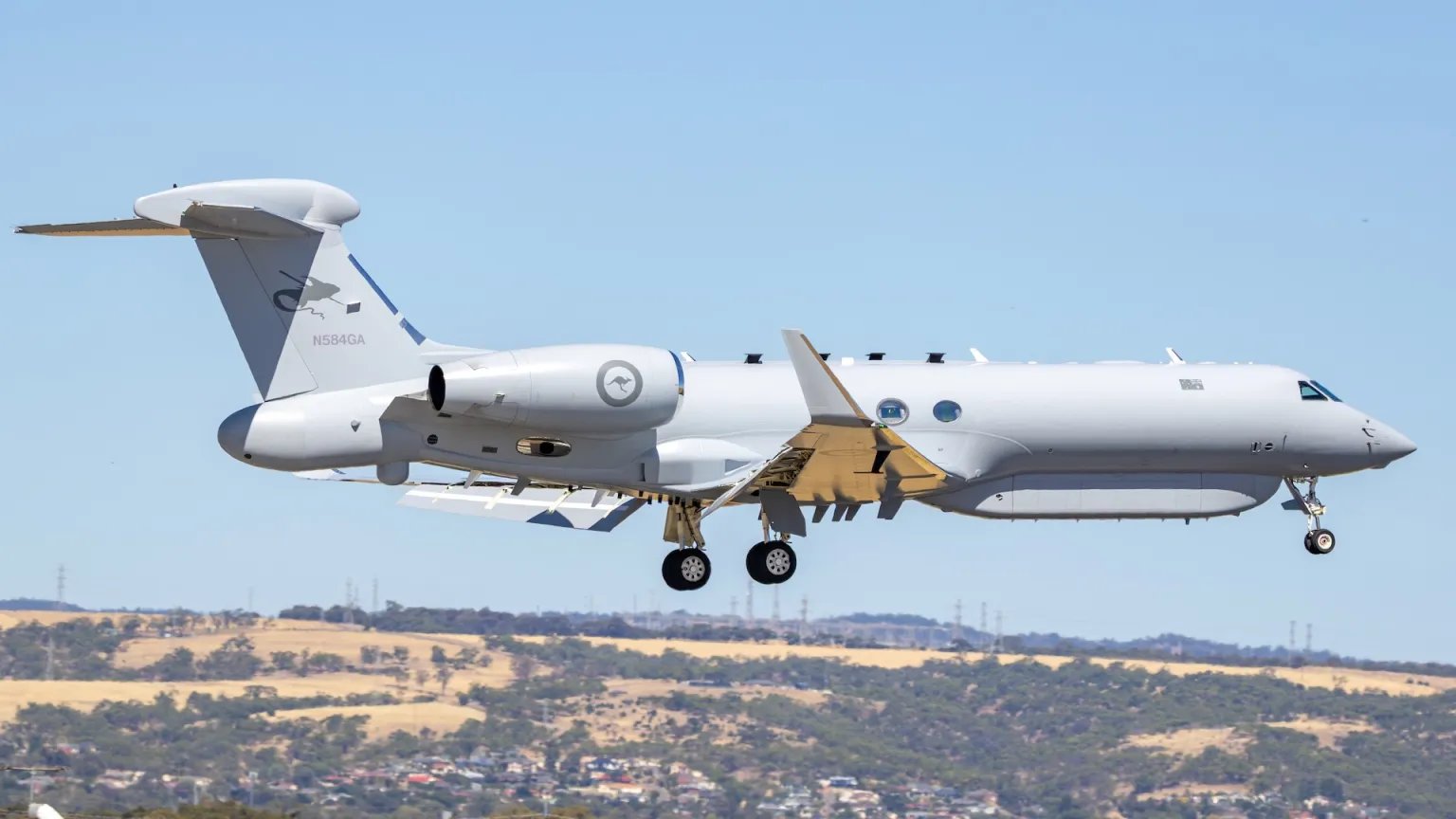 The first MC-55 to arrive at RAAF Base Edinburgh, South Australia, touched down there on January 22, 2026, after a multi-leg delivery flight that took it from the L3Harris facility in Greenville, Texas, to Australia via stopovers at Davis-Monthan Air Force Base, Arizona; Hickam Air Force Base, Hawaii; Wake Island; and Andersen Air Force Base, Guam. @airman941
 The aircraft can also serve as a networking relay and data-fusion platform, linking together other aircraft as well as surface combatants and ground forces. TWZ has previously confirmed that the MC-55 incorporates technology ported directly over from the RC-135 Rivet Joint, as you can read about here. In the past, we have also speculated that the jet is likely outfitted with active electronically scanned arrays (AESA), which would be used for standoff electronic attacks, as well as intelligence-gathering.
In the context of missions in the South China Sea, the MC-55 is a highly capable passive intelligence-collection platform, bringing a major boost to the ADF as it seeks to keep tabs on the growing Chinese military threat in the Indo-Pacific region.
The aircraft’s ISR capabilities mean it will be well-suited to surveilling Chinese military expansion and monitoring Beijing’s activities, which have already seen a number of incidents involving the ADF and Chinese military assets. As well as operating from the Philippines, and potentially from Malaysia and Singapore, the RAAF plans to deploy the MC-55 to the Cocos Islands, deep in the Indian Ocean, approximately midway between Australia and Sri Lanka.
With the first appearance of the MC-55 at Clark Air Base, Australia appears to be moving from relying primarily on the P-8A for South China Sea maritime surveillance toward having a dedicated, highly specialised airborne SIGINT/EW capability operating alongside it. This will give the ADF and its partners a much better picture of Chinese radar, communications, air defense and naval activity.
The first overseas deployment of the MC-55 — among the most advanced surveillance and electronic attack platforms in the world — marks a significant expansion of Australia’s ability to monitor and understand Chinese military activity in the South China Sea, strengthening the ADF’s intelligence and electronic warfare reach across the Indo-Pacific.
Contact the author: thomas@thewarzone.com