 By The Epoch Times | Created at 2026-09-02 18:01:53 | Updated at 2026-09-02 18:52:53
56 minutes ago
By The Epoch Times | Created at 2026-09-02 18:01:53 | Updated at 2026-09-02 18:52:53
56 minutes ago
Through written words and daily life, Wendell Berry celebrated a passion for small family farms, the land, and the Appalachian region he called home. The Kentucky author, farmer, poet, and conservationist died at the age of 92 on Sept. 1 at his home in Port Royal, Kentucky.
A writer who first gained acclaim as a novelist, Berry left New York City for Port Royal, where he lived and farmed for more than 40 years, writing by hand or typewriter.
Berry crafted more than 50 books of poems, fiction, and essays while farming with draft horses.
His works celebrated agriculture and nature and encouraged pursuing a simpler life. He championed independent farms and rural families, regenerative agriculture, and a more sustainable food system.
Mary Berry, Wendell Berry’s daughter, founded The Berry Center in 2011 to put his writings and philosophies into action. The center is an advocate for small- and mid-scale farms, land conservation, and sustainable regional food economies.
She told a Kentucky television station that her father was “a completely lovely man” and a “man of hope.”
“He was gentlemanly. He was kind,” she said.
“My father understood that we weren’t going to have any kind of justice in this country as long as we continued with the land-destroying, people-destroying economy that we have,” she added. “We’re going to continue on with the work that was important to him.”
Born and raised in a farming town during the Great Depression, Berry challenged modern assumptions about happiness and prosperity.
Most of his fiction was based on his childhood and set in rural Port William, which was inspired by Port Royal.
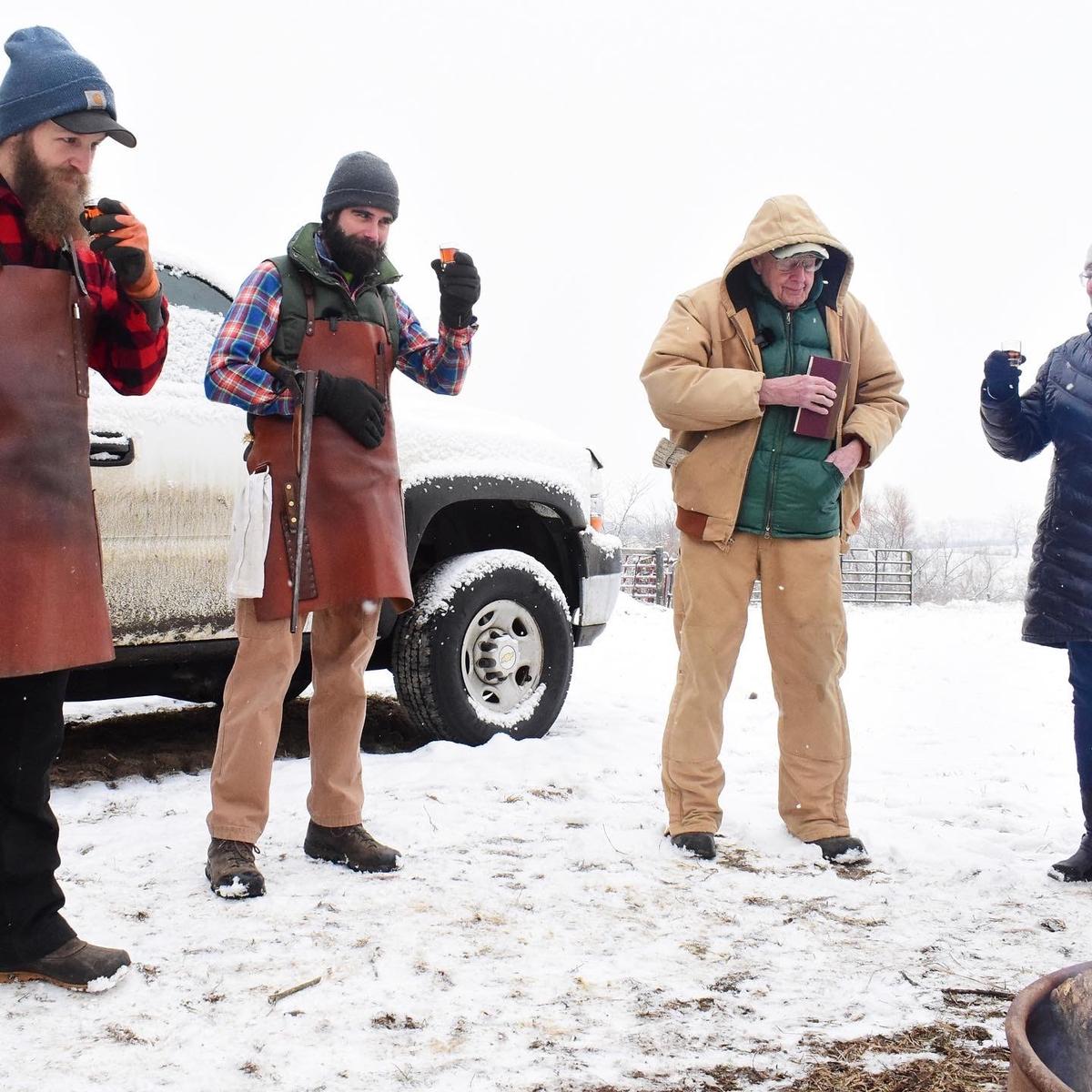
Poet, novelist, and environmentalist Wendell Berry (R) attends a hog butchering held by Hand Hewn Farm. Courtesy of Hand Hewn Farm
Beginning with the 1960 novel “Nathan Coulter,” Berry constructed a multi-generational exploration of farmers, business owners, and families whose lives were committed to the land and to each other.
Berry’s novel “Andy Catlett: Early Travels” was published in 2006. The book showcased his reverence for a traditional agrarian life centered around community and family, and skepticism toward modern industrial consumerism.
In the book, an older and wiser Andy Catlett remembers a childhood visit to his grandparents’ farm in rural Kentucky during the winter of 1943. It was a time when the labor-intensive ways of life were giving way to modern infrastructure and technology.
“Increasingly over the last maybe forty years, the thought has come to me that the old world in which our people lived by the work of their hands, close to weather and earth, plants and animals, was the true world, and that the new world of cheap energy and ever cheaper money honored greed, and dreams of liberation from every restraint is mostly theater,” Berry wrote.
“The world I knew as a boy was flawed, surely, but it was substantial and authentic. The households of my grandparents seemed to breathe forth a sense of the real cost and worth of things. Whatever came, came by somebody’s work,” he added.
Berry was born in Henry County, Kentucky, in 1934 into a family that had farmed in the same area for five generations. New Castle, where The Berry Center is located, sits within a region known as “the golden triangle” between Cincinnati, Lexington, and Louisville.
Berry’s father, John Marshall Berry, was a tobacco farmer and lawyer, and the family worked on his grandfather’s farm. His mother, Virginia Erdman Berry, was raised in a similar background.
Berry graduated from the Millersburg Military Institute and attended the University of Kentucky, where he earned a B.A. (1956) and a master’s (1957) in English. He helped edit the campus magazine before gaining a Wallace Stegner Fellowship from Stanford University in 1958, where he stayed a year as a visiting lecturer.
In the early 1960s, he lived in New York City, where he flourished as a novelist and poet. He and his wife, Tanya, bought Lane’s Landing Farm, which at the time was a 50-acre property situated along the Kentucky River near the point where it flows into the Ohio River.
The couple settled in with their two children, Mary and Pryor (“Den”). He built a career on writing and working the farm mostly without chemicals and heavy machinery. Over the years, Berry expanded Lane’s Landing to 125 acres.
For decades, Berry and his wife lived without computers, television, or phones. They installed solar units in 2005 as an act of defiance and as a commitment to clean energy in a state powered by coal.
His honors included a National Humanities Medal and membership in the American Academy of Arts and Letters. The National Book Critics Circle presented him with a Lifetime Achievement Award in 2016.

(L-R) Honorees Paul Krugman, Wendell Berry, and Sister Simone Campbell attend the 2013 Roosevelt Institute Four Freedoms Awards & Benefit reception at the Asia Society in New York City on Oct. 16, 2013. Taylor Hill/Getty Images
Berry’s legacy extended well beyond Kentucky.
The tall, slender Berry chronicled and lived out his vision of a self-sustaining community where people knew the names of their neighbors and where people knew where and how their food was raised.
Berry’s poems celebrate the ordinary miracles of animals, fields, woods, and the four seasons.
His nonfiction titles addressed conservation, traditional farming, and his disdain for the consolidation and mechanization of agriculture.
“The Unsettling of America: Culture and Agriculture,” published in 1977, is considered by many his most influential book.
He wrote that industrial agriculture is not just inefficient or environmentally destructive but is also a cultural and spiritual failure that separates people from the sources of their food and from each other.
The book inspired some of today’s most well-known regenerative agriculture figures, including Joel Salatin, a self-described “Christian Libertarian environmentalist capitalist lunatic farmer” who operates Polyface Farm in the hills of Virginia’s Shenandoah Valley.
“That book lit a fire in my soul that never dimmed. It was like the footers in constructing a house,” Salatin said.
Regarded as one of the nation’s foremost authorities on regenerative farming, Salatin is the author of more than a dozen books on the topic and travels around the world speaking at conferences and serving as a generously paid consultant.
He advocates for local food networks, independent farmers, and what he calls “personal choice in food sourcing,” and he is outspoken about what he believes is “extreme government overreach” in agriculture.
Salatin, who also writes an opinion column regularly for The Epoch Times, called Berry the original voice of the sustainable agriculture movement.
On Sept. 1, Salatin posted a tribute to Berry on his blog, The Lunatic Farmer.
“I’m fighting tears at the loss of a giant, perhaps the most articulate voice for good farming and right cultural living in America: my friend and mentor Wendell Berry,” Salatin wrote.
“Every time I dig my heels in as an iconoclast—no smartphone, never using an app, never texting, never receiving messages, no AI use—I think of Wendell, bigger than life and always, always, always questioning techno-convenience,” noted Salatin, who said that he writes on a laptop, contrary to Berry’s preference.
“I spent the day with him once at his home and in his writing perch; he showed me his technique. No. 2 pencil—the man wouldn’t even use an ink pen. He wrote in spiral notebooks. He wrote every morning in his writing cabin on stilts on the edge of a river. The walls were all glass so he could see outdoors; it gave the sense of being nested in a tree.”
Salatin recalled a time when he and Berry were scheduled to speak at a University of Virginia lecture series. A local television station set up on the sidewalk to interview both of them, but Berry declined the on-camera appearance.
“When they were ready, their point person came in to get Wendell. ‘We’re ready to do an interview; could you please come out now?’ Wendell, as courteously as possible, said ‘No,’” Salatin wrote, adding, “Wendell didn’t do cameras. Period.”

Wendell Berry visits the Cathedral of the Assumption in Louisville, Ky., on March 20, 2015. Stephen Cohen/Getty Images
Salatin hosts year-round events at Polyface Farm that feature some of the most influential figures in regenerative agriculture. He invited Berry to the farm, but the visit never happened.
“He was close several times, but he despised travel. As he aged, he became more and more reclusive. I’ve read that one of the marks of a genius is spending large blocks of time in isolation. Wendell’s genius grew out of his meditations. The dozens of prestigious awards bestowed on him never altered his ‘awe, shucks’ persona. He was ever true blue,” Salatin said.
Rory Feek is a singer and songwriter who has written singles for Clay Walker, Blake Shelton, and Tracy Byrd, among other artists. He also practices sustainable homesteading and regenerative farming at The Homestead at Hardison Mill in Columbia, Tennessee.
In a Sept. 2 tribute post on his Substack page, This Life I Live, Feek called Berry “my literary and living hero.”
“His writing wasn’t something that you put down when the book ends. It stays with you, challenges and convicts you. And, ultimately, if you’re anything like me, it changes you. Forever.”
“Mr. Berry knew well that most of the choices we as a culture make in the name of ‘progress’ come at a much greater cost than the economic bottom line shows, and his life’s work and literary passion were devoted to exposing—and reversing—that pattern,” Feek wrote.
John Klar is an attorney turned regenerative cattle farmer in Vermont. He works with the nonprofit MAHA Action and is the author of “Small Farm Republic” and “The War on Farmers: How Corporations, Activists, and Climate Alarmists Are Fueling a Global Food Crisis,” among other titles.
As it was for Salatin, “The Unsettling of America” was foundational for Klar, as were Berry’s other works.
“As I learned to farm, I couldn’t understand why it was so difficult to make a profit, and why so many laws were stacked against the small producer,” Klar told The Epoch Times. “Then I encountered Wendell Berry’s decades of essays explaining the various sinister ways that corporations and government regulatory agencies have conspired to destroy the small family farms that were once the economic and cultural wellspring of America.”
“If we are to reclaim our health and our liberty, we must all carry forward the legacy of writers like Wendell Berry. His warnings have never been more imperative.”