By The Straits Times | Created at 2026-10-11 14:51:51 | Updated at 2026-10-11 16:47:16
2 hours ago
By The Straits Times | Created at 2026-10-11 14:51:51 | Updated at 2026-10-11 16:47:16
2 hours ago
DELHI and BENGALURU – Defiant youths returned to Delhi’s streets on Oct 11, staging flash protests across the city despite a sweeping police crackdown that saw more than 2,000 people detained the previous day.
Detention too did not deter representatives of student unions and the Cockroach Janta Party (CJP), who resumed their protests even after being released.
Supporters of the youth-led CJP, student organisations including the All India Students’ Association (AISA), and opposition politicians have been demanding the resignation of India’s Chief Election Commissioner, Gyanesh Kumar.
They allege that a sweeping revision of electoral rolls overseen by Kumar has unfairly removed more than 130 million names, potentially disenfranchising legitimate voters. The Election Commission of India, however, maintains that the exercise aims to weed out ineligible voters.
After their call for a peaceful protest on Oct 10, the Indian government deployed more than 35,000 police and paramilitary personnel to prevent demonstrators from reaching Jantar Mantar, a designated protest venue near India’s Parliament.
Practically all of India’s capital New Delhi, a district within the larger city of Delhi, was locked down on Oct 10. Nearly 60 metro stations were closed and several intercity trains were not allowed to stop at Delhi. The internet was shut down too in many parts of the national capital. Barricades blocked entry into much of central Delhi.
The police detained thousands of protesters, as well as some journalists, putting them in buses and holding them in stadiums for hours on the city outskirts.
In videos the detained protestors uploaded, most said they were not told where they were taken, or why they were being held. While they had their phones, few were allowed access to lawyers.
Restrictions were eased on Oct 11 (Sunday) with metro operations resuming and internet services active, but the heavy deployment of police and paramilitary forces remained. They outnumbered demonstrators and detentions continued, making it difficult for protesters to gather and demonstrate.
Yet, many persisted, finding roundabout routes, pushing through police barricades, or simply running away from the police.
This included about ten members of the Fraternity Movement, a youth group affiliated with the Welfare Party of India, a Delhi-headquartered political party.
“Arrest CEC Gyanesh Kumar”, read one banner, as the youth staged a brief protest beneath the Ramakrishna Ashram Marg metro station in central Delhi, chanting Inquilab Zindabad (Long live the revolution).
Their march lasted barely a minute before the police and paramilitary personnel rushed in to grab them. A rough scuffle ensued, and protesters were dragged to waiting buses that ferried them away for detention.
A screaming woman writhed, trying to break free from the grip of several female security officers, while a male companion being pulled behind her shouted: “SIR bandh karo” (Stop the SIR). SIR stands for Special Intensive Revision, the Election Commission of India’s controversial voter-roll revision exercise.
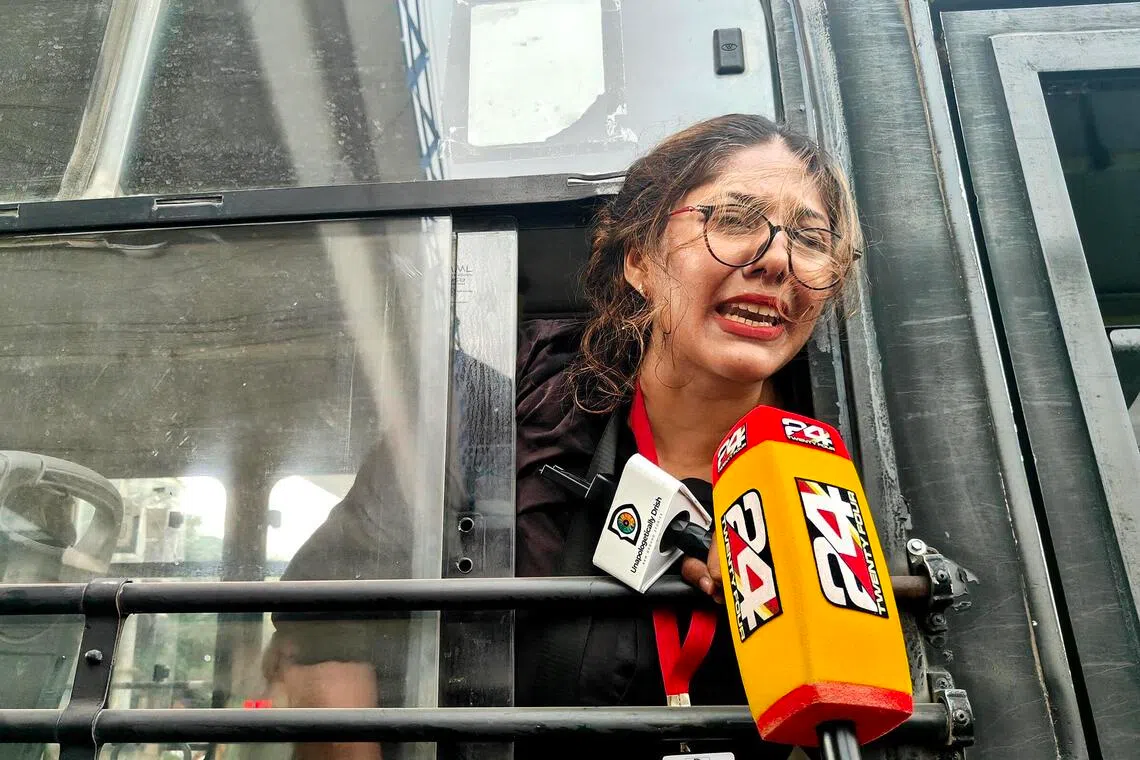
A news content creator speaking to media from a bus before she was ferried away from a protest site in New Delhi on Oct 11.
ST PHOTO: DEBARSHI DASGUPTA
Ghous Mohammed, another detainee, held a banner reading “SIR=Suppressing India’s Right” from the window of the bus into which he had been pushed. The youth from Rajasthan said he had also been detained on Oct 10, but was determined to continue protesting.
“I will come again to protest if they release me,” he told The Straits Times before the bus was driven away.
The same defiance was evident among CJP leaders who had been detained the previous day.
On the morning of Oct 10, the Delhi police had boarded an Air India flight from Mumbai to Delhi to detain CJP’s top leaders Abhijeet Dipke, Saurav Das, and Ashutosh Ranka. A magistrate ordered their release the next day, on the condition that they would not breach public peace for a year.
Within hours of being released, Das and Ranka joined student activists at a meeting at the Press Club of India in New Delhi. Dipke had returned to his home state of Maharashtra for his grandmother’s funeral.
“Our fight was against the Election Commission and Gyanesh Kumar. But (with the mass detentions and police action) Prime Minister Narendra Modi and Home Minister Amit Shah have turned this fight into a war,” said Ranka.
Das alleged that the police had detained CJP members without any paperwork, seized their phones and transported each leader separately to different locations.
“Haven’t signed any bond that says we won’t protest. We will hit the streets again,” Dipke posted on X on Oct 11. India’s key opposition parties have said they will hold a protest march in New Delhi on Oct 12 against Chief Election Commissioner Kumar.
Elsewhere, AISA national president Neha Bora marched with dozens of protestors from Ramakrishna Ashram Marg, hopped across barricades and broke into a run as they entered the cordoned-off Connaught Place.
They were detained within hours but continued posting videos decrying police brutality and vowing to return.
Similar scenes unfolded across central Delhi, where barricades, riot-control vehicles and security personnel lined the streets.
At Rajiv Chowk, a busy commercial hub near Jantar Mantar, loudspeaker announcements warned against gatherings. Drones hovered overhead while police watched from elevated positions.
Among those caught up in the crackdown was John Brittas, an opposition Member of Parliament, who was found visibly distressed in Rajiv Chowk on Sunday.
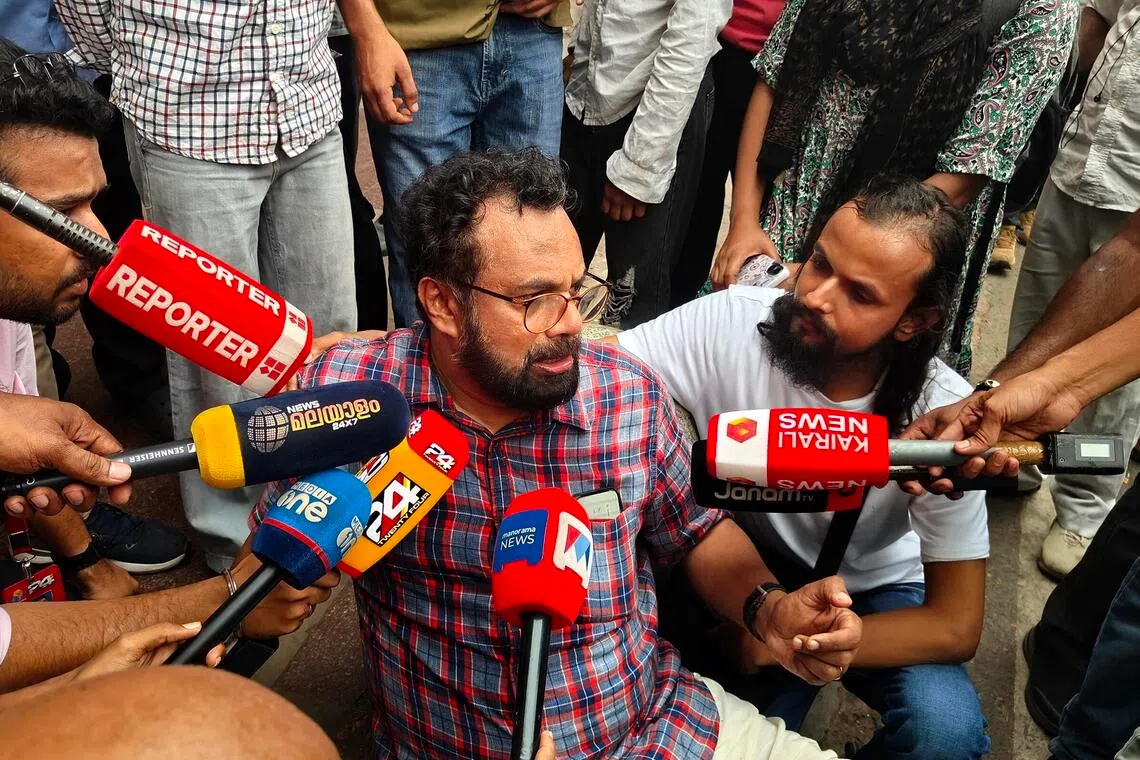
Opposition Member of Parliament John Brittas from the Communist Party of India (Marxist) speaking to media after he was allegedly detained and assaulted by security personnel in New Delhi on Oct 11.
ST PHOTO: DEBARSHI DASGUPTA
His party, the Communist Party of India (Marxist), alleged that police had detained him while he was leading a march towards Jantar Mantar and later assaulted him, before leaving him by the roadside.
Journalists were also detained, with some reporting that authorities confiscated their phones. This was despite a Supreme Court directive that journalists, lawyers and other professionals should not be obstructed in performing their duties.
For student protesters, getting to the demonstration had become an all-day cat-and-mouse game with police.
The Straits Times accompanied a group answering AISA’s call to gather at Ramakrishna Ashram Marg around 2.30pm. The students plotted how to reach the site without encountering police, eventually choosing a longer tuk-tuk ride instead of a shorter metro ride to avoid security personnel stationed at metro stops.
“Being a student is enough for them to think of us as protesters,” said Aditya, who wore a mask and asked that his real name not be used.
For him, the protests were more than just about Kumar’s resignation or allegedly “stolen votes”. It reflected simmering youth anger over other grievances, including sexual violence against women and a hostel building collapse in Delhi on Sept 6 that killed six people.
“We may be students but we are educated adults… and we raise our voice when we see something is wrong,” he added. “I really feel it’s time for the BJP and Modi government to fall out of power at the next election.”
The group carried no banners or placards, planning instead to just rely on their vocal cords to chant revolutionary and anti-government slogans when an opportunity arose.
“I think it’s important for us to be able to stand up for what we believe in,” said another protester, a 21-year-old sociology student who gave her name only as Maya. She too had been detained on Oct 10 but managed to escape through the window of the police bus.
Encouraged by the resignation of India’s education minister Dharmendra Pradhan in July following youth-led protests, she added, “We once again feel confident in our capability of having a say in democracy… I think for the first time in a long time we feel like we understand what it means to be a citizen.”
But that idealism did not last long. Soon after the students got off their tuk-tuks, the police were onto them. They scattered in different directions and Aditya disappeared into the crowd before the police could reach him.
ST lost sight of the students. But before disappearing into the crowd, Aditya had said that even if detained, he would wear it as a “badge of pride” for being “part of history”.
“I don’t want to be one of those silent spectators who see that things are going wrong, but I’m still sitting at home, sipping my coffee or doing armchair revolution,” Aditya said.
“That’s not the kind of person I am… I want to be on the streets and make a change as much as I can,” he added.