 By The Epoch Times | Created at 2026-08-08 22:46:47 | Updated at 2026-08-08 22:59:56
29 minutes ago
By The Epoch Times | Created at 2026-08-08 22:46:47 | Updated at 2026-08-08 22:59:56
29 minutes ago
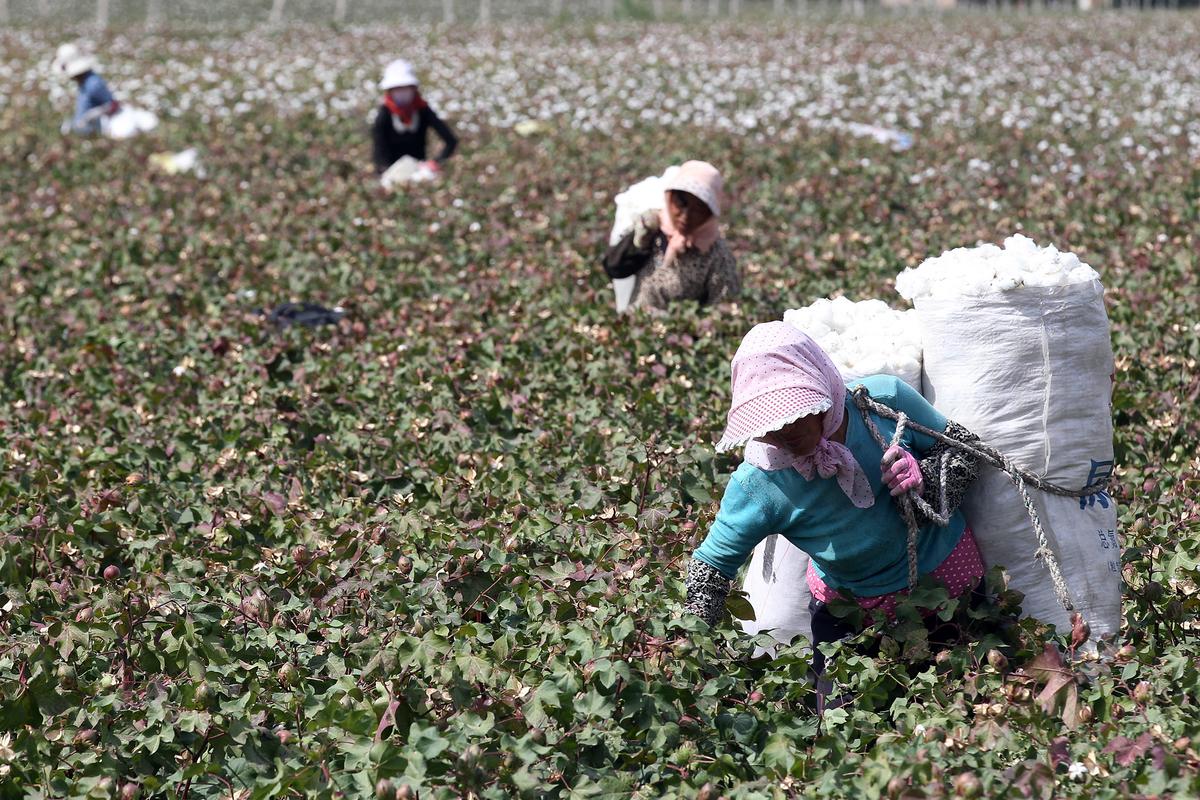
This photo taken on Sept. 20, 2015 shows Chinese farmers picking cotton in the fields during the harvest season in Hami, in northwest China's Xinjiang region. STR/AFP via Getty Images
A cotton fiber carries a record of where it grew. Soil and water leave elemental traces that survive spinning, weaving, dyeing, and shipping. Two American companies have built a business reading that record. On Aug. 5, Beijing barred every organization and individual in China from working with either of them.
The move came five days after Washington expanded its forced labor import ban to cover 43 more Chinese companies.
Applied DNA Sciences and Stratum Reservoir were among six U.S. entities placed on China’s countermeasures list for assisting U.S. sanctions related to the region of Xinjiang. The other four were an audit network, a supply chain mapping firm, an industry standards body, and a rights group.
The two companies do different things, and the combination is the point.
Applied DNA Sciences applies molecular tags to cotton and genotypes fiber further down the chain, establishing that a shipment is the same cotton it claims to be. Stratum Reservoir performs stable isotope analysis, which links cotton to a geographic area by measuring concentrations of stable elements such as carbon and hydrogen found in both the crop and the ground where it was grown.
Tagging proves continuity. Isotopes prove origin. The two firms signed an agreement in December 2021 to combine the methods and to build a reference database of cotton, yarn, and fabric from known sources.
That database is what makes the test work. An isotope reading means nothing without a library to match it against.
What Testing Found
Reuters reported that between February 2023 and March 2024, the firms tested 822 cotton-containing products bought from big box retailers and e-commerce platforms, including garments, footwear, and cotton swabs. Of those, 19 percent carried traces of Xinjiang cotton, though the U.S. ban had been in force since June 2022.
The labeling was the more striking finding. Among the positive samples that claimed a single origin, 57 percent carried labels claiming U.S.-only origin. Two-thirds showed the banned fiber blended with cotton from outside the region.
The firms declined to name the retailers whose merchandise they tested.
Why Capability Matters
The Uyghur Forced Labor Prevention Act does not require U.S. authorities to prove forced labor. It presumes it for goods linked to Xinjiang and puts the burden on the importer to rebut.
Overcoming that presumption requires clear and convincing evidence along with complete upstream supply chain documentation—a demanding standard that trade lawyers, including major law firm Troutman Pepper Locke, note produces low approval rates for rebuttal submissions.
Since the law took effect, Customs and Border Protection has denied entry to more than 24,300 shipments worth nearly $1 billion.
The Chinese regime has consistently denied that forced labor exists in Xinjiang. The commerce ministry said the six entities had assisted U.S. sanctions it considers unlawful.
What the designation does in practice is unclear. The published orders specify no asset freezes or travel bans, only a prohibition on transactions and cooperation. Neither Applied DNA Sciences nor Stratum Reservoir has publicly disclosed how much business, if any, it does inside China.