By Literary Hub | Created at 2026-06-12 09:19:24 | Updated at 2026-06-12 20:43:51
11 hours ago
By Literary Hub | Created at 2026-06-12 09:19:24 | Updated at 2026-06-12 20:43:51
11 hours ago
In 1989, a year into my judgeship in Denver County Court, I began writing at night about the last week of my father’s life—trying to understand his absence from it after my interracial marriage. How could he let me go like that? The sentences I wrote, their rhythms, their flats and sharps, gave form to something I could not otherwise hold. Within months, I had a hundred pages. The grief had not disappeared, but it had shifted.
Article continues after advertisement
The following summer I drove four hours to a writers’ conference in Aspen, where I enrolled in a nonfiction workshop to work on my manuscript. On the first night, the faculty poets read their work, and the room was full of anticipation and excitement. First, Carolyn Forché walked to the podium, her chestnut eyes gleaming. She spoke into the microphone with a slight whisper, describing her latest work. “It’s an anthology of witness,” she said. Witness—the word resonated with me. It was a judge’s word. She read poems that had been bottled and buried by political prisoners, or scratched onto paper and sent flying over borders by the exiled, or memorized and recited by those crazed from war and repression. Next, Sharon Olds, with her fierce intelligence, read poems of raw, domestic interiors. Finally, Bin Ramke, Denver bard and teacher, offered poems that seemed to expand outward from restless thought.
My interest in the story I had been writing about my father’s last days fell away in that room; instead, poetry became the force I wanted to wrestle with. It was as if, in the middle of my quiet, organized life, poetry demanded a relationship I had not planned. My attention shifted from writing words on paper to sounding them in the air. I longed for a language less governed by law and order—one shaped by rhythm, image, and movement. I wished some literary cop would lock me in that slammer of subtlety where sound, image, movement, and rhythm could work me over. I began to rise early, not to lose the ghosts of my dreams. Poetry began to have its way with me, and I allowed it.
People in pain or fear searched for language that might make sense of what had happened.
Soon I heard its music in the courtroom—voices, cadences, refrains. At the end of every trial, I read the jury instructions aloud, page after page of language meant to guide ordinary people toward a just decision. The words rolled off my tongue, and the courtroom filled with their steadying, almost biblical cadence:
Reasonable doubt means a doubt
based upon reason and common sense
which arises from a fair and rational consideration
of the evidence, or the lack of evidence in a case.
It is not a vague, speculative or imaginary doubt
but such a doubt as would cause reasonable people
to hesitate to act
in matters of importance
to themselves.
Reasonable doubt is a troublesome concept with multiple meanings. The poetic repetition of the word “doubt” reminds a juror that uncertainty is a healthy state of mind with which to begin deliberations. Then a reversal conveys the sense that the concept of reasonable doubt is fluid and changeable (it is that and is not that . . . the truth might be somewhere in there.) The instruction includes several pairs of seeming opposites (reason/common sense, fair/rational, evidence/lack of evidence) to provide balance and security for the juror (if I don’t have one, maybe I will have the other). I had listened to my voice reading the jury instructions so many times and in doing so, I came to realize that their poetic and repetitive qualities truly could assist a juror in deciding a case—could elevate their tasks to another level.
I had seen a similar effect in photographic repetition at the Denver Art Museum—the way repetition slows perception and opens space for attention. In court, familiar testimony could produce the opposite effect. “It was Friday night . . .” a witness would begin, and my mind would rush ahead—payday, a bar, anger, children waiting. I had to stop myself from completing the story. Recognition can flatten experience, replacing a particular life with a familiar pattern. And yet, hearing similar stories again and again could also move them outside of time. As a judge, like a photographer or a memoirist, I worked within gaps—lapses of memory, fragments of attention, partial truths. I wanted to be accurate about the facts of a case, but also attentive to what exceeded them: the inner experience, the context, the unspoken.
Like weak poetry, crucial testimony could sound pre-packaged, ornately framed, and ultimately predictable. People in pain or fear searched for language that might make sense of what had happened. Often, they reached for cultural shorthand. “It was a Fatal Attraction,” one woman said, describing a stalker, referencing a popular film of the day. “He said he’d do an O.J. on me,” And I think he might,” another trembled, using the football star’s name as a verb, an obscene metaphor for slitting your wife’s throat and getting away with it. Language carried not only meaning, but memory, media, and fear.
Now when I think back to those days in the early 1990s, I think of how my heightened awareness of language and the reality of judging changed me. In the process, I carried other people’s stories. I knew how to listen for operative facts, how to construct a legal analysis and deliver a sound conclusion. I paid close attention when I listened to testimony, not only for the legal requirement—those were few and easy–but also to absorb what testimony revealed that the official record did not. Just as I wanted to understand the nuances of the lives of my children, my dying father, my friends—people I loved—the longer I sat in that chair, the more I wanted to understand the unique context of the lives of witnesses, and then let it all go before I overdid it.
In A Chorus of Stones: The Private Life of War, feminist philosopher-poet Susan Griffin explores the questions of how and when we know something before we are aware of what we know. She describes a scene of an Italian village where Jews were in hiding during World War II:
“Those peasants living near the village in Italy. That woman who convinces her husband to hide you in the cellar. The baker who knows why he brings extra bread to your house. And perhaps even, the one in a million, that very exceptional soldier. . . He senses this family at the edge of the village is hiding someone. But he has also figured out something else. Something inside him that is buried. And so in this instant he looks the other way. . . [H]e wants to know, he wants this that he cannot yet even put into words but still he senses is there. . . .”
I began to think about Joan of Arc and the voices of her saints she had heard calling her.
Much human communication is pre-knowledge, nonverbal, and based on cultural assumptions that may or may not be shared. The law has always recognized that judges and juries attend not just to words, but also to tone, and manner of testimony, subtext, and expression–the texture of a trial which is affected by its site in the U.S. legal culture itself. Credibility is always affected by “off the record” knowledge, and amounts to forms of communication that are invisible, and even more powerful for that very characteristic.
I believed I was part of a tradition of judges committed to seeing clearly, even under pressure. I was also aware of the toll of listening to violence, of enduring public scrutiny, of holding authority in contested spaces.
Then, one day, after a trip to Washington, I returned to Denver to find a police officer waiting to tell me that someone had threatened my life.
Officers followed me home, checked the doors and windows, and advised me to buy a gun and use it. In the past there had been a bomb threat and public demonizing–not one of these incidents had produced an attack. . . But then again, I had learned that threats don’t have to materialize; they are by nature phantoms of the night. Threats do their dirty work in the dark.
Maybe I should step down from the bench. I had done the work I could do on the county court. Something else was calling me. I began to think about Joan of Arc and the voices of her saints she had heard calling her. Years earlier, I had taken St. Joan’s name as a symbol of female authority and conviction. Now I wondered whether I had become bound by that mythology, and I began to examine the evidence: I was not a saint, certainly not a virgin, and I did not intend to become anyone’s martyr. Not much of a warrior, I wouldn’t even carry a gun. I had worked my whole life to find my voice, and now I could hear voices calling to me from another place. I wanted my voice back to use in public in ways that a judge is not permitted. I had a reasonable doubt and the verdict was clear: It was time to let the myth be consumed by the fire. Both the judge and the saint had to go.
The decision came into focus during a yoga class. “How you come out of the pose is part of the pose,” the teacher said. “Notice the moment before your balance gives way. Then come out before the collapse.” Upside down, my shoulders trembling, I felt the truth of it. I lowered myself into child’s pose and let go. I wanted to leave the bench that way—before collapse, with intention. I was not Joan of Arc.
In June 1994, I resigned. For a time, I continued part-time judicial work, but I was already moving into another life. What I carried with me was the discipline of attention—the practice of being fully present to a person, a moment, a question. In that brief, focused attention, there is always the possibility that something just may emerge. Poetry is like that, too. From the intimacy of a single moment, something true can arise. Words might form, and language might appear in the magical way it does and it will take the lead. Can’t you hear it calling?
__________________________________
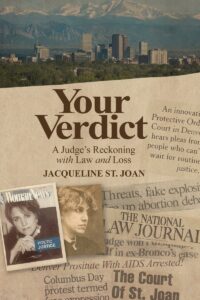
Your Verdict: A Judge’s Reckoning with Law and Loss by Jacqueline St. Joan is available from Golden Antelope Press.