By The Rio Times | Created at 2026-08-07 08:41:56 | Updated at 2026-08-07 11:43:33
3 hours ago
By The Rio Times | Created at 2026-08-07 08:41:56 | Updated at 2026-08-07 11:43:33
3 hours ago
Key Facts
- Brazil’s Ibovespa fell 1.23% to 175,546 points, its weakest close since the central bank’s latest interest-rate decision took the Selic to 14%
- The real firmed 0.20% to 5.1104 per US dollar, bucking the equity market’s slide as the currency extended its recovery from 5.5901, its weakest level of the past year
- Petrobras preferred shares edged up 0.5% on heavy turnover, after the oil major reported a 97% surge in second-quarter net income to R$52.4 billion on higher crude prices and volumes
- Vale’s common shares dropped 1.7%, weighing heavily on the benchmark index as iron-ore sentiment softened on global demand uncertainty
- Smartfit shares plummeted 7.8%, the session’s steepest fall among domestic names, in a move traders attributed to profit-taking after a strong run
Today’s Focus
Brazilian equities lost ground on Thursday as the market digested a flurry of corporate earnings and the lasting effect of the central bank’s fourth straight Selic rate cut. The Ibovespa—Brazil’s main stock index—declined 1.23% to 175,546 points, with heavyweight miner Vale dragging the most.
The real bucked the trend, firming 0.20% to 5.1104 per dollar. The currency has now clawed back a good chunk of its recent losses and stands 8.6% below its 52-week high, helped by still-wide interest-rate differentials even after the Selic was trimmed to 14%.
Petrobras got a lift from bumper profits, but Bradesco’s improving loan book and Smartfit’s sudden sell-off dominated the domestic narrative. The session felt like a pause for breath rather than a change in direction.
What matters today. Markets are struggling to find a new equilibrium now that the Selic easing cycle is fully priced in and earnings season is delivering sharply divergent stories.

01 The session in one read
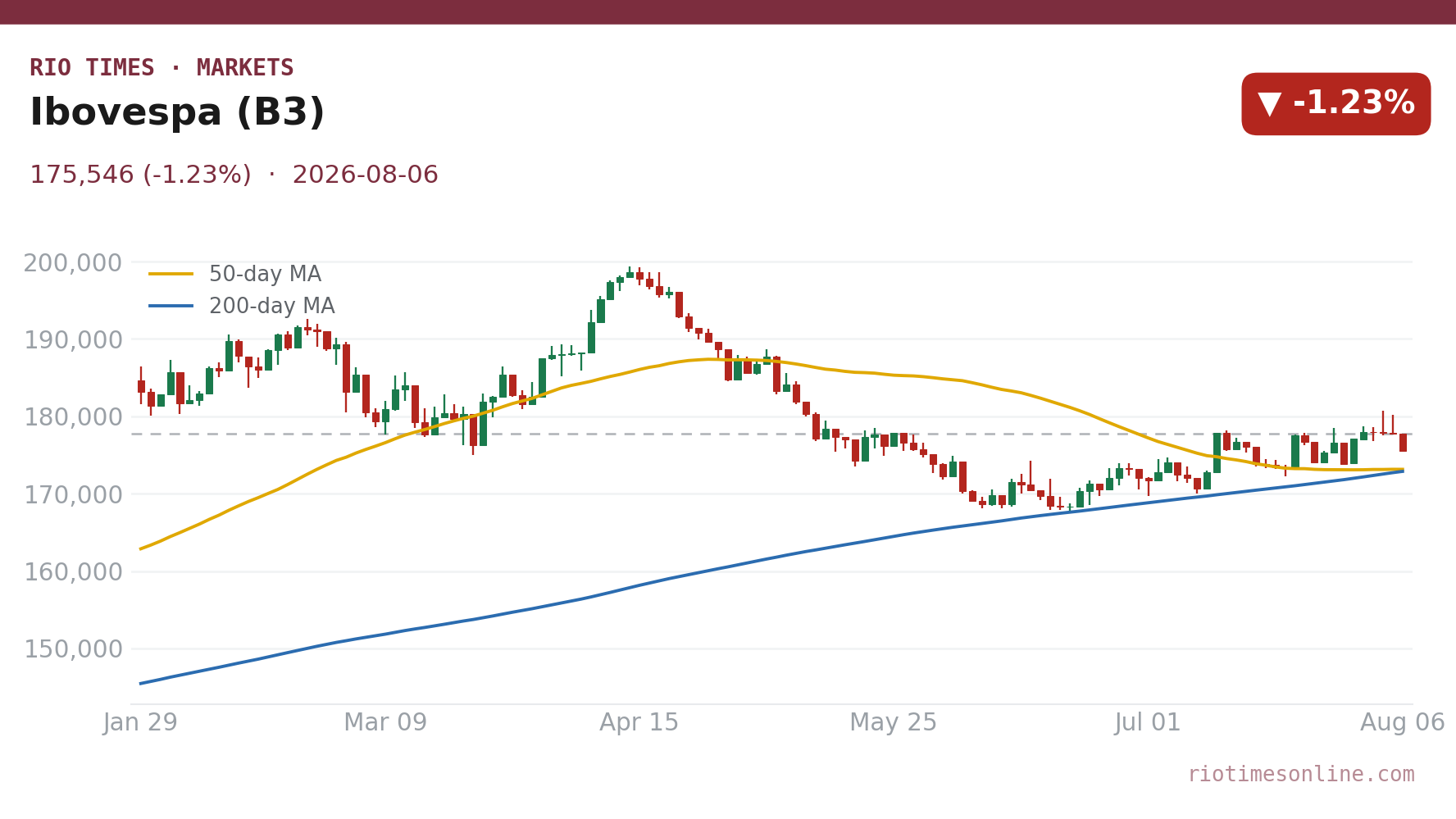
Brazilian stocks retreated on Thursday, with the Ibovespa losing 1.23% to close at 175,546 points. The decline was broad, touching commodity giants, big banks and recent market favourites, and it came just a day after local yields adjusted to the central bank’s decision to lower the Selic rate to 14%.
The real, however, wrote its own script. Brazil’s currency strengthened 0.20% to 5.1104 per US dollar, putting more distance between itself and the 52-week high of 5.5901 reached during an earlier bout of fiscal nerves.
The backdrop was a mixed global session—the S&P 500 slipped a tiny 0.18% while the Dow dropped 0.85%—but the local story was overwhelmingly about individual company reports. Petrobras delivered a blowout profit of R$52.4 billion for the second quarter, a 97% leap from a year earlier, while Bradesco posted its tenth straight quarter of rising earnings.
Yet good news on the earnings front was not enough to hold up the broad tape. Miner Vale fell 1.7%, Smartfit tumbled 7.8%, and even large private banks such as Bradesco and Itaú saw their shares decline despite reporting improved return on equity and contained loan delinquencies.
Assessment — A consolidation under the earnings microscope MEDIUM
The breadth of the decline was notable, with large banks and commodity names sliding alongside a few high-flying growth stocks. The one clear positive was the real’s stability, suggesting that foreign capital is not yet fleeing despite lower local rates. The next stretch will be dictated by whether US payrolls data on Friday tilts the global rate outlook, and whether the flood of local quarterly reports—from Itaú to WEG—can offer a steadier handhold for the index after it ran into resistance well below its 2026 high.
02 The day’s numbers
| Ibovespa | 175,546 | −1.23% | Pulled lower by Vale and banks |
| Session range | — | — | Intraday data not available |
| USD/BRL | 5.1104 | −0.20% | Real firmed for a second day |
| 52-week vs high | −11.6% | — | High stands at 198,657 |
| 52-week vs low | +31.8% | — | Low stands at 133,151 |
| Key technical level | 180,000 | — | Round-number resistance above the close |
The Ibovespa’s 1.23% drop pushed the index further away from the psychologically important 180,000 mark, a level it has struggled to hold in recent weeks. At 175,546, the benchmark now sits 11.6% below its 52-week high of 198,657, though it remains comfortably above the 133,151 low plumbed during last year’s sell-off.
The real’s 0.20% gain to 5.1104 was modest but confirmed that the currency market is taking the Selic cut to 14% in its stride. The real is now 0.2% stronger than the 5.5901 it touched at its weakest point of the past year, a level that triggered intervention talk when it was tested earlier this year.
Live Market IntelligenceBrazil — Live Market BoardInside: market breadth, the sector heatmap, currencies & rates, the Latin America scoreboard and the full instrument board.
Rio Times · Live Market Intelligence
Brazil — Live Market Board
B3 · São Paulo
Aug 7, 2026 · 05:36
Ibovespa · benchmark
175,546.36 -1.23%
+30.48% over 12 months
Market breadth · 15 names
13% advancing
2 ▲ advancing13 declining ▼
Currencies, rates & key inputs
Sector heatmap · average move today
Consumer Disc.
+1.44%
AZZA3
Energy
-0.26%
PETR4, PRIO3
Consumer Staples
-1.14%
ABEV3
Industrials
-1.74%
WEGE3, RENT3
Financials
-2.03%
ITUB4, BBDC4, BBAS3, B3SA3
Mining
-2.41%
VALE3, CSNA3, GGBR4
Latin America scoreboard
IndexLastTodayStrength
IbovespaBrazil 175,546.36 -1.23%
S&P/BMV IPCMexico 66,396.15 -0.19%
S&P IPSAChile 11,275.15 +1.05%
S&P MERVALArgentina 3,100,732 -1.76%
MSCI COLCAPColombia 2,350.44 +0.24%
BVL S&P PerúPeru 58,781.02 +0.81%
Full instrument board
| IBOV | 175,546.36 | -1.23% | +30.48% | 177,726.17 | — | — | — |
| USD/BRL | 5.11 | +0.04% | -6.35% | 5.11 | 5.11 | 5.10 | — |
| SELIC | 14.00% | — | — | — | — | — | |
| PETR4 | 42.13 | +0.48% | +30.23% | 41.93 | 42.47 | 41.92 | 46,628,700 |
| VALE3 | 75.39 | -1.66% | +40.21% | 76.66 | 76.55 | 75.38 | 21,962,700 |
| ITUB4 | 41.83 | -1.30% | +19.22% | 42.38 | 42.90 | 41.83 | 22,003,600 |
| BBDC4 | 17.70 | -1.94% | +12.95% | 18.05 | 17.99 | 17.54 | 58,444,200 |
| BBAS3 | 20.28 | -3.66% | +8.45% | 21.05 | 21.00 | 20.20 | 22,775,100 |
| B3SA3 | 15.36 | -1.22% | +20.75% | 15.55 | 15.52 | 15.24 | 24,218,800 |
| ABEV3 | 15.66 | -1.14% | +25.48% | 15.84 | 15.78 | 15.56 | 27,603,800 |
| WEGE3 | 48.40 | -0.82% | +26.83% | 48.80 | 49.13 | 48.25 | 5,951,500 |
| PRIO3 | 58.61 | -1.00% | +47.30% | 59.20 | 59.78 | 58.46 | 8,397,300 |
| SUZB3 | 41.97 | -2.03% | -18.69% | 42.84 | 42.85 | 41.97 | 4,333,300 |
| RENT3 | 38.16 | -2.65% | +7.80% | 39.20 | 38.96 | 37.99 | 5,579,500 |
| AZZA3 | 16.19 | +1.44% | -56.28% | 15.96 | 16.29 | 15.84 | 1,394,900 |
| CSNA3 | 4.74 | -3.07% | -34.35% | 4.89 | 4.90 | 4.74 | 6,848,600 |
| GGBR4 | 25.65 | -2.51% | +60.41% | 26.31 | 26.24 | 25.46 | 9,864,300 |
| ENEV3 | 26.60 | -1.41% | +94.16% | 26.98 | 26.86 | 26.36 | 5,410,300 |
Largest moves today
BBAS3 20.28 -3.66%
CSNA3 4.74 -3.07%
RENT3 38.16 -2.65%
GGBR4 25.65 -2.51%
SUZB3 41.97 -2.03%
BBDC4 17.70 -1.94%
VALE3 75.39 -1.66%
AZZA3 16.19 +1.44%
The session read
The Ibovespa eased 1.23%, with breadth negative — 2 of 15 names higher. Consumer Disc. led, while Mining lagged.
03 Why it moved — rate-cut hangover meets earnings traffic
The central bank’s decision to lower the Selic by a quarter-point to 14%—the fourth straight reduction—is now fully absorbed, and the initial relief rally that greeted the move has faded. What is left is a market trying to gauge how much further the easing can run, and how quickly it will feed into company margins and consumer spending.
Earnings reports provided the session’s main flashpoints. Petrobras delivered a 97% profit leap to R$52.4 billion, powered by higher crude prices and rising production. But the shares managed only a modest 0.5% gain on heavy turnover, suggesting that a good chunk of the good news was already in the price.
Bradesco’s numbers were widely described as reassuring: net income climbed 16.2% from a year earlier to R$7.1 billion and return on equity—a gauge of how profitably a bank deploys shareholder capital—rose to 16.2% from 14.6%. Yet Bradesco’s preferred shares fell 1.9%, and Itaú Unibanco’s shed 1.3%.
That sell-the-news reaction in financials, combined with Vale’s 1.7% drift lower on softer iron-ore sentiment, was more than the index could absorb. The overall tone was not panic—it was a re-pricing of expectations now that the rate path feels clearer.
04 The day’s movers
| Smartfit (SMFT3) | — | −7.8% | Largest domestic loser; profit-taking after strong run |
| C&A Modas (CEAB3) | — | +1.1% | Retailer bucked the down-trend |
| TIM Brasil (TIMS3) | — | +1.1% | Telco held up in a weak tape |
| Petrobras PN (PETR4) | — | +0.5% | Heaviest turnover; lifted by 97% profit jump |
| Vale ON (VALE3) | — | −1.7% | Second-heaviest turnover; dragged on commodities |
| Bradesco PN (BBDC4) | — | −1.9% | Fell despite improved ROE and lower delinquencies |
| Itaú Unibanco PN (ITUB4) | — | −1.3% | Slipped in sympathy with sector |
Smartfit, the gym-chain operator whose shares have been a market darling, suffered the worst session among local names with a 7.8% plunge on turnover of R$115 million. Traders pointed to profit-taking rather than any company-specific bad news.
Among the few gainers, C&A Modas and TIM Brasil each rose 1.1%, while Petrobras preferred shares edged 0.5% higher on the session’s heaviest volume of R$384 million. The market’s cross-listed foreign trackers also saw heavy selling—MercadoLibre’s Brazil-listed certificate (MELI34) slumped 5.1%, mirroring the tech giant’s New York slide rather than a local Brazil story.
05 The regional scoreboard
| Ibovespa | Brazil | −1.23% |
| IPC | Mexico | −0.19% |
| IPSA | Chile | +1.05% |
| Merval | Argentina | −1.76% |
| COLCAP | Colombia | +0.24% |
| BVL Perú | Peru | +0.81% |
Latin American markets painted a mixed picture. Chile’s IPSA outperformed with a 1.05% gain, while Argentina’s Merval dropped 1.76% in a volatile session marked by local political noise over the Milei administration’s proposed land-reform legislation.
Mexico’s IPC slipped 0.19%, still wrestling with sluggish GDP projections and trade uncertainty with the United States, as Brazil Journal noted during the session. Colombia’s COLCAP and Peru’s BVL managed modest gains of 0.24% and 0.81% respectively. The live market board above carries the verified closes for every regional index.
06 The technical picture
The Ibovespa’s 1.23% decline left the index sitting on a cluster of recent lows near 175,500, a level that has acted as a floor several times since early July. The 52-week high of 198,657, reached in February, now looks distant, and the market is trading 11.6% below that peak.
The 180,000 mark, a round number that also coincides with a minor resistance level formed in late June, is the immediate upside barrier. On the downside, the 173,000-174,000 zone is the next obvious support band—a break below that would open the door to a test of the 170,000 handle, which the index has not seen since May.
07 What to watch
- US payrolls: Friday’s nonfarm payrolls report will set the tone for the dollar and global rates; a weak number could fuel emerging-market inflows.
- Bank earnings: Itaú and Santander Brasil are due to report shortly; their results will confirm whether Bradesco’s improving credit trend is sector-wide.
- Selic path: Copom minutes and central bank communications will be parsed for signals on how much further the 14% rate can fall.
- Vale and iron ore: Iron-ore futures in Asia will dictate whether Vale can reverse Thursday’s decline and give the Ibovespa a broader lift.
Background: Brazil’s Bradesco Launches US$2 Billion Capital Raise.
Background: Italian State to Control TIM Brasil, Dubbed a ‘Jewel’.
Frequently Asked Questions
What is the Ibovespa?
The Ibovespa is Brazil’s main stock index, tracking the largest and most-traded companies listed on the B3 exchange in São Paulo.
Why did the Brazilian real strengthen if stocks fell?
The real firmed to 5.1104 because Brazil still offers high interest rates compared with developed markets, attracting carry-trade flows even as the Selic was cut.
What does the Selic cut mean for Brazilian stocks?
A lower Selic rate of 14% can help company earnings by reducing borrowing costs and boosting consumer spending, but it also reduces the appeal of Brazilian fixed-income for foreign investors.
Why did Petrobras shares rise only 0.5% after such strong profits?
Markets often ‘price in’ expected good news ahead of an earnings release. The 97% profit jump partly reflected higher oil prices, which were already known, so the share price reaction was muted.
This article was produced by The Rio Times’ automated newsroom system. How we use AI · Report an error
LatAm Markets: Live Signals → — real-time movers, turnover leaders and FX across Latin America.
The Rio Times · Power Map
See who really holds power in Latin America
Click to open the Power Map →