By The Rio Times | Created at 2026-07-22 05:38:49 | Updated at 2026-08-04 19:22:07
1 week ago
By The Rio Times | Created at 2026-07-22 05:38:49 | Updated at 2026-08-04 19:22:07
1 week ago
Key Facts
- The Ibovespa closed at 173,326 points, a marginal decline of 0.03% on the session, as heavyweight commodity shares failed to lift the broader index into positive territory.
- The Brazilian real strengthened 0.33% to close at 5.0732 per US dollar, buoyed by easing geopolitical anxiety and softer demand for the greenback.
- Oil giant Petrobras jumped 1.2% and miner Vale added 0.4%, providing a floor for the index as crude prices climbed on Middle East supply concerns.
- Drugmaker Hypera tumbled 5.5%, leading a sharp sell-off in healthcare stocks that dragged the index down and erased the gains from the financial sector.
- State-controlled lender Banco do Brasil surged 3.5% in a session of heavy trading, topping the turnover charts and extending a robust rally for the banking sector.
Today’s Focus
The Ibovespa—Brazil’s main stock index—barely budged on Tuesday, slipping just 0.03% to 173,326 points. It was a classic session of internal rotation: strong performances from oil, mining and banking heavyweights were completely neutralised by a steep sell-off in healthcare and consumer names.
Petrobras (PETR4) climbed 1.2% as crude prices rallied, and Vale (VALE3) ticked up 0.4% ahead of its production report, but those gains were overshadowed by Hypera’s 5.5% plunge and losses exceeding 3% for both RD Saúde and Rede D’Or.
The real had a better day, firming to 5.0732 per dollar, a drop of 0.33% for the US currency. Traders pointed to hopes for progress on a Middle East ceasefire, which calmed some immediate fears and reduced the dash for dollar liquidity.
What matters today. A narrow range and a flat close mask a fierce rotation out of healthcare and into beaten-down cyclicals and banks, suggesting investors are repositioning rather than retreating.

01 The session in one read
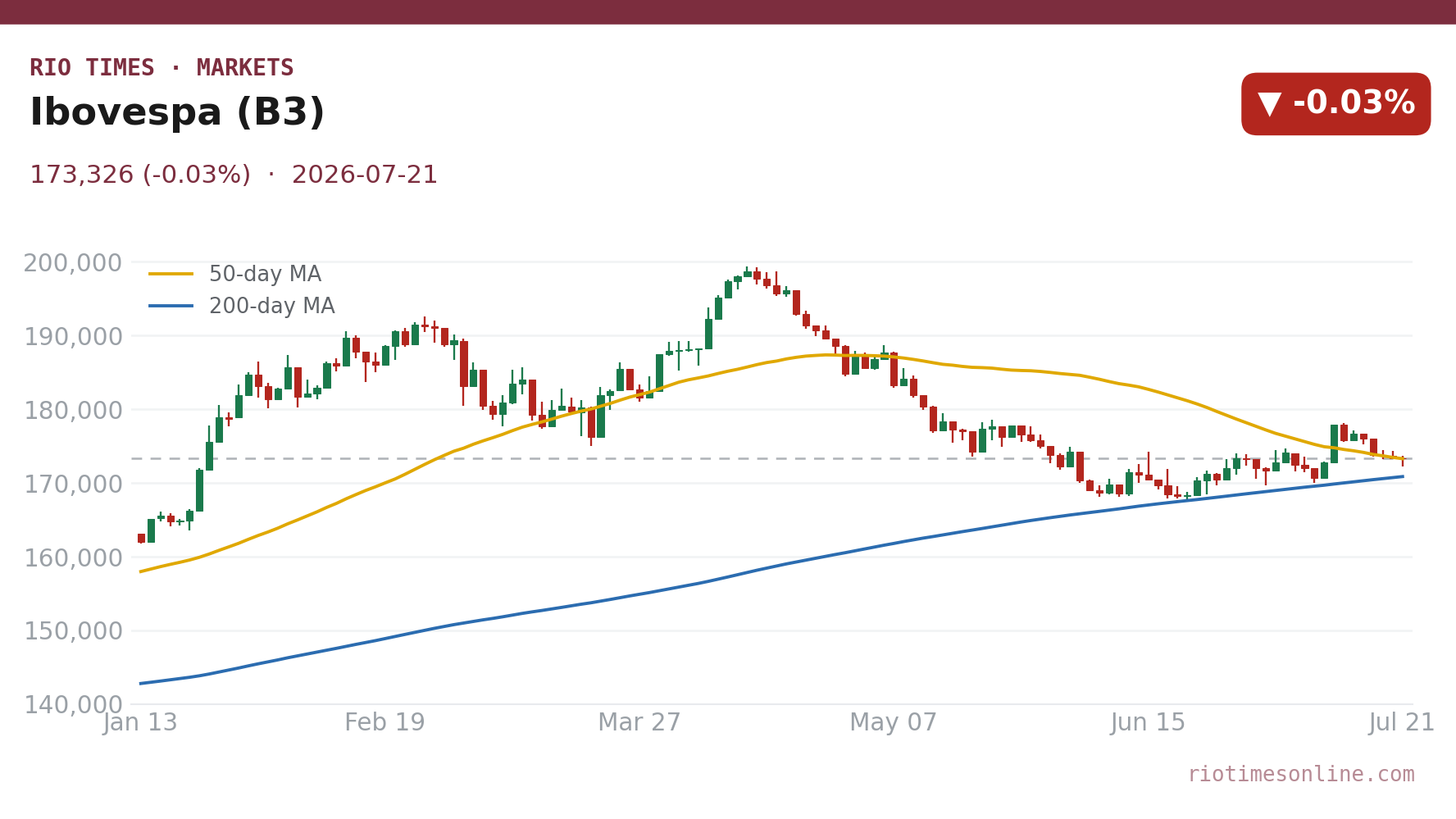
Tuesday’s session on the Brazilian stock exchange was a game of two halves that ultimately canceled each other out. The Ibovespa, which tracks the biggest companies listed in São Paulo, drifted sideways to close at 173,326 points, a barely perceptible dip of 0.03%.
The local currency, the real, inched ahead against the US dollar to settle at 5.0732. The greenback lost 0.33% as a broad sense of calm returned to currency markets—traders cited expectations of progress toward a ceasefire in the Middle East, which reduced the immediate appeal of the dollar as a safe haven.
Under the surface of that steady headline index number, the movement was violent and directional. Oil and mining shares, championed by Petrobras and Vale, rose in lockstep with firmer global commodity prices, while the banking sector continued its recent muscular run. But that combined weight was wholly offset by a rush for the exits in healthcare and a handful of consumer names, giving the session its split personality.
Assessment — A stable facade hiding sector war HIGH
The flat index reading is deceptive. The session’s intense sector rotation—aggressive buying in large banks like Banco do Brasil (+3.5%) and steel names, matched by aggressive dumping of healthcare stocks—indicates conviction-driven repositioning, not mere profit-taking. This breadth divergence suggests the market is betting on a pivot toward value and cyclical exposure, but the lack of immediate domestic rate catalysts means the index remains tethered to global risk appetite. The variable to watch is whether Thursday’s mid-month inflation data in Mexico and Friday’s US jobless claims can inject enough momentum to break the current sideways grind.
02 The day’s numbers
| Ibovespa | 173,326 | −0.03% | Flat; within a tight 1,500-point range |
| USD/BRL | 5.0732 | −0.33% | Dollar softer on ceasefire hopes |
| 52-Week Ibovespa | 132,129 – 198,657 | −12.8% vs high | Still deep in correction territory |
| 52-Week USD/BRL | 4.8909 – 5.5901 | −9.2% vs high | Real firmly off its weakest levels |
| S&P 500 | 7,509 | +0.89% | Positive global backdrop for risk |
The index traded within a tight band during the session, touching a low of 172,218.88 before recovering to a high of 173,719.50. That roughly 1,500-point range is narrow by recent standards and speaks to a market lacking a strong directional catalyst from local economic data.
The currency pair’s close at 5.0732 places the real comfortably stronger than its 52-week low near 5.59, but still a fair distance from its peak strength at 4.89. The dollar’s decline tracked a broader global move where easing geopolitical tension lifted most Latin American currencies.
Live Market IntelligenceBrazil — Live Market BoardInside: market breadth, the sector heatmap, currencies & rates, the Latin America scoreboard and the full instrument board.
Rio Times · Live Market Intelligence
Brazil — Live Market Board
B3 · São Paulo
Jul 22, 2026 · 02:38
Ibovespa · benchmark
173,325.65 -0.03%
+29.19% over 12 months
Market breadth · 15 names
47% advancing
7 ▲ advancing8 declining ▼
Currencies, rates & key inputs
Sector heatmap · average move today
Financials
+1.06%
ITUB4, BBDC4, BBAS3, B3SA3
Energy
+1.05%
PETR4, PRIO3
Consumer Staples
+0.06%
ABEV3
Mining
-0.11%
VALE3, CSNA3, GGBR4
Industrials
-2.02%
WEGE3, RENT3
Consumer Disc.
-3.80%
AZZA3
Latin America scoreboard
IndexLastTodayStrength
IbovespaBrazil 173,325.65 -0.03%
S&P/BMV IPCMexico 66,709.60 +0.88%
S&P IPSAChile 10,954.04 +0.52%
S&P MERVALArgentina 3,281,979 +1.81%
MSCI COLCAPColombia 2,301.34 +0.13%
BVL S&P PerúPeru 56,620.35 —
Full instrument board
| IBOV | 173,325.65 | -0.03% | +29.19% | 173,371.35 | — | — | — |
| USD/BRL | 5.07 | -0.31% | -8.83% | 5.09 | 5.07 | 5.07 | — |
| SELIC | 14.25% | — | — | — | — | — | |
| PETR4 | 41.66 | +1.24% | +34.17% | 41.15 | 41.66 | — | — |
| VALE3 | 72.24 | +0.43% | +28.88% | 71.93 | 72.24 | — | — |
| ITUB4 | 42.53 | +0.54% | +23.47% | 42.30 | 42.58 | 42.18 | 9,818,100 |
| BBDC4 | 18.55 | +0.76% | +18.30% | 18.41 | 18.64 | 18.35 | 19,389,500 |
| BBAS3 | 20.88 | +3.52% | +5.14% | 20.17 | 20.88 | 20.08 | 25,242,900 |
| B3SA3 | 15.17 | -0.59% | +15.80% | 15.26 | 15.17 | — | — |
| ABEV3 | 15.80 | +0.06% | +17.73% | 15.79 | 15.90 | 15.74 | 19,626,800 |
| WEGE3 | 42.47 | -1.53% | +1.19% | 43.13 | 42.47 | — | — |
| PRIO3 | 58.18 | +0.85% | +36.06% | 57.69 | 58.18 | — | — |
| SUZB3 | 41.63 | -0.62% | -18.37% | 41.89 | 42.01 | 41.44 | 2,360,700 |
| RENT3 | 36.55 | -2.51% | +2.04% | 37.49 | 37.51 | 36.52 | 7,497,600 |
| AZZA3 | 17.48 | -3.80% | -50.80% | 18.17 | 18.27 | 17.30 | 1,739,400 |
| CSNA3 | 5.06 | -0.20% | -36.67% | 5.07 | 5.06 | — | — |
| GGBR4 | 23.49 | -0.55% | +41.34% | 23.62 | 23.49 | — | — |
| ENEV3 | 25.42 | -0.90% | +84.20% | 25.65 | 25.42 | — | — |
Largest moves today
AZZA3 17.48 -3.80%
BBAS3 20.88 +3.52%
RENT3 36.55 -2.51%
WEGE3 42.47 -1.53%
PETR4 41.66 +1.24%
ENEV3 25.42 -0.90%
PRIO3 58.18 +0.85%
BBDC4 18.55 +0.76%
The session read
The Ibovespa eased 0.03%, with breadth negative — 7 of 15 names higher. Financials led, while Consumer Disc. lagged.
03 Why it moved — geopolitics, oil and a sector battle
The driver sitting atop the session was geopolitics. While Brazilian markets had no fresh domestic data to digest, traders kept one eye firmly on the Middle East. Reports suggesting a possible ceasefire framework softened the dollar globally and nudged oil prices higher—setting up a perfect split-screen for Brazil.
Higher crude is a direct tailwind for Petrobras, the state-controlled oil producer that is the single largest stock in the Ibovespa. Its preferred shares (PETR4) rose 1.24% on turnover exceeding R$1.1 billion, while the common shares (PETR3) did even better, gaining 1.43%. That gave the index a solid foundation.
But that foundation was cracked by a brutal rotation out of the healthcare sector. Hypera (HYPE3) plunged 5.51% to become the session’s worst-performing large-cap stock. Hospital and pharmacy operators RD Saúde (RADL3) and Rede D’Or (RDOR3) fell 3.0% and 4.3% respectively, collectively shaving enough points off the index to erase the commodity gains.
The banking sector played the role of a stabiliser. A 3.5% surge in Banco do Brasil (BBAS3) drove that stock to a session turnover of R$104 million, while Itaú (ITUB4), Bradesco (BBDC4) and Santander Brasil (SANB11) all rose between 0.5% and 0.8%. This broad-based financial strength stopped the index from sliding deeper into negative territory.
04 The day’s movers
| Petrobras PN (PETR4) | R$41.66 | +1.2% | Oil rally; liquidity leader at R$1.1bn |
| Vale (VALE3) | — | +0.4% | Anticipation of Q2 production data |
| Banco do Brasil (BBAS3) | R$20.88 | +3.5% | R$104m turnover; top blue-chip mover |
| Itaú Unibanco (ITUB4) | — | +0.5% | Broad banking rally |
| Hypera (HYPE3) | — | −5.5% | Largest large-cap faller |
| Rede D’Or (RDOR3) | — | −4.3% | Healthcare rotation target |
| Marfrig (MBRF3) | — | +4.1% | Treasury share cancellation approved |
| Usiminas (USIM5) | R$8.46 | +3.7% | Steel rebound after tariff pressure |
The turnover table tells a story of a market willing to commit capital to the commodity and banking trades. Petrobras dominated with R$1.1 billion changing hands, while Banco do Brasil’s R$104 million turnover for a 3.5% gain signals genuine institutional conviction behind the banking trade, not merely short-covering.
Yet the pain was concentrated and severe. Hypera’s 5.5% slide was the standout, but the entire healthcare complex suffered from a lack of positive catalysts. The sector rotation was decisive—investors clearly decided to lighten exposure to domestic healthcare and funnel the proceeds into export-oriented cyclicals and financials, a classic trade when oil prices are rallying.
05 The regional scoreboard
| Ibovespa | Brazil | −0.03% |
| IPC | Mexico | +0.89% |
| IPSA | Chile | +0.52% |
| Merval | Argentina | +1.81% |
| COLCAP | Colombia | +0.13% |
Brazil was the regional laggard in a session where every other major Latin American market posted gains. Argentina’s Merval surged 1.81%, extending its remarkable run as investors continue to chase assets tied to the country’s economic reform story despite the index’s stratospheric nominal levels.
Mexico’s IPC climbed 0.89% and Chile’s IPSA added 0.52%, both lifted by the positive global mood and a softer US dollar. The narrow 0.03% decline for the Ibovespa makes Brazil an outlier, but the flat reading was driven by internal sector dynamics rather than any pessimism about the local macro picture.
06 The technical picture
The Ibovespa’s close at 173,326 sits uncomfortably below the psychologically important 175,000 handle, a level it has struggled to hold since the sharp correction from its 52-week high of 198,657. The index remains 12.8% below that peak, and the tight range on Tuesday—a low of 172,218 and a high of 173,719—suggests resistance is building near 174,000.
On the currency side, the 5.07 floor for the dollar has held firm in recent sessions, keeping the real from testing the 5.00 barrier. The greenback’s 9.2% decline from its 52-week high of 5.59 implies significant real appreciation, but momentum appears to be stalling. A decisive break below 5.05 would be needed to reframe the short-term narrative, while a bounce back above 5.15 could signal the correction has run its course.
07 What to watch
- Mexican mid-month inflation: Thursday’s release could shift rate-cut expectations across the region if the core reading diverges from the consensus estimate of 3.96%.
- Vale’s Q2 production report: Any surprise in iron-ore output or forward guidance will dictate whether the stock can extend Tuesday’s modest 0.4% gain and lead the Ibovespa higher.
- Middle East ceasefire updates: The dollar’s trajectory and oil prices are both tethered to headlines; a confirmed ceasefire would likely strengthen the real further but cap oil gains.
- US jobless claims: Thursday’s data will calibrate expectations for Federal Reserve policy and set the tone for global risk appetite heading into the week’s close.
Background: Ibovespa Liquidity Dries Up to Pandemic Lows in July.
Background: Nubank Acquisition Seals Bank License Amid BofA Doubts.
Frequently Asked Questions
What is the Ibovespa?
It’s Brazil’s main stock-market index, tracking the roughly 80 most-traded companies on the São Paulo exchange (B3). Think of it as Brazil’s equivalent of the S&P 500.
Why did the Ibovespa barely move on Tuesday?
Gains in heavyweight commodity stocks like Petrobras and banks were cancelled out by steep drops in healthcare companies like Hypera and Rede D’Or, leaving the index flat.
What does a stronger real mean for my investments?
If you hold Brazilian stocks from abroad, a stronger real boosts your returns in dollar terms, as your shares are now worth more when converted back. For Brazilian exporters, however, a stronger currency can pressure margins.
Why did Banco do Brasil jump 3.5%?
State-owned Banco do Brasil has been a market favourite recently due to strong earnings momentum and attractive dividend yields. Its heavy trading volume on Tuesday confirms large institutional interest.
LatAm Markets: Live Signals → — real-time movers, turnover leaders and FX across Latin America.
The Rio Times · Power Map
See who really holds power in Latin America
Click to open the Power Map →