By Reduxx | Created at 2026-08-14 21:36:04 | Updated at 2026-08-14 23:17:14
1 hour ago
By Reduxx | Created at 2026-08-14 21:36:04 | Updated at 2026-08-14 23:17:14
1 hour ago
An veteran University worker in Brazil has been sentenced to 1 year in prison for “misgendering” a trans-identified male student. Luís Adripaulo Mendes Barros was charged under the nation’s notorious “social racism” law after a trans-identified male student reported him to police for “transphobia.”
The incident occurred on October 14 of 2022 at the Federal University of Paraíba, one of the two main public Universities in the coastal eastern state of Paraíba, Brazil. That day, a male student named Odara Moraes entered one of the women’s washrooms on campus only to be confronted by a female janitor who challenged his presence in the women’s facilities.
Speaking to Reduxx last year, the female janitor noted that she was initially confused by Moraes, seeing him as a biological wearing a “crop top and mini skirt.” But the janitor, whose name Reduxx is withholding for her privacy, politely informed him that he was not in the correct washroom, a statement she said had not been intended to cause offense.
 Odara Moraes, the trans-identified male student at FUP who reported two University workers to police for misgendering him. Photo: Instagram
“I didn’t mean to offend anyone or hurt anyone. I just spoke to him politely, and I was politely bothered. Because it was a female space, not a male one. I was simply speaking about a fact, about a right — my right as a woman to defend our space, a female space. I had never seen anything like that before — a man using a women’s bathroom,” she says. But Moraes immediately became combative, pulling out his phone to begin filming her and calling her “transphobic.” He also demanded that she refer to him with feminine pronouns.
Upon realizing that the janitor was a contracted employee at the University, he demanded to speak with campus administration. Unsure of what else to do, the janitor brought Moraes to the office of Luís Adripaulo Mendes Barros, the school’s administrative director. During the short journey to the office, Moraes continued to lambast the female janitor, calling her names and accusing her repeatedly of transphobia.
Barros attempted to de-escalate the situation, but Moraes refused and instead repeatedly asserted that he would call the police and press charges against the janitor for “transphobia” – a criminal offense in Brazil.
Unsure of what to do, Barros asked Moraes if he had any documents proving he was legally a woman, but Moraes responded that his “word” should simply be enough. As Moraes continued to insist he was a ‘woman,’ Barros attempted to clarify: “You are trans, not a woman.”
Moraes then stormed out of the office screaming that he had been “discriminated against.”
Four days later, both the janitor and Barros were contacted by police, informing them they were under investigation for criminal transphobia.
Barros, who had been working at the University for nearly 40 years, says he began to struggle with anxiety around this time.
“I came to work feeling discouraged, almost angry, struggling to avoid depression and not pass on the psychological and emotional pressure I was experiencing to my subordinates. I became distracted from my work activities and fell behind on many tasks,” he told Reduxx.
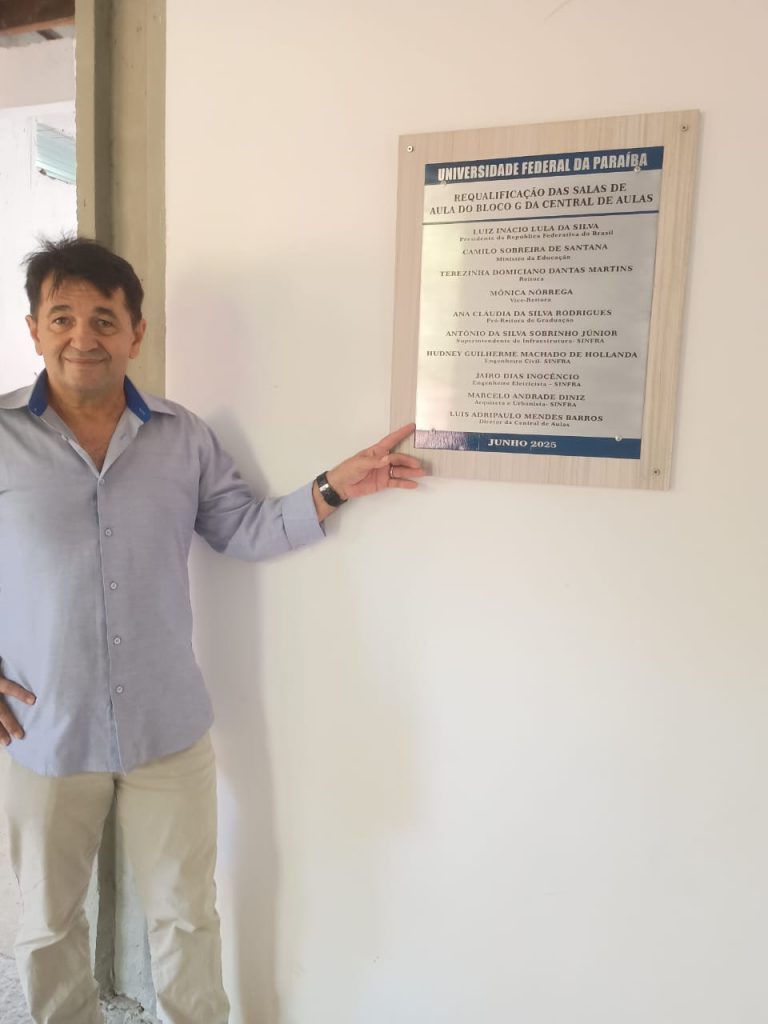 Barros proudly standing outside of his office. Photo Supplied.
After learning about the incident, trans activists on campus, likely under the instruction of Moraes, began targeting Barros directly. Graffiti was spray-painted outside of his office, and he was labeled a “fascist” by other students.
The female janitor ultimately lost her job after the school refused to renew her contract, and she was left unemployed after almost more than a decade. After being made aware of their situation, MATRIA Brazil, a women’s rights organization, stepped in to offer legal assistance to the two workers and launched a fundraiser to assist the janitor support her family.
Both the janitor and Barros were formally charged in October last year with aggravated prejudice under the classification of “social racism,” an offense created by Brazil’s Supreme Court in 2019 when it found that discrimination on the basis of sexual orientation or gender identity was in fact covered under already pre-existing anti-discrimination laws relating to race or national origin. The trial itself began in March of 2025, and concluded in June of 2026.
Reduxx has now been provided with a copy of court records detailing the final outcome of the case.
The female janitor was acquitted of her charges, with Judge Manuel Maia de Vasconcelos Neto determining that he was unsatisfied that her conduct, in her particular role and circumstances, met the standard for criminal conviction.
Barros, however, was found guilty because the court determined that he knowingly and authoritatively denied the transgender student’s “right to use the bathroom” corresponding to his self-declared gender identity, and rejected his explanations that he was merely protecting women or following his duties.
Judge Vasconcelos Neto ruled that even Barros’ attempt to verify Moraes’ self-declared gender identity constituted a criminally discriminatory act.
“The requirement of ‘documentary proof’ of femininity […] constitutes, in itself, a discriminatory act,” the Judge wrote in his ruling. “By demanding documentation and repeatedly stating that [Moraes] ‘was not a woman,’ Luís Adripaulo was not acting to repel any aggression, but to deny a right.”
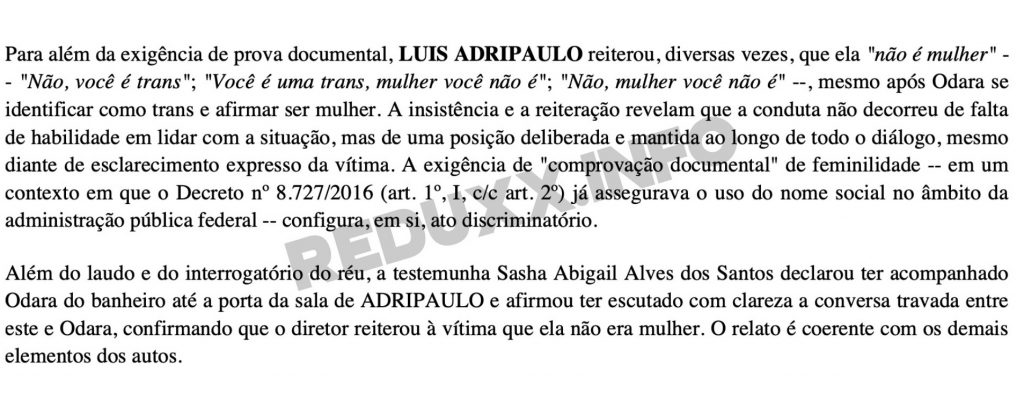 From the judgement against Adripaulo.
The court imposed a one-year custodial sentence in the initial “open” regime, but substituted imprisonment with a restriction-of-rights penalty, meaning he would not serve the sentence in prison. The judgment also imposed 10 day-fines, calculated at 1/30 of the minimum wage applicable in October 2022 for each day-fine, but did not specify the total.
Speaking to Reduxx, Barros said he was “deeply shaken” by the verdict, and turned to his deeply-held faith for solace.
“There is a battle going on in my mind as I try to understand, above all, God’s plan for me. God had already prepared me for all of this, but when it actually happens, it is different,” he says, speaking through a translator provided by MATRIA Brazil.
“I do not want to feel sorry for myself; that is not what this is about. But I have fallen out of my normal routine because, when I go through something I never planned for and did nothing to bring about, it really disrupts my life. My mind is not functioning properly. I am normally an avid reader, and I have not been reading. I have not been sleeping well, and I have been worried about my children.”
While Barros has not lost his job at the University, he was effectively demoted and stripped of a leadership role he had held for 13 years following his conviction. The demotion came with a severe blow to his income.
“I try to protect my family — my wife and my children — from the emotional impact of all this. I try to show strength, to find strength, so that these things do not psychologically affect the people closest to me. When I hear people saying that they want to destroy my family, there is an immense perversity of heart in that,” he expresses. “And then I see the justice system supporting it. Judges have families, members of Congress have families, everyone has a family. When an agenda like this is supported, where do I turn?”
Barros has filed an appeal and intends to try and fight the verdict.
Throughout the case, Barros was supported by MATRIA Brazil, an independent women’s rights organization which regularly lends support to those impacted by Brazil’s extreme gender identity laws.
Clarice Saadi, a representative of MATRIA, expressed outrage at the verdict and anger towards the state of freedom of speech in Brazil.
“It seems like every week now we are dealing with someone being sentenced to jail time for recognizing a man is a man. The situation in Brazil is extreme right now,” Saadi says.
“[Luís] was convicted for seeing a man in front of his eyes and referring to him accordingly, in the masculine form, as is usual in Portuguese. Ironically, both the judge and the federal prosecutor did the same during the hearings but, according to the judgement handed down, it is ‘very different’ in their case, as they ‘slipped’ and had no intent to disrespect,” she explains.
“The ‘clearly hateful’ intent attributed by the judge to Mr. Barros comes from him having stood his ground, saying to ‘Odara’ Moraes: ‘you are trans. Not a woman.’ We seem to be living a nightmare, where the truth doesn’t matter anymore and the courts are convicting people for supposedly hurting men’s feelings.”
The news of Barros’ conviction comes just days after another ruling in Brazil sentencing influencer Bianca Barreto to two years in prison for “criminal transphobia.”
As previously reported by Reduxx, Barreto received her sentence from the 9th Criminal Court of Salvador on July 29, after she was found guilty of the “intentional and pejorative use of the gender opposite… [to a] self-declared identity.”
The sentence followed a lengthy case stemming from a 2024 video posted to social media by Barreto. In the video, she criticized Duda Salabert, a member of Brazil’s Chamber of Deputies. Salabert is a member of the left-wing Socialism and Liberty Party, and was one of the first openly trans-identified people to be elected to the Chamber, serving since 2022.
In her video, Barreto described Salabert as “a guy who says he’s a trans woman, but he’s married to a woman and has a son or daughter.” She continued, saying that whatever “she does in her private life is not my problem. Now, it will always be a problem when these people try to impose things on us that are not real, that are a product of her imagination. By ‘her’ I mean the person, because a man is a man, a woman is a woman, and that’s it.”
Barreto argued in court that her content was legitimate political discourse, and that as a Christian she had the right to advocate for candidates that share her values, but that she was neither encouraging violence against nor hating trans-identified individuals.
But the judge disagreed, claiming that it was a form of “marginalization” to refer to trans-identified males with masculine pronouns. Citing the 2019 Supreme Court ruling, the judge argued that the recognition of self-declared gender identity is completely mandatory in Brazil, because it is an “inseparable element of personality rights and the dignity of the human person.” The judge added that “the deliberate use of biological sex at birth to ridicule and disqualify the social identity of a trans woman in a public arena is not merely an exercise of opinion; it is an act that refuses to recognize her citizenship.”
Barreto was ultimately sentenced to two years in prison, to be served in the “open” system, which is similar to house arrest in that her movement will be restricted and she will be required to check in with a police officer or judge regularly. Barreto was also forced to pay damages of R$20,000, which is approximately $3,800 USD.
Reduxx is your source of pro-woman, pro-child safeguarding news and commentary. We’re 100% independent! Support our mission by making a donation.