By The Straits Times | Created at 2026-06-17 11:16:38 | Updated at 2026-06-17 14:52:47
3 hours ago
By The Straits Times | Created at 2026-06-17 11:16:38 | Updated at 2026-06-17 14:52:47
3 hours ago
BEIJING/BANGKOK – On June 16, Myanmar’s former junta chief Min Aung Hlaing was greeted in Beijing by Chinese President Xi Jinping along with a military guard of honour and children waving flags, gaining him the crucial political validation as Myanmar’s legitimate leader.
During their meeting, Xi touted their “profound ‘pauk-phaw’ friendship” – a term describing the brotherly bond between the neighbouring countries – and added that China supported Myanmar’s new government in “finding the correct development path that is in line with the national conditions and supported by the people”.
This was a boost to the fledgling administration of Min Aung Hlaing, who led the coup against Myanmar’s democratically elected government in February 2021 but has now transitioned to its top civilian leader.
Analysts said that for Min Aung Hlaing and his administration, China’s political recognition from his five-day visit outweighs the economic outcomes.
His appointment in April came after a national election between December 2025 and January 2026 that resulted in a landslide victory for the military-aligned Union Solidarity and Development Party, which many countries did not consider free or fair.
ASEAN does not officially recognise the outcome of the election, with no consensus among its member states on whether and how much to engage the new government, although there has been a cautious thaw of late.
Unlike ASEAN, China sent a delegation to observe the election, with a Chinese foreign ministry spokesman saying in January, upon its conclusion, that the process was “smooth and orderly” and that China respected the people’s choice.
At Min Aung Hlaing’s inauguration ceremony in April, China had the highest profile among foreign representatives, with senior official Jiang Xinzhi attending as Xi’s special envoy.
The high-level recognition extended to his China visit, as Min Aung Hlaing also met Premier Li Qiang and Zhao Leji, the National People’s Congress chairman, who are the second and third-ranked leaders in the Communist Party of China, on June 16.
Richard Horsey, who is senior Myanmar adviser at the Crisis Group, told The Straits Times: “A state visit hosted by Xi Jinping is a visible signal that Beijing is prepared to deal with Myanmar’s new administration as a full partner.”
Benjamin Ho, assistant professor at the S. Rajaratnam School of International Studies’ China programme in Singapore, added that the relationship between China and Myanmar had not suffered too much during the years under the junta, making China’s full recognition this time unsurprising.
Amid the continuing conflict that has killed more than 93,000 people, China has remained Myanmar’s largest trading partner and largest source of imports. By 2025, bilateral trade reached US$19.4 billion, a year-on-year increase of 19 per cent.
Joanne Lin, senior fellow and coordinator at the ASEAN Studies Centre at the ISEAS-Yusof Ishak Institute in Singapore, told ST that in terms of granting the new Myanmar government legitimacy, China operates on a different calculus than ASEAN and its member states.
Since the coup, ASEAN has linked Myanmar’s return to normal political-level participation to progress on the Five-Point Consensus peace plan as agreed by ASEAN leaders, she noted.
“Embracing Min Aung Hlaing would, therefore, risk rewarding non-compliance and validating an election that most member states regard as engineered to consolidate military rule. It might also deepen existing divisions within ASEAN.”
But China does not attach engagement to democratic legitimacy and frames its approach in terms of sovereignty and non-interference, said Lin.
“Its immediate concerns are border stability, strategic access to the Indian Ocean, protection of Chinese projects and action against cross-border crime. Several (ASEAN member states) do engage Myanmar bilaterally, but ASEAN collectively remains cautious about restoring full political recognition,” she added.
Adam Simpson, a senior lecturer in international studies at Adelaide University in Australia who focuses on Myanmar, said that in Beijing’s calculation, opposition forces are unlikely to overcome the Myanmar military in the cities.
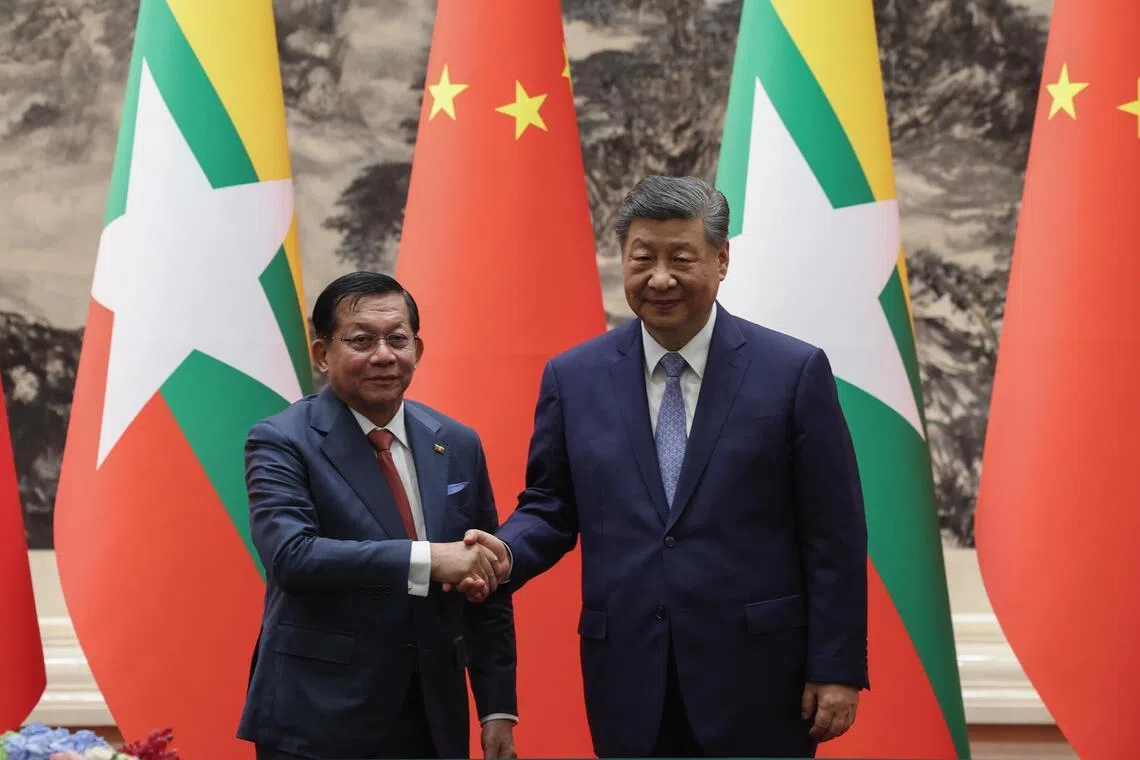
Chinese President Xi Jinping (right) with Myanmar's President Min Aung Hlaing at the Great Hall of the People in Beijing, on June 16.
PHOTO: EPA
Referring to Beijing, he said: “So...they are willing to throw in their lot with the military junta and its successors. However, they also recognise that powerful ethnic opposition groups are unlikely to be removed from their core regions and constituencies.
“They are, therefore, willing to negotiate with groups like the (Kachin Independence Army) in their trade for rare earths since the regime is unlikely to regain full control of the borders and those rare earths-rich areas nearby.”
Min Aung Hlaing’s China visit came shortly after a five-day trip to India, Myanmar’s other major neighbour, earlier in June, when he was also given a red carpet welcome and met Indian Prime Minister Narendra Modi.
That trip was also seen as an effort to gain international legitimacy.
In China, Min Aung Hlaing’s visit resulted in 18 memoranda of understanding in areas such as human resource development and boosting trade, although there were no signs that he and Xi discussed resuming the Myitsone Dam project.
The long-stalled, Chinese-financed Myitsone Dam has reportedly been under public consultation, an attempt by the Myanmar government to revive it despite strong domestic opposition.
Independent Myanmar analyst Wai Yan Phyo Naing believes this project is no longer a priority for China, as it already has sufficient capacity to supply electricity to Yunnan.
“This is significantly different from the situation 15 years ago, when China had stronger incentives to support the Myitsone Dam to meet Yunnan’s electricity needs,” he said.
But political recognition does not necessarily mean that Myanmar’s domestic situation will become more stable. China has long been concerned about the security of its investments and personnel involved in major projects such as the flagship China-Myanmar Economic Corridor.
Lin of the ISEAS-Yusof Ishak Institute said that Chinese recognition alone cannot overcome continued conflict or weak control on the ground.
In practical terms, Min Aung Hlaing is seeking economic lifelines, investment, border trade, and progress on Chinese-backed infrastructure.
He also wants Beijing to use its leverage over border-based armed groups to contain fighting and prevent further military losses.
“In return, China will expect stronger protection for its economic interests and personnel, action against cross-border crime, and movement on strategic projects such as Kyaukphyu and the wider China-Myanmar Economic Corridor,” said Lin. The China-backed Kyaukphyu port and special economic zone connects Yunnan province to the Bay of Bengal.