 By The Straits Times | Created at 2026-10-20 11:46:42 | Updated at 2026-10-20 13:17:19
1 hour ago
SYDNEY - An attack on an MP in Australia has prompted appeals by Prime Minister Anthony Albanese and the nation’s spy chief to “turn down the temperature” following a series of recent warnings that the country faced a heightened risk of political violence.
A driver repeatedly struck Helen Haines with his four-wheel-drive vehicle outside her electorate office in the state of Victoria on Oct 19.
The attack has stunned the nation, where politicians tend to mingle freely with the public and assassination attempts have been extremely rare.
Police on October 20 said the attacker was Brendan Nugent, a 43-year-old from Victoria, who allegedly drove his vehicle at Haines and struck her before reversing and hitting her again. A bystander – a local barber, Ricky Jefferies, who has been hailed as a hero – removed Nugent from the vehicle and held him until police arrested him.
Haines, 65, an independent politician well-liked by MPs of all persuasions, has lost a leg and remains in hospital. Doctors reportedly fear she may lose both legs.
Nugent’s motivation remains unknown. His social media posts show he has been an active campaigner against logging and wrote a tweet in 2020 questioning Haines’s support for forestry workers. He will appear in court on Oct 21 and has been charged with dangerous driving causing serious injury, intentionally causing serious injury and causing harm to a federal public official.
The attack in Wangaratta, a town in rural Victoria north of Melbourne, follows growing concerns about the increasingly vitriolic and polarised nature of political debate in Australia. State and federal MPs on all sides of politics have warned that they face regular attacks, often including death threats, mainly on social media.
The Australian Federal Police (AFP) has received 1,067 reports of harassing politicians in the 2025-26 year (to June 30, 2026), up from 951 in 2024-25 and just 555 in 2021-22.
The AFP revealed on Oct 20 that a unit that began operating in October 2025 to focus on politically motivated violence and hate crimes has charged 41 people with offences involving threats against parliamentarians and high office holders.
Australia’s domestic agency, the Australian Security Intelligence Organisation (ASIO), warned in its annual threat assessment in June 2026 that the risk of politically motivated violence was worsening and involved “extremists across the ideological spectrum”.
‘Words matter’
The agency’s head, Mike Burgess, said on Oct 20 that “elevated levels of grievance, intolerance and polarisation continue to create a permissive environment of violence”. He expressed concern about the growing use of violent rhetoric in public discourse, saying: “Words matter.”
“ASIO has seen direct correlations between inflamed language, inflamed tensions and acts of violence,” he said in a statement. “I genuinely believe the temperature of our security environment would be several degrees lower if we recommitted to conversing with civility, debating with respect and disagreeing with restraint.”
Echoing this view, Albanese repeatedly called on Oct 20 for Australia to “turn the temperature down”, noting that other countries faced a similar phenomenon. He said social media allowed people to say things that “they would never say face to face”.
“The way that politics is conducted, the way that it’s reported on, the way that we engage with each other, we all have a responsibility to turn the temperature down,” he told Channel Nine.
Australian politicians have increasingly spoken out about personal threats, particularly on social media. Australia’s Small Business Minister, Anne Aly, recently revealed on Instagram that she had received 19 death threats on social media in the space of just one week. She was responding to an Opposition MP’s claim during a debate in Parliament that she and Albanese should be “shamed and stoned in the square”.
“In the past I’ve had death threats that are couched in that exact same language: stone her,” Aly said.
One of Australia’s longest-serving MPs, Tanya Plibersek, who entered Parliament in 1998 and is now Social Services Minister, said death threats had become “part of the job” for Australian MPs.
“The threats of violence have gone through the roof in the time I’ve been there,” she told Channel Seven on Oct 20. “Rape and death threats are regular.”
Threats and hateful personal attacks on MPs in Australia have increased as the political debate has become more polarised and heated in recent years, particularly since the Covid-19 lockdowns, which resulted in an angry backlash from segments of the community.
More recently, far-right anti-migrant groups – including neo-Nazis – have become increasingly vocal and visible, while elements of far-left and pro-Palestinian protesters threatened MPs and vandalised offices over the war in Gaza.
Australia has never experienced an assassination of a federal MP, though New South Wales (NSW) state MP John Newman was murdered in Sydney in 1994. A local councillor and political rival, Phung Ngo, was convicted.
The attack on Haines has not only prompted calls for a national reckoning about the temperature of political debate but is set to lead to tighter security for politicians.
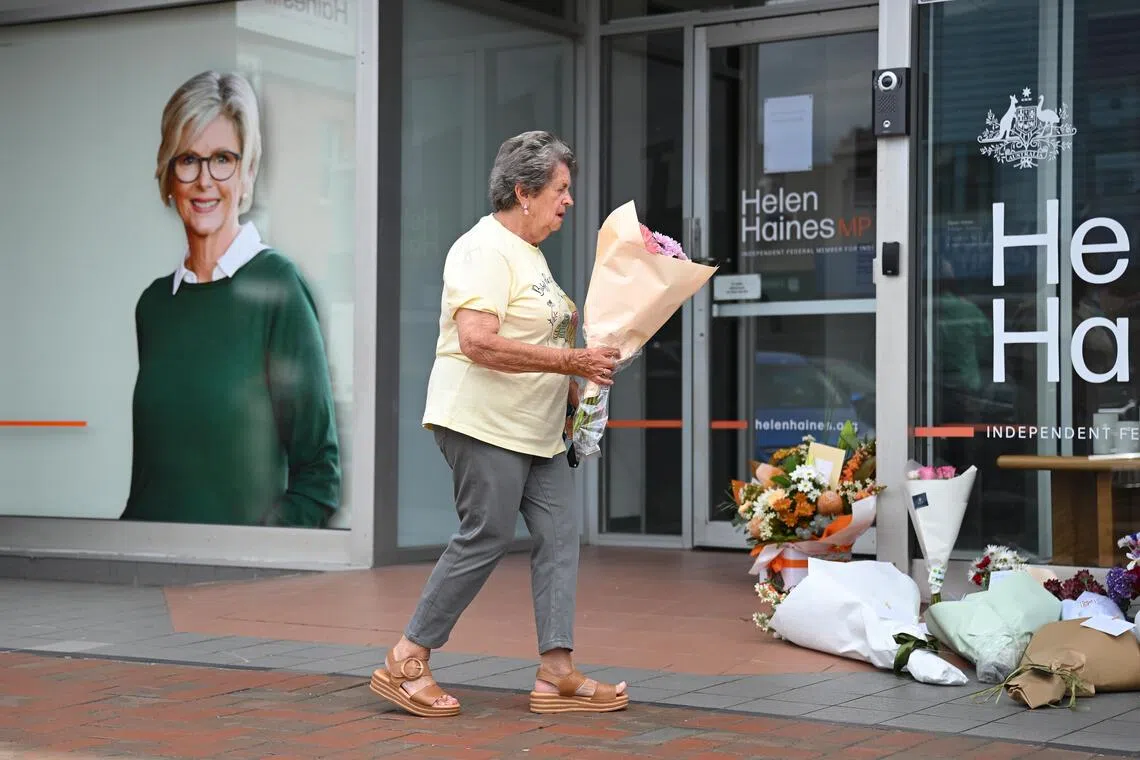
A lady with flowers for Independent Australian federal MP Helen Haines outside her electoral office on Oct 20.
PHOTO: EPA
Victoria’s Premier, Ben Carroll, said on Oct 20 that additional security measures could be imposed at voting booths at the state’s election in November.
But politicians also warned that overhauling security and imposing barriers between MPs and their constituents poses a risk to the egalitarian foundations on which Australian democracy is built.
“Being able to get out, being able to stop in at a pub and meet people, go to a bowls club, go to a market and not feel fear, I think is an important part of this (job),” Jonathon Duniam, a Coalition MP and Shadow Minister for Home Affairs, told ABC News on Oct 20.
“I’m sad for Helen. I’m sad for her family that they’ve had this inflicted on them. But I’m sad for democracy that this is the kind of thing we’re seeing now come into our democratic discourse.”