By The Straits Times | Created at 2026-09-16 13:25:16 | Updated at 2026-09-16 14:16:29
56 minutes ago
By The Straits Times | Created at 2026-09-16 13:25:16 | Updated at 2026-09-16 14:16:29
56 minutes ago
HONG KONG – At a time when flats around the world are getting ever smaller, Hong Kong’s Chief Executive John Lee has vowed to give Hong Kongers bigger homes – and more of them – in a sprawling new tech and business hub being developed next to Shenzhen.
It was a bold promise Lee was making as he unveiled Hong Kong’s first-ever five-year plan and his annual policy address in a three-hour-long speech on Sept 16 – especially so in a city notorious for its extortionate nano flats and squalid subdivided units.
“We strive to achieve higher living standards in the Northern Metropolis,” Lee said, delivering the five-year plan ahead of his policy speech at the Legislative Council in Admiralty.
Half the size of Singapore, the Northern Metropolis is the planned mega hub set to become a new major driver of innovation and growth for China’s Greater Bay Area, which comprises Hong Kong, Macau and nine cities in Guangdong province.
Lee said: “We will … raise the unit size requirements for private residential development in new projects in the Northern Metropolis, so as to create favourable conditions for enhancing the average living space per person.”
He did not forget those priced out of private property, either.
“For public housing, preparations are underway to deliver units for rental and sale over the next decade ... We will progressively enhance the internal floor area of these units and increase the proportion of larger units for newly built subsidised sale flats, including those in the Northern Metropolis,” he pledged.
It was the first time a Hong Kong leader was setting out a long-term roadmap for the territory’s development that is explicitly tied to China’s strategic directions, alongside the city’s yearly measures for policy implementation.
It came after Beijing in March approved the plan for the five years until 2030 as part of China’s traditional five-year national planning cycle.
Lee said the plan provides the city with the policy continuity that its annual addresses lack.
The address this year is his fifth and final one in his five-year term, which ends in June 2027. He has so far skirted the issue of whether he will seek a second term.
Housing in the Northern Metropolis was a key area the leader addressed on Sept 16.
He set an “anticipatory” target of completing 70,000 residential units in the mega hub by 2030, more than six times the existing 11,000 flats, and a “binding” target of having 900 hectares of land, over seven times the current amount, ready for construction there.
The binding target is a key performance indicator that the government is required to meet, while the anticipatory target functions more as an economic compass point.
When fully developed in the 2040s, the Northern Metropolis is expected to provide 500,000 homes for 2.5 million people, add 650,000 jobs, and generate at least 13 per cent of Hong Kong’s gross domestic product. It will also house three university campuses.
When completed, Lee said, the mega hub “will emerge as a well-equipped metropolitan area ideal for living, work, and travel, further boosting Hong Kong’s overall competitiveness and momentum for sustainable development”.
The Northern Metropolis is Hong Kong’s first stop at making bigger homes the norm, as such development planning usually spans “a very long time”, with each project potentially taking eight to 10 years to complete, economist Billy Mak told The Straits Times.
“We can make such plans (to build bigger homes) only when we have an abundant supply of land and can build them up from scratch,” said Mak, an associate professor of practice at Hong Kong Baptist University’s (HKBU) department of accountancy, economics and finance.
The significance of the Northern Metropolis lay in “the opportunity to develop transport, housing, research facilities, technology and industrial space together”, noted global law firm Clifford Chance’s Hong Kong managing partner Dauwood Malik.
“This can create the capacity Hong Kong needs for new industries to grow and strengthen the city’s competitiveness over the longer term,” Malik said.
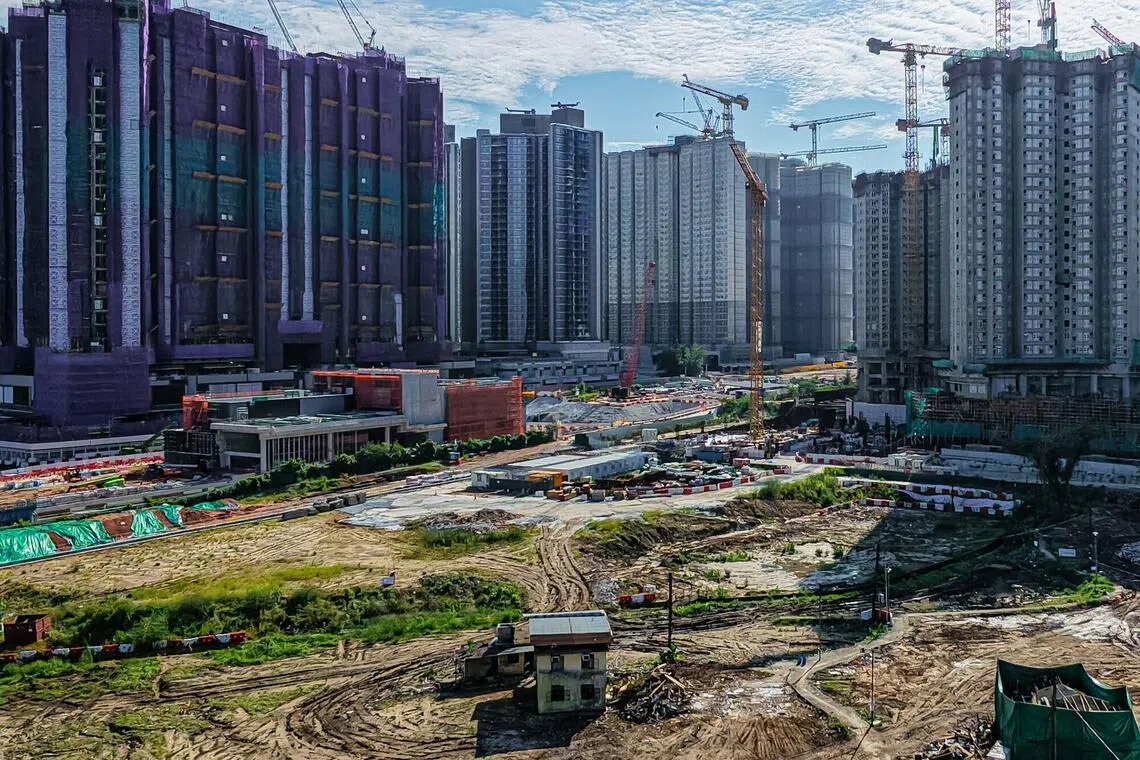
Residential buildings under construction beyond a now-demolished village house in Hong Kong’s Kwu Tung area, as part of the Northern Metropolis development plan.
PHOTO: BLOOMBERG
While Lee did not specify how much larger the Northern Metropolis apartments were expected to get nor the timeframe within which such bigger flats would be built, housing minister Winnie Ho had recently suggested that the homes would be roughly 10 per cent bigger than the city’s standard public flats by 2030.
“Larger” flats would account for at least 25 per cent of public subsidised housing in the area, she told the local media South China Morning Post in June. She defined such units as being of at least 400 sq ft, a size that would still be considered small in most other major cities.
Singapore’s smallest public housing option, a 2-room Built-To-Order flat, averages around 400 to 500 sq ft.
Beyond the Northern Metropolis, Lee pledged to add 196,000 public housing units across Hong Kong and cut residents’ wait time down to less than four years by 2030.
The government would also “take an orderly approach to the eradication of poor-quality subdivided units”, encourage “upward mobility”, and “enhance the housing ladder to promote home ownership among young people”, he said.
Hong Kong’s scarce land supply has for decades put home ownership out of reach for many of its residents.
To boost the city’s dismal birth rate, the chief executive promised three more years of a baby bonus of HK$20,000 (S$3,200) for firstborns, and HK$30,000 each for more children beyond the first, on top of tax deductions and other benefits.
In his broader economic objectives, Lee said Hong Kong would launch its first central clearing and settlement system for gold in the first quarter of 2027, and implement central bank digital currency settlement by the end of 2026.
The city’s stock exchange operator HKEX will promote dual primary and secondary listing of overseas enterprises from South-east Asia and countries in China’s Belt and Road Initiative.
Hong Kong would also boost its efforts to develop itself into a centre for international legal and dispute resolution services, he said.
Lee added that the major aims of the five-year plan include solidifying Hong Kong’s financial, maritime and trade areas, accelerating efforts in information and technology, and strengthening its role as a global offshore renminbi hub.
HKBU economist Mak lauded the roadmap that will now guide the city’s direction until 2030.
“Hong Kong used to lack real long-term planning as the administration changes every five years,” he told ST.
“But now with the five-year plan, our officials will have to follow the overarching direction and report their scorecard to the public on how many items on the list they have completed. It also forces the separate and often-divided government bureaus to cooperate on overlapping matters.”
“It’s a ‘check and balance’ for the government, which is a good thing for Hong Kong,” he added.