 By The War Zone | Created at 2026-09-16 23:35:51 | Updated at 2026-09-17 00:14:08
54 minutes ago
By The War Zone | Created at 2026-09-16 23:35:51 | Updated at 2026-09-17 00:14:08
54 minutes ago
A new drone collaboration by Cessna owner Textron and autonomy provider Merlin Labs aims to offer the U.S. military a hot production line and a familiar platform for uncrewed aerial logistics, including in contested environments.
The product is SkyCourier UX, a drone version of the Cessna 408 SkyCourier that has flown for FedEx, foreign special operations forces and small remote commercial airlines during its six years of active service. TWZ previously covered how the SkyCourier would likely end up taking on military applications when it was first announced, which you can read here.

Introducing SkyCourier UX
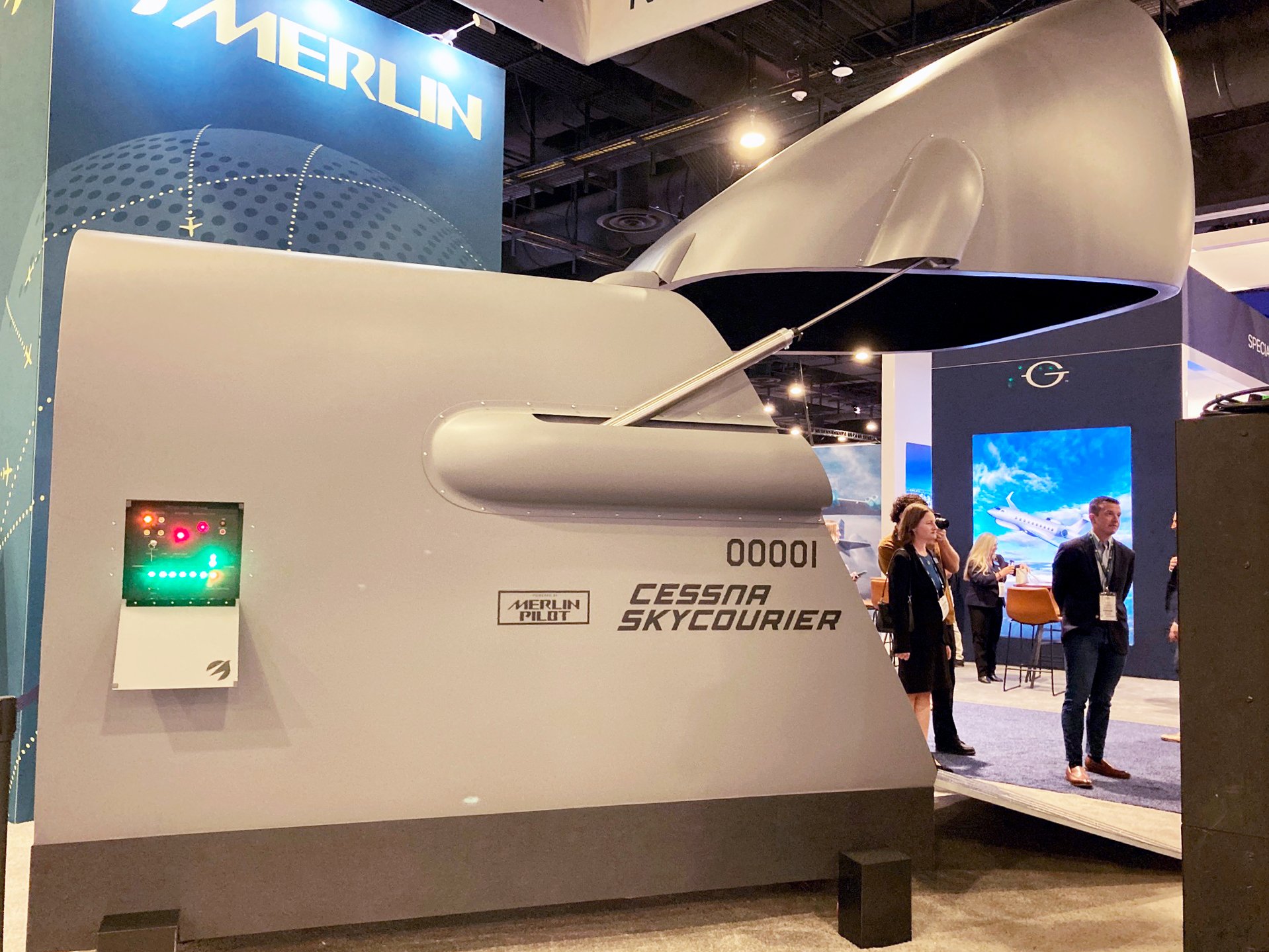
A partial full-size model on the show floor at the Air & Space Forces Association’s Air, Space & Cyber Conference in Washington, D.C., this week showed a nose that opened with hydraulics to a cargo bay in lieu of a cockpit. We have seen this same front door conversion concept for uncrewed cargo-carrying helicopters as of late. This allows for easy loading of outsized cargoes without specialized equipment, according to the company, though it does not increase the payload. Like the original SkyCourier, it’s good for about 6,000 pounds, or three standard containers.
 (Hope Hodge Seck)
 The form factor of the uncrewed SkyCourier variant is otherwise identical to its crewed counterpart, with twin turboprops, a high-wing configuration and an aluminum body.
As with the base SkyCourier, a major advantage of the aircraft is its optimization for loading and carrying standard pallets. This means that cargoes don’t necessarily have to be downloaded, broken up and repackaged for movement to forward positions. This is a big logistical advantage and can speed the flow of critical supplies to where they are needed most.
The aircraft’s range is about 900 nautical miles, which the makers say suits it well for Pacific island-hopping, allowing for refueling stops on austere runways. It can take off on runways as short as 3,300 feet and land in just 2,500 feet, according to a spec sheet.
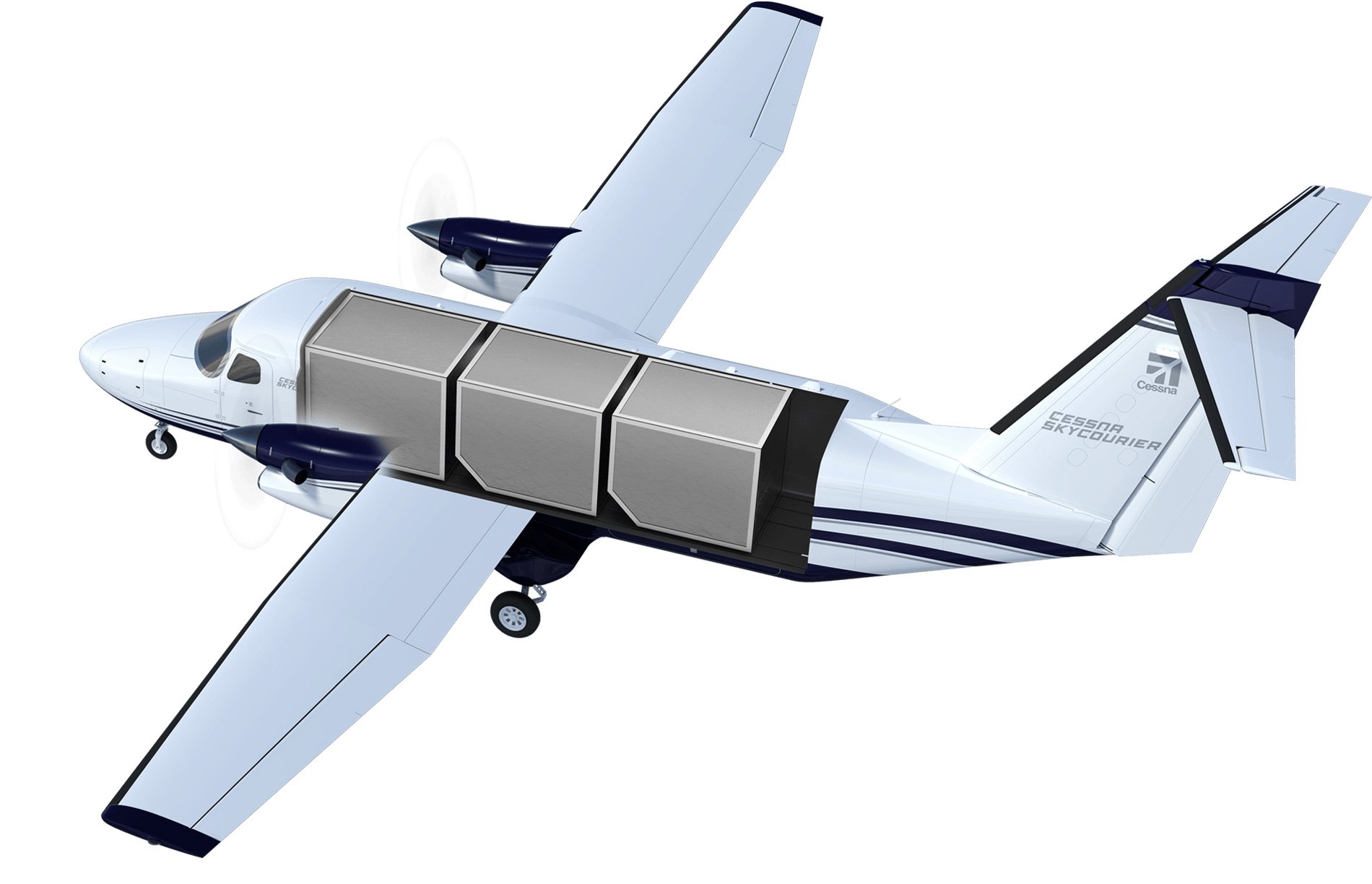 SkyCourier can hold three standard LD3 pallets. (Textron)
 The Textron/Merlin collaboration aims to differentiate itself with proven capability in the missions it intends to fulfill, along with the ability to roll out a new drone variant fast and one it can sustain consistently. Bob Gibbs, Textron’s vice president of special missions sales, told reporters in a Monday briefing that the conventional SkyCourier was now fulfilling new orders, not previously announced, to deliver modified aircraft to foreign nations for medical evacuation, casualty evacuation and environmental protection.
“The aircraft’s being operated literally from the Arctic to the Amazon,” Gibbs said. “There are three different island nations in the Pacific that have airline fleets of them. We support our aircraft in 170 countries around the world. So, just like a Cessna Caravan or a Beechcraft King Air, they’re ubiquitous. You find them anywhere, and we support them anywhere in the world.”

The $7 Million Flying Box: Inside the Cessna SkyCourier
While the 900-mile range can’t take the loaded-up aircraft the nearly 2,000-mile stretch between the first and second island chains, Merlin and Textron executives said they don’t need to accomplish that to make it effective.
“This is the ability to disperse the forces among the second island chain … to do the island-hopping to be able to get to, whether it’s Palau, Tinian, Saipan, pick your various islands there,” Kyle Kremer, a retired Air Force major general who now advises Merlin, said. “With the range that it has, it has the ability to agilely move through there” and connect logistics pipelines.
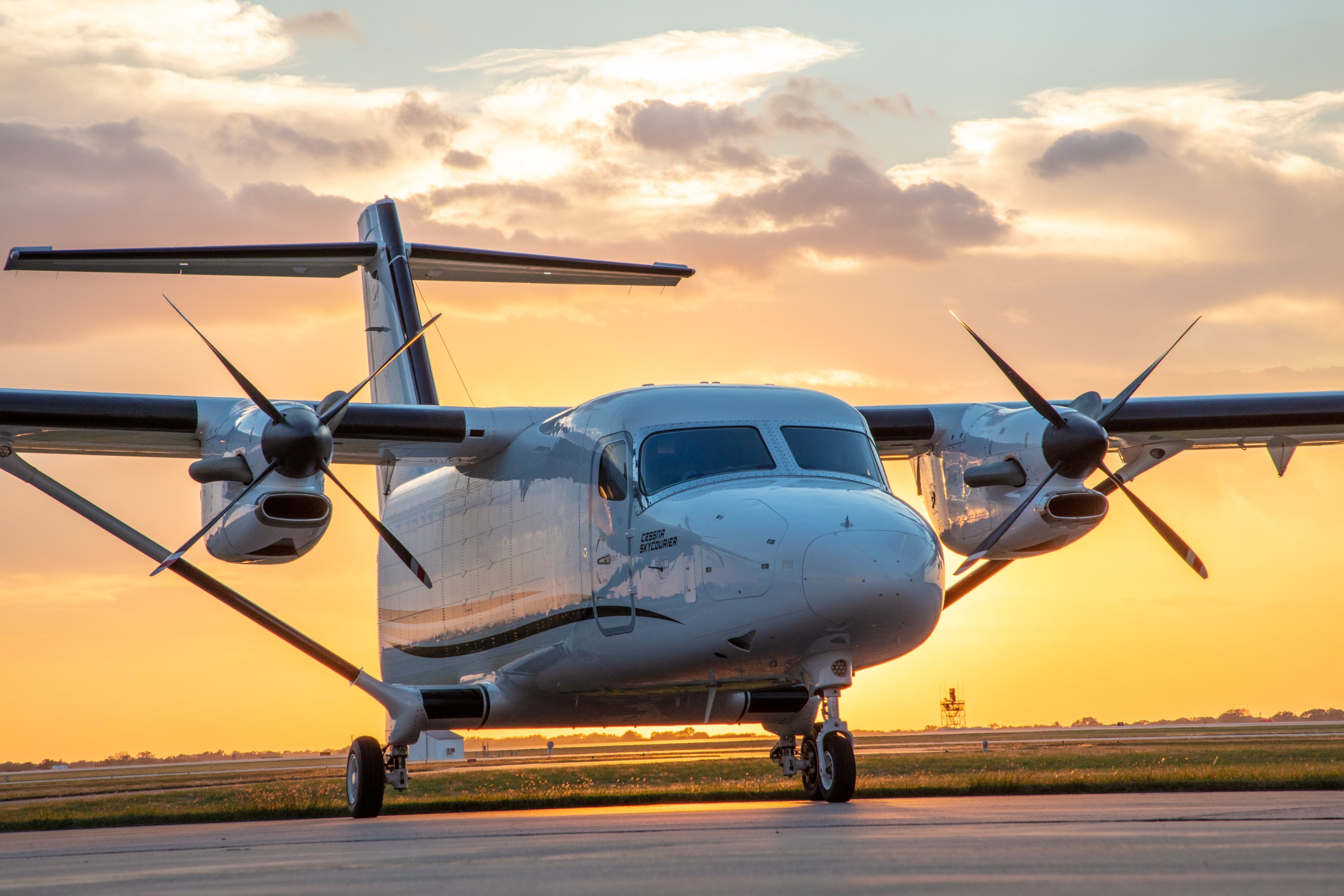 SkyCouriers are flying all over the world, including in some very harsh environments. (Textron)
 The autonomy package, Merlin Pilot, is already in use under a $105 million U.S. Special Operations Command contract to develop autonomy for the C-130J Super Hercules transport aircraft. It’s been flown aboard four different single and multi-engine airframes, the company says. A promotional web page for Merlin Pilot shows tanker-class and commercial cargo applications with developing and future capabilities.
Merlin has also teamed with the Air Force to develop an AI copilot for KC-135 tankers that can decrease crew workload and even possibly fly the aircraft on its own in the future. TWZ reported on planned tests for these autonomy-enabled tankers in 2024, with the flights set to begin the following year.
However, the Air Force has not confirmed the completion of any flight tests for the effort since. And on Wednesday, Lt. Gen. Daniel Tulley, commander of Air Force Mobility Command, appeared to confirm that the tests had never taken place.
“There’s some companies out there who have offered to develop things where they can bring a carry-on kit onto old KC-135s and other aircraft, but we haven’t seen them test those successfully,” he said.
He added that autonomy technology may lack the maturity needed for tanker missions.
“An optionally manned or an unmanned tanker at range, [at] the ranges we needed to operate at. It’s a very large aircraft, and we’re not yet to where we’re employing fully autonomous large aircraft. But the technology, I would say, is there and rapidly getting there,” he said.
Tulley did stress that the Air Force saw a need for unmanned aircraft in the last-tactical-leg delivery.
“I’m wrestling with that as we develop an AMC strategy,” he said. “There is absolutely room for some sort of autonomous or other small light lift capability, and that’s just one domain in the air, right? This could be by sea, could be by land, but there is absolutely some requirement for distribution from those major points of debarkation.”
In addition to autonomous takeoff, landing and navigation, and protection of the flight envelope, Merlin Pilot, the company says, has digital copilot human-machine teaming characteristics that include pilot health monitoring, gaze tracking and fatigue detection; pilot incapacitation and contingency response; and flight monitoring and assistance.
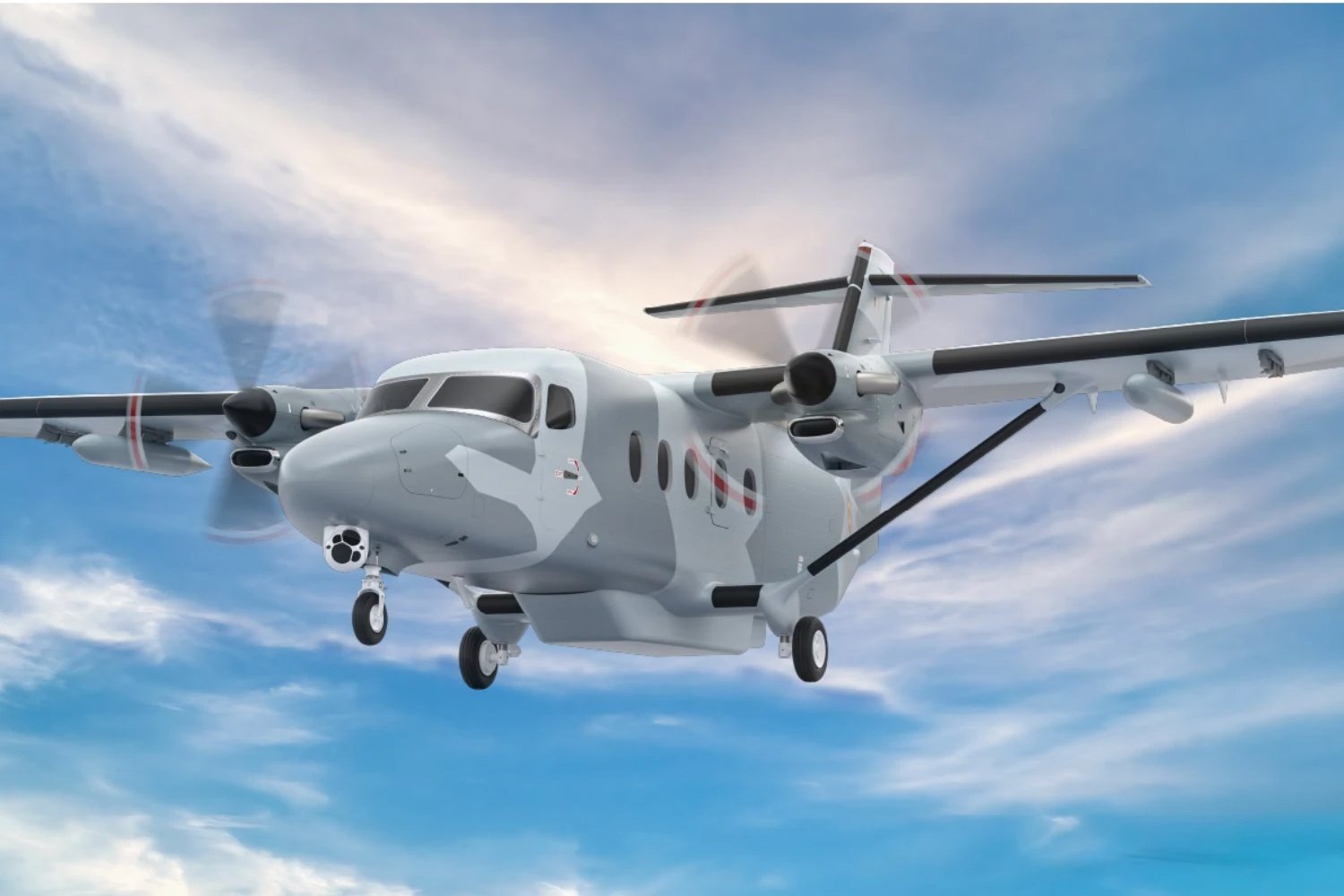 A military variant concept of the SkyCourier. (Textron)
 Some of Textron’s new features are making light steps toward autonomy already. Gibbs pointed out that the company’s Cessna Citation Gen3 business jets now include standard Garmin auto-land technology.
“Obviously, it’s a different scale than what Merlin’s doing as far as automation,” he said. “But … as we develop new products, we try to future-proof them, and so that’s where you get this nice transition between us.”
The SkyCourier can cost up to $8.5 million, depending on modifications, and while the SkyCourier UX sports GPS-denied navigation and the ability to seek different flight paths to avoid danger, it doesn’t have other built-in defenses. For contested logistics missions, it’s not clear how much risk the services are willing to tolerate for a relatively small logistics payload capability. Kremer maintained, though, that a drone of this size could be a mission-saving capability when dispatched to austere locations. And, in a Pacific conflict, it may reduce demand on already-stretched C-130 transports, now the smallest platform capable of carrying standard containers and long overtasked.
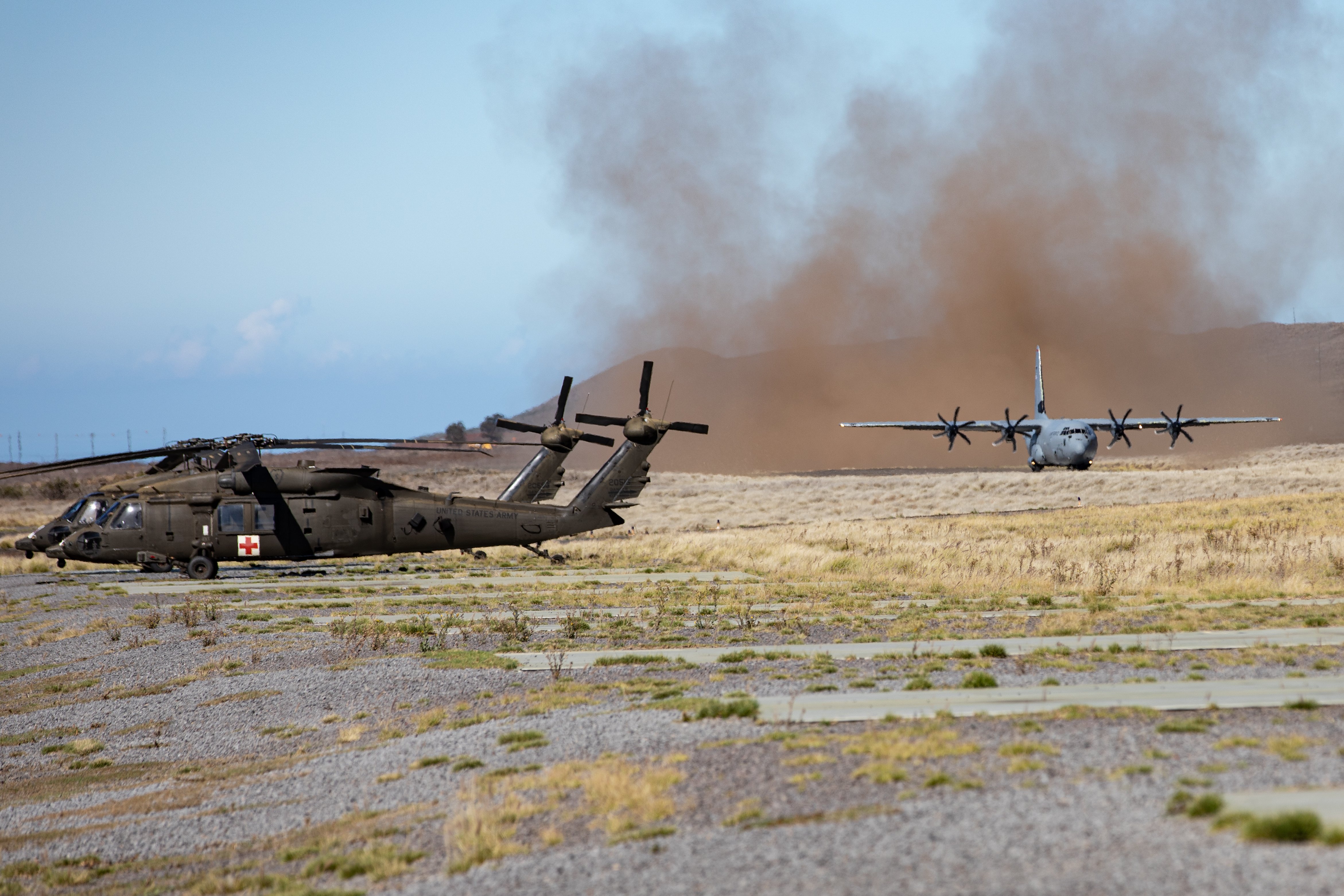 A U.S. Military C-130 prepares for takeoff at Pohakuloa Training Grounds, Hawaii, Oct 28, 2022. (U.S. Army photo by Pfc. Wyatt Moore / 28th Public Affairs Detachment) Spc. Wyatt Moore
“If you can’t get the spare tire, if you can’t get the component, that small thing where you need it in these dispersed operations, they don’t keep the big logistic supply chain built up in these locations,” Kremer said. “You have to be able to get it where you need it, when you need it, and that’s what this provides.”
Nonetheless, the Air Force has a clear appetite for a capability like this. Last year, it signed a $17.5 million contract to put a Reliable Robotics autonomy package on a Cessna 208B Caravan.
On Monday, Air Force Chief of Staff Gen. Ken Wilsbach reiterated the Air Force’s interest in unmanned aerial logistics platforms.
“We’re doing testing on them,” he said in response to an audience question. “We believe that there’s some value in that as well. It certainly could be valuable in the Pacific with the ranges that we’re talking about, and so we’re looking at several different options and evaluating them. But I would say nothing, no program of records just yet, but [we’re] certainly taking a look at some demonstrators and the like to see what’s available to us.”
Notably, China has made significant advancements in developing logistic drone capabilities, with reported successful flight tests of massive heavy-lift uncrewed aircraft, including a 7-ton cargo plane that’s currently the world’s largest uncrewed freighter to take flight. Among them is China’s CH-YH1000, a medium-altitude cargo drone developed by the China Academy of Aerospace Aerodynamics that boasts, like SkyCourier UX, a hatch in lieu of a cockpit for ease of flat-pallet loading up to a weight of 1.2 tons. These are just some of an increasing number of similar systems being developed in China that aim to take the crew out of lower-end logistical missions over short, medium and long distances.
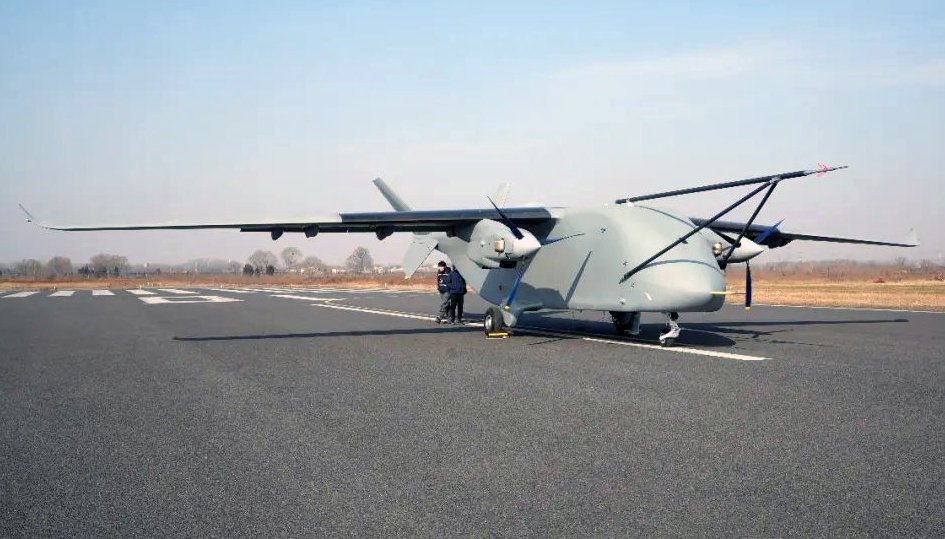 China’s big CY-8 uncrewed logistics aircraft undergoing testing. (Chinese Internet)
 Though Textron and Merlin have yet to build a SkyCourier UX prototype, Merlin CEO Matt George emphasized that the company had chosen to partner with Textron because they could start delivering aircraft fast.
“You’ll see over the course of the show a lot of concept aircraft. You’ll see a lot of renders. You’ll see a lot of people who have big empty factories all around the country,” he said. “But I also want to be very clear about the fact that none of this matters without production … There’s 14,000 Americans working in Wichita, Kansas, on a production line where these aircraft, at least in the crewed configuration, are coming off the production line. So when we talk about capability, we’re talking about that capability and bringing that capability to bear soon, rather than in the future.”
Next in the development process, executives say, will be an optionally piloted version of SkyCourier that will allow users to develop comfort with the platform and open the door to further iteration.
The Textron/Merlin team is also leaving its options open in terms of which U.S. military customer might find its platform most useful.
“I hope [the Army and Air Force] fight over it,” Gibbs said.
Contact the editor: [email protected]