By The Straits Times | Created at 2026-09-01 14:21:21 | Updated at 2026-09-01 15:19:17
1 hour ago
By The Straits Times | Created at 2026-09-01 14:21:21 | Updated at 2026-09-01 15:19:17
1 hour ago
HONG KONG – Chinese leader Xi Jinping arrived in Central Asia this week with a message for a world increasingly unsettled by US President Donald Trump: China has friends and influence, and is prepared to help shape what comes next.
The scene unfolded at a security summit in Bishkek, the capital of Kyrgyzstan, where Xi gathered with the leaders of Russia and Iran. He presented Beijing as a source of stability and a champion of an “orderly multipolar world” that would replace the current US-dominated order.
If the Bishkek summit was designed to project solidarity, a meeting of the world’s most powerful countries in the mountains of Asheville, North Carolina, offered an image of fracture.
European officials attending that meeting of the Group of 20 nations’ (G-20) finance ministers and central bankers expressed outrage this week that the Trump administration had invited Russia, despite its war against Ukraine.
Treasury Secretary Scott Bessent claimed that Canada was too small to fight a trade war with the United States.
And officials were already confronting the economic fallout from the US-Israeli war with Iran, which disrupted the flow of oil and pushed global energy prices up and threatened to slow growth.
The simultaneous gatherings happening across the world reflected the broader contest over who will define the next phase of global order.
China is using its solidarity with Russia and Iran, two countries at war with the West, to project its influence, giving Xi leverage as he prepared for a summit with Trump later in September.
The US, meanwhile, was straining the alliances and economic relationships that have underpinned decades of global leadership.
“China’s theory of the case for bending the international political order in its preferred direction is to amass support from the ‘global majority’,” said Ryan Hass, a former career diplomat and White House national security official now at the Brookings Institution.
“This is why Xi’s participation in these groupings is so important to Beijing,” he added. “It builds a narrative around China gaining momentum in building support for playing a more central role on the world stage.”
In Bishkek, at the summit of the Shanghai Cooperation Organisation, Xi met with the leaders of Kyrgyzstan, Mongolia and Uzbekistan, but his talks with President Vladimir Putin of Russia carried the most weight.
Just days earlier, CIA Director John Ratcliffe made a secret trip to Moscow to urge the Kremlin to end the war in Ukraine.
Xi told Putin: “The foundation of China-Russia relations will become ever stronger.”
President Masoud Pezeshkian of Iran also attended the summit, though it was not immediately clear if Xi held talks with him.
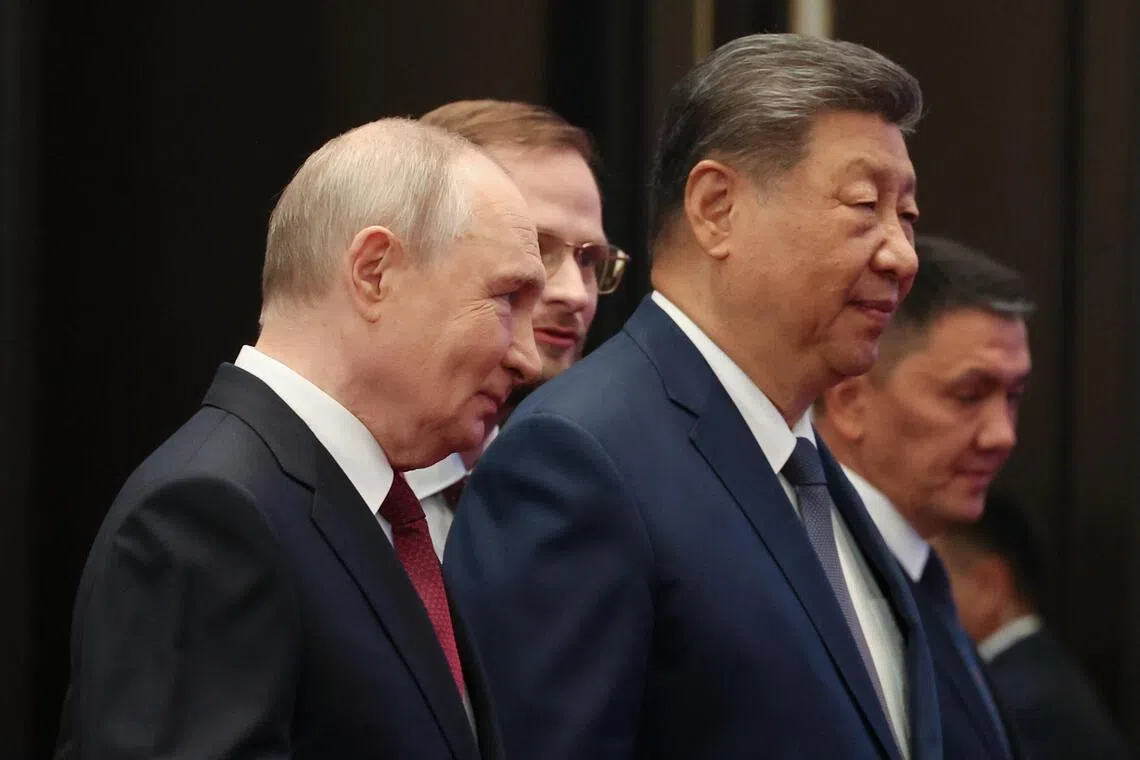
Russian President Vladimir Putin and Chinese President Xi Jinping at the Shanghai Cooperation Organisation summit in Bishkek, Kyrgyzstan on Sept 1.
PHOTO: EPA
By comparison, the US appears to be drifting away from its historical allies and weakening America’s ability to project strength globally.
Trump has opened up a trade war with Canada and reduced war games with South Korea. Concerns are also growing that the United States is depleting its munitions in Iran and unable to meet its defence commitments around the world.
Lars Klingbeil, the German vice-chancellor and finance minister, told reporters at the G-20 that it was “troubling” that the Trump administration invited Russia’s finance minister, Anton Siluanov.
Klingbeil said he scolded Siluanov during a session on Aug 31 over Russia’s war in Ukraine.
Many Europeans were also angered that the Treasury Department did not invite representatives from South Africa, a longtime G-20 member and Africa’s largest economy.
An opportunity for China
Beijing is happy to seize the opportunity that Trump is presenting by alienating Washington’s partners.
Wu Xinbo, an American studies scholar at Fudan University in Shanghai who advises China’s Foreign Ministry, said Beijing had two objectives: to build a consensus so the US could no longer dictate the agenda alone and to take a larger role in powering the world economy. (China also attended the G-20 meeting.)
“Now that the American engine is losing steam – or even generating negative side effects – China, as an economic engine, must step up and play a greater role in driving and leading global growth,” he said.
The meeting in Bishkek was one stop in a broader diplomatic campaign by Xi to work both sides of the emerging divide in global politics.
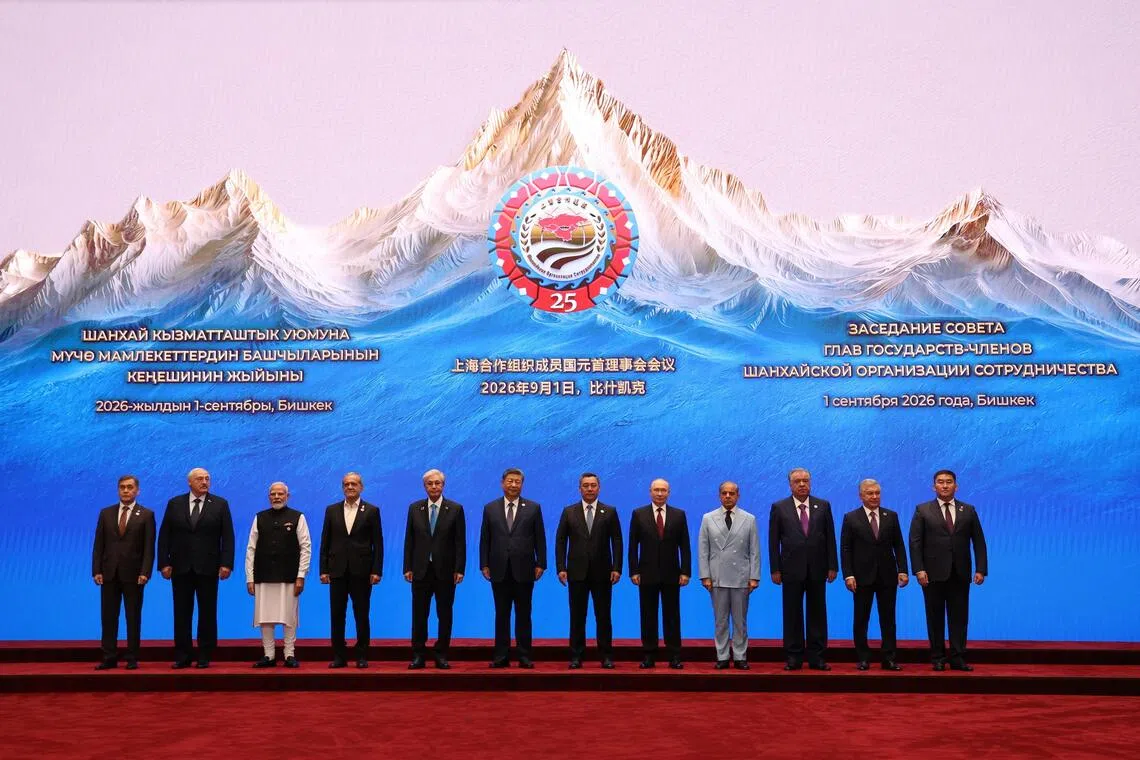
World leaders pose for a group photo at the Shanghai Cooperation Organisation summit in Bishkek, Kyrgyzstan.
PHOTO: EPA
He has hosted many Western leaders, including those from Germany, Britain and Canada. He will head to Cairo next and is also expected to attend a summit of BRICS nations, a group of emerging economies led by China and India, in New Delhi.
As much as Xi would like to cast such groupings as a unified counterbalance to the West, disagreements and tensions still abound.
Beijing and New Delhi have traditionally been at odds in BRICS over how to rival the US, with India reluctant to be too confrontational.
In another sign of a crack, Prime Minister Narendra Modi of India urged Putin during talks on the sidelines of the summit in Kyrgyzstan to end his war in Ukraine for the sake of “humanity”.
Putin told Modi that Russia was “moving in this direction”, according to Russian state media.
The Bishkek summit also exposed the limits of the group’s solidarity.
The Shanghai Cooperation Organisation is not a military alliance. Beijing can offer diplomatic backing, but has been unwilling to commit forces to defend Russia or Iran.
To China, that is the point of the arrangement, argues Zhou Bo, a retired People’s Liberation Army senior colonel who is now at Tsinghua University in Beijing.
“It is not based on alliance relationships, so it is not provocative,” he said. “That’s why people have no problem accepting it or engaging with it.”
As Washington retreats and the world becomes increasingly multipolar, countries will choose to join more pragmatic forums with less strings attached, Zhou said.
“Naturally everyone is hedging their bets,” he said. NYTIMES
This article originally appeared in The New York Times.