By The Straits Times | Created at 2026-08-14 11:27:03 | Updated at 2026-08-14 12:32:57
1 hour ago
By The Straits Times | Created at 2026-08-14 11:27:03 | Updated at 2026-08-14 12:32:57
1 hour ago
SHENZHEN – Malls in China are getting creative to woo shoppers. Their latest gambit: hosting quirky contests, apparently the stranger, the better.
Who can fling a slipper off their foot the farthest? Who will shell melon seeds the fastest? Who might be the first to fan a pig-shaped balloon to the finish line?
Such events have sprung up in shopping centres around the country in 2026, drawing as many as hundreds of people to mall atria and basements at a time when brick-and-mortar retailers are battling slowing sales as many move to shopping online and as the economy slackens.
One recent Saturday afternoon, some 200 people gathered in the basement of the Longgang Wanda Plaza in Shenzhen city to take part in a “garlic peeling competition” that was free to enter.
The contestants, split into four groups, each had to peel three heads of garlic until no trace of skin remained. Then the quickest 10 in each group advanced to the final, where they raced to peel five heads of garlic. The fastest person would win one gram of gold; every contestant could take home the garlic.
“We saw this after eating lunch and thought it was quite interesting,” said 22-year-old engineer Liu Jiahong, who entered the contest while on a date with his girlfriend. They were among participants that included students, young families and grandparents, sitting side by side in the garlic-scented air.
Also in the crowd was Li Li, 28, who works in human resources and read about the contest online. “I thought this was very suitable for my mother, so we’re here to take part together,” she said.
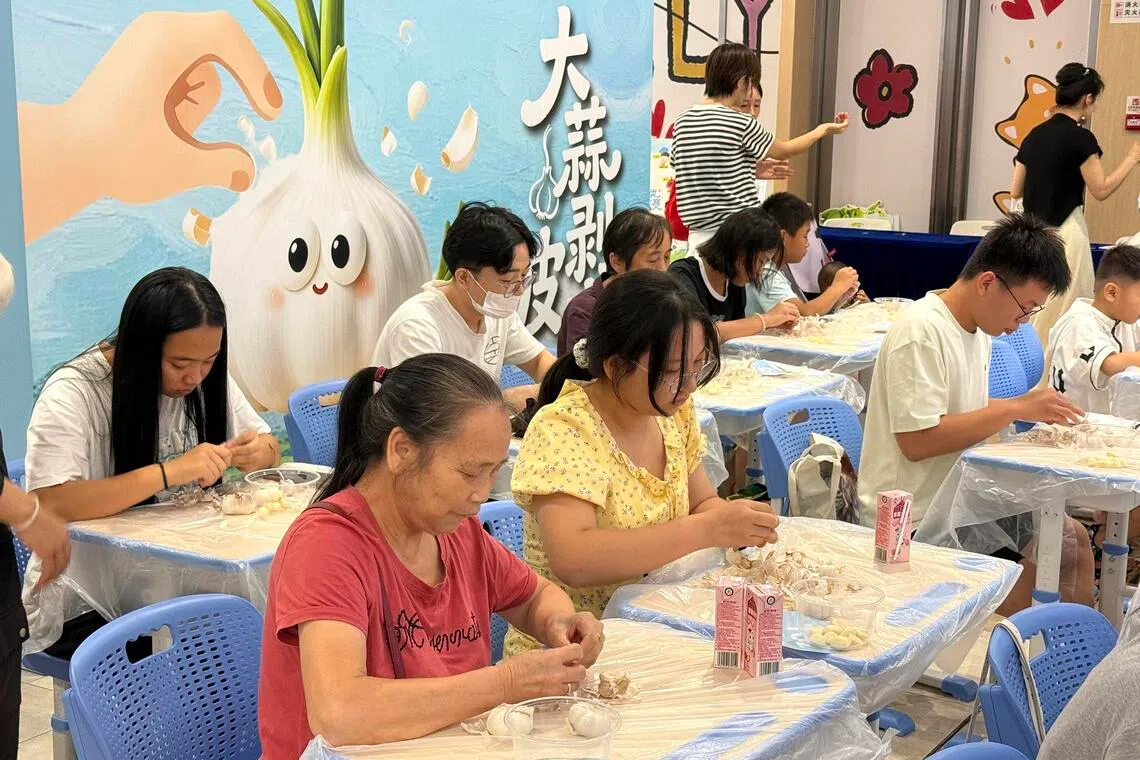
People participate in a garlic peeling contest at the Longgang Wanda Plaza in Shenzhen on Aug 8.
ST PHOTO: JOYCE ZK LIM
Li, who shops online and purchases from physical stores “if the price is about the same”, said she liked that her neighbourhood mall was holding such events. “It lets people experience something different on the weekends or holidays, otherwise malls are just places to eat or buy things,” she said.
The contest was the fifth in a series of eight such events the Longgang Wanda Plaza is holding during the summer school holidays from July to August. “If people are bored at home, they can come and participate,” said Lin Jiayi, who works at the mall’s marketing department.
The aim is to boost footfall and also give shoppers more to do while at the mall, mirroring a broader trend across the country, she said. “These days, many shopping centres are doing these sorts of creative competitions.”
In eastern Ningbo city, contests have ranged from seeing how quickly people can shell melon seeds and twist screws into a board, to – in one instance – having them plant rice seedlings in a mock paddy field. In north-western Xi’an city, shoppers have raced to pull the longest noodle from a ball of dough, eat watermelons and knock prizes out of frozen slabs of ice.
During the weekend of Aug 8-9 in southern Shenzhen, there were at least 10 competitions announced, including one for people to see how far they could kick slippers off their feet, and another where people fanned pig-shaped balloons to the finish line.
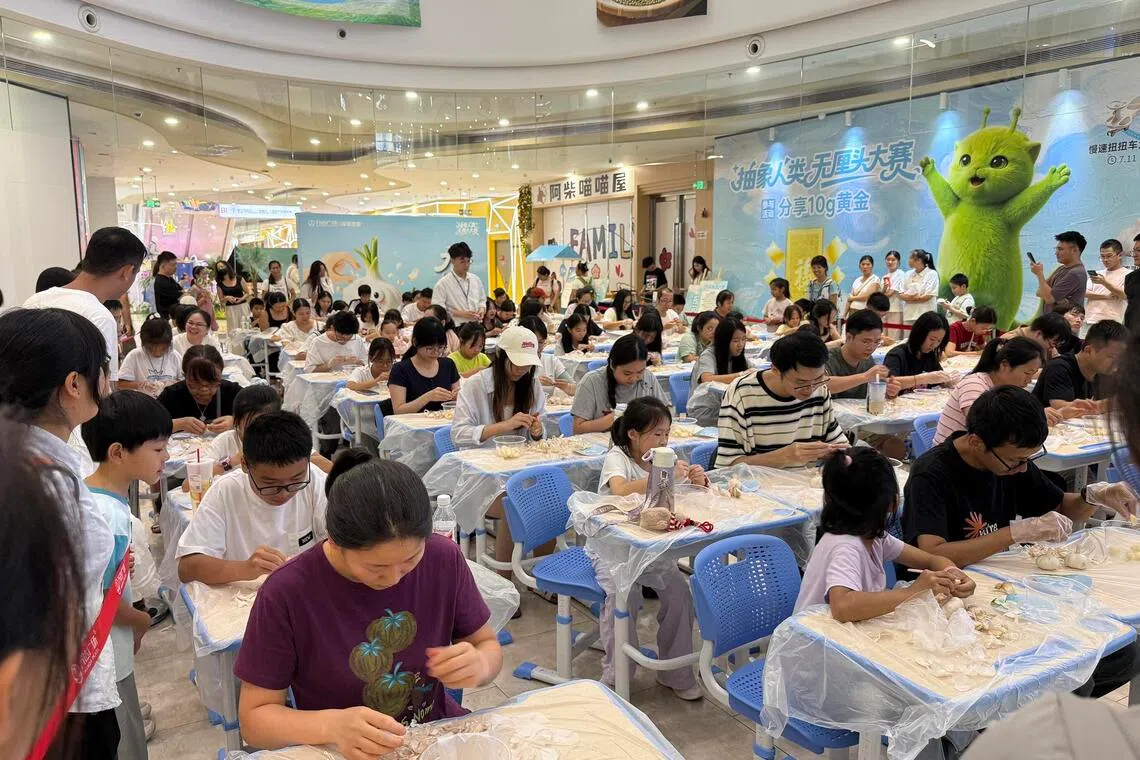
People participate in a garlic peeling contest at the Longgang Wanda Plaza in Shenzhen on Aug 8.
ST PHOTO: JOYCE ZK LIM
Around the country, from Beijing and Shanghai to Lanzhou in the north-west, one especially popular contest has entailed “sneak eating”: where people sit at desks in a mock classroom setting and race to scarf down food and drink without being caught by staff acting as teachers. On Douyin, China’s version of TikTok, posts tagged “sneaky eating contest (tou chi da sai)” have been viewed more than two billion times altogether.
That shopping centres have had to hustle in this manner shows that just selling things is “no longer enough” these days, said Ming Yii Lai, a senior consultant at Daxue Consulting, a market research firm, in Shanghai.
Malls are seeking out new ways to stay relevant as people shop more online, with e-commerce accounting for 26.1 per cent of consumer goods sold in China in 2025, up from 10.8 per cent a decade earlier, official statistics show.
According to a report by the China Commerce Association for General Merchandise and the Hong Kong University of Science and Technology, more than half of department store retailers surveyed said that their sales, net profits and footfall declined in 2025.
In the first half of 2026, department store sales fell 2.1 per cent while the online sales of goods rose 4.8 per cent year on year, official figures show, even as some other retailers such as supermarkets and convenience stores continue to record growth.
With e-commerce often a cheaper and more convenient option for shoppers, malls now have to “sell what cannot be delivered”, such as a sense of participation and the chance to witness something unexpected, Lai said.
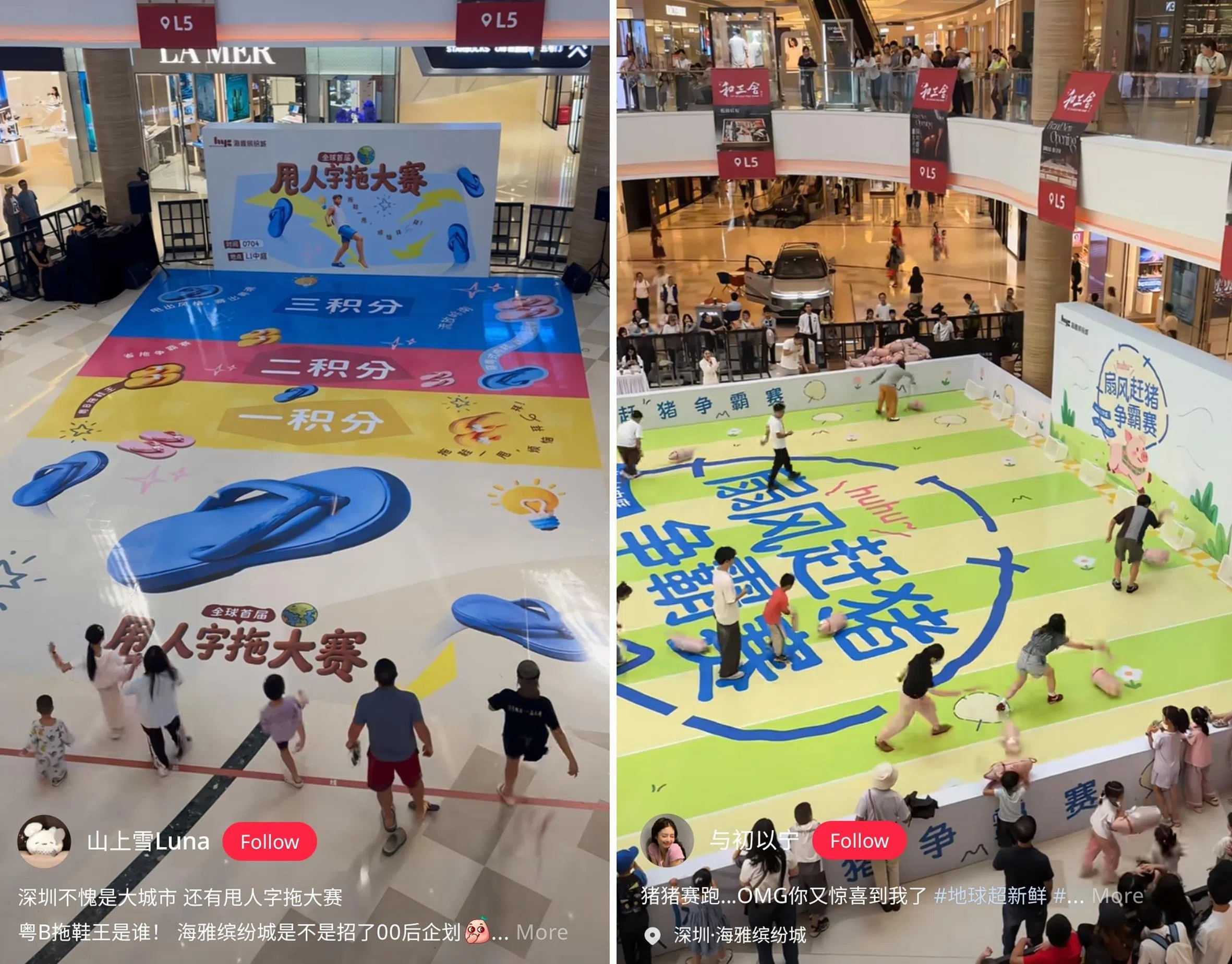
People participate in slipper-flinging and pig balloon-fanning contests in Shenzhen.
PHOTOS: SCREENGRABS FROM XIAOHONGSHU
Such contests, which best suit family-oriented, sub-urban and neighbourhood malls, give people a reason to visit – and hopefully stay longer to eat, drink and browse, she added.
They are one way in which malls are trying to become more attractive spaces for consumers to linger, with the Chinese government unveiling in July guidelines aimed at transforming physical retail spaces into places that also provide immersive experiences, entertainment and social interaction.
Still, whether they can meaningfully grow footfall as more malls jump on the bandwagon – and then turn that into sales – remains to be seen.
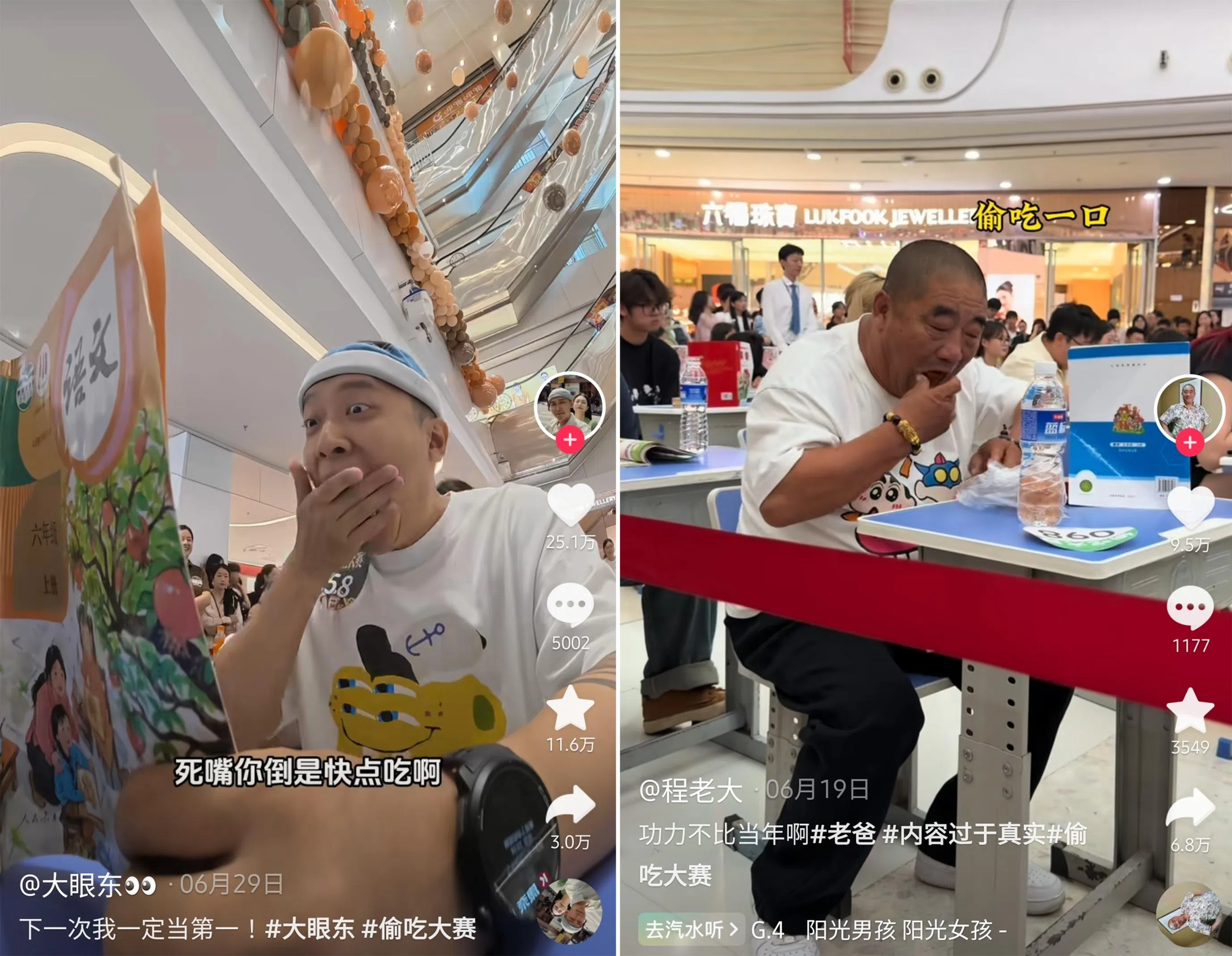
People participate in "sneaky eating contests" in China.
PHOTOS: SCREENGRABS FROM DOUYIN
Back at the garlic peeling contest in Shenzhen, a shop assistant at a nearby bubble tea store said more people had been coming to buy drinks since the contests began, but another at a cosmetics store said sales had not increased much.
“It looks like there’s a lot of people, but not that many come into our store,” she said, surmising that stores selling food or drinks likely stood to gain more.
As the competition wound down and people began leaving, some contestants made plans to return for the following week’s edition: bean-picking.
“If I have time, I will join,” said retiree Zhang Wen, 58, who was there at the suggestion of her son-in-law, whom she roundly out-peeled. She and her family had lunch at the mall before the contest.
Li, another participant, was inclined to do the same. And before heading home, she would spend some time at the mall with her mother and infant daughter, she said. “We’re not in a hurry to go home and cook – we’ll have dinner here before going back.”