By The Straits Times | Created at 2026-07-18 16:11:42 | Updated at 2026-08-03 00:05:55
2 weeks ago
By The Straits Times | Created at 2026-07-18 16:11:42 | Updated at 2026-08-03 00:05:55
2 weeks ago
BEIJING/SHANGHAI – Chinese President Xi Jinping on July 17 urged more equitable global access to artificial intelligence, while hailing the establishment of a new international cooperation organisation in Shanghai as a key milestone in the technology’s development history.
In a 20-minute keynote address at the World AI Conference (WAIC) in Shanghai, Xi said that as a responsible major country, China is committed to providing international public goods related to AI.
China is seeking to position itself as a leader in multilateral efforts to govern the technology, and as a more reliable partner in AI development compared with the United States, the other global AI powerhouse.
“We must carry out extensive international cooperation and help Global South countries with capacity building to bridge the AI and digital divides, promote sustainable development, and prevent the creation of new historical injustice in AI,” he added.
Xi said that in the next five years, China will provide developing countries with 5,000 opportunities in AI training and seminar programmes as well as develop AI application cooperation centres with ASEAN and other regional groupings, such as BRICS.
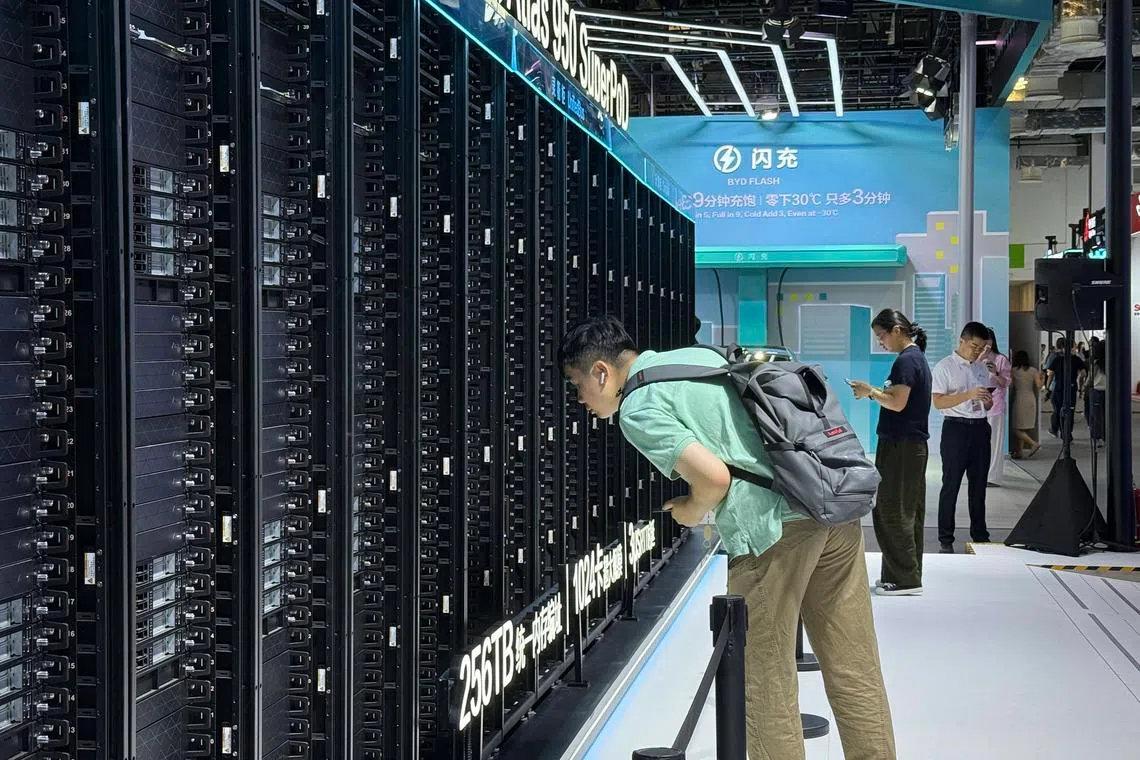
A visitor leans in for a closer look at Huawei's Atlas 950 SuperPod at the World AI Conference in Shanghai.
ST PHOTO: JOYCE ZK LIM
This was the Chinese leader’s first appearance at China’s flagship AI event, underlining Beijing’s ambitions to be at the forefront of global governance of the strategic technology at the heart of US-China competition.
In the past two years, Premier Li Qiang, China’s second-ranked leader, had delivered the keynote addresses at the conference, held annually since 2018. In 2025, Li proposed the establishment of a world AI body to promote global governance, based in Shanghai.
On July 16, a signing ceremony was held in Shanghai for an agreement to set up the international non-governmental organisation, the World Artificial Intelligence Cooperation Organisation (WAICO), which involved representatives from 29 countries – including Brazil, Kazakhstan, Pakistan, Russia, Laos and Indonesia – as founding members.
On the new organisation, Xi said: “We often say in China, ‘A single string cannot make music, and a single tree does not make a forest.’ AI development should not be a solo performance by a single country, but a symphony of international cooperation.”
The US and China are competing in AI across different domains, not just in frontier models, talent and chips, but also in winning more users to their respective ecosystems. China has long cast itself as a responsible player championing accessible and open-source AI models, particularly for developing countries.
At the conference, Xi’s call for greater equity in AI access came as Chinese firms showcased the latest software and hardware, from chips and models to the robots, AI agents and myriad applications they power. China often touts its AI solutions as being more cost-effective than US alternatives.
Huawei, the telecommunications giant now critical to China’s efforts to develop hardware self-sufficiency in AI, lifted the lid off its Atlas 950 supercomputing cluster – a domestic alternative to the US AI chip designer Nvidia for large-scale AI training and inference.
Its sleek black cabinets occupied a prime spot at the entrance to an exhibition hall where many other Chinese chip companies, including the buzzy start-up Dongfang Suanxin, were displaying their newest processors.
Elsewhere, humanoid robots of all shapes demonstrated how they could turn screws in factories, pick medication off store shelves, and play a game of ping-pong — a showcase meant to illustrate how androids are increasingly put to work in real life. A robot dressed in a Tang-style shirt, and another in a bow tie, brewed Chinese tea for curious onlookers.
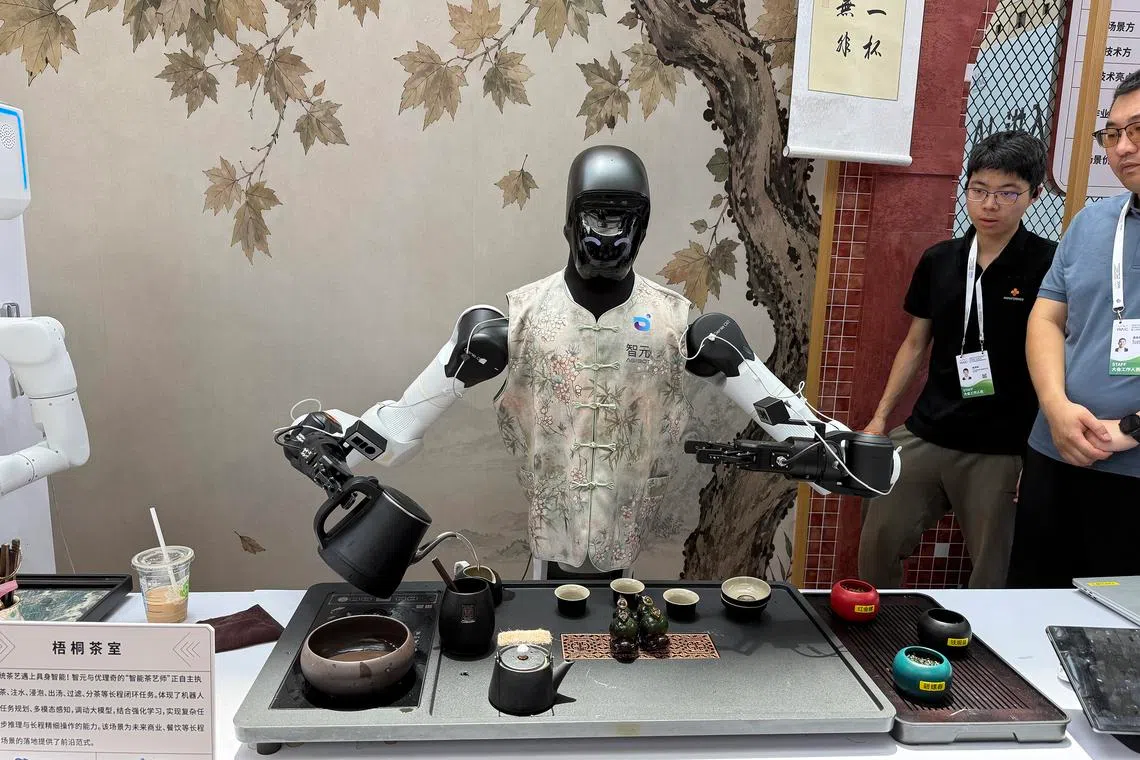
A humanoid robot pours tea for visitors at the World AI Conference in Shanghai.
ST PHOTO: JOYCE ZK LIM
The four-day event in Shanghai draws renowned AI scholars as well as international leaders including UN Secretary-General Antonio Guterres, Cambodian Prime Minister Hun Manet, Thai Prime Minister Anutin Charnvirakul and ASEAN Secretary-General Kao Kim Hourn.
It is held alongside a High-Level Meeting on Global AI Governance, as China seeks to present itself as a steadier partner in AI development compared with the US.
Conference attendee George Chen, partner and chair of digital practice at The Asia Group, an American strategic advisory firm, said that Beijing has been using the Shanghai AI conference to deliver key messages on AI cooperation, safety, and what officials now call “AI diplomacy”.
The goal is to rally allies and partners, particularly across the Global South and Belt and Road countries, Chen told The Straits Times, adding that the US and China are now competing over which AI models other countries adopt.
“Will countries choose China’s DeepSeek or other open-source systems that are more affordable and appealing to developing economies, or opt for US closed models like OpenAI’s, which require repeated upgrades tied to American providers?” he mused.
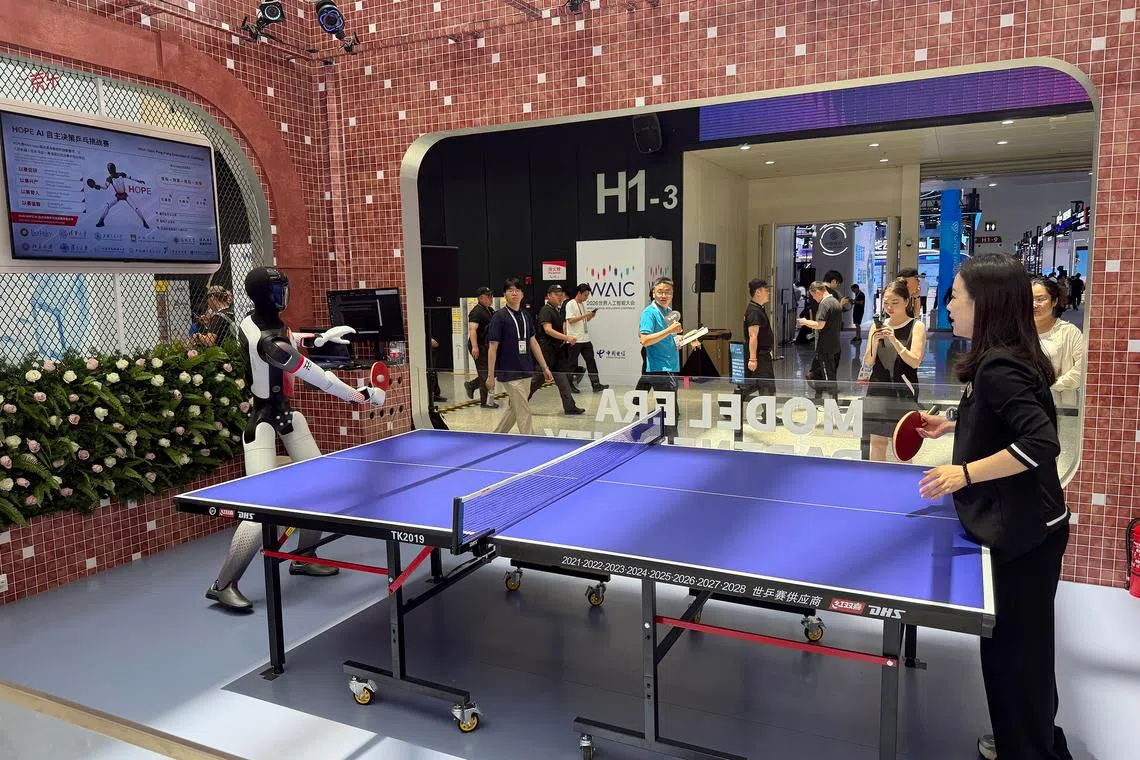
A humanoid robot playing table tennis at the World AI Conference in Shanghai.
ST PHOTO: JOYCE ZK LIM
Recent US export restrictions on Anthropic’s Claude models – quickly imposed and then lifted – have heightened perceptions of uncertainty around American technology policy, he said. For many Global South governments, the abruptness of such actions and retractions raises doubts about long-term reliability.
While China has not made similar moves, Reuters reported on July 7 that Chinese authorities had held meetings with top tech firms about potentially restricting overseas access to China’s most advanced AI models, highlighting their strategic nature.
Chen added: “China sees an opening: to present itself as the steadier partner in AI development. WAIC offers President Xi and Chinese scholars a prominent stage to advance this agenda and promote Beijing’s vision for global AI standards.”
For some who face difficulties accessing American technologies, China’s AI offerings represent a crucial alternative. US export control laws seek to prevent advanced American chips from being used by “countries of concern”, which are primarily China and Russia.
At a busy exhibition hall in Shanghai, Sergei Markov, a director of AI technology advancement at Russian bank Sberbank, was looking for chips for model inference given a “shortage of Nvidia chips” back home.
Huawei’s display was “my favourite here”, said the third-time visitor to the conference. His firm develops AI models and humanoid robots and is looking into how the Chinese tech giant’s offerings fit its needs.
Sberbank, a target of US sanctions, works with Chinese companies and uses Chinese parts, he said. “I think it’s really hard not to use some Chinese hardware,” he said.