 By Latin America Reports | Created at 2026-10-19 22:31:40 | Updated at 2026-10-19 23:31:46
1 hour ago
Bogotá, Colombia – On a visit yesterday to the San Andres and Providencia archipelago, Colombia’s northernmost territory, President Abelardo de la Espriella reignited a decades-long dispute with Nicaragua.
Reaffirming Colombian sovereignty over the islands and their territorial waters, the far-right leader dismissed a 2012 International Court of Justice (ICJ) ruling that expanded Nicaragua’s maritime boundary, pledging to redraw the nautical map.
Though de la Espriella pledged dialogue with Managua, he also threatened to use force if needed to “defend the sovereignty” of Colombia, ratcheting up diplomatic tensions between the two nations.
“There is not a single meter in dispute here, there’s no debate. This here is our homeland, our territory,” declared the president in a speech from a naval ship off the coast of San Andres on Sunday evening.
He pledged to sign a decree on November 30 redrawing the territorial boundaries in favor of Colombia. Such unanimous action is not binding under international maritime law but will alter official nautical charts in Colombia.
Though the ICJ affirmed Bogotá’s sovereignty over the territories comprising the archipelago in 2012, Colombia lost an estimated 19,000 square miles of maritime territory to Nicaragua following the ruling.
De la Espriella’s administration is now reviving the dispute over the lost territorial waters.
“The 2012 ruling seeks to tear apart the archipelago – which is an inseparable whole – and leave our islands as enclaves separated by a foreign sea,” wrote Interior Minister Rodrigo Lara in a post on X yesterday.
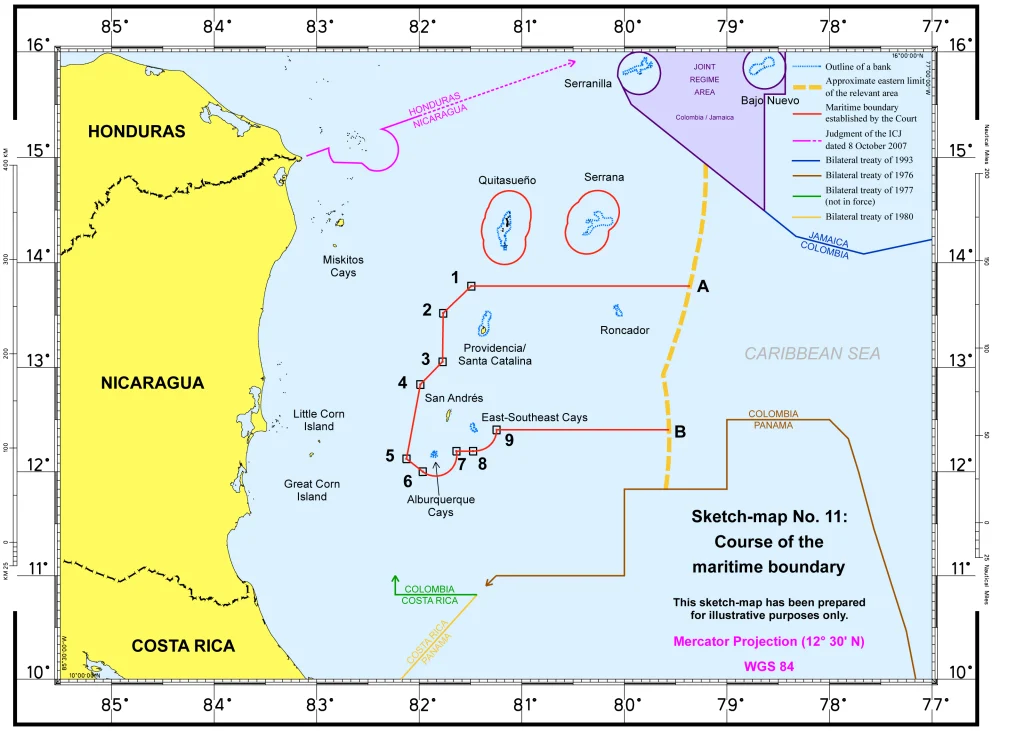 A map showing the outcome of the ICJ’s 2012 ruling. Image credit: ICJ.
Right now, some of the islets – like Quitasueño and Serrana – and their respective waters are surrounded by Nicaraguan territory, rather than being connected by sea to the main archipelago.
Lara argued that the Colombian government failed to make its case before the ICJ in 2012 that the archipelago was “a territory that Colombia had administered and defended as a single entity” rather than “a trail of little dots in the sea.”
Despite not legally administering the waters, Colombian islanders continue to fish them and government conservation efforts have also taken place there.
The ICJ ruled in 2022 that Colombia “violated the Republic of Nicaragua’s sovereign rights and jurisdiction in this maritime zone” by “interfering” with fishing, research, and naval vessels.
De la Espriella’s revival of the dispute with Nicaragua follows his pledge to sever relations with Managua and close its embassy in Colombia.
His government nevertheless pledged to engage in dialogue with Nicaragua: “Anyone who wants to discuss the future of this sea will find a place at the negotiating table.”
But the president, who won on a platform promising law, order, and to “defend the homeland” through brute force issued a thinly veiled warning to Managua.
“Anyone who wants to break the law in Colombia’s waters will find the national navy ready to defend our sovereignty.”
Featured image description: A beach on San Andres island.