By Latin America Reports | Created at 2026-10-08 19:22:30 | Updated at 2026-10-08 21:04:31
3 hours ago
By Latin America Reports | Created at 2026-10-08 19:22:30 | Updated at 2026-10-08 21:04:31
3 hours ago
After the recent Venezuelan and Colombian earthquakes, many stories have emerged about the involvement of AI tools. From mapping damage to coordinating donations and aid, AI was suddenly entering the realm of disaster management.
One area where AI is beginning to play a role- to varying degrees of success- was early warning systems.
The Android Earthquake Alert System (AEA) was part of this. During the Venezuelan earthquakes, this system sent out 11.4 million alerts, reportedly notifying people within seconds to a couple of minutes that shaking would hit. AEA statistics regarding the Colombian earthquakes in August are not readily available.
As AI technology advances, more startup companies are entering the fray to provide “lifesaving” information before quakes strike.
One such company is SeismicAI Mexico, which operates an earthquake early-warning and rapid impact-assessment system that uses sensors to detect initial seismic waves and algorithms. This helps estimate the earthquake’s location, magnitude, and likely ground shaking.
On Seismic AI’s ‘Shakewatch’ app, users can click on a button indicating either that they are “safe” or that they “need help”. Selecting the latter will contact their inputted emergency contact, detailing their updated location.
Jocelyn Vargas, CEO of Seismic AI Mexico, told Latin America Reports that the company has been in contact with the governments of Venezuela, Peru, and Ecuador, as part of their processes to improve earthquake-resilient infrastructure and systems.
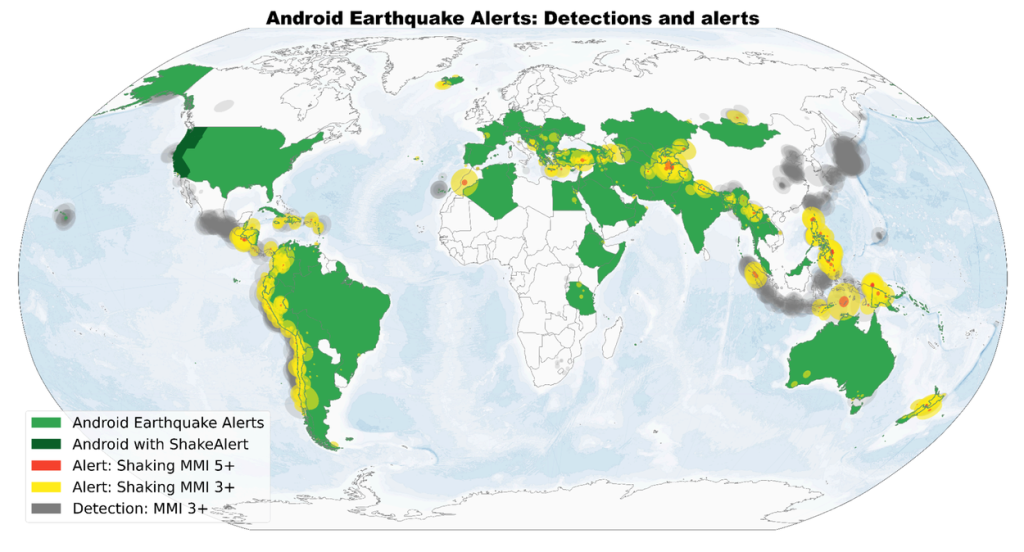 Light green areas show the countries where the Android Earthquake Alerts System is currently detecting and delivering alerts. The areas alerted in individual earthquakes are shown in red where there was strong shaking (Modified Mercalli Intensity (MMI) 5+) and yellow for lighter shaking (MMI 3-4). The gray circles indicate other Android detections in regions where alerts were not issued. Android also delivers alerts generated by ShakeAlert in California, Oregon and Washington (dark green). Image credit: Google Research
 Another AI early warning system startup in the market is Sismos Venezuela, set up by German software developer Martin Börner, after he saw devastation in Venezuela. It uses seismic station data from the Caribbean and Colombia to notify users of an earthquake when stations have detected matching P-waves.
The company’s website mentions that Venezuela does not have many seismic stations, especially in the Eastern regions, and suggests that users start to use their phones as an alternative seismometer. Like SeismicAI, the system allows users to notify their emergency contacts whether they are ‘OK’ or whether they ‘need help’.
Sismos Venezuela is free of charge, and the founder says that he runs the company to help Venezuelans.
Börner highlights that his service ‘is not a substitute for disaster management services’, or for FUNVISIS, otherwise known as the Venezuelan Foundation for Seismological Research.
He rather calls it ‘a complement’ to the services provided by the Venezuelan government and directs users to always follow authorities’ guidance.
The question of accuracy still looms large regarding any machine learning system which claims to predict earthquakes. Professor Bruce D. Malamud, Director of the Institute of Hazard, Risk and Resilience at Durham University, pointed out that Google’s published evaluation from the 2026 Venezuelan earthquakes found that, among respondents to Android Earthquake Alerts, 36% received alerts before shaking, 28% during it and 23% afterwards, meaning that over half of the alerts were not effective in warning citizens.
Malamud elaborated on this, telling Latin America Reports that “because data and alerts can travel much faster than seismic waves, some locations farther from the rupture may receive anything from a few seconds to tens of seconds of warning before the strongest shaking arrives. Places close to the rupture may receive little or no warning.”
Malamud continued: “AI may improve aspects of signal detection and rapid estimation, but it does not remove physical limits. Its value should be assessed using transparent, independently tested evidence on false alarms, missed events, latency and warning times. Early warning can reduce impacts, but it complements rather than replaces earthquake-resistant buildings, resilient infrastructure, preparedness and clear public guidance.”
Other limitations also exist. Android’s AEA system only works on Android devices, including smartwatches.
Luckily, Android is dominant in Latin America, giving the system considerable reach, but there are still many iPhone users who cannot receive the Android Earthquake Alerts.
Innovations from AI startups are undoubtedly increasing in today’s modern technology landscape, but, as Martin Börner, founder of Sismos Venezuela, and Professor Bruce D. Malamud of Durham University warn, any AI technology should be considered complementary, rather than a leading and totally reliable source of information.
Featured image: Buildings collapsed in La Guaira, Venezuela following a pair of devastating earthquakes on June 24, 2026.
Image credit: Julio Blanca for Latin America Reports