By Gatestone Institute | Created at 2026-06-26 09:00:09 | Updated at 2026-06-26 10:19:08
1 hour ago
By Gatestone Institute | Created at 2026-06-26 09:00:09 | Updated at 2026-06-26 10:19:08
1 hour ago
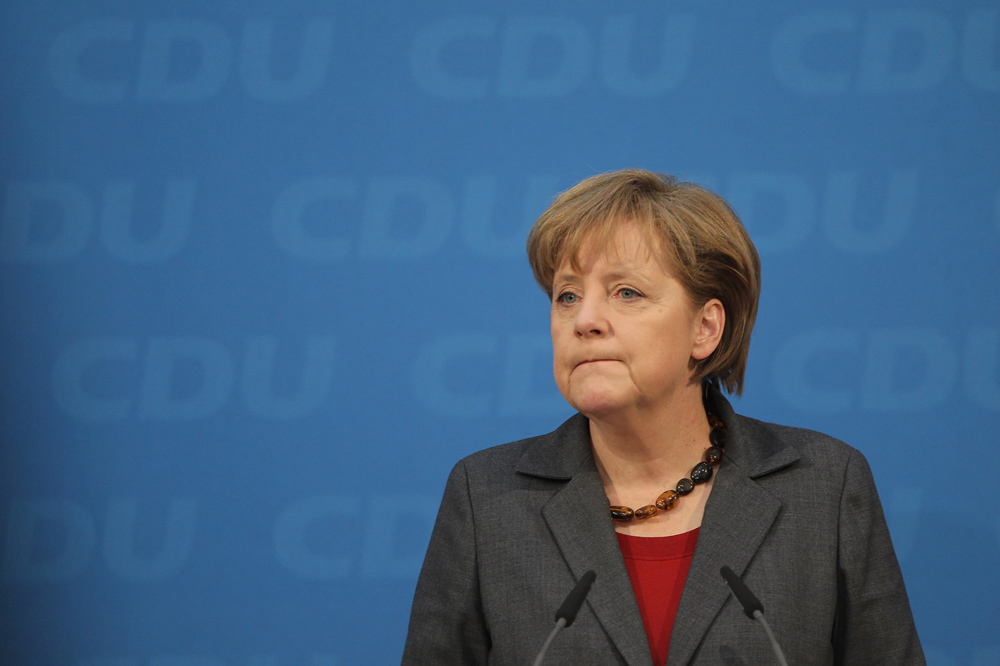 Pictured: Merkel in 2018.
The Ministry for State Security (Stasi), the infamous secret police of the communist German Democratic Republic (GDR), was one of the most ruthless and pervasive instruments of repression ever created in Europe. Operating as the iron fist of the communist dictatorship, the Socialist Unity Party of Germany (SED), the Stasi maintained a suffocating web of surveillance over its own population. Nearly 91,000 full-time officers and up to 189,000 unofficial collaborators (Inoffizielle Mitarbeiter, IM) -- meaning roughly one in every six or seven East Germans -- was spying on family, colleagues, or friends.
Through systematic psychological destruction known as Zersetzung (subversion), the Stasi ruined lives without leaving visible traces. They destroyed careers, marriages and mental health through targeted disinformation, anonymous letters, workplace sabotage and relentless harassment. Political prisoners were tortured in notorious facilities such as Hohenschönhausen, the Stasi prison outside Berlin, where thousands were broken or murdered.
The Stasi kidnapped dissidents abroad, collaborated with international terrorists (including the Red Army Faction (Baader-Meinhof Group) and Palestinian groups), trafficked weapons, and ran a vast network of forced labor and industrial espionage that stole Western technology on a massive scale. By 1989, it had amassed more than six million files on individuals -- a monstrous archive of betrayal and fear that turned an entire society into a prison of mutual suspicion. Even today, the full horror of this perfected totalitarian machine remains only partially exposed, its surviving architects and beneficiaries often shielded by post-reunification silence.
Did Angela Merkel Work for the Stasi?
Did Angela Merkel Work for the Stasi? Officially, no. There is no publicly confirmed evidence that Merkel was a Stasi employee or one of the formal Inoffizielle Mitarbeiter (IMs). She has repeatedly stated that she refused recruitment attempts, notably in the late 1970s when applying for an academic position.
Unofficially, however, the extreme and ongoing protection of her Stasi-related files raises legitimate and troubling questions. In March 2026, the Berlin Administrative Court upheld the Federal Archives' refusal to grant access to any documents concerning her, even to researchers. This decision shields one of modern Europe's most consequential leaders from full historical scrutiny -- decades after the fall of the Berlin Wall.
The Facts on Record: Merkel's Rapid Rise Amid Stasi Networks
Angela Merkel (née Kasner), born in 1954 in Hamburg, West Germany and raised in Templin, East Germany, is the daughter of Protestant pastor Horst Kasner (known as "the Red Pastor"), who moved his family to the GDR because he embraced the "idea"of communism. Kasner was an advocate for the separation from the West German church and Christian-socialist reconciliation. His Evangelical Church was actively collaborating with communist authorities. Merkel studied physics, earned a doctorate in quantum chemistry, and worked at the Academy of Sciences in Berlin-Adlershof until 1990.
Key documented elements that fuel suspicion:
Free German Youth (FDJ ) Involvement: Merkel served as Secretary for Agitation and Propaganda (Agitations- und Propaganda-Sekretärin) in the FDJ at the Academy of Sciences in Berlin-Adlershof, where she worked from 1978 onward -- a role that typically required close alignment with the communist regime and cooperation with the Stasi. The position required promoting the state's communist ideology, organizing political training, and monitoring the political loyalty of colleagues. Holders of such roles were always recruited by or worked closely with the Stasi. Merkel has downplayed this as "cultural affairs," but contemporaries dispute her account. Her former colleagues asserted she indeed propagated Marxist-Leninist ideology among students and colleagues.
In East Germany, an IM (Inoffizielle Mitarbeiter) was an unofficial collaborator -- an informant -- who delivered private information to the Ministry for State Security.
Wolfgang Schnur: In late 1989/early 1990, during the Wende (the peaceful revolution), Schnur -- a long-time Stasi informant since the mid-1960s who reported on church and opposition figures -- founded the Democratic Awakening (Demokratischer Aufbruch) party. He personally recruited the then-unknown 35-year-old Merkel as press spokeswoman in February 1990. Schnur was exposed as a Stasi IM just days before the March 18, 1990 elections, leading to the party's collapse. Merkel distanced herself but benefited directly from his patronage.
Lothar de Maizière: After Schnur's fall, Merkel moved seamlessly to the East German branch of West Germany's Christian Democratic Union (CDU) under Lothar de Maizière, the last Prime Minister of East Germany (April-October 1990). De Maizière, who negotiated German reunification with West German Chancellor Helmut Kohl, was himself exposed in December 1990 as a Stasi informant (registered since at least 1981, with files linking him to surveillance of the church and West German contacts). Merkel served as his deputy government spokeswoman. He resigned from the Germany's federal government shortly after unification when the allegations surfaced.
Both of Merkel's political mentors in 1989-1990 were thus long-term Stasi collaborators. Both had close ties to her father's church network, itself deeply engaged in collaboration with the totalitarian regime. Merkel's ascent from relative obscurity to Bundestag member in December 1990, then to Cabinet minister under Kohl, remains one of the most meteoric and least scrutinized in German history.
Yet no full file has ever been released publicly -- and the 2026 court ruling ensured it stays that way.
The Court's Reasoning: Privacy Above Historical Truth
In March 2026, the Berlin Administrative Court dismissed a lawsuit brought by Marcel Luthe (a researcher and former politician) seeking access to Merkel's Stasi files. The court ruled that:
- Merkel was not proven to be a Stasi collaborator, so she does not fall under the categories allowing broader disclosure. The reasoning is quite ironic, given that the investigation is specifically aimed at determining whether or not Merkel did actually collaborate with the Stasi.
- Merkel was not a sufficiently significant "person of contemporary history" (Person der Zeitgeschichte) before 1990 to justify overriding privacy protections.
- The Stasi Records Act (Stasi-Unterlagen-Gesetz) prioritizes personal data protection over research interests when no clear collaboration exists.
- Releasing files could harm Merkel's privacy rights, although as Chancellor (2005-2021), she was one of the most powerful figures in Europe for 16 years.
The court did not even require the archives to confirm the existence of files or review them in camera. Luthe was ordered to pay around €20,000 in costs.
This is the same legal framework that allows victims and researchers wide access to files on ordinary citizens and confirmed IMs -- but apparently not for Germany's former Chancellor.
Why This Ruling Is a Legal and Democratic Aberration
The court's decision is not merely cautious -- it is an intellectual and moral outrage that undermines the very purpose of the Stasi archives: confronting the past to safeguard democracy.
First, Merkel was politically active before 1990. She held a leadership position in the FDJ at a major research institute, joined the DA party during the revolution, and served as its spokeswoman. By early 1990, she was already transitioning into high politics. Her claim that she was a "private person" with no public relevance until after unification strains credulity.
Second, the two men who launched Merkel's career were both exposed Stasi informants and she had been a staunch Marxist, following in the footsteps of a father whose entire church was possibly a Stasi front. In any transparent democracy, this network would demand full disclosure, not a blanket of secrecy. The public has a legitimate interest in understanding whether Merkel benefited from, navigated, or was protected by these compromised circles.
Third, the ruling creates a two-tier system: ordinary former East Germans must live with full exposure of their Stasi files, while the elite -- especially the long-serving chancellor whose policies shaped modern Germany's migration crisis, energy dependence on Russia, and EU direction -- receive extraordinary protection.
Vergangenheitsbewältigung? (Coming to Terms with the Past)
This concealment is the opposite of Vergangenheitsbewältigung (coming to terms with the past), the principle Germany claims to uphold since the Nazi era. By shielding Merkel's files, German institutions send a dangerous message: some pasts are too sensitive for the public. In an age of declining trust in elites, this breeds legitimate suspicion. If there is "nothing to hide," why the extraordinary legal fortress?
Germany's democracy deserves better than selective amnesia. If there is really "nothing to hide," why such an impenetrable legal shield around a former chancellor? The full opening of Merkel's Stasi-related documents is not a matter of harassment -- it is a matter of historical justice and public accountability.
A democracy that protects its powerful against the truth ceases to be a democracy and returns to the era of suspicion -- exactly the trademark of the Stasi.
Drieu Godefridi is a jurist (University Saint-Louis, University of Louvain), philosopher (University Saint-Louis, University of Louvain) and PhD in legal theory (Paris IV-Sorbonne). He is an entrepreneur, CEO of a European private education group and director of PAN Medias Group. He is the author of The Green Reich (2020).