By The Moscow Times | Created at 2026-06-17 16:05:18 | Updated at 2026-06-17 21:00:07
5 hours ago
By The Moscow Times | Created at 2026-06-17 16:05:18 | Updated at 2026-06-17 21:00:07
5 hours ago
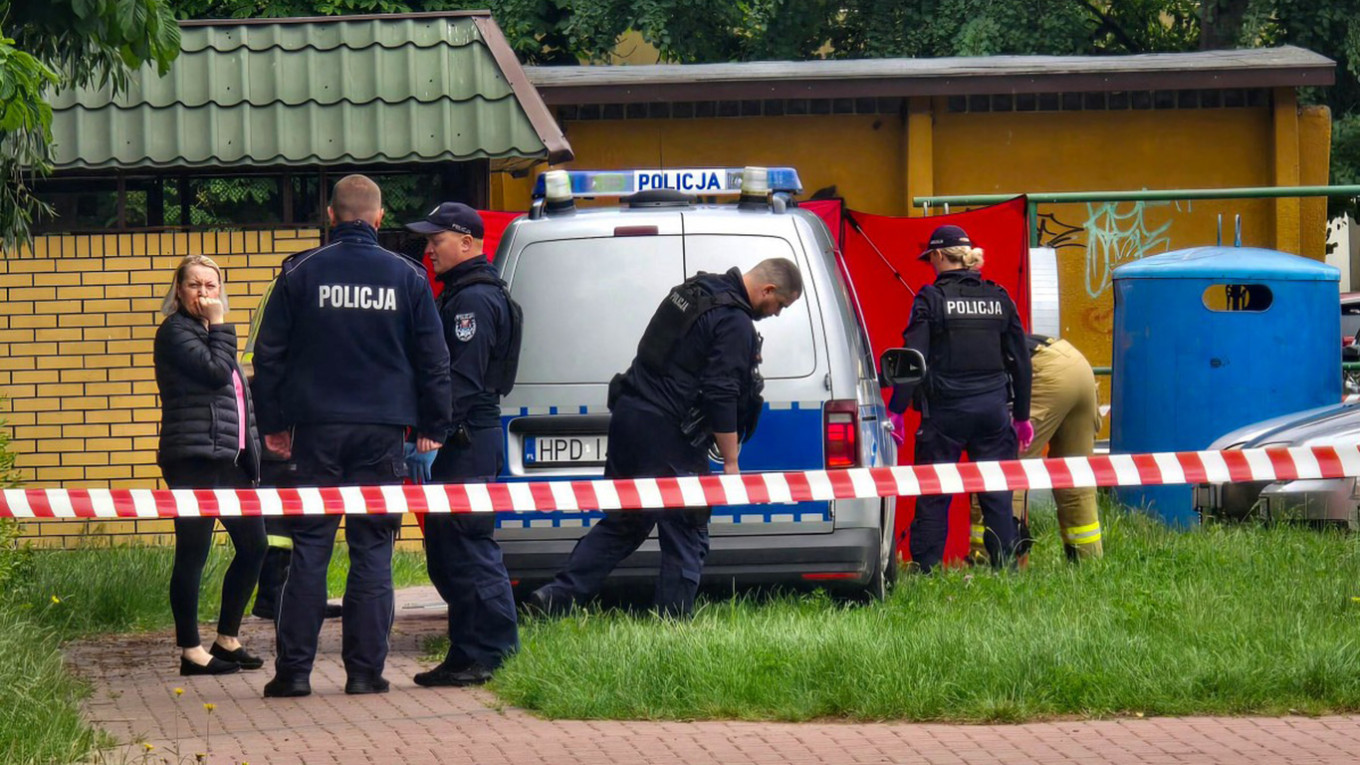 Police work at a crime scene covered with a tent (back R) in Biala Podlaska, eastern Poland on June 16, 2026, where Russian artist Semyon Skrepetsky, known for his satirising Russian President Putin has been shot dead.
Piotr Pyrkosz / SLOWO PODLASIA / AFP
Police work at a crime scene covered with a tent (back R) in Biala Podlaska, eastern Poland on June 16, 2026, where Russian artist Semyon Skrepetsky, known for his satirising Russian President Putin has been shot dead.
Piotr Pyrkosz / SLOWO PODLASIA / AFP
The fatal shooting in eastern Poland of a Russian artist known for his caricatures of President Vladimir Putin was likely politically motivated, Polish Prime Minister Donald Tusk said Wednesday.
"All indications are that this is a political murder," Tusk said of the murder of Semyon Skrepetsky, whose real name is Robert Kuzovkov.
"If it was commissioned by Russia, then this is also a very serious matter with an international dimension," he added.
According to Polish officials, Skrepetsky was shot three times on Monday morning by an unidentified gunman armed with a handgun.
When the artist fell to the ground, he was approached by the assailant, who fired two more shots at close range.
The Polish government says they offered Skrepetsky protection, which he declined.
Two Belarusian citizens were arrested in conjunction with the artist's death, but they have since been released according to Polish officials.
An investigation by Polish services is ongoing.
The case risks rekindling tensions between Poland and Russia, which were exacerbated by drone crashes on Polish territory last autumn that Warsaw blames on Moscow.
Skrepetsky was known for his sometimes provocative caricatures, which targeted prominent Russian political figures ranging from Putin and Soviet dictator Josef Stalin to opposition figure Alexei Navalny and Chechen ruler Ramzan Kadyrov.
One of his best-known works reinterprets a classical Orthodox icon, depicting Stalin cradling Putin in place of the Mother of God holding the infant Jesus.
Skrepetsky moved to Poland in 2021, saying he feared political persecution in Russia.
In exile, he maintained a contrarian stance, attending Russian opposition events while openly criticising the opposition itself.
Several opponents of the Russian authorities have been victims of attacks abroad, including in Britain, Germany, and Lithuania.
Moscow has always denied any involvement in these attacks.
A Message from The Moscow Times:
Dear readers,
We are facing unprecedented challenges. Russia's Prosecutor General's Office has designated The Moscow Times as an "undesirable" organization, criminalizing our work and putting our staff at risk of prosecution. This follows our earlier unjust labeling as a "foreign agent."
These actions are direct attempts to silence independent journalism in Russia. The authorities claim our work "discredits the decisions of the Russian leadership." We see things differently: we strive to provide accurate, unbiased reporting on Russia.
We, the journalists of The Moscow Times, refuse to be silenced. But to continue our work, we need your help.
Your support, no matter how small, makes a world of difference. If you can, please support us monthly starting from just $2. It's quick to set up, and every contribution makes a significant impact.
By supporting The Moscow Times, you're defending open, independent journalism in the face of repression. Thank you for standing with us.
Continue

Not ready to support today?
Remind me later.