By The Straits Times | Created at 2026-10-08 05:06:58 | Updated at 2026-10-08 07:12:02
2 hours ago
By The Straits Times | Created at 2026-10-08 05:06:58 | Updated at 2026-10-08 07:12:02
2 hours ago
SEOUL - A landmine blast that injured three South Korean soldiers has underscored the growing dangers along the heavily fortified border with North Korea, where little margin of error exists for tensions to be defused.
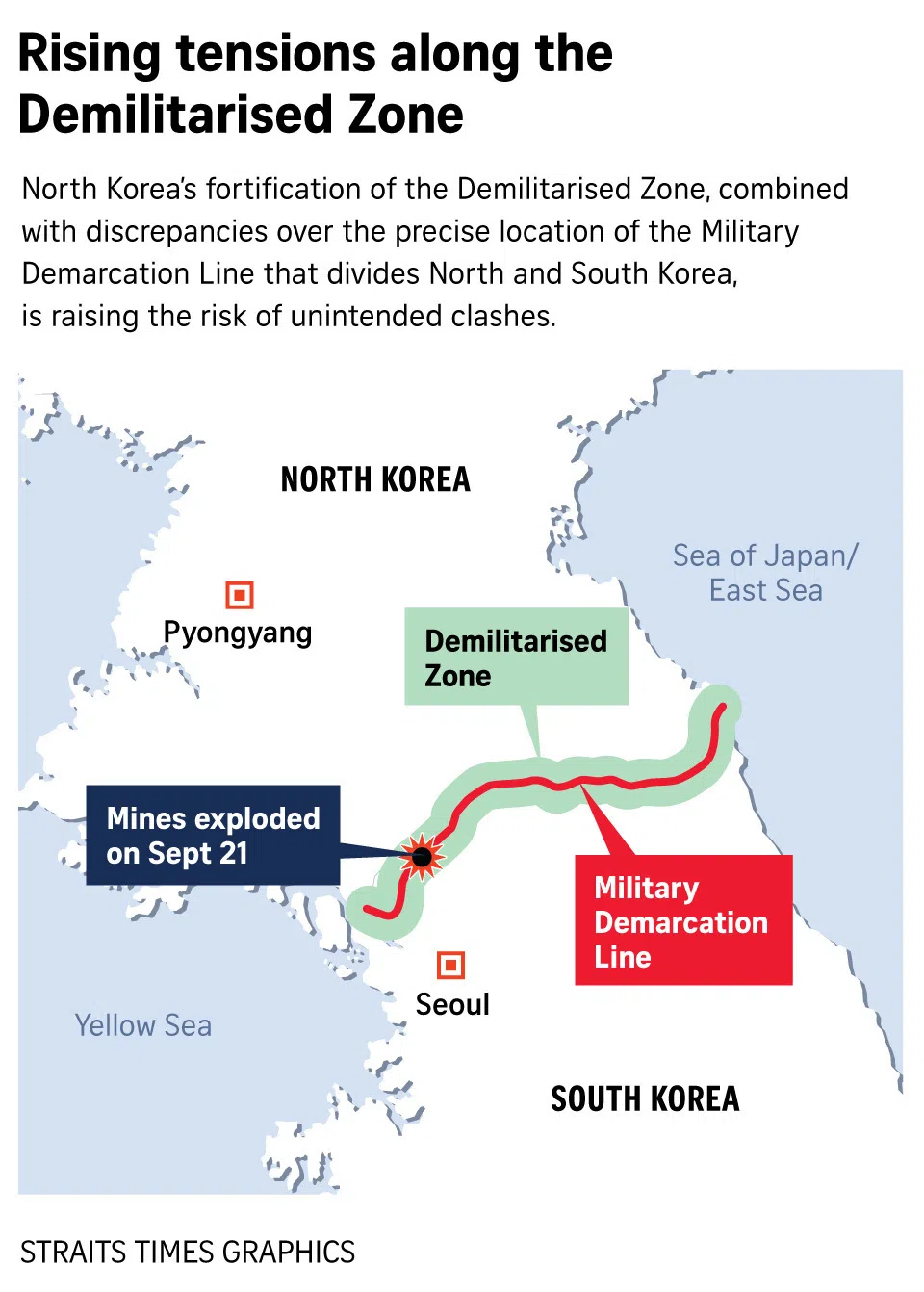
A joint investigation by South Korea and the United Nations Command (UNC) concluded on Oct 5 that the two mines, which exploded on Sept 21 within the Demilitarised Zone (DMZ) separating the two Koreas, were deliberately planted by North Korea. Investigators estimated that the mines were planted as recently as 12 months ago.
This timeframe coincides with North Korea’s border fortification campaign, which began in April 2024 when leader Kim Jong Un recast inter-Korean ties as relations between two hostile states.
Kim instructed the military to sever all inter-Korean road and rail links and to establish physical barriers along the “southern border”. Subsequently, reinforced fences and anti-tank barriers were erected on the North Korean side of the DMZ.
The DMZ is a buffer zone that extends 2km on either side of the Military Demarcation Line (MDL), which has divided the Koreas since the signing of an armistice agreement in July 1953. The two sides remain technically at war.
The mines that exploded on Sept 21 were found 10m south of the MDL on South Korea’s side of the DMZ.
Seoul has demanded an apology and the removal of the mines. However, Kim’s sister, Kim Yo Jong, rejected the findings as fabricated and warned of “immediate and merciless” military retaliation should Seoul take corresponding action.
Both Seoul and Pyongyang have maintained heightened postures on their respective sides of the border, with North Korea’s foreign ministry issuing a statement on Oct 6, warning that if even just “a spark of fire” from the South goes a millimeter beyond the border, the North’s border guard forces “will take an immediate and powerful counteraction”.
Meanwhile, local media reported that South Korean military had kept front-line units at the DMZ ready to open fire at short notice since the Sept 21 blast, as a precaution against any unexpected North Korean military action.
Analysts cautioned that the North’s fortification of the DMZ is increasing the risk of an unintended crisis, particularly as inter-Korean communication remains largely stalled.
The tensions are also threatening to derail President Lee Jae Myung’s efforts to revive dialogue with Pyongyang, amid expectations of a possible summit between US President Donald Trump and Kim before the end of the year.
South Korea’s conservative opposition has accused Lee’s liberal administration of downplaying the incident to avoid worsening inter-Korean relations and has called for retaliatory measures, including the resumption of frontline loudspeaker broadcasts.
Under the previous conservative government led by Yoon Suk Yeol, the loudspeakers broadcast anti-North Korean propaganda to North Korean troops and residents near the border. The broadcasts were suspended in June 2025 after Lee took office, as part of his administration’s efforts to ease military tensions and restore inter-Korean trust.
South Korea’s conservatives have generally taken a harder line towards North Korea, while liberals have tended to favour greater engagement and dialogue with Pyongyang.
Speaking at a parliamentary audit on Oct 6, Foreign Minister Cho Hyun said the government viewed the situation “with great gravity”, stressing the need to balance firm demands on North Korea for an apology with efforts to prevent unnecessary escalation, which he described as “two sides of the same coin”.
President Lee himself has also highlighted the importance of breaking off from a vicious circle of “hostility and confrontation to create a virtuous cycle of peace and prosperity”.
He made the remarks in a speech on Oct 4, marking the 19th anniversary of the Oct 4 Inter-Korean Declaration, signed by former President Roh Moo-hyun and then-North Korean leader Kim Jong Il, the father of current leader Kim Jong Un.
The declaration had sought to improve inter-Korean ties, reduce military tensions and work towards replacing the Korean War armistice with a permanent peace regime.
But the agreement has gone largely unfulfilled. Following a period of diplomatic engagement, the collapse of denuclearisation talks at the second Trump-Kim summit in 2019 sent inter-Korean ties into a rapid decline, culminating in the current state of heightened military tensions.
Any escalation of tensions near the DMZ could develop into an unintended crisis, said Hwang Ji-hwan, an international relations professor at the University of Seoul.
He told The Straits Times that Pyongyang’s reinforcement of its positions along the MDL appears calibrated to respond more decisively should a confrontation occur, while also sending a strong message to Seoul about its commitment to a “hostile two-state relationship” between the Koreas.
Hwang warned that “if efforts by either side to deter the other were to escalate into an armed confrontation, the situation could spiral rapidly”.
And with North Korea refusing to halt its fortification work in the DMZ, the risk of further incidents is growing.
Blurred border
According to South Korea’s defence ministry, the demarcation of the MDL has become increasingly unclear over the years, with the vast majority of the original markers lost to flooding, landslides and erosion, compounded by restrictions on maintenance within the zone. Only around 250 of the original 1,292 markers remain.
With so many physical markers missing, discrepancies have emerged between South Korean and UNC maps of the MDL’s precise location, further complicating efforts to determine the exact ground boundary.
Since the start of 2026, North Korean troops have crossed the demarcation line more than 50 times, a sharp increase from the 17 incursions recorded in 2025.
Seoul proposed talks with Pyongyang in November 2025 to address the discrepancies in MDL mapping and prevent further incursions, but received no response.
The latest incident has underscored the urgency of more precisely demarcating the MDL. Foreign Minister Cho has said that Seoul is in talks with the UNC on how to resolve this outstanding issue.
And while it remains unclear whether North Korea’s planting of the mines was a deliberate provocation or the result of a misjudgment of the MDL, analysts agree that a controlled response from Seoul is necessary to prevent the situation from escalating further.
Andrew Yeo, a senior fellow at the Brookings Institution, pointed out that North Korea’s testing of a hypersonic missile on Oct 4, amid the standoff over the landmine explosion, makes it clear that “North Korea is not open for dialogue”.
He suggested that Seoul step up border patrols and continue its demining operations with the UNC.
Cho Han-bum of the state-run think tank Korea Institute for National Unification in Seoul warned against tough responses such as the resumption of loudspeaker broadcasts that South Korea’s opposition is pushing for.
“It not only inflames tensions, but also creates more problems, such as harm to residents in the border areas,” said Cho.
“Beyond a principled response, which is to establish clearly that North Korea was responsible, demanding an apology and assurances against recurrence, and pursuing military dialogue between the two Koreas, there are few viable options at this point,” said the analyst.