 By Better Living | Created at 2026-10-20 01:37:09 | Updated at 2026-10-20 02:59:13
1 hour ago
Yes, pecans go bad. They are rich in oil, so they turn rancid, and heat makes it happen faster. Below: how long each form lasts, how to spot a bad pecan, and which source each figure comes from.
Do pecans go bad?
The short answer: Yes. The National Pecan Shellers Association (NPSA) says shelled pecans keep about nine months in the refrigerator and up to two years in the freezer, and in-shell pecans 6 to 12 months in a cool, dry place. Pantry storage for shelled pecans is shorter, about 2 months for halves per one grower. These are quality windows, and signs of trouble are an oily film, a strange odor, mold or insect damage.
For a complete pantry storage reference, see our Food Storage Guide. Got pecans to use up? Try our pumpkin pecan muffins or maple pecan pie bars.
📋 Do Pecans Go Bad: At a Glance
| Shelled, refrigerated | NPSA: about 9 months in an airtight container. NCHFP: nuts refrigerated at 32 to 45°F keep quality for one year |
| Shelled, frozen | NPSA: up to 2 years. K-State: up to 1 year, with 6 months preferred |
| In-shell | NPSA: 6 to 12 months in a cool, dry place. NMSU: 4 months at 70°F, 18 months at 32 to 36°F |
| Pantry (shelled) | Priester’s table: about 2 months for halves and 1 month for pieces. Heat speeds rancidity |
| Roasted and salted | One brand: best if used by 6 months, then 12 to 18 months refrigerated once opened |
| Expiration date | Diamond of California says to go by the best before marking. These windows are quality guidance |
| Signs of trouble | An oily film, a strange odor, mold, insect damage or a shriveled kernel |
Key Takeaways
- Yes, pecans go bad. They are high in oil, and rancidity develops faster at warm temperatures. Cold, dry, sealed storage slows it.
- The National Pecan Shellers Association says shelled pecans keep about nine months in the refrigerator and up to two years in the freezer. It says in-shell pecans keep 6 to 12 months in a cool, dry place.
- The sources disagree on the long end. K-State says up to one year frozen, NPSA says two years, and New Mexico State University (NMSU) says in-shell pecans can last 5 years or more at 0°F. We show each source’s number and don’t pick one.
- Pantry storage is the shortest. Priester’s, a pecan grower, gives about 2 months for shelled halves and 1 month for pieces. Pecan South reports University of Georgia research finding rapid quality loss at 32°C (about 90°F).
- Rancidity is mainly a quality problem. NCHFP says it makes nuts unappealing though not unsafe, in a post about nuts in jars. Visible mold is different, and we’d discard moldy pecans.
- Contamination is separate from spoilage. A Government of Canada notice recalled raw pecan halves over possible Salmonella in February 2026 and says contaminated food may not look or smell spoiled. Storage can’t fix that.
- Published figures run from about 2 months (shelled halves in a pantry) to 5 years or more (in-shell pecans at 0°F), so the form and the temperature decide the answer.
- For roasted and candied pecans we found guidance from one maker only, so check your package. The USDA FoodKeeper data could not be reached.
How Long Do Pecans Last?
Start with the form you have, because shelled, in-shell and roasted pecans run on different clocks. These are quality windows from growers, extension services and one maker, not expiration dates.
| Shelled, refrigerator | About 9 months in an airtight container such as a jar with a lid | NPSA |
| Shelled, freezer | Up to 2 years in sealed plastic bags. Can be thawed and refrozen repeatedly during that period | NPSA |
| Shelled, refrigerator or freezer | K-State: freezer is best, up to 1 year, with 6 months preferred | K-State |
| Shelled, room temperature | Halves about 2 months and pieces about 1 month in a pantry at 70 to 80°F, per a table credited to Georgia researchers | Priester’s |
| Shelled, NMSU table | 3 months at 70°F, 6 months at 47 to 50°F, 12 months at 32 to 36°F | NMSU |
| Shelled halves vs. pieces, refrigerated | Priester’s table: halves 9 months, pieces 5 months. NMSU: limit pieces to 1 or 2 months at about 32°F | Priester’s, NMSU |
| In-shell, cool dry place | 6 to 12 months | NPSA |
| In-shell, 70°F | 4 months | NMSU |
| In-shell, 32 to 36°F | 18 months | NMSU |
| In-shell, 0°F | 5 years or more | NMSU |
| Roasted and salted (one brand) | Best if used by 6 months. Once opened, 12 to 18 months refrigerated and up to 2 years frozen | Hudson Pecan Company |
| Candied (one brand) | Praline Pecans: once opened, 12 to 18 months refrigerated or up to 2 years frozen | Hudson Pecan Company |
| After coming out of cold storage | NPSA: pecans stay good an additional two months (approximate quality guidance) | NPSA |
How Long Do Shelled Pecans Last?
Shelled pecans keep about nine months in the refrigerator and up to two years in the freezer, per the National Pecan Shellers Association. Those are quality windows, not expiration dates.
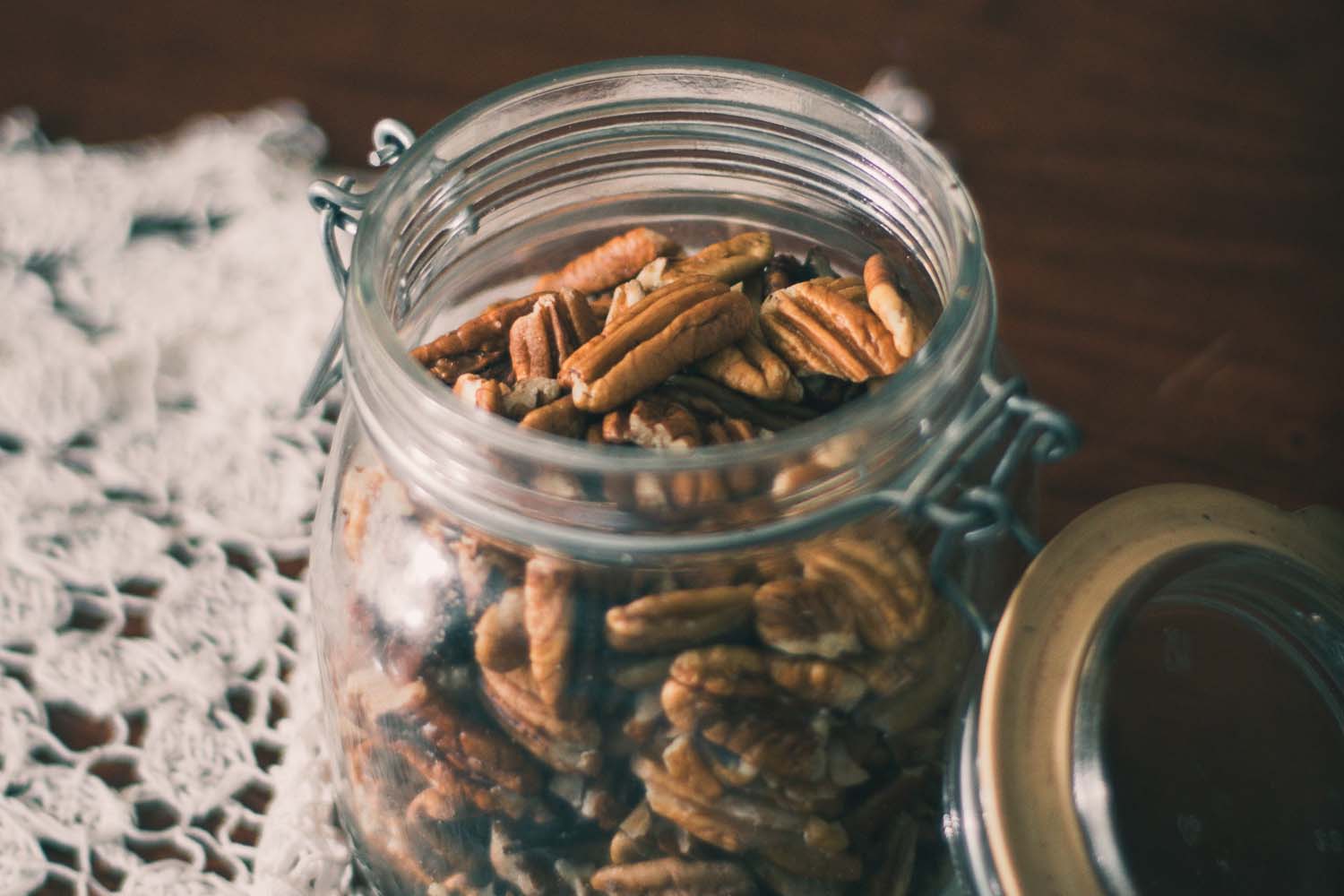
The National Pecan Shellers Association’s storage tips page (page copyright 2021) says shelled pecans can be kept in the refrigerator for about nine months and in the freezer for up to two years. It says airtight containers, such as jars with lids, are best for the refrigerator, and sealed plastic bags are best for the freezer. It says pecans can be thawed and refrozen repeatedly during the two-year period without loss of flavor or texture.
Other sources give different figures, partly because they cover different temperatures and forms. K-State Research and Extension’s nut storage story (December 2022) quotes horticulturist Ward Upham saying nuts can be kept in a freezer up to one year, and that using them within six months is preferred. That story covers nuts in general, not pecans alone. The National Center for Home Food Preservation’s nutmeats post (November 2014) says refrigerated nuts at 32 to 45°F maintain quality for a year. It says frozen nuts at 0°F keep quality for 1, 2 or even 3 years depending on the type.
Room temperature is the shortest window. Priester’s Pecans’ storage tips page gives about 2 months in a pantry (70 to 80°F) for halves and 1 month for pieces, in a table it attributes to Georgia Experiment Station research. NMSU’s table gives shelled pecans 3 months at 70°F, 6 months at 47 to 50°F and 12 months at 32 to 36°F. Pecan South magazine’s shelled pecan storage article (February 2026) reports University of Georgia research in which shelled pecans kept acceptable quality for several months at 23°C (about 73°F) but with rising deterioration risk. It says pecans stored at 32°C (about 90°F) lost quality rapidly regardless of packaging.
Pieces are the weak spot. NMSU says pieces have a shorter shelf life than halves and should be limited to 1 or 2 months at about 32°F. Priester’s table gives 5 months in the refrigerator. We can’t reconcile the two, so use the lower figure if you want a margin.
| NPSA (trade association) | Shelled: about 9 months refrigerated, up to 2 years frozen. In-shell: 6 to 12 months cool and dry |
| NMSU (guide revised 2005) | In-shell: 18 months at 32 to 36°F and 5 years or more at 0°F. Beyond a year, use the freezer |
| UGA Extension (2018) | At 32 to 34°F, 65% humidity and 4.5% moisture, in-shell and shelled may stay acceptable up to 3 years, with quality suffering somewhat after 18 months |
| NCHFP (2014) | Nuts refrigerated at 32 to 45°F keep quality for a year, and frozen at 0°F for 1, 2 or even 3 years depending on the nut |
| K-State (2022) | Freezer up to one year. Using nuts within six months is preferred |
| Diamond of California | Refrigerate after opening. Ideal storage is 45 to 55°F in tightly sealed containers at 55 to 65% relative humidity (tree nuts generally) |
How Long Do In-Shell Pecans Last?
In-shell pecans last longer than shelled ones because the shell protects the kernel. UGA Extension’s Storing Pecans post (January 2018) says in-shell nuts generally decline in quality more slowly than shelled nuts. NMSU calls an unbroken pecan shell one of the best packages for kernels.
NPSA says in-shell pecans keep 6 to 12 months in a cool, dry place. NMSU says they can remain good for 4 months at 70°F, and 18 months at 32°F to 36°F. It says storage may extend to 5 years or more at 0°F. UGA Extension says pecans stored at 32 to 34°F, 65% humidity and 4.5% moisture may stay acceptable up to 3 years, though quality may suffer after 18 months.
Those sources measure different conditions. For a home kitchen, we’d use a cool cupboard first, the refrigerator next, and the freezer for anything beyond a year, following NMSU.
Cracked or broken shells are a different case. NMSU says that as shelled pecans turn rancid, an oil film starts at the broken spots and spreads across the kernel. That is about shelled kernels, but a cracked shell leaves the kernel exposed to air, and we’d treat those nuts like shelled ones.
How Long Do Roasted or Candied Pecans Last?
We found one maker’s figures for roasted pecans. Hudson Pecan Company’s roasted pecans page says its roasted and salted Georgia pecans are best if used by 6 months. It says that once opened, they can be refrigerated for 12 to 18 months and frozen for up to 2 years, and to store them alone because pecans can absorb odors.
That brand’s refrigerated figure is longer than NPSA’s nine months for shelled pecans, and the page doesn’t explain the difference. Treat it as one maker’s claim for one product. Check your own package.
Candied and coated pecans vary by recipe and packaging, so follow the maker’s storage instructions. Hudson Pecan Company’s Praline Pecans page says its Praline Pecans can be refrigerated for 12 to 18 months and frozen for up to 2 years once opened, and that guidance applies to that product. We found no extension source for candied pecans.
Do Pecans Have an Expiration Date?
Diamond of California’s non-retail products page tells buyers to refer to the best before markings on its packaging for shelf-life information. USDA’s food product dating page says product dates are about quality rather than safety, except on infant formula. That is general guidance, not a pecan-specific deadline, and the windows above are quality guidance too.
In-shell pecans sold loose may carry no printed date, so we’d treat the purchase date as the best clue. A bag past its best-by date is a quality question. Check it for the signs below before you use it, and remember that a normal look doesn’t prove quality.
How Can You Tell If Pecans Are Bad?
Look for an oily film, an odd or paint-like smell, mold, webbing or small holes, or conspicuously shriveled kernels.
Priester’s lists an odd smell, an oily look and an off taste as the marks of rancid pecans. We don’t suggest tasting to test. NMSU describes that same oil film, spreading from broken spots, as rancidity develops.
USDA’s grade standards for shelled pecans (effective July 2024) is a voluntary grading standard for shelled pecans, not consumer advice. It treats distinctly rancid kernels, any plainly visible mold, decay, and insects, web, frass or any distinct evidence of insect feeding as serious damage. It defines rancidity by taste and says staleness of flavor shall not be classed as rancidity. It lists a very conspicuously wrinkled kernel as damage. K-State says excessive water loss can leave nutmeats shriveled and that the fats can spoil, developing an off-flavor or rancid taste.
Our checklist, built on those sources: a paint-like, sour or stale-oil smell, an oily film, mold, webbing or small holes, or a rubbery or dry, shriveled kernel. A few signs of age are a reason to replace the bag. Smell alone isn’t a safety test, and a bag with none of these signs may still be past its best.
Small holes matter in the shell too. Texas A&M’s Evaluating Pecan Problems fact sheet (a 1995 orchard fact sheet) describes a small hole in the shell with the kernel eaten as pecan weevil damage. It also ties black spots on the kernel to stink bug damage in the orchard. Those are growing problems, not storage spoilage, so we’d discard the nut with the hole and judge a spotted kernel by the other signs.
Can Bad Pecans Make You Sick?
Rancid pecans are mostly a quality problem, while mold and contamination are safety problems. The National Center for Home Food Preservation’s post on canning nut meats (January 2013) says rancidity will eventually develop in nuts, making the product unappealing though not unsafe. That statement is about nuts stored in jars, not pecans specifically, and we found no pecan-specific source on illness from rancid kernels.
Mold is a different matter. FDA’s mycotoxins page (updated July 2026) says aflatoxins are produced by certain Aspergillus molds. It lists peanuts, corn and tree nuts such as Brazil nuts and pistachios among the foods most susceptible, and says regularly eating foods with aflatoxins can increase the risk of liver cancer. That page doesn’t name pecans, but FDA’s compliance program on mycotoxins in foods lists pecans among the nuts susceptible to aflatoxin and potentially ochratoxin A contamination. We found no source saying you can judge a toxin by sight or smell, so visible mold is a reason to discard and a clean look doesn’t rule contamination out. We’d not try to cut around mold.
Contamination is a separate issue from spoilage. The Government of Canada’s recall notice for Johnvince raw pecan halves (February 2026) covers 230-gram tubs recalled over possible Salmonella, with no reported illnesses. It says food contaminated with Salmonella may not look or smell spoiled but can still make you sick, and that recalled product should be thrown out or returned. That recall was in Canada. Good storage can’t fix contamination, so check FDA’s recalls page or your local recall list when you buy.
How Should You Store Pecans?
Keep pecans cold, dry and sealed. NPSA says to keep them in airtight containers in the refrigerator or freezer. K-State recommends a solid plastic container with a tightly fitted lid or a heavy-grade resealable bag, and says nuts quickly absorb flavors from other stored products. Our guide on whether pecans need to be refrigerated covers the pantry, refrigerator and freezer in detail. We’d also buy only what you’ll use within a few months, or choose in-shell pecans for longer pantry life, given NPSA’s longer in-shell window.
What Can You Make With Pecans Before They Go Bad?
The easiest way to beat rancidity is to use pecans while they’re fresh. NPSA says shelled pecans keep about nine months in the refrigerator, so a bag bought for the holidays has time to become several batches of baking. Our pumpkin pecan muffins and keto pumpkin pecan muffins put them in a muffin, and our maple pecan pie bars are made without corn syrup. For a lighter use, there’s our strawberry pecan salad. Pecans also go into loaves, so for a bake where you could add chopped pecans, see our pumpkin spice bread and banana bread.
Baking brings other pantry staples with their own clocks. If you’re making the bars, check your syrup with our guides on whether maple syrup goes bad and whether maple syrup needs to be refrigerated. Most baking calls for butter, covered in whether butter goes bad, and if you’re making the muffins, canned pumpkin has its own guide in whether canned pumpkin goes bad. Serving a crowd? See our maple pumpkin pie for dessert, whether pumpkin pie goes bad for leftovers and our Thanksgiving wine pairing guide.
Signs Something Is Actually Wrong
- Visible mold on a kernel or inside a shell.
- A strange, paint-like, sour or stale-oil smell.
- An oily film on the kernels, which NMSU ties to developing rancidity.
- Webbing, insect debris or small holes, which the USDA grade standard counts as serious damage.
- Shriveled, conspicuously wrinkled or rubbery kernels.
These signs follow NMSU, Priester’s and the USDA grade standard, and the checklist is our own. The grade standard defines rancidity by taste, and we don’t suggest tasting to test. A bag with none of these signs may still be past its best.
Normal Things That Aren’t a Problem
- Stale flavor without a rancid smell. The USDA grade standard says staleness of flavor shall not be classed as rancidity.
- Cold pecans straight from the freezer. NPSA says no thawing is necessary.
- Thawing and refreezing. NPSA and Priester’s both say pecans can be refrozen repeatedly.
- A drier, more brittle texture after long freezing. UGA Extension says pecans become more dry and brittle the longer they are kept at freezing temperatures.
Quick Storage Reference
- Shelled, refrigerator: Airtight jar. About 9 months (NPSA).
- Shelled, freezer: Sealed bag. Up to 2 years (NPSA), or 1 year (K-State).
- In-shell: Cool, dry place, 6 to 12 months (NPSA).
- Pantry, shelled: About 2 months for halves (Priester’s). Keep away from heat.
- Odors: Keep them tightly sealed and away from strong-smelling foods.
- After cold storage: NPSA says an additional two months, as approximate quality guidance.
- Never: Keep them near the stove or in a hot car.
| Shelled halves bought last month, in the pantry | Within the roughly 2 months Priester’s gives for halves at room temperature. Move them to the fridge if you won’t use them soon. |
| Shelled pecans in the pantry for 6 months | Beyond the roughly 2 months Priester’s gives for halves. Check for an oily film, odor, shriveling or mold before using them, and remember a normal look doesn’t prove quality. |
| Opened bag of shelled pecans, sealed jar in the fridge for 6 months | Within the about nine months NPSA gives for refrigerated shelled pecans. |
| Shelled pecans in the fridge for 14 months | Beyond NPSA’s nine months and the one year NCHFP gives. They may have lost flavor and gone rancid, so check them carefully. |
| Shelled pecans in the freezer for 18 months | Within NPSA’s two years. K-State says up to one year, so quality may be lower under the stricter view. |
| Shelled pecans in the freezer for 3 years | Beyond NPSA’s two years and K-State’s one year. We found no source setting a safety cutoff, and texture and flavor may have declined. |
| In-shell pecans in a cool cupboard for 8 months | Within NPSA’s 6 to 12 months. |
| In-shell pecans in a warm garage over summer | Heat speeds rancidity. Pecan South reports rapid quality loss at 32°C (about 90°F), so check the kernels carefully. |
| Pecans stored on a shelf above the stove | Heat speeds rancidity, and UGA Extension and Diamond both give humidity ranges for storage. A warm, steamy spot is the opposite of that, so check the pecans before use. |
| Pecans that smell like paint or old oil | Discard them. A paint-like or stale-oil smell is reason enough to replace the bag. NMSU notes pecans absorb odors, so also check what they were stored near. |
| Kernels with visible mold | Discard them. FDA says aflatoxins are produced by certain molds, and we wouldn’t cut around mold. |
| In-shell pecan with a small hole and a hollow kernel | Texas A&M describes that as pecan weevil damage. Discard that nut and check the rest of the bag. |
| Shriveled, wrinkled kernels with no odor | A quality issue. The USDA grade standard counts conspicuous wrinkling as damage, and K-State ties shriveling to water loss. |
| Pecans from a recalled lot | Discard or return them as the recall notice says. The Government of Canada notice says contaminated food may not look or smell spoiled, so a normal look proves nothing. |
| Roasted salted pecans, opened and refrigerated for 10 months | Within the 12 to 18 months one brand, Hudson Pecan Company, gives for its roasted pecans. Check your own package. |
| Frozen pecans thawed and refrozen | Within what NPSA and Priester’s allow. Both say pecans can be refrozen repeatedly. |
How We Checked This
In October 2026 we read the National Pecan Shellers Association’s storage tips page, New Mexico State University’s Storing Pecans guide (revised 2005) and the UGA Extension pecan team’s Storing Pecans post. We read the National Center for Home Food Preservation’s posts on nutmeats, K-State Research and Extension’s nut storage story and Pecan South magazine’s 2026 article on shelled pecan storage. We read Priester’s Pecans’ storage tips, Diamond of California’s non-retail products page and Hudson Pecan Company’s roasted and Praline Pecans pages. We also read the USDA grade standards for shelled pecans, FDA’s mycotoxins page and FDA’s compliance program on mycotoxins. We read USDA’s food product dating page, a Government of Canada recall notice and Texas A&M’s Evaluating Pecan Problems fact sheet. We could not reach USDA’s FoodKeeper data, so we don’t cite it. Where we found no source we say so, and our own suggestions say so plainly, with wording like we’d or we suggest. This article is general information, not medical advice.
Do Pecans Go Bad FAQ
Do pecans go bad?
Yes. Pecans are high in oil and turn rancid over time, faster in heat. NPSA says shelled pecans keep about nine months refrigerated and up to two years frozen, and in-shell pecans keep 6 to 12 months in a cool, dry place.
How long do pecans last?
It depends on the form and the storage. NPSA gives about nine months for shelled pecans in the refrigerator and up to two years in the freezer. In-shell pecans keep 6 to 12 months in a cool, dry place.
How long do shelled pecans last in the pantry?
Priester’s table gives about 2 months for halves and 1 month for pieces at 70 to 80°F, and NMSU’s table gives shelled pecans 3 months at 70°F. Pecan South reports several months at 23°C (about 73°F) with rising deterioration risk. We’d move them to the fridge after a month or two.
How long do shelled pecans last in the refrigerator?
NPSA says about nine months in an airtight container, and NMSU’s table gives shelled pecans 12 months at 32 to 36°F. NCHFP says nuts refrigerated at 32 to 45°F maintain quality for a year. NMSU also says pieces should be limited to 1 or 2 months at about 32°F.
See also

How long do pecans last in the freezer?
NPSA says up to two years. K-State says up to one year, with six months preferred. NMSU says in-shell pecans can last 5 years or more at 0°F. See whether pecans need to be refrigerated for how to freeze them.
How long do in-shell pecans last?
NPSA says 6 to 12 months in a cool, dry place. NMSU says 4 months at 70°F and 18 months at 32 to 36°F. UGA Extension says up to 3 years under ideal conditions, with quality suffering somewhat after 18 months.
Do pecans expire?
They have a quality window, not a pecan-specific safety expiration date that we could find. USDA says product dates are about quality rather than safety, except on infant formula. Diamond of California says to go by the best before marking.
Can you eat expired pecans?
We found no source that sets a safety cutoff. Past the window they may be stale or rancid. Check for an oily film, odd smell, mold or insect damage first, and don’t rely on a normal look to prove quality.
How can you tell if pecans are bad?
Priester’s lists an odd smell, an oily look and an off taste. NMSU describes an oil film spreading over kernels. The USDA grade standard counts mold, decay, insects and web as serious damage. We don’t suggest tasting.
What do rancid pecans smell like?
We found no extension source that describes the smell. Priester’s mentions an odd smell. We’d treat a paint-like, sour or stale-oil smell as a reason to discard.
Can rancid pecans make you sick?
NCHFP says rancidity makes nuts unappealing though not unsafe, in a post about nuts in jars. We found no pecan-specific source on illness. Moldy pecans are different, and we’d discard them.
What are the white or black spots on pecans?
We found no storage source on white spots. Texas A&M ties black spots on kernels to stink bug damage in the orchard. Mold is a reason to discard, so judge a spotted kernel by odor, texture and any fuzz.
Why are my pecans soft or chewy?
NMSU says humidity above the values it gives can cause kernel molding and texture deterioration, with pecans turning soft and rubbery. So treat a texture change as a reason to check for mold and odor, not as harmless. The USDA grade standard separates staleness from rancidity.
What does a hole in a pecan shell mean?
Texas A&M describes a small hole in the shell with the kernel eaten as pecan weevil damage. The USDA grade standard counts insect feeding as serious damage. We’d discard that nut.
Do roasted pecans go bad faster?
We found one maker’s figures. Hudson Pecan Company says best if used by 6 months, then 12 to 18 months refrigerated once opened. It gives the same 12 to 18 months for its Praline Pecans. Check your own package.
Can pecans carry Salmonella?
Yes, nuts can be recalled for it. A Government of Canada notice from February 2026 recalled raw pecan halves over possible Salmonella and says contaminated food may not look or smell spoiled. Check recall lists when you buy.
How can you tell if in-shell pecans are bad?
Texas A&M ties a small hole in the shell to pecan weevil damage, and the USDA grade standard counts mold and insect evidence as serious damage. We found no extension source on the shake or rattle test, so we’d crack one and check the kernel.
What if a pecan tasted bitter or harsh?
We don’t suggest tasting to test, but if you already did, treat it as a warning. The USDA grade standard defines rancidity by taste. We found no extension source on bitterness, so stop eating that batch and check the rest.
Can you freeze pecan pie?
NCHFP says to bake, cool rapidly and freeze briefly before packaging, and that frozen pecan pies stored at 0°F are expected to last 3 to 4 months. For another holiday pie, see whether pumpkin pie needs to be refrigerated.
Can I use old pecans for baking?
We found no source on baking with old pecans. Cooking doesn’t make a questionable nut a good one, so we’d skip any with the signs above. Got a fresh batch? Try our pumpkin pecan muffins or maple pecan pie bars.
What should I do with a lot of pecans?
Freeze what you won’t use soon. NPSA says shelled pecans keep up to two years in the freezer with no thawing necessary, and about nine months in the refrigerator. Then bake in batches, such as our pumpkin pecan muffins or maple pecan pie bars.
Further Reading

Better Living may earn commissions through affiliate links and may occasionally feature sponsored or partner content. If you make a purchase through our links, we may receive a small commission at no cost to you.