 By The Epoch Times | Created at 2026-07-25 10:32:07 | Updated at 2026-07-25 12:16:44
2 hours ago
By The Epoch Times | Created at 2026-07-25 10:32:07 | Updated at 2026-07-25 12:16:44
2 hours ago
Doctors should warn patients that traveling to China for an organ transplant could result in another person being killed, medical and legal experts said during a July 21 forum on Capitol Hill.
“Every transplant patient should be told by the doctor who’s dealing with them that if you go abroad for a transplant to China, someone may be killed for their organs for that transplant,” Canadian human-rights lawyer David Matas said while joining the discussion remotely.
Matas said physicians do not need to wait for legislation before giving that warning, and medical societies could incorporate it into professional ethics rules.
He joined neurologist Dr. Alejandro Centurion, Piero Tozzi of the America First Policy Institute, and Erping Zhang of the Falun Dafa Information Center for a panel at the Chinese Freedom & U.S.–Taiwan Security Forum.
The speakers urged governments and medical institutions to combine criminal penalties, transplant tourism restrictions, professional education, patient warnings, sanctions, and international coordination in response to forced organ harvesting attributed to the Chinese regime.
Warning Patients Before They Travel
Matas said transplant candidates often do not closely follow evidence concerning China’s organ transplant system and may not know the potential source of an organ offered on unusually short notice.
“People with morals will think twice about going to China once they’ve heard that,” he said.
Doctors would still provide follow-up care after a patient returned, Matas said. But in jurisdictions that criminalize participation in transplant abuse, physicians could also be required to report the case to authorities.
The warnings could be adopted by transplant associations regardless of whether a national law is in place, he said.
Centurion, associate director of medical affairs at Doctors Against Forced Organ Harvesting (DAFOH), said education should extend to medical students, physicians, transplant societies, licensing boards, professional associations, governments, and the public.
He said ethics training on forced organ harvesting could be incorporated into continuing medical education courses required by physicians.
Centurion said China’s censorship and refusal to permit independent scrutiny have made it difficult to obtain the type of access that would ordinarily be expected in a criminal investigation.
“The pursuit of perfect evidence must never become an excuse for moral paralysis,” he said.
Abuses Spanning Decades
Matas and former Canadian Secretary of State David Kilgour began
investigatingallegations of organ harvesting from Falun Gong practitioners in 2006.
Falun Gong, also known as Falun Dafa, is a spiritual discipline and meditation practice based on the principles of truthfulness, compassion, and tolerance. The practice was first introduced to the public in 1992 and quickly grew in popularity to reach an estimated 70 million to 100 million practitioners by the decade’s end.
In July 1999, fearing that Falun Gong’s popularity threatened the regime’s power, the CCP’s top leadership launched a brutal persecution campaign aimed at eradicating the practice. Since then, untold numbers of practitioners have been subjected to arbitrary detention, forced labor, torture, and forced organ harvesting.
Matas and Kilgour’s work relied on telephone calls to Chinese hospitals, transplant volumes, short waiting periods, witness accounts, medical testing of detainees, and the absence of a disclosed voluntary-donor pool sufficient to explain the number of procedures.
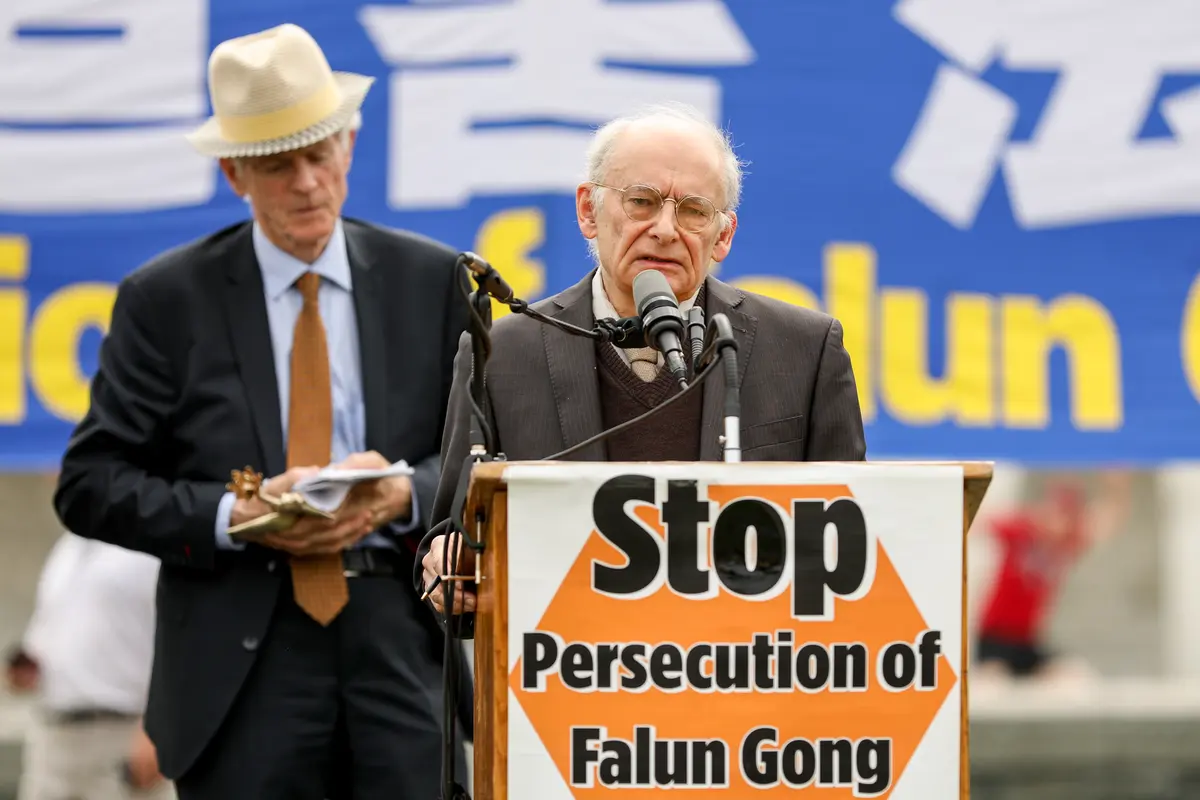
David Matas (R) speaks at a rally after receiving the Friends of Falun Gong Human Rights award jointly with David Kilgour (L) in Washington on June 20, 2018. Samira Bouaou/The Epoch Times
An independent people’s tribunal chaired by British barrister Geoffrey Nice later
concludedin 2019 that forced organ harvesting had occurred in China for years on a substantial scale. The tribunal said Falun Gong practitioners had probably been the principal source of organs and that it had found no evidence the practice had stopped.
U.N. human-rights experts
saidin 2021 that they were alarmed by reports of organ harvesting targeting Falun Gong practitioners, Uyghurs, Tibetans, Muslims, and Christians held in Chinese detention facilities. The experts cited allegations that detainees were subjected to blood tests, ultrasounds, and organ examinations without informed consent.
Matas told the forum that Beijing’s explanations for the source of transplant organs have shifted over time—from denying the use of executed prisoners to acknowledging it, and later claiming a transition to voluntary donations.
He said a 1984 Chinese regulation permitting the use of organs from executed prisoners under certain conditions remained in place even after officials announced the transition.
Congress Pressed to Act
The panel’s recommendations came as two major forced organ harvesting measures remained before the Senate.
The U.S. House of Representatives passed the
Stop Forced Organ Harvesting Actin 2025. The bill would establish criminal penalties for knowing participation in forced organ trafficking, authorize sanctions and visa restrictions, and require federal reporting.
Rep. Chris Smith (R-N.J.), co-chair of the Congressional-Executive Commission on China,
saidat a May 14 hearing that the measure could bring penalties of up to 20 years in prison and fines of as much as $1 million.

Rep. Chris Smith (R-N.J.), Congressional-Executive Commission on China (CECC) chair, after a hearing about the Chinese Communist Party’s (CCP) forced organ harvesting in Washington on March 20, 2024. York Du/The Epoch Times
A second measure, the Falun Gong and Victims of Forced Organ Harvesting Protection Act, was awaiting further action. The Senate bill, S.4009, would impose sanctions on people responsible for involuntary organ harvesting in China and require the State Department to report on the Chinese Communist Party’s policies and transplant system.
Tozzi said state restrictions on insurance coverage and public funding could also deter Americans from seeking transplants in China.
Medical Institutions Urged to Cut Ties
Centurion said medical institutions should review training programs, research partnerships, data sharing, and professional exchanges involving Chinese transplant centers.
The International Society for Heart and Lung Transplantation
announcedin 2022 that it would not accept research submissions involving human donors from China because of concerns about transplant ethics.
Centurion called for an independent international investigation with access to hospitals, detention facilities, donor records, and transplant data.
He said medical organizations should not normalize Chinese transplant institutions while basic questions about organ sourcing remain unresolved.
“Physicians are entrusted to prevent harm, protect human life, and defend human dignity—not simply to document atrocities after every doubt has been eliminated,” he said.

Dr. Alejandro Centurion, associate director of medical affairs at DAFOH, speaks at a rally outside the American Transplant Congress 2024 in Philadelphia on June 2, 2024. Frank Liang/The Epoch Times
Covert Calls Presented at Forum
Zhiyuan Wang, president of the World Organization to Investigate the Persecution of Falun Gong (WOIPFG), separately presented recordings of calls to Chinese officials and medical personnel.
Wang said investigators placed calls while posing as officials, prospective patients, or relatives seeking organs. WOIPFG
reportedin 2018 that, when doctors at 13 hospitals were asked whether they had used organs from Falun Gong practitioners, 10 admitted they had, six did not deny it, and one denied it.
In one
recordingthat was made in 2020, Li Guowei, a kidney transplant surgeon at Xijing Hospital, which is affiliated with the PLA Air Force Medical University (formerly the Fourth Military Medical University), offered to let the caller see a prospective donor in his 20s.
Wang said WOIPFG had compiled evidence concerning hundreds of hospitals and thousands of doctors.
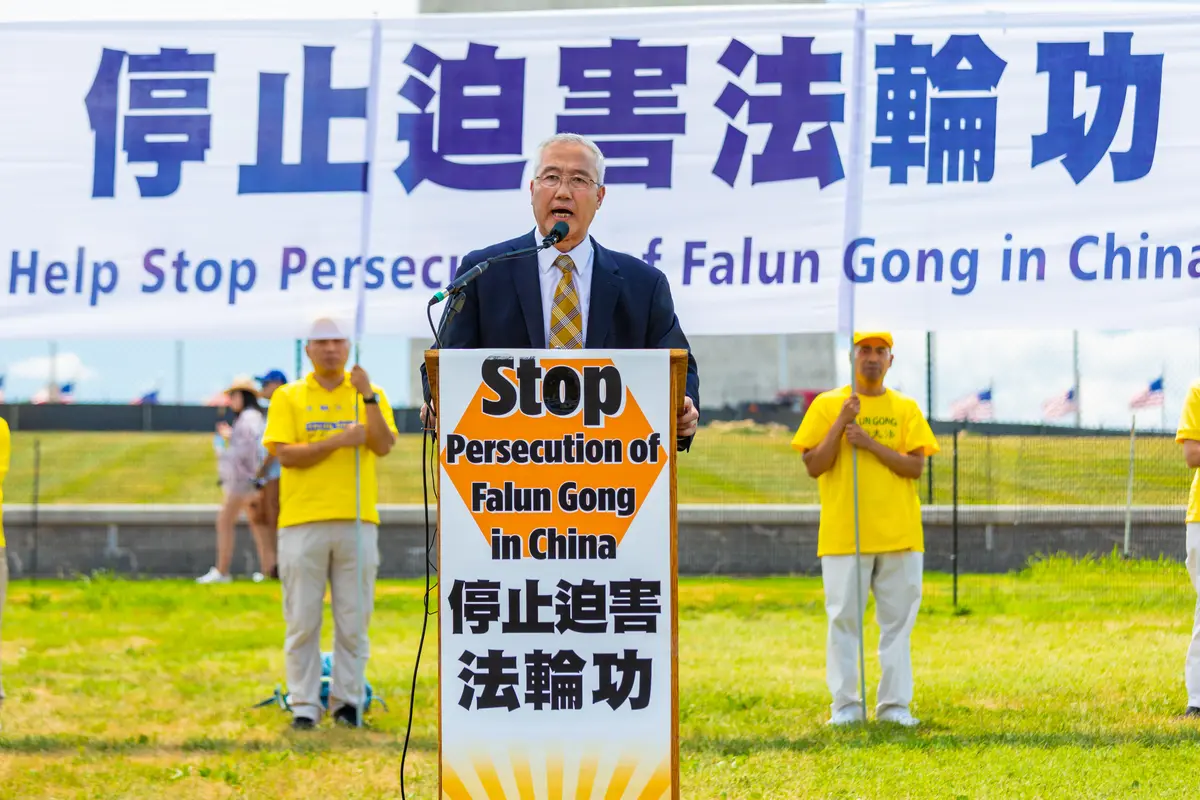
Wang Zhiyuan, chairman of the World Organization to Investigate the Persecution of Falun Gong, speaks at a rally calling for an end to the persecution of Falun Gong, in Washington on July 19, 2018. Mark Zou/Epoch Times
Medical and Moral Responsibility
Centurion said the medical profession should not treat the issue solely as a geopolitical dispute or wait for criminal courts to establish every allegation before taking ethical precautions.
He urged medical schools to teach the issue, professional associations to adopt formal positions, and doctors to speak directly with patients considering overseas transplantation.
Matas said those conversations could prevent patients from becoming part of an abusive system before legislation catches up.