
 By The War Zone | Created at 2026-08-10 21:00:59 | Updated at 2026-08-10 22:05:54
1 hour ago
By The War Zone | Created at 2026-08-10 21:00:59 | Updated at 2026-08-10 22:05:54
1 hour ago
The TWZ Newsletter
Weekly insights and analysis on the latest developments in military technology, strategy, and foreign policy.
Drones of an unknown origin were reportedly sighted over the remote joint U.S.-U.K. Diego Garcia installation located deep in the Indian Ocean. As we have frequently reported, this island base has long been a highly strategic operating location for the U.S. military. Beyond its large airfield that has been an epicenter of bomber operations over the decades, it plays many roles for the Pentagon. These include hosting Space Force operations, serving as a key port for U.S. Navy vessels, including nuclear submarines, and its lagoon provides shelter for a Sealift Command Prepositioning Ship Squadron.
The installation was targeted by Iranian ballistic missiles during the Epic Fury operation, but the threat posed by drones is even more plausible for the island outpost, especially at this extremely tense time as the standoff between the U.S. and Iran grinds on.
The issue of reported drones over Diego Garcia highlights a plausible threat of sea-launched drones that TWZ has been drawing attention to for years now. It also again raises concerns about the danger to critical infrastructure and aircraft parked in the open at Diego Garcia and many other U.S. installations. This is another issue TWZ has been highlighting for years.
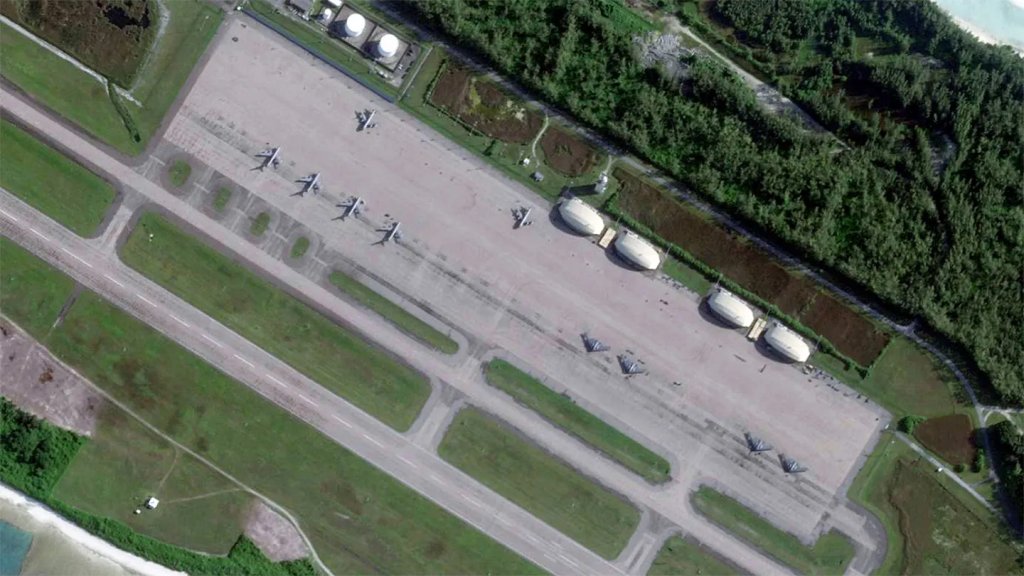 Six B-52 Stratofortress and four B-2 Spirit bombers seen out in the open on Diego Garcia in 2025. PHOTO © 2025 PLANET LABS INC. ALL RIGHTS RESERVED. REPRINTED BY PERMISSION
 “We are aware of reported sightings of drones (UAS) over Diego Garcia,” the U.K. Defense Ministry (MoD) told us Monday morning. “We are unable to provide any details about a situation which may affect the security or operation of the joint U.K.-U.S. base on Diego Garcia.”
“The U.S. and U.K. Commanding Officers on Diego Garcia consider and implement appropriate measures to ensure the security and safety of the base and the safety of the personnel on the island,” MoD added.
U.S. officials were less forthcoming.
“As a matter of operational security, we do not discuss specific force protection measures or security procedures at U.S. military installations,” an official from U.S. Pacific Command (PACOM) told us on Friday. “We remain vigilant in protecting U.S. personnel and facilities.”
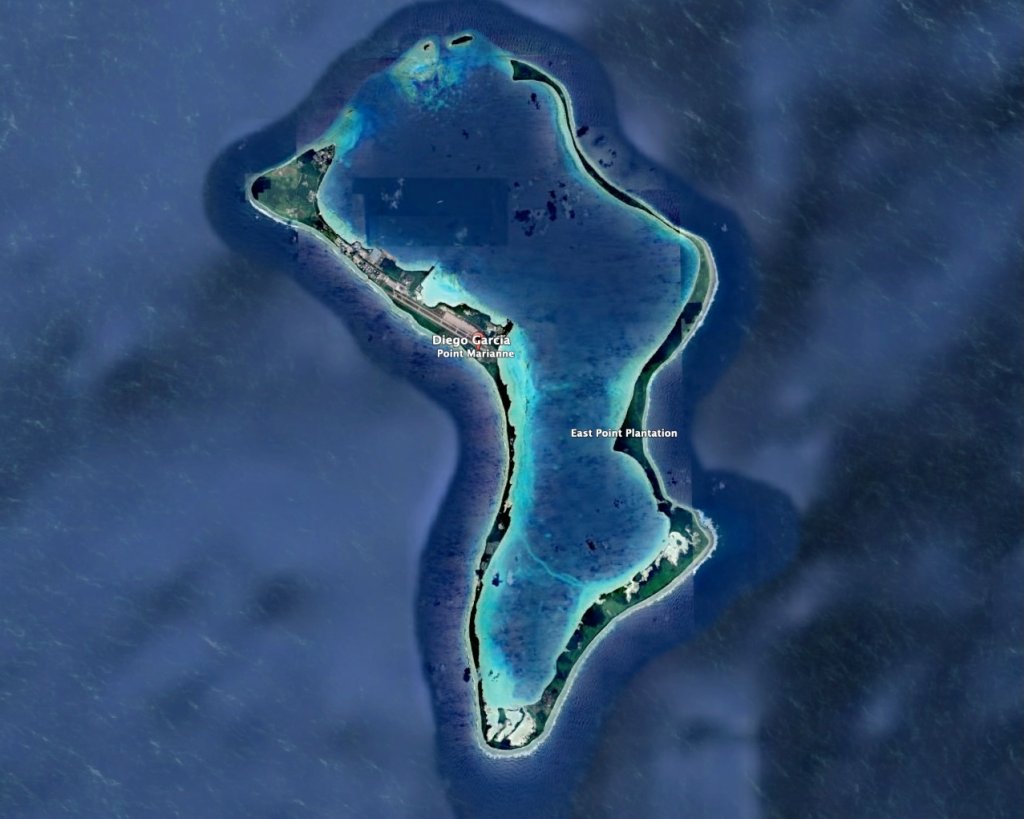 Diego Garcia. (Google Earth)
 Neither MoD nor PACOM would say what kinds of drones were sighted, when they were sighted, who was operating them or what, if any, defensive measures were taken as a result. Both military organizations were responding to our questions about an Aug. 7 posting on the Air Force amn/nco/snco Facebook page, an unofficial social media channel that posts about service topics.
“Inbox: ‘Diego Garcia. Drones spotted near fuel farm. Base on 0700 to 1900 curfew until further notice’ Note: message us if you have further information, thanks,” the post read.
 (Air Force amn/nco/snco Facebook)
 On Sunday, the page published a second post on the topic titled “Diego Garcia Curfew reportedly due to Drone Threats.” The post displayed what the page purported to be an official listing of curfew times for various locations around the installation.
 (Air Force amn/nco/snco Facebook)
 We cannot independently confirm the accuracy of these posts and have reached out to MoD and PACOM for details. MoD did not specify who reported the drone sightings over Diego Garcia, so we have asked for clarification. Making this an even more unusual event, Diego Garcia is essentially a closed island with no significant general population or tourists around to be operating drones on a recreational basis. So seeing one or more over the base would certainly raise alarms.
Though Diego Garcia is about 1,000 miles from Sri Lanka, the nearest large landmass, its remote location does not rule out the possibility of drone incursions by an adversary.
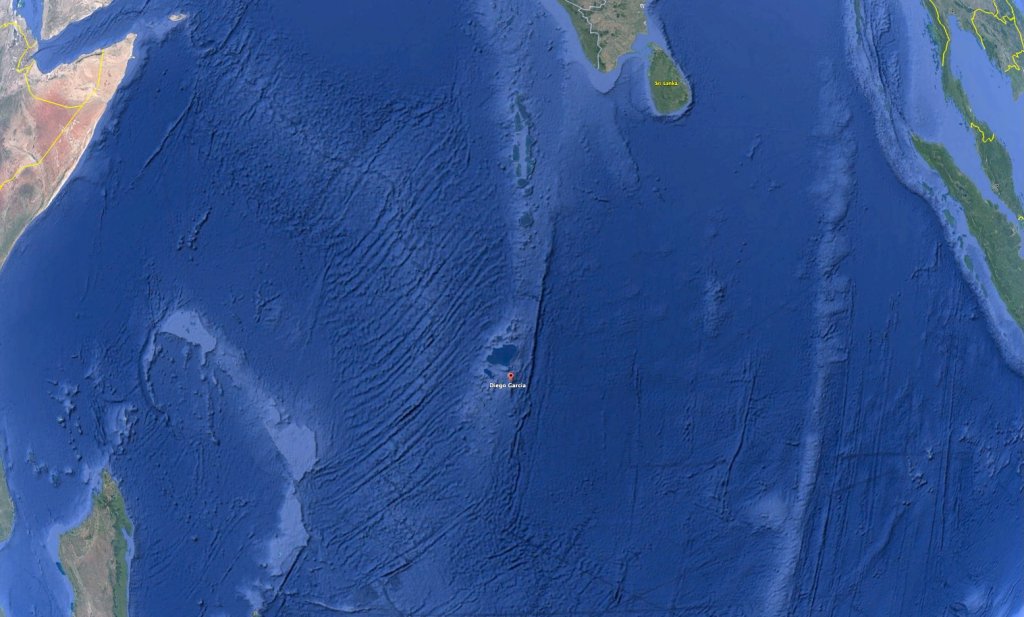 Diego Garcia (Google Earth)
 During the run-up to the launch of the Epic Fury operation against Iran, the FBI sent out an alert warning about the possibility of an Iranian drone attack on targets in California using uncrewed aircraft launched from ships off the coast. Though the alert was based on raw, unverified intelligence, and was sent out of an abundance of caution rather than any fears of an imminent action, the overall threat of drone attacks from ships is very real. You can read our feature about this very real threat vector and its relation to that questionable intelligence release here.
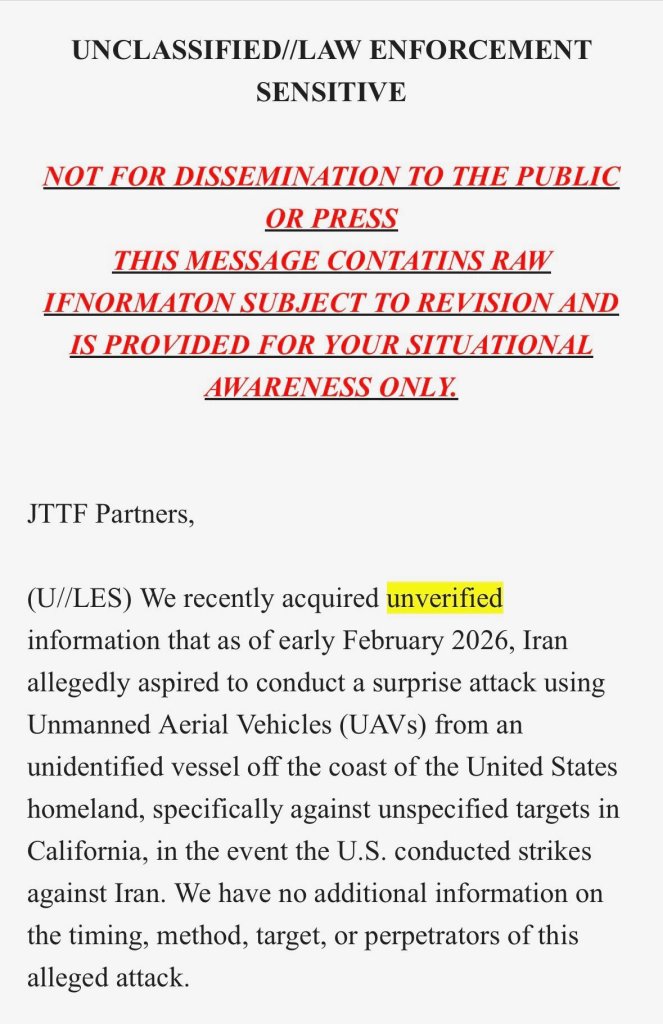 FBI
FBI Generally speaking, there are long-standing concerns that Iran and/or other actors operating on its behalf could seek to launch asymmetric attacks on targets in the United States, as well as elsewhere outside of the Middle East, in retaliation for large-scale strikes or even in an unprovoked manner. The risks of Iranians deciding to take such action have historically been seen as especially high in any scenario where there might be an existential threat to the regime in Tehran.
There were enough concerns about an Iranian attack on Diego Garcia that F-16s were deployed there in February, before the war erupted, for protection primarily against one-way attack drones and cruise missiles. F-15Es were first deployed to Diego Garcia for this same purpose last year, in what appeared to be a first of its kind force protection change. As noted earlier, Iran clearly sees the installation as a top target, as it has long been something of a refuge for U.S. forces to fallback from the Middle East from, if need be. Iran subsequently launched two intermediate-range ballistic missiles at Diego Garcia during Epic Fury; however, neither struck the base.
The threat from drones launched by ships is not just limited to Iran. Russia is suspected of sending drones over key European military installations from vessels.
Long-range one-way attack drones with endurance measured in many hundreds of miles, if not more than a thousand miles, are increasingly a staple in military arsenals globally, and have also been proliferating to non-state actors. Yet the drone threat isn’t just limited to these kinds of weapons for remote locales like islands. Ukraine has carried out devastating attacks on Russian radars and other targets on Crimea and elsewhere using short-range aerial drones launched by uncrewed surface vessels (USVs). This same capability set is proliferating around the globe, allowing for the USV to work as a relatively low-cost delivery system for highly precise and relatively inexpensive short-range drones that can then execute near-field attacks. The U.S. and others are also developing similar capabilities for its submarines and future uncrewed underwater vehicles (UUVs), which could even more easily sneak into close proximity to targets ashore before launching their deadly drone munitions.
The following video shows a Ukrainian USV launching drones against Russian targets:
As we noted earlier in this story, the claims about drone sightings over Diego Garcia rekindle concerns that the U.S. is not doing enough to protect its aviation assets. This situation is another data point in the already heated debate over whether the U.S. military should be investing more in new hardened aircraft shelters and other base infrastructure amid rapidly evolving standoff aerial attack threats.
It is indisputable that aircraft sitting exposed on a flightline are particularly vulnerable to attack — even to drone threats leveraging commercially available technology. This is something we regularly highlight and that has been continually demonstrated in the ongoing war in Ukraine. The June 2025 Ukrainian Operation Spiderweb attack on Russian bombers is a glaring example of the dangers drones pose to aircraft. So too was the discovery of an explosive-laden drone found near a massive An-124-100 Ruslan (NATO reporting name Condor) cargo jet at Leipzig/Halle Airport in Germany last week.
There was just a reported drone incursion over RAAF Williamtown in Australia, an F-35A base, for instance, as well.
Even very troubling drone incursions on critical bases in remote areas aren’t entirely new. Between late February and early March of 2019, the massive installation at Andersen Air Force Base on the Island of Guam experienced repeated incursions by unmanned aircraft that appeared to be extremely interested in one highly sensitive area of the highly strategic base, the U.S. Army’s Terminal High Altitude Area Defense (THAAD) battery that is tasked with defending the island from ballistic missile attacks.
Beyond threats from drones, the U.S. saw several aircraft parked out in the open destroyed or damaged by Iranian ballistic missile strikes on U.S. bases in the Middle East. Also during Epic Fury, troops were killed and radars and other critical assets were destroyed and damaged by Iranian long-range drone and ballistic missile attacks. Even short-range drones operated by Iranian-backed local militias scored hits on U.S. aircraft and infrastructure.
You can see an image of an E-3 Sentry destroyed in an Iranian attack on Prince Sultan Air Base in Saudi Arabia below:
New image reportedly showing the USAF E-3 Sentry destroyed in an Iranian attack at Prince Sultan Airbase on Friday.
Matches 81-0005, an E-3C seen deployed to the base in recent weeks. pic.twitter.com/zRVzzkEPeU
The reports of drones over Diego Garcia are certainly very concerning, although we do not know anything more about them at this time. Above all else, they are a reminder that the threat this very diverse group of systems and their potential delivery systems presents is only becoming more troublesome and complex as time goes on.
Contact the author: [email protected]





