 By GB News (World News) | Created at 2026-09-17 14:05:41 | Updated at 2026-09-17 14:51:07
52 minutes ago
By GB News (World News) | Created at 2026-09-17 14:05:41 | Updated at 2026-09-17 14:51:07
52 minutes ago
Politicians and campaigners opposing North Sea oil should debate offshore experts face-to-face rather than hide behind social media posts, energy leaders were told.
The case for approving both Rosebank and Jackdaw was “overwhelming”, trade body Offshore Energies UK said, at the launch for its 2026 Economic Report.
But the two fields were just the “tip of the spear”, the launch heard, and a more holistic approach to the North Sea would unlock more than 100 projects and attract £50 billion in investment.
Rosebank is Britain’s biggest untapped oil field and Jackdaw a giant gas field. Work at both has been stopped because of climate concerns.
Government decisions had been expected this week but have been delayed until after a key by-election.
OEUK energy policy director, Enrique Cornejo, said the fields had become symbolic of the wider North Sea debate. He called for Prime Minister Andy Burnham to prove that his pledge of re-industrialisation was “more than words”.
Mr Cornejo argued that the projects would support hundreds of jobs and inject billions into the economy. He said that almost 200 contracts hung on Rosebank’s approval.
“If you believe that Rosebank and Jackdaw should not proceed, come and explain that directly to the people whose jobs depend on those projects,” said Mr Cornejo.
Politicians and campaigners should face offshore experts face-to-face, energy leaders have been told

“Explain why workers already offshore should be told that their jobs no longer exist.
Explain that to their families and to their communities.
“Explain why billions of pounds of investment should leave the UK economy. Explain why we should reduce tax revenues at the time when we need to invest more in defence, public services, and energy security.
“Explain why it is acceptable to increase global emissions by importing energy with a higher carbon footprint rather than producing it here on the UK environmental standards.
“There are some influential figures and politicians that oppose these projects. Please don't hide behind open letters, press releases, or social media posts.
“Come and debate decisions with us, with our sector.”
He said that the offshore industry was determined to play its part in fighting climate change. But he said politicians needed to be honest “about the energy system that we have today”.
At the turn of the century the UK exported energy. Today, it imports 40 per cent of its needs, with gas coming from Norway and LNG from the US.
Under forecasts from the Climate Change Committee, the UK will still need the equivalent of 12 billion barrels of oil as it heads to Net Zero by 2050.
With the right framework in place, Mr Cornejo said, at least half of that could be met domestically.
“That means supporting jobs, supporting investment, strengthening energy security, improving our balance of payments, generating tax revenues, and reducing the need for imports,” he said.
He said that, under Mr Burnham, engagement with Government had become more constructive. Energy Secretary Miatta Fahnbulleh’s visit to Aberdeen, shortly after her promotion to the Cabinet, was “an important signal”.
Andy Burnham has admitted Britain 'cannot ignore' North Sea oil drilling amid the cost-of-living crisis

PA
He said: “I want to make it very clear. This is not an argument against the energy transition. This is an argument about managing it responsibly.
“The Prime Minister has spoken about a pragmatic approach. These words are important, but now it is time for action. It's time for decisions. A decision on Jackdaw, a decision on Rosebank.
“It's time to make it clear that the UK government seriously backs UK industries, backs, UK communities - that re-industrialisation is more than words.”
David Latin, chair of Serica Energy, said the North Sea presented investment opportunities, but that companies needed certainty on policy.
“We need to know if we drill a well in one of our existing licenses, when we find something, we'll be able to develop it and produce it,” he said. “We don't know that, and that's not very helpful.
“Why would I go and drill a well and spend tens of millions of pounds, not knowing whether if I find something I'll be able to put it online and produce it?”
Serica produced ten per cent of the UK’s gas and “would like to produce more”, he said.
“It can't make sense to bring in gas from Louisiana when we can produce it offshore, here in the UK,” he said.
“How does that make sense?
It doesn't. It's worse for everything, including the climate.”
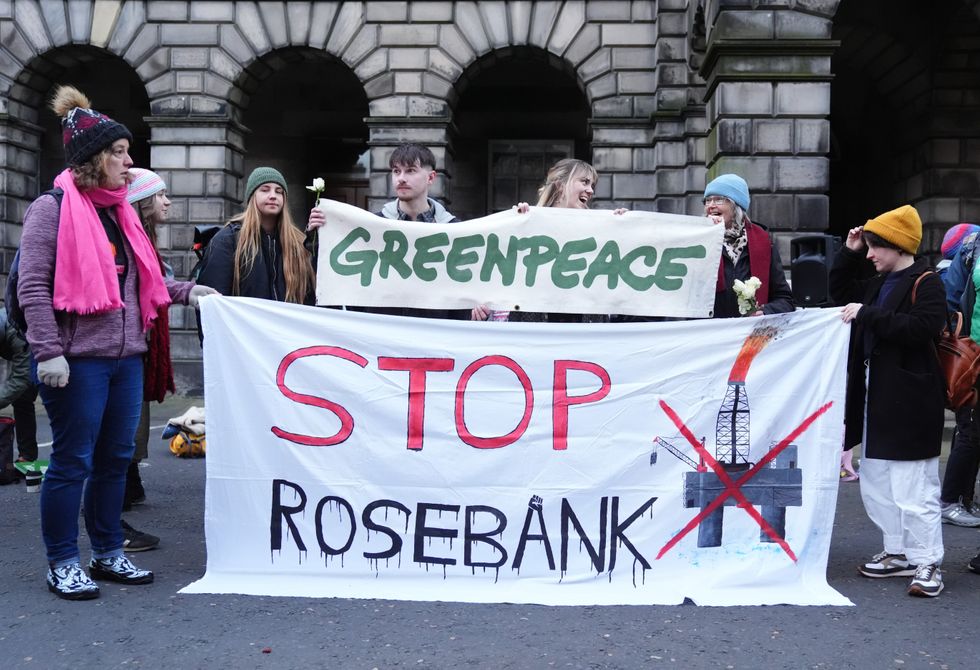
Climate campaigners maintain that the environmental cost of Rosebank and Jackdaw is too high.
Yesterday, almost 600 climate scientists, health professionals and conservationists made fresh calls for Mr Burnham to reject Rosebank.
In a letter to Mr Burnham and Ms Fahnbulleh, the group of 575 experts warned against approving the oil field, arguing the decision would fly in the face of climate science and see the UK breach its national and international climate commitments.
The Department for Energy Security and Net Zero has refused to be drawn on when announcements will be made on Rosebank and Jackdaw.
It has said any decisions would take into account all relevant evidence, including environmental assessments and public representations made at consultation.
It says the North Sea remains a “vital national asset” and that oil and gas will continue to play a role in our energy mix for years to come.