 By GB News (World News) | Created at 2026-07-28 08:48:00 | Updated at 2026-07-28 11:14:50
2 hours ago
By GB News (World News) | Created at 2026-07-28 08:48:00 | Updated at 2026-07-28 11:14:50
2 hours ago
English football is set to introduce a new trial measure this season to stamp out goalkeepers' tactical time-wasting.
Under the scheme, an outfield player from the goalkeeper's team will be required to leave the pitch for one minute whenever their keeper receives on-field treatment from the physio.
The initiative has been backed by the Football Association, Premier League, English Football League, National League and Women's Super League, after the International Football Association Board (IFAB) granted permission for the trial to proceed.
Howard Webb's Pro Ref organisation led discussions with the various leagues to identify an effective response.
It settled on the rule that when a referee has waved the physio onto the pitch to attend to a goalkeeper, the team's manager will have just 10 seconds to select an outfield player to temporarily withdraw, communicating their decision to the fourth official.
Should the coach fail to nominate someone within that window, the team's captain will automatically be obliged to step off.
The rule will get its first outing this Saturday, when Tranmere host Rochdale in the Carabao Cup preliminary round.
The trial applies the same principle already in place for outfield players, who are required to leave the field for a minute when receiving treatment from medical staff.
The issue came to light last November when Leeds United manager Daniel Farke publicly accused Manchester City's Gianluigi Donnarumma of faking an injury

GETTY
The practice of goalkeepers going to ground and calling for medical attention has grown in recent seasons, with calls to stamp out the tactic from the game.
Once the manager has finished delivering their message, the keeper simply stands up and carries on.
Beyond facilitating impromptu team talks, the move has also been used to interrupt the flow of play when the opposition has the upper hand.
The issue came to light last November when Leeds United manager Daniel Farke publicly accused Manchester City's Gianluigi Donnarumma of faking an injury to "bend the rules" and disrupt the game.
Argentina's Emi Martinez also went down at times during the World Cup

GETTY
Pierluigi Collina, IFAB's head of referees, said at the board's annual general meeting in February that tackling the goalkeeper timeout was a top priority.
At the 2026 World Cup, Collina instructed match officials to stop players from approaching the technical area during all stoppages, though the effectiveness of that approach was debatable, given that three-minute hydration breaks in each half already offered natural coaching opportunities.
English football's authorities concluded that simply preventing players from gathering at the touchline would not be enough to discourage managers from exploiting goalkeeper treatment breaks.
Several exemptions have been built into the trial, including cases where the goalkeeper declines treatment, suffers a foul requiring immediate attention, is bleeding, sustains a serious injury necessitating substitution, or is involved in a collision with a teammate.
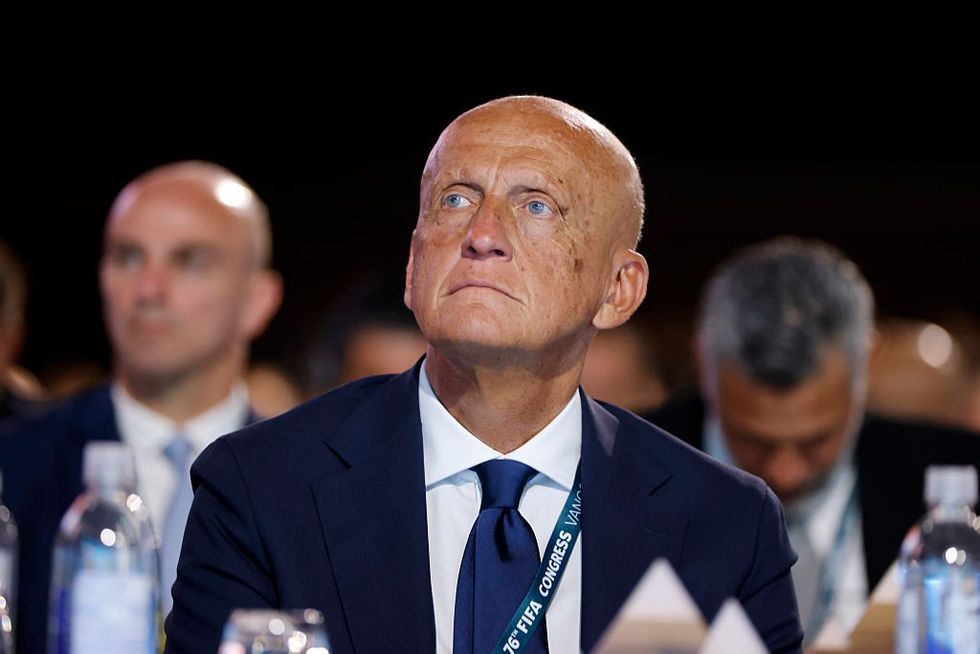
Pierluigi Collina, IFAB's head of referees, declared at the board's annual general meeting in February that tackling the goalkeeper timeout was a top priority
There are concerns that the rule could encourage players to carry on through injuries rather than accept treatment.
Australia's A-League will trial a different version in which the captain must always be the player withdrawn.
IFAB will review the trial's outcomes at meetings throughout the season, with the possibility of a permanent worldwide law change from 2027-28.