By The Rio Times | Created at 2026-08-11 08:31:54 | Updated at 2026-08-11 09:42:41
1 hour ago
By The Rio Times | Created at 2026-08-11 08:31:54 | Updated at 2026-08-11 09:42:41
1 hour ago
Colombia · Security
Key Facts
- Drone cluster Explosive-laden drones struck police posts, a town hall and a military target in Colombia in early August 2026.
- Officer killed A drone strike on the San Roque substation in Cesar killed Subintendente Argemiro Rodelo Canchila on the night of Aug 7.
- Tolima hit Drones struck Rioblanco’s town hall and police station on Aug 9; a separate attempt on a Planadas base was intercepted.
- Tactics, not training Groups are using Ukraine-war-style drones, but there is no credible evidence they were trained in Ukraine.
- Antioquia risk Police say about 35 stations have anti-drone countermeasures, concentrated in the Bajo Cauca region.
- Hardline response President de la Espriella’s forces killed six armed-group members over the weekend of Aug 9–10.
Explosive drones have become a routine weapon for Colombia’s armed groups, with a deadly police strike and scattered attacks in early August.
You may have seen news of the Colombia drone attacks in early August 2026, but the pattern is what matters. This was not a one-off. A cluster of strikes with explosive-laden drones hit the country’s southwest and north, and the army has named specific FARC dissident fronts. The ELN and the Clan del Golfo are in the picture too. If you live in or invest in rural Colombia, it marks a sobering shift in how the conflict is fought.
One-stop reference
Company Intelligence
Every listed company in Latin America — financials, ownership and structure for 1,450+ companies across 26 exchanges, in one place.
Inside the wave of Colombia drone attacks
The deadliest incident came on the night of August 7, 2026, in Cesar. A drone loaded with explosives struck the police substation in San Roque, in the municipality of Curumaní, killing Subintendente Argemiro Rodelo Canchila, 43, who had 18 years of service. This was a deliberate strike on a small, fixed post — and it shows that police stations are now targets from the air.
Two days later, on August 9, drones hit the town hall and a police station in Rioblanco, Tolima. No one was hurt; the army blamed the Ismael Ruiz front of FARC dissidents. On August 7, a separate attempt targeted the General Domingo Caicedo infantry battalion in Planadas, also in Tolima — but the army said it detected and neutralised the explosive-laden drones before they reached the base. The targets — town halls, police posts, an army battalion — point to a coordinated effort to test defences and challenge state authority.
A tactic borrowed from Ukraine — not training
Here is the crucial point. Credible reporting says these groups are adopting Ukraine-war-style drone tactics: cheap commercial drones modified to drop explosives, and first-person-view (FPV) drones flown straight into a target. There is no reliable evidence that any of them were trained in Ukraine. The method has spread; the training claim has not been shown. Do not mistake one for the other.
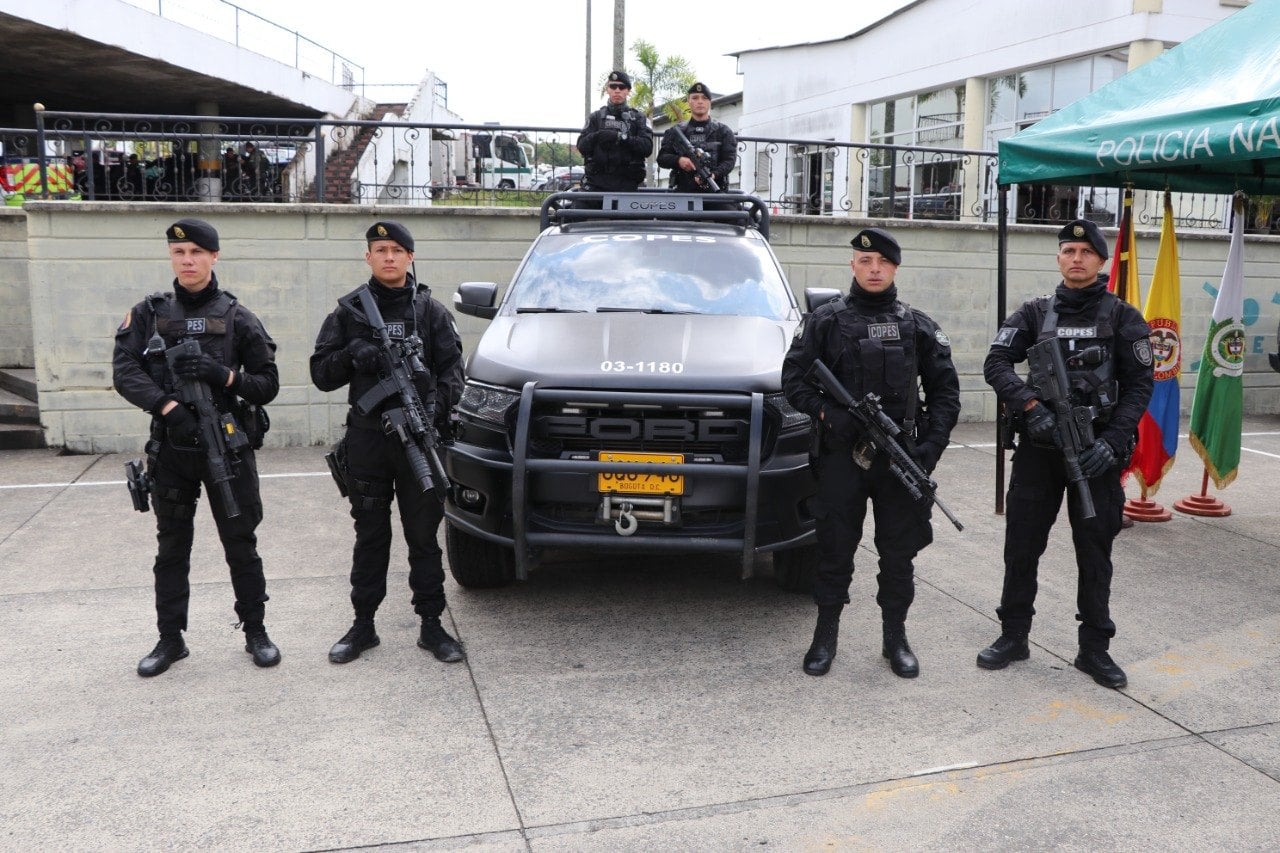
That distinction matters for risk. You do not need an army to run this kind of attack — just a commercial drone, some explosives and the know-how to marry the two. That lowers the barrier for every armed group in the region. In Antioquia, the police commander, Colonel Luis Muñoz, said about 35 stations and substations now have countermeasures, with the risk concentrated in the Norte, Nordeste and Bajo Cauca subregions — Segovia, Ituango, Cáceres, Tarazá and Caucasia. The catch: anti-drone systems are mostly under army control, and they are not everywhere.
Why this matters for investors and residents
A drone strike on a rural police post is not a distant worry. Rural investment — mining, agriculture, energy — depends on secure supply chains and safe staff movement, and a hit near a mine or a farm is a direct operational threat. Roads matter too. On August 8, attackers detonated explosives that destroyed a toll booth under construction on the Pan-American Highway near Santander de Quilichao, in the Mondomo sector of Cauca. Accounts of injuries conflict, with leading Colombian outlets reporting none, and FARC dissidents linked to alias “Iván Mordisco” are suspected, though authorities had not formally confirmed responsibility.
An explosives attack on a toll booth is an attack on mobility and trade, not just a building. And the bigger story runs past Colombia: cheap drone warfare is spreading to non-state actors across Latin America, and Colombia is simply the frontline. If these tactics work here, they will surface elsewhere — which is why security planners around the region are watching.
The government’s response
President Abelardo de la Espriella, who took office on August 7, is leaning hard into a “firm hand” security line. Over the weekend of August 9–10, security forces killed six members of illegal armed groups — four FARC dissidents in Meta and two Clan del Golfo members in Antioquia. It is a clear signal of intent.
But hardline operations have limits without technology. The anti-drone systems are thin on the ground, and smaller-town police posts stay exposed. The drones are not going away, so the state will need sustained investment in detection and interception. Until then, the southwest and northern subregions like Bajo Cauca will remain fragile — and the sky above them contested.
Frequently Asked Questions
What are the Colombia drone attacks of August 2026?
They are a cluster of explosive-drone strikes on police posts, a town hall and a military target in the southwest and north in early August 2026. The army attributed several to FARC dissident fronts. The ELN and the Clan del Golfo also pose a threat.
Were these groups trained in Ukraine?
No. Credible reporting indicates armed groups are adopting Ukraine-war-style drone tactics, using cheap commercial drones modified to drop explosives. There is no reliable evidence of Ukrainian training; the tactic has spread on its own.
Which regions face the highest drone risk?
Antioquia is a key area, especially the Norte, Nordeste and Bajo Cauca subregions, including Segovia, Ituango, Cáceres, Tarazá and Caucasia. Tolima, Cesar and Cauca also saw attacks in early August 2026.
Sources: Infobae Colombia; El Espectador; Vanguardia; Pulzo; Semana; El Pilón; Blu Radio; Al Jazeera.