By Literary Hub | Created at 2026-08-07 13:43:21 | Updated at 2026-08-07 15:33:13
6 hours ago
By Literary Hub | Created at 2026-08-07 13:43:21 | Updated at 2026-08-07 15:33:13
6 hours ago
Back in 1991, on the corner of Bleecker and Broadway, under the VG restaurant, was Pool Bar, a short-lived dive that also served as an unofficial, all-ages venue. A few weeks after school started, a line of kids, all under twenty-two but most still in high school, stood with a 3×5 lime-green flyer in hand. Each with their own variation on shaved or colored hair, they inched one by one down the black metal staircase, into the basement bar.
Article continues after advertisement
A tall Black guy who was equal parts Howard Stern and Rick James stood at the entrance, eliciting authority with a clipboard and rubber stamp. On the way downstairs, I caught David out of the corner of my eye. Hidden from the doorman’s view, he licked the top of his hand, then firmly pressed it against a friend’s. Their eager eyes lit up upon confirmation of success: one freshly stamped smudge became two, thus evading the five-dollar cover.
They obviously didn’t think much of Jheri Curl Joey Ramone and his authority. The fact that each tally mark was a dollar in the band’s pocket, and that sneaking in was essentially stealing money from them, also didn’t faze us. At the time, I had no qualms about trying to squeeze another transfer off the top of David’s hand too but…
“Five bucks; who are you here to see?” Black Frankenstein, Superfly Snuka droned, without looking up from his clipboard. With a packed house, he was obviously on autopilot.
“Bushmon,” I responded with a totally uncool chipper tone, “Ryan said I was on his list?” My voice might have cracked during that last part.
Only a few months into living in New York, I was still trying to find my footing in the local punk community.
This wasn’t the first time Black punks had existed, but it was the first time I felt that presence in my own body, in my own moment. Being Black, in that room, felt like an asset.
This “being on the list” thing was a big deal to me. This show wasn’t like Stigmata at the Pyramid. The list wasn’t unlimited, yet Ryan offered me one of the spots. Being on the list made me feel like my presence mattered. I didn’t happen upon the flyer; I wasn’t just any spectator; I was invited. Despite the jaded energy from the doorman, someone onstage wanted me inside.
The doorman lifted a sheet of paper covered in tally marks and checked for my name. I could feel my heart racing against my sternum. What if he forgot? I mean, we just became friends!
I began to panic.
“He probably comped a girl he’s into instead,” I thought.
I looked back up at David and his friend, wondering if it was too late for me to get one of those transfers.
“I see it,” he said lifelessly as he scratched out my name, “Razzle.”
He pushed the gooey stamp on the back of my hand, leaving behind a smear of purple ink.
As I stepped into the tiny venue, I could hear the Ebony Unskinny Bop behind me robotically continuing, “Five bucks; who are you here to see?”
If I had to guess, Pool Bar was established at the time to serve the runoff of washed-up rockers who wanted to escape the crowds of the once legendary, now tourist-packed venues a few blocks down on Bleecker Street, like the Bitter End and Cafe Wha?, where Bob Dylan, Jimi Hendrix, and Janis Joplin had once played, but that now hosted bands who, at best, covered those acts.
The single room that was Pool Bar housed a bar, a pool table, and a one-foot-high stage. That’s it. Hosting bands appeared to be a relatively new idea. On a typical night, the bar’s namesake pool table was normally centered in front of the performance area. When a band played, the table was pushed against the wall, so the audience had room to move. A splintered piece of plywood protected the table’s felt top from the eight or nine kids sitting and standing on top of it. This left ample room for the fifty to sixty kids peppering the floor.
As far as bar shows go, the space was a perfect venue for local bands but it was the crowd that made the place truly special. This wasn’t your typical punk/hardcore show demographic. Laughing, smoking cigarettes, and sipping bottles of Red Stripe, numerous packs of Black folks lounged around the joint.
In smaller towns and cities, like the one I came from, counting all the Black members of the alternative scene only requires a finger or two. A lot of those kids eventually move to big cities to find their people. Pool Bar became a meeting spot for Black alternative kids, as the venue regularly booked Black rock acts. The bands on this bill drew us together. Mixed with the other people of color in the room, for once, the white kids were in the minority.
Onstage, five Black dudes set up their gear. They were all just a couple years out of high school, but at four or five years my senior, they seemed like men—intimidating. These guys had jobs, paid rent, and had live-in girlfriends. Mic checking at their helm was my one-man welcoming committee, Ryan Bland.
He wore a baggy pair of overalls rolled in an accidentally-on-purpose kind of way, revealing knee-high white Doc Martins. Sans shirt, he displayed a perfect “I don’t give a fuck about muscles” skinny-chested sex appeal. I was self-conscious about my own bird chest and wondered why skinny looked so good on him. He was unlike anyone I’d ever met before. While most kids of color in the scene seemed to downplay race, Ryan went out of his way to put together a Black band. He made the effort to befriend me. Like an older brother, he took me under his wing. I was enamored. I couldn’t be more excited to see his band for the first time. It was important to me that he knew I was there.
The crowd got tighter as I pushed closer to the stage. The muscles around my mouth became tense. I could feel acid squirting into my stomach; I was all nerves. Ryan was unraveling a microphone cable from its stand. I saw him tuck the single green dreadlock swinging from the front of his head behind his ear. I was weaving between two chatty Black girls with ratty box braids, dreading at the roots, when our eyes met. He shot me his wide, gap-toothed grin.
“You came!” He cheered.
I tried not to look too eager. “Yeah man, for sure.”
Behind him, the members of his band continued setting up; the singer always has it easiest. The drummer tightened his snare with a metal key. The guitar player assembled a daisy chain of pedals. The bass player plucked each of his instrument’s four strings, one at a time, while turning the corresponding tuning pegs.
I was making awkward small talk when his drummer called him away. Self-consciously blocking the view of the now-irritated girls with raggedy braids, I stood at the front of the stage.
Moments later, the band stood at attention signaling to the soundman they were ready to begin. Ryan, stage right, back flat against the wall, looked as if he was attempting to sink into the painted orange cinder-block masonry. We could all see him standing there; the entire stage was only fifteen feet across, but his goal was clear. As the bartender quieted whatever terrible hair-metal mixtape had been playing over the house PA, and the lights glowed red on the stage, Ryan was trying to create the illusion of a behind-the-curtain, big-stage, rock star entrance. I could see the anticipation on his face. I could feel my own.
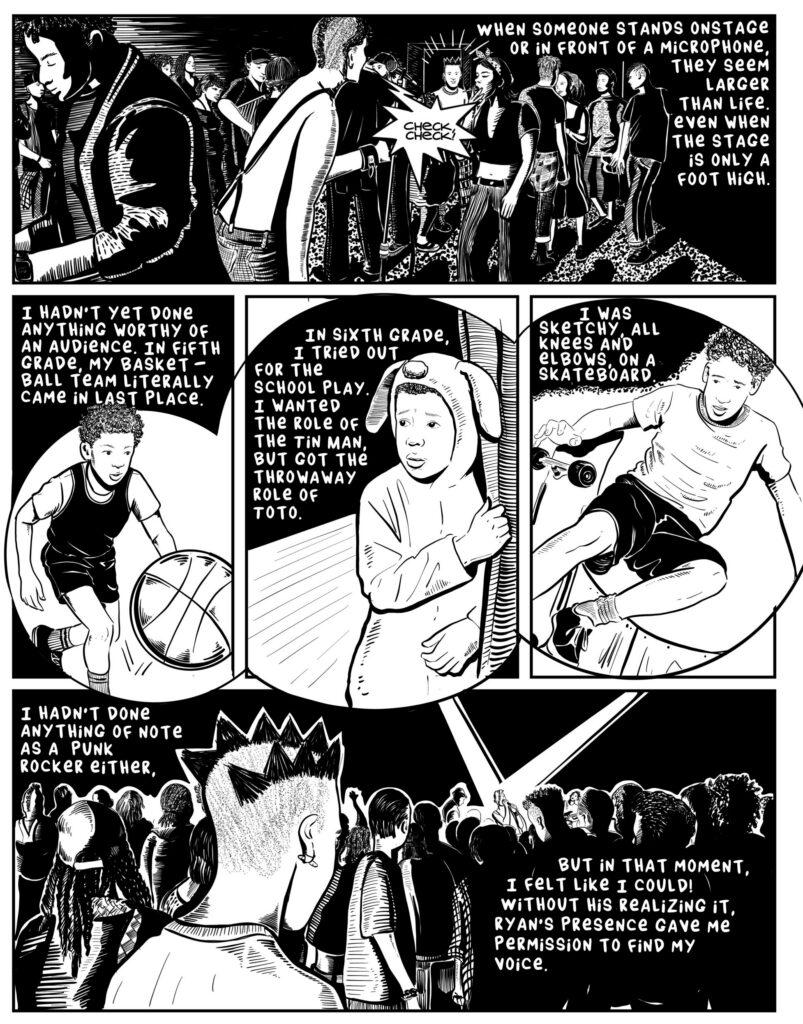
Smacking his sticks together, the drummer counted it off: Click click click! The band blasted into a machine-gun pace, waking the entire crowd. Those who weren’t paying attention before were now. There was no pathetic pleading with the audience to come closer. We were all magnetized, drawn in by the music. This would be the instrumentalists’ only time to shine. As they moved into the bridge of their musical assault, Ryan jumped into the middle of the stage. From that point on, all eyes were glued to him. He ferociously shook his head, whipping his dreaded devil lock from side to side.
The song’s pace changed from a blitz into a groove, not so much a mosh part, but definitely more danceable. In lockstep, Ryan bounced off his boys onstage. On the final note, when the sticks hit the snare for the last time, Ryan dove on top of the crowd. As if preplanned, and agreed upon, those of us up front stretched and strained to push and keep him above our heads. This wasn’t the first time I saw someone ride the crowd, but I didn’t know it could be done with such grace.
Pool Bar, being a basement club, had an unusually low ceiling, so Ryan was able to place his hands and feet on it as the crowd held him aloft. Eventually, regulars to the club called this move the spider walk.
Pool Bar even printed up T-shirts with spiders across the chest, in homage. I wonder if the diners in the restaurant upstairs felt or heard the rumble of his feet? I imagine someone about to bite into a burger, stopping, mouth agape, as their table bounced across the floor in front of them.
The band seamlessly transitioned into the next song. Just in time to start singing, Ryan landed back onstage and grabbed the mic. The sequence couldn’t have been more cleanly choreographed. I was amazed. Being so close to this creative energy, at times eye to eye, is part of what makes punk rock so inspiring. In the underground, the lines between band and audience often blur. When half of the crowd are members of other bands on the bill, dancing alongside fans, little room is left for hierarchy.
To discount or ignore my race felt like a betrayal, but I didn’t understand how to embody my Blackness while still being true to my punk rock spirit.
Seeing these Black men rock out in a room filled with Black people was life-changing. This wasn’t the first time Black punks had existed, but it was the first time I felt that presence in my own body, in my own moment. Being Black, in that room, felt like an asset. In that moment, I felt whole. Without really knowing anyone, I believed I belonged. Seeing all these melanated people onstage, moshing with this largely Black audience, was validating. Ryan provided me with a much-needed example of how to be Black and punk at the same time. All that representation went a long way toward affirming my self-esteem. Regardless of what anyone said on the subway or at school, I had confidence that I wasn’t some weird exception.
All Black, originators of hardcore, and already legendary, Bad Brains should have filled that role. But by the time I got to New York, they were heading into their Rise era, experimenting stylistically and performing without H.R., the vocalist who defined them. They weren’t playing around New York much, and what existed of Bad Brains for someone my age came mostly through stories and records, not lived experience. Punk, at least the version that mattered to me at fifteen, was a living, breathing thing—a lifestyle to encounter in a tiny basement club, in real time. My personal heyday was today, unfolding around me.
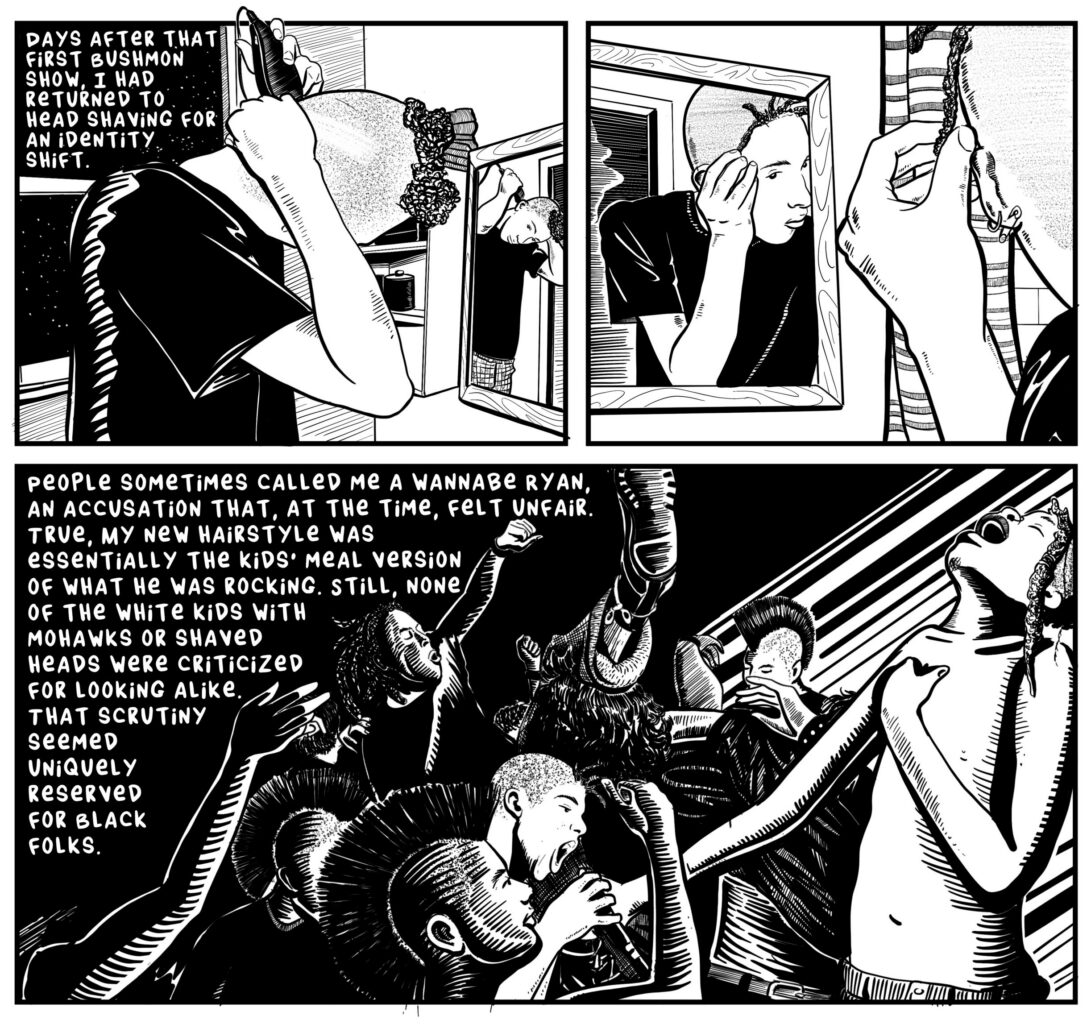
I became aware that revered New York hardcore bands like Warzone and Burn had Black members. Frequenting the smaller downtown venues, I found bands like Shift, Disassociate, and No Redeeming Social Value also had Black guys on the mic. Even the Casualties had a Black founding member. Finding all these guys, and so many more peppering the scene, served as an important reminder. People who say punk is white aren’t paying attention.
New York’s punk and hardcore scenes centered the aforementioned acts. The community, however, be it club bookers or the kids themselves, relegated Ryan’s band to the edges of the scene. I couldn’t at first understand why. They were undeniably feel-good punk, with a loyal fan base, but routinely booked with soulful, funky, alt-rock bands like FunkFace and Song of Seven. They were also lumped in with ska and reggae acts like the Slackers, Agent 99, and 32 Tribes. All notable local acts of their time, this marginalized POC scene within a scene embodied the “unity” punk rock had been preaching since the formation of the Clash, yet sonically, Bushmon was a striking outlier. I came to learn Ryan was friends with members of most if not all of these bands, so it made sense that they would play together, but musically Bushmon belonged on bills with bands like Murphy’s Law and the Bouncing Souls. Why didn’t they regularly get those kinds of gigs too?
Likely stigmatized within parts of the hardcore scene, Bushmon’s proximity to largely Black alternative bands put their authenticity under suspicion. No one said the words outright, but again and again, I saw bands with more than one Black member dismissively downgraded to “Black rock.”
Six years earlier, in 1985, Vernon Reid, guitarist of Living Colour, partnered with the illustrious music journalist Greg Tate to start the Black Rock Coalition.
The mission, according to their literature, was to create “an atmosphere conducive to the maximum development, exposure, and acceptance of Black alternative music.” The move was a noble effort, with some truly legendary acts on their roster: Bad Brains, Living Colour, Fishbone, and 24-7 Spyz among them. After attending a BRC showcase, I found out that for a $25 membership fee, any Black-led rock-adjacent act could join up. The showcase also made me acutely aware many of the bands they promoted had a wah-wah pedal, funky rock or soul-metal fusion sound I couldn’t warm up to. That’s just my taste. The bigger issue was the label itself. “Black Rock” may have been a term meant to unite, but it ended up flattening genuinely different artists into a unified sound that was easier for the scene to dismiss than engage with. At times, the label felt like a consolation prize.
To be fair to those BRC artists, a lot of bands in the nineties blended genres. Anthrax, Sublime, and Red Hot Chili Peppers were easy and often embarrassing examples, but the funky waka-waka guitar sound extended to Rage Against the Machine, Green Jellÿ, and Suicidal Tendencies (and their side project, Infectious Grooves). Regionally, several beloved East Coast hardcore bands were among the funkiest: Dog Eat Dog, Token Entry, Supertouch, Heads Up!, and Underdog could all start with distorted guitars and heavy riffs but slip effortlessly into slap bass, hip-hop beats, or ska and reggae breakdowns. The nineties were wild. I remember doing the Flavor Flav dance in mosh pits all across the city.
As I spent more time attending traditional hardcore and punk shows, I felt like I was straddling two different scenes: one legitimized by the white gatekeepers, the other pushed to the margins. While many Bushmon fans went to Vision of Disorder shows, few VOD fans had ever heard of Bushmon. I often felt like Goldilocks trying on various versions of punk.
Surrounded by white friends who never had to contend with race, I wanted that privilege too. To discount or ignore my race felt like a betrayal, but I didn’t understand how to embody my Blackness while still being true to my punk rock spirit. Ryan opened the door to an identity that seemed to fit best, but if the punk community didn’t accept his band, then what would they say about their fans? What would they think of me? I didn’t want question marks around my personhood, but they were popping up at every turn.
______________________________
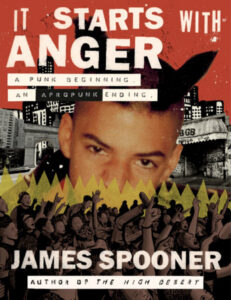
From It Starts with Anger: A Punk Beginning. An AFROPUNK Ending. by James Spooner. Reprinted by permission of Pantheon Books, an imprint of the Knopf Doubleday Publishing Group, a division of Penguin Random House LLC. Copyright © 2026 by James Spooner.
Audio excerpted with permission of Penguin Random House Audio from IT STARTS WITH ANGER by James Spooner, read by a full cast. James Spooner ℗ 2026 Penguin Random House, LLC. All rights reserved.