 By The War Zone | Created at 2026-10-06 17:20:55 | Updated at 2026-10-06 18:19:28
1 hour ago
By The War Zone | Created at 2026-10-06 17:20:55 | Updated at 2026-10-06 18:19:28
1 hour ago
The first-ever F-16 Block 72 has taken to the air, marking a major milestone for the program and for Morocco’s long-running effort to field what Lockheed Martin describes as the most advanced version of the Viper.
The first of the jets for the Royal Moroccan Air Force (RMAF), a two-seat F-16D, completed its maiden flight at Lockheed Martin’s facility in Greenville, South Carolina, the company announced today. The aircraft will now proceed through flight testing ahead of its delivery to Morocco.
Morocco’s first @LockheedMartin F-16 Block 72 aircraft has taken flight in Greenville, South Carolina. The milestone marks another step toward delivering the most advanced F-16 configuration to the Royal Moroccan Air Force.
— Lockheed Martin News (@LMNews) October 6, 2026Interestingly, one of the photos of the jet published by Lockheed Martin shows the pilot in the front cockpit wearing a Digital Joint Helmet Mounted Cueing Systems (D-JHMCS). This advanced helmet is not often seen worn by F-16 pilots and it is not clear if it has been ordered by Morocco.
Regardless, Morocco was the first customer to select the Block 72 configuration when the U.S. government approved its purchase in March 2019.
At that time, the Defense Security Cooperation Agency said Morocco was seeking 25 F-16C/D Block 72 aircraft in a package estimated at $3.787 billion. The proposed aircraft were to be equipped with the AN/APG-83 Scalable Agile Beam Radar (SABR), an active electronically scanned array type, new mission computers, Link 16 Multifunctional Information Distribution Systems, modernized navigation systems, helmet-mounted cueing systems, and a range of air-to-air and air-to-ground weapons.
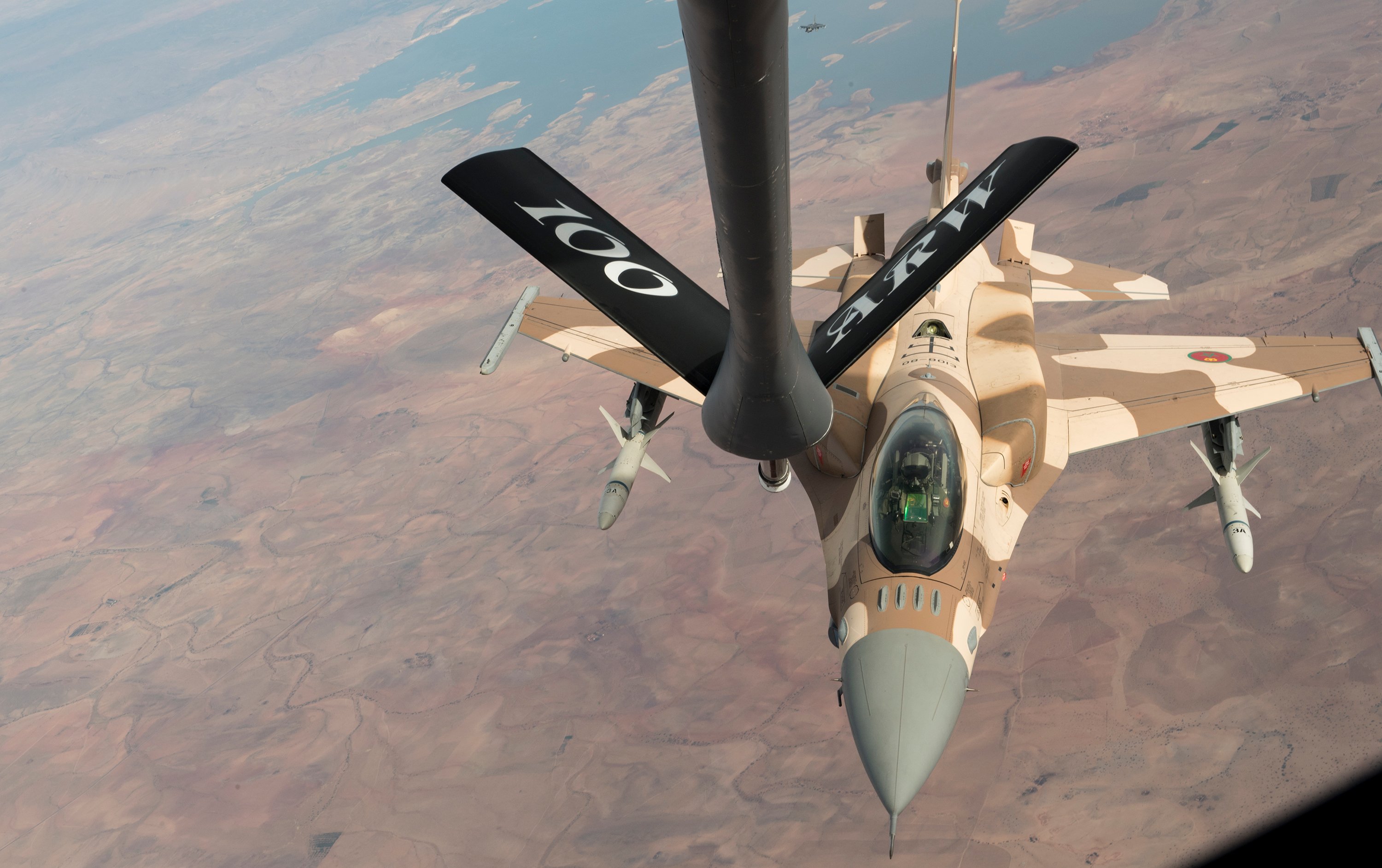 A Royal Moroccan Air Force F-16C/D Block 52+ with a pair of AGM-88 High-speed Anti-Radiation Missiles (HARM) under the wings. U.S. Air Force photo by Staff Sgt. Ceaira Tinsley
 The distinction between the Block 70 and Block 72 is the engine. The Block 70 uses General Electric’s F110-GE-129, while the Block 72 uses Pratt & Whitney’s F100-PW-229, providing fractionally more power. The two configurations otherwise share the same major avionics and systems modernization package.
The F-16 began life as a Pratt & Whitney-powered fighter, with the F100 selected to power the original F-16A/B. But reliability and maintainability problems with early F100s prompted the U.S. Air Force to launch its Alternate Fighter Engine competition in the 1980s, leading General Electric to develop the F110 as an alternative. The resulting “Great Engine War” established two competing F-16 engine families, with Pratt & Whitney’s F100 and GE’s F110 ultimately becoming the principal powerplants for later F-16C/Ds. Although U.S. procurement eventually became heavily concentrated on the GE-powered F-16, Pratt & Whitney continued to supply F100-powered aircraft to international customers.
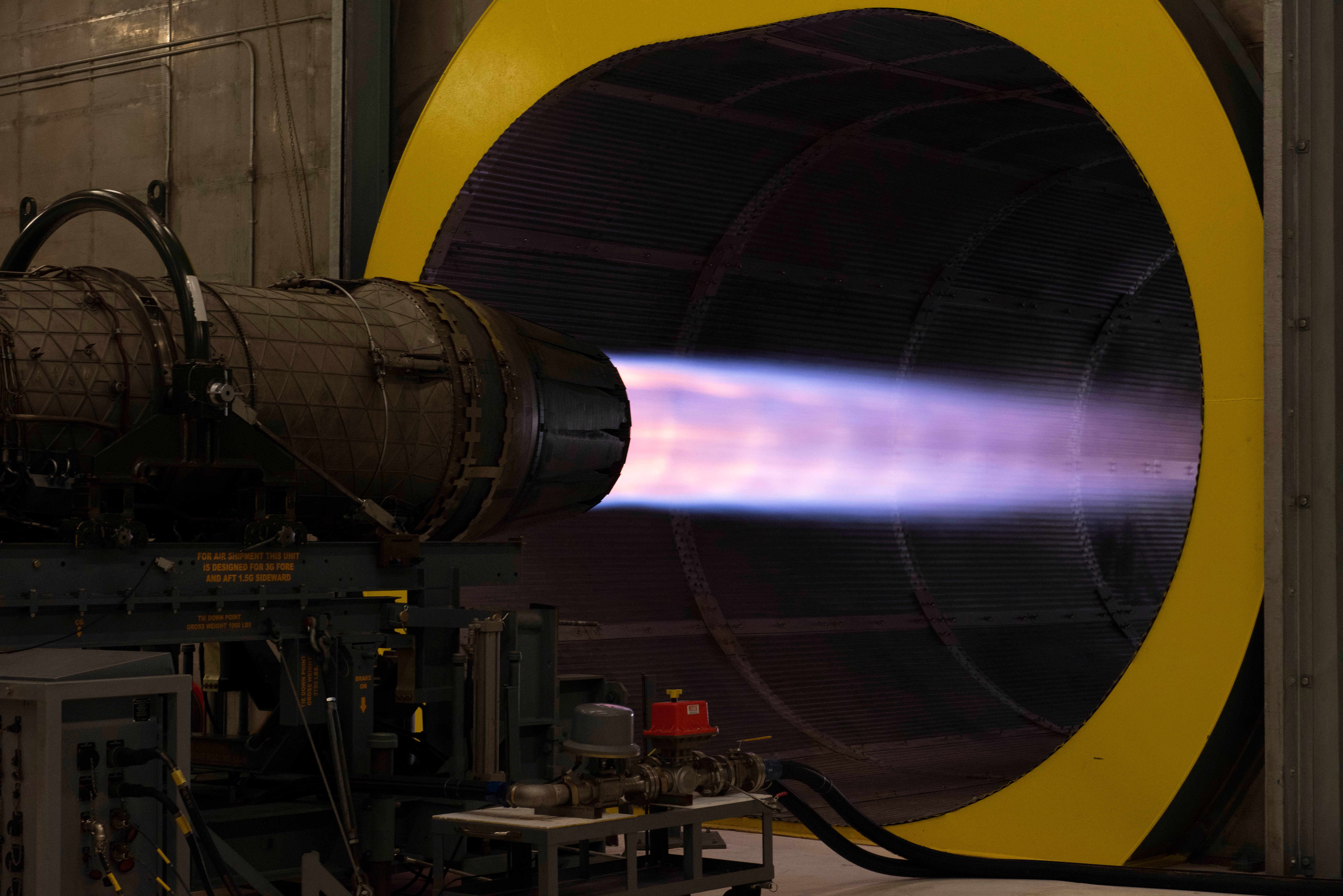 Airmen conduct a test run on a Pratt & Whitney F100 turbofan engine in the hush house at Holloman Air Force Base, New Mexico. U.S. Air photo by Airman 1st Class Isaiah Pedrazzini
 For Morocco, the choice of the Block 72 is based on ensuring as much fleet commonality as possible. The RMAF already operates F-16C/D Block 52+ aircraft powered by F100 engines, making the new aircraft a natural fit within its existing support infrastructure.
Morocco is also upgrading its existing F-16 fleet to the F-16V configuration, which is broadly similar to the new-build Block 70/72 standard.
That will eventually provide the RMAF with a larger fleet centered around a common, substantially modernized F-16 standard.
A separate notification in March 2019 covered the upgrade of Morocco’s existing 23 F-16C/D Block 52+ aircraft to the F-16V standard.
Morocco’s new and upgraded F-16s could also provide a significant boost to combined operations with its other international partners. In recent years, Moroccan F-16s participated in the campaign against ISIS, while the country has also deployed the aircraft on missions against Houthi rebels as part of the Saudi Arabia-led coalition in Yemen. In 2015, a Moroccan F-16 crashed in Yemen. Although the Houthis claimed they had shot down the aircraft, Moroccan authorities attributed the loss to a technical malfunction.
Outside of combat operations, the RMAF also frequently takes part in exercises with its allies, including the African Lion series, the largest annual, multinational joint military exercise led by U.S. Africa Command (USAFRICOM) and partner nations.
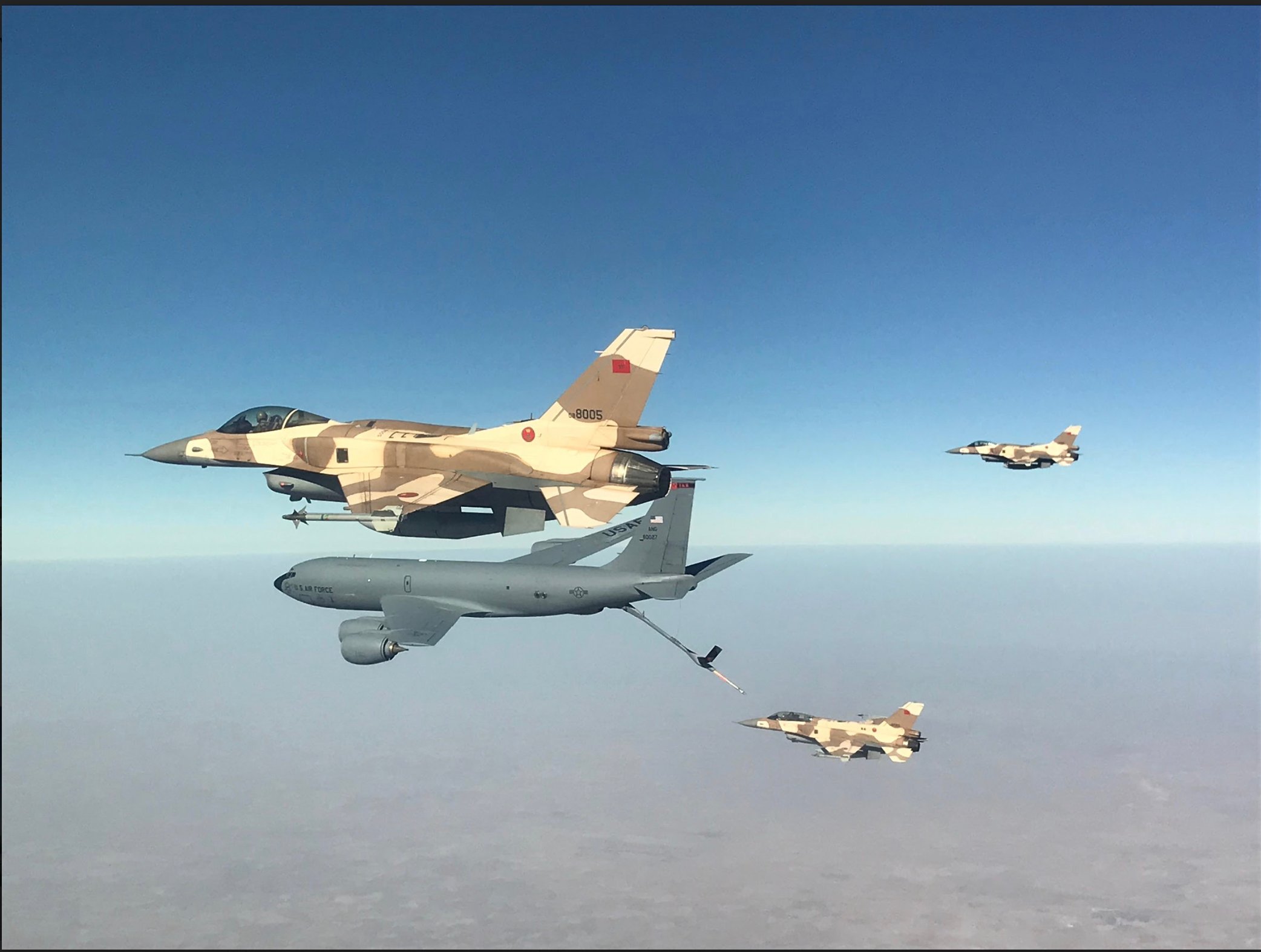 A Utah Air National Guard KC-135 Stratotanker refuels a Royal Moroccan Air Force F-16 over central Morocco as part of Exercise African Lion 2019. U.S. Air Force/Courtesy Photo
 Meanwhile, the new-build Moroccan aircraft also arrives at an interesting point in the F-16 program.
The Block 70/72 has attracted customers across Europe, the Middle East, Asia, and elsewhere, with Bahrain, Bulgaria, Jordan, Peru, the Philippines, Slovakia, Taiwan, and Turkey also having selected the latest-generation Viper configuration. So far, only Block 70s have been ordered, although tbe Block 72 has been offered to some customers and potential customers. There is also apparent U.S. Air Force interest in a version of the Block 70 tailored for its specific needs and referred to by the manufacturer as the F-16G.
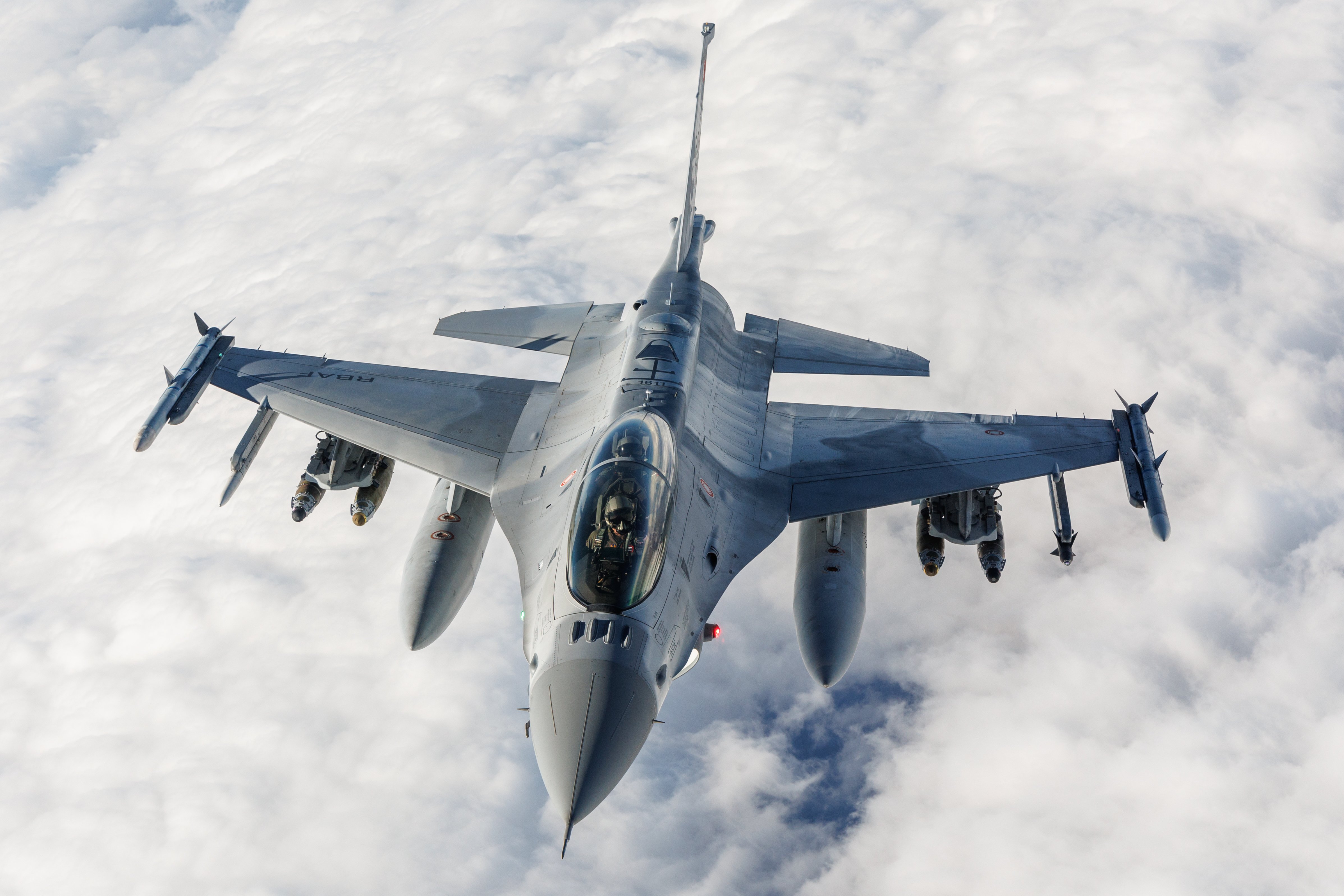 An F-16D Block 70 aircraft for the Royal Bahraini Air Force prior to delivery. U.S. Air Force
 Morocco’s position as the Block 72 launch customer means the aircraft now flying is effectively the prototype-standard production aircraft for an export configuration that other countries can now buy.
The Moroccan F-16 program is also increasingly tied to a broader effort to develop the country’s military-industrial and sustainment infrastructure.
Lockheed Martin says it is working with Moroccan industry, including Maintenance Aero Maroc, on an upcoming MRO facility at Benslimane. The more than 86,000-square-foot facility is intended initially to support heavy maintenance and modernization of C-130 Hercules aircraft, with plans to expand into additional platforms, including the F-16.
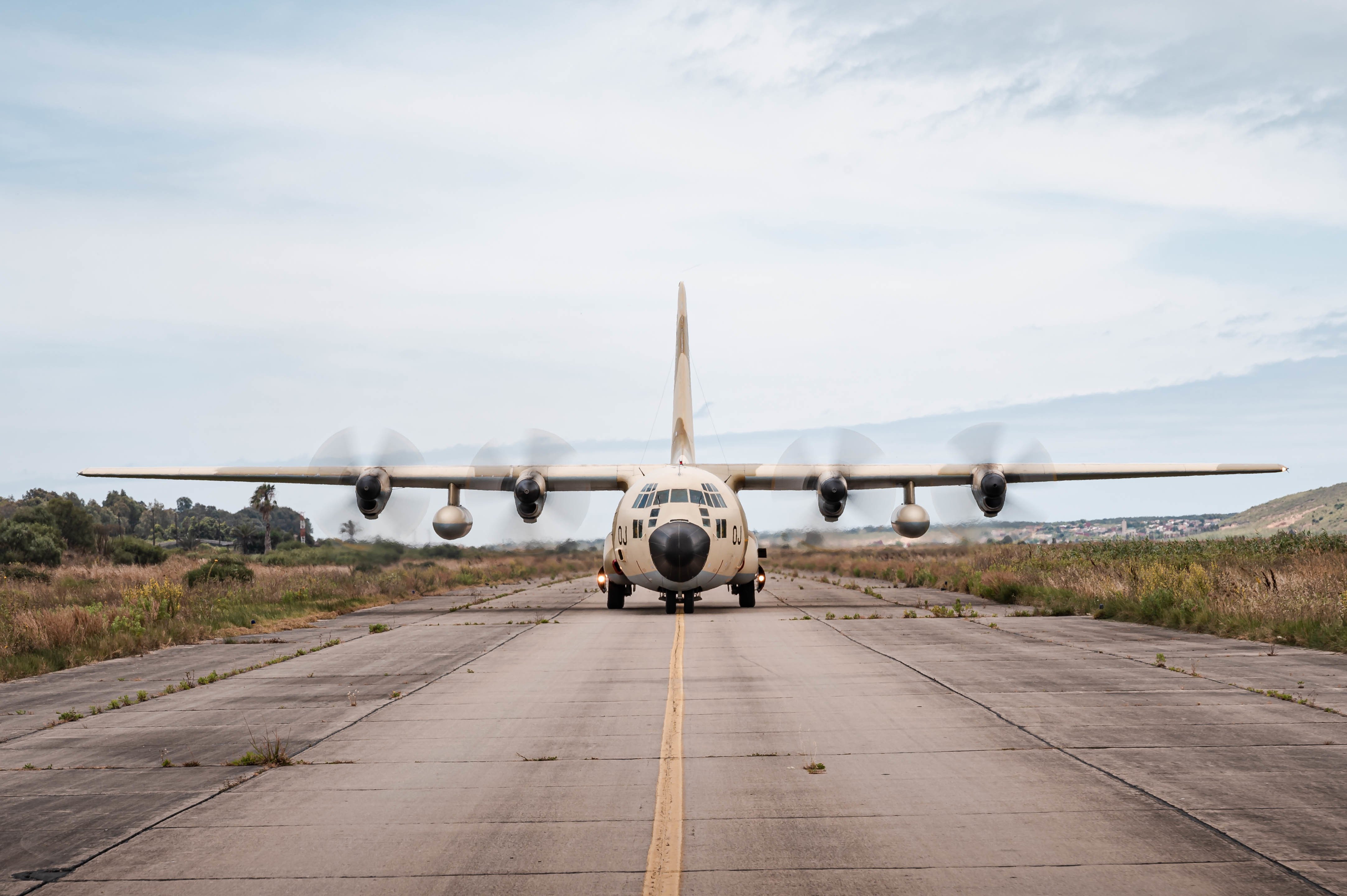 A Royal Moroccan Air Force C-130 Hercules taxis down the runway at the 3rd Royal Moroccan Air Force Base in Kenitra, Morocco. U.S. Air Force photo by Tech. Sgt. Devin Nothstine
 That could eventually give Morocco a greater role in sustaining its own expanding fleet and potentially supporting other aircraft in the region.
The F-16 program itself is part of a much broader U.S.-Moroccan defense relationship that dates back more than five decades. The Royal Moroccan Armed Forces now operate a range of U.S.-supplied systems, while Morocco is also set to receive HIMARS and has expanded its rotary-wing capabilities with AH-64E Apache attack helicopters.
For the RMAF, however, the F-16 remains central to its combat-aircraft modernization and, once it arrives, it will be the spearhead of the country’s fighter fleet.
Contact the author: [email protected]