By Finbold | Created at 2026-09-04 15:05:22 | Updated at 2026-09-04 15:40:20
38 minutes ago
By Finbold | Created at 2026-09-04 15:05:22 | Updated at 2026-09-04 15:40:20
38 minutes ago
Four months after passing with 98.06% approval, Flare’s landmark governance proposal FIP.16 has reshaped the network’s core economics, with most of its roadmap now live and early data beginning to show measurable effects onchain, according to a DefiLlama Research analysis published September 4, 2026.
The proposal tackled five areas simultaneously: FLR issuance, transaction fee burns, staking weight, protocol revenue routing, and the creation of a new governed treasury called FIRE. The breadth of the changes made it one of the most significant single governance decisions in Flare’s history.
Inflation cut, burn rate multiplied, and staking shifted toward locked capital
Annual issuance was cut from 5% to 3% in May, reducing the hard cap from 5 billion to 3 billion FLR per year. Applied to an inflatable supply of roughly 87 billion tokens, gross annual issuance now sits at around 2.6 billion.
The effective impact goes further because FIP.16 also narrowed the base the rate applies to, excluding permanently burned tokens, unearned rewards in penalty pools, and FLR held by FIRE from the inflation calculation. As the burn address grows and FIRE accumulates, fewer tokens are minted each period.
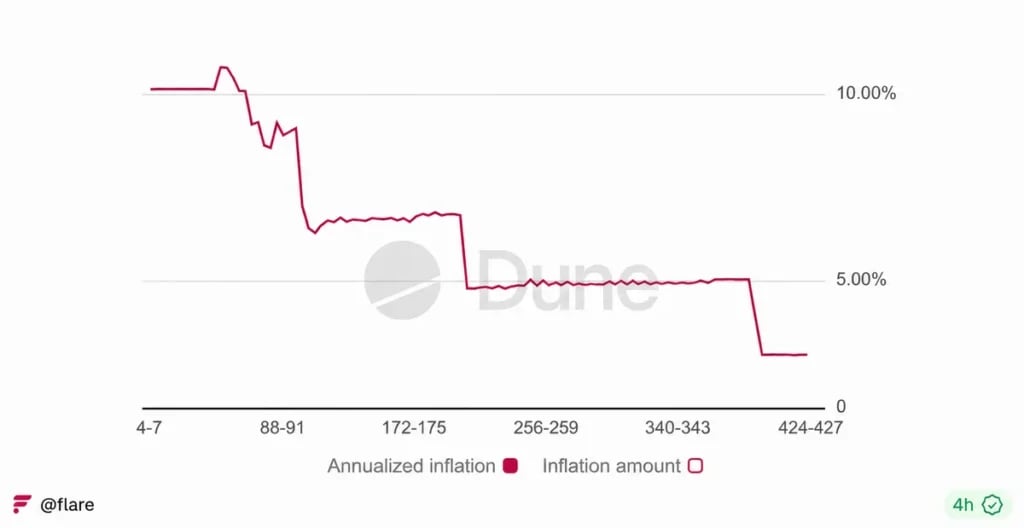 Annualized inflation % by 4-epoch cycle Inflation timelineCredit: DefiLlama Research · © Flare
The July 14 hard fork raised the base transaction fee from 25 gwei to 500 gwei, a 20x increase that lifted the burn rate significantly. More than 40% of the 15.6 million FLR burned year to date through transaction fees has occurred since the fork, putting the current burn rate at more than ten times its pre-fork baseline.
On staking, FIP.16 now counts P-chain locked stake at five times the weight of C-chain delegation, which remains liquid and can exit at any time.
The maximum validator size was also raised from 200 million to 300 million FLR. Since the hard fork, staked FLR has climbed from roughly 16 billion to 21.5 billion, with staking’s share of all staked-or-delegated FLR rising from around 32% in April to roughly 46% by late August.
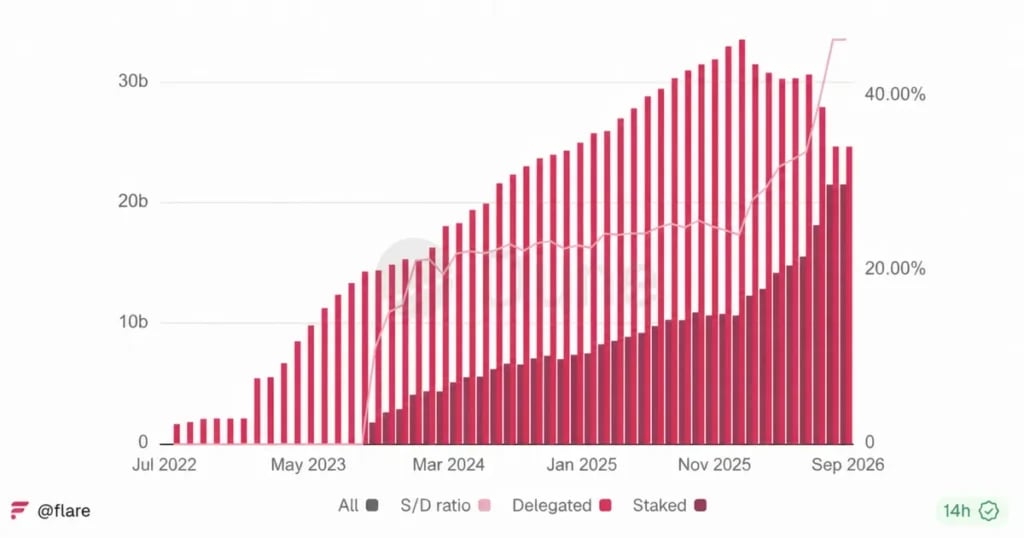 Staked to Delegated Ratio timelineCredit: DefiLlama Research · © Flare
FIRE begins collecting protocol revenue across four fee streams
The Flare Income Reinvestment Entity, or FIRE, is a governed pool designed to reduce FLR supply through burns and open-market buybacks. It has been collecting since May and has taken in $31,438 to date across four active fee streams: FAssets minting fees, which are the largest contributor at $18,248 across 7,708 mints; FDC request fees at $12,676, which began routing in August; FXRP destination-tag registration fees at $505; and FAssets redemption fees at $9.
Additional revenue streams including Flare Smart Account fees, Confidential Compute fees, and MEV capture are staged for later phases as the underlying infrastructure ships. FIRE is currently administered by the Flare Foundation, with a community vote possible after the first year to move it into joint governance.
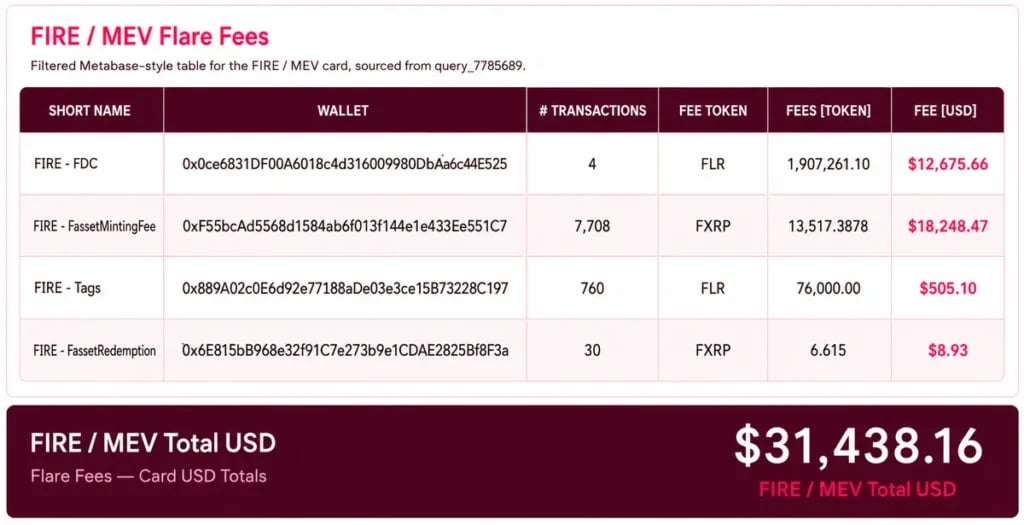 Fire / MEVCredit: DefiLlama Research · © Flare
The proposal was designed to compound over time rather than deliver its full impact immediately. With the core mechanisms now live, the scale of the effect will depend on how FAssets and FDC volumes develop from here.
Featured image via Shutterstock.