 By The Epoch Times | Created at 2026-09-28 09:06:46 | Updated at 2026-09-28 09:45:21
45 minutes ago
By The Epoch Times | Created at 2026-09-28 09:06:46 | Updated at 2026-09-28 09:45:21
45 minutes ago
CAREFREE, Ariz.—The 25th anniversary of Sept. 11 has passed. For most people, life moves on.
Bob Jenkins keeps driving.
His dark gray Mustang GT convertible is difficult to miss. An eagle in red and white enamel stretches across the hood, flanked by the twin towers and a message: “Never Forget 9/11.”
The rest of the car bears similar images.
“I'll pull up to a stoplight and people will give me a thumbs up or honk. Some people don’t say anything,” Jenkins said.
“I drive just to remind people—just to keep the image of 9/11 alive.”
By his own account, Jenkins should have died that day.
After the first plane hit at 8:46 a.m., he was on the 39th floor of the north tower with no clear way out.
His military training taught him not to panic. He found a stairwell and began moving down, one floor at a time, until sunlight struck his face and he could breathe again.
What worries Jenkins most is that future generations will have no connection to that day a quarter century ago. That Sept. 11, 2001 will become just another entry in the history books. Just another date that comes around once a year.
So he keeps driving the Mustang as a rolling memorial.

A 2018 Mustang GT was transformed by 9/11 survivor Bob Jenkins into a tribute to honor victims of the attack. The car displays its message in Carefree, Ariz., on Sept. 20, 2026. Allan Stein/The Epoch Times
Jenkins, 71, said he never planned it that way. He never intended to become a mobile advocate for remembering the deadliest terror attack in U.S. history.
But he felt that an entire generation was being born for whom 9/11 was just an abstraction.
The retired contractor from Carefree, Arizona, had walked down 39 flights through choking smoke. There had to be a way to make the fall of the World Trade Center real for people who had never experienced it.
One day in 2018, a former client and retired New York City detective mentioned the September 11th Victim Compensation Fund, and it gave Jenkins an idea.
He applied for the program, and used part of the money to purchase a Mustang GT the color of night. A friend who detailed cars offered to wrap it in 9/11 imagery as a tribute.
Jenkins didn’t need to say a word. He raised both index fingers to represent the twin towers. His friend knew immediately what he wanted. An eagle on the hood. The north and south towers against the New York City skyline. The Statue of Liberty on a rear quarter panel.
On the driver’s and passenger sides, two New York City firefighters raise the flag at Ground Zero.

Bob Jenkins, 71, a survivor of the Sept. 11, 2001, World Trade Center attacks, in Carefree, Ariz., on Sept. 20, 2026. Jenkins hold the ID card that got him into the north tower just minutes before the first plane struck it. Allan Stein/The Epoch Times
A message for all to see: “Never Forget 9/11.”
“This car doesn’t belong to me—it belongs to the people that died,” Jenkins told The Epoch Times.
“It’s the only reason I have this car. It’s the only reason I’m doing this.”
Nearly 3,000 people died in the terror attacks, including 343 firefighters and 72 law enforcement officers. Thousands more survivors and first responders have since developed 9/11-related illnesses.
A Beautiful Morning
Jenkins carries more than the memory of Sept. 11, 2001. He has dealt with emotional trauma and physical ailments in the years that followed.
He’s had three types of cancer, which he believes were caused by exposure to toxic chemicals inside the 110-story north tower.
Much of that morning remains clear in Jenkins’s mind, though some memories are too painful to revisit.
Sept. 11, 2001, began as a crisp Lower Manhattan morning. The sky was a perfect blue. The previous day’s heat and humidity had broken. Jenkins was on his way to work as a salesman for a Lehman Brothers contractor, coffee in hand.
“It was just the kind of weather that makes you feel good,” Jenkins said.
His team hailed a cab and arrived at the World Trade Center around 8 a.m. for a morning meeting. People streamed through the doors.

Bob Jenkins, 71, a former Marine, stands next to the Mustang GT he converted into a mobile 9/11 tribute, in Carefree, Ariz., on Sept. 20, 2026. Allan Stein/The Epoch Times
“It was like being in a vacuum getting sucked into the building,” Jenkins said.
He grabbed his ID tag and headed for the elevator.
A conference room had been reserved on the 39th floor. Everybody sat down, exchanged pleasantries, and the meeting began.
“Nothing fancy, no water, no coffee, just, you’re there to do business in a conference room,” Jenkins said.
Jenkins said he was briefing attendees of the purpose of the meeting when a violent explosion suddenly erupted above them.
The room jolted.
Everyone froze, eyes wide.
‘This Is Where I Die’
“It was quiet for a nanosecond,” he said, “and then you felt that energy—that wave, that concussion that came down through the building.”
His Marine training as a combat engineer took over. Familiar with explosives, Jenkins stayed calm.
“A lot of people didn’t realize that a plane had hit the building,” he said. “The building just started to convulse back and forth.”
“Right off the bat, I knew this was not an earthquake.”
Logic told him the elevators were probably broken. There was no way to climb down from the 39th floor through a window and survive. He feared the stairwells were impassable.

Bob Jenkins survived the terror attacks that collapsed the World Trade Center on Sept. 11, 2001. Here, he makes a sign of the twin towers, in Carefree, Ariz., on Sept. 20, 2026. Allan Stein/The Epoch Times
He got up and made his way toward the exit and the windows, then looked out over the city.
There was the Statue of Liberty, the Hudson River, the streets below—and above it all, that “beautiful cobalt blue sky.”
He saw what looked like white ticker tape, “like snowflakes,” and thought, “God how beautiful—like parade confetti.”
It was paper and documents blown from the floors above, he said.
The building swayed back and forth, and Jenkins imagined it toppling. He put his hands in his pockets, felt the loose change, and a terrible thought entered his mind.
“This is where I die.”
“Jumping would have killed me. I couldn’t take the elevator because the elevators were out. The stairs, in my mind, were inoperable,” he said.
As quickly as it started, the building stopped shaking with an audible “clunk.” A woman shouted there had been an explosion in the mechanical room on the 42nd floor.
One way or another, Jenkins was determined to get out of the north tower and reunite with his family—“at least, I was going to try.”
He rushed to the nearest stairwell, but the crush of people brought him to a crawl. A man in a wheelchair blocked the way on a lower level.
Several stories below, a woman having difficulty keeping pace was slowing the flow.
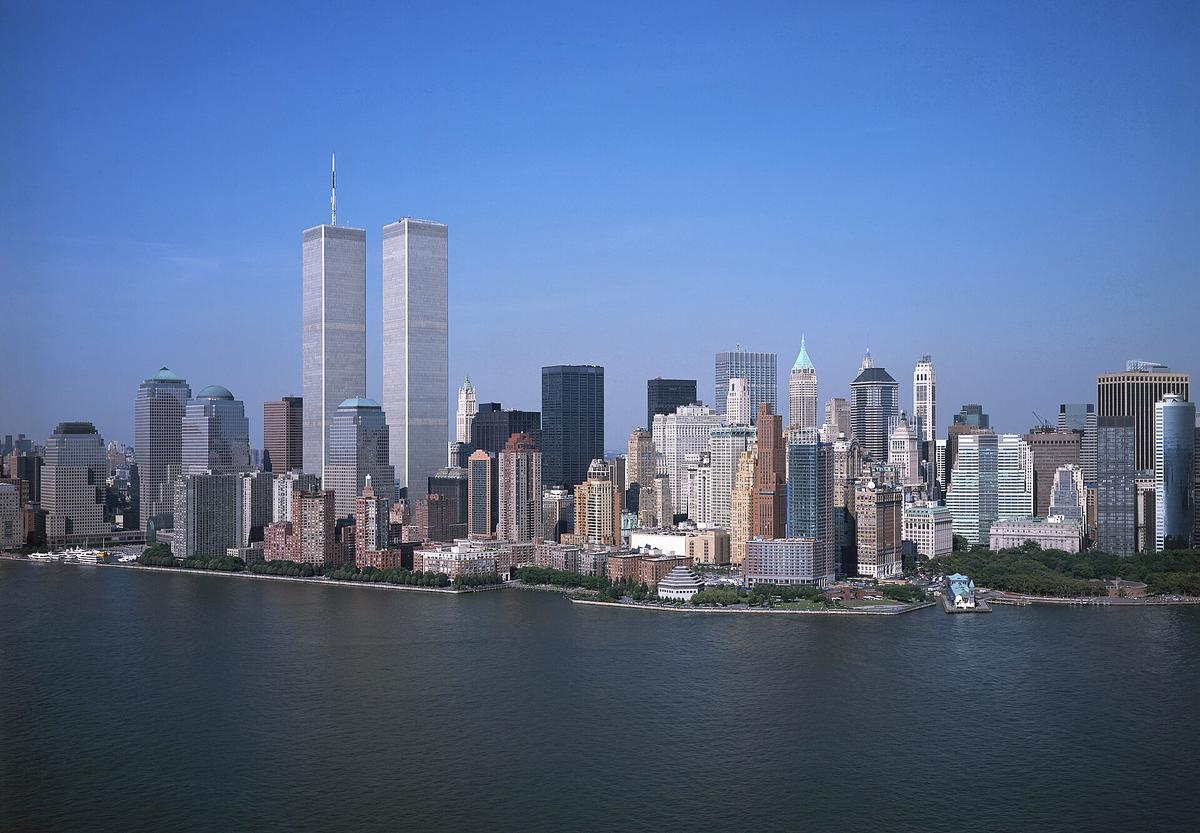
The twin towers as seen from the Hudson River in New York City in July 2001, two months prior to the Sept. 11 attacks. Public Domain
As they moved down, first responders raced up. Smoke and jet fuel filled the stairwell, making it difficult to breathe.
“At one point, I felt we were going to die of smoke inhalation,” Jenkins recalled.
He remembers counting the floors going down—9, 8, 7, 6, 5, 4 …
Then, a door opened. He was outside, able to breathe again.
Jenkins was hyperventilating, soaked in sweat, water, and jet fuel.
“I opened the door [to the ground level]. I looked at all the people. I looked at the smoke.”
He realized he’d left his overnight bag inside and thought about going back.
He turned toward the building, took a step, then stopped.
His body seemed to resist, as if invisible hands were gripping his shoulders and pulling him back. He remained on the sidewalk until he finally reconnected with his team.
“That’s the only reason I’m sitting here at this moment—that’s the only reason I’m alive,” Jenkins said.

World Trade Center attack survivor Bob Jenkins reads a copy of Life magazine published soon after the event, in Carefree, Ariz., on Sept. 20, 2026. Allan Stein/The Epoch Times
Survivor’s Guilt
Others weren’t as fortunate.
From the sidewalk, Jenkins watched people jumping from windows to their deaths. Falling like rag dolls.
“I turned around to all these people, and I yelled: ‘Folks, this is not live entertainment. I will not stand here and watch people commit suicide.’”
The man in the wheelchair, the woman blocking the stairwell, the people falling—those are the memories Jenkins said remain hardest to live with.
At first, there was guilt, too, for having survived.
“I was crying hysterically. All I could picture was a man and woman jumping off the building. I was crying like a baby,” Jenkins said.
Twenty-five years later, Jenkins still has the ID card from that day. He plans to keep it for the rest of his life.
He started a webpage, survivor911.com, and is working with Indie Books International to publish his memoir, “Stairway to Heaven,” an account of what preceded 9/11 and the events of that tragic day.
“Part of the reason I wrote the book is we have people that were not alive then. Or they were so young they have no knowledge,” Jenkins said.
“It’s now just becoming history. I’m afraid to let it go.”
Jenkins drives his Mustang GT with the top down and the black leather seats immaculate whenever he gets the chance.
He hasn’t met many survivors. Others have told him they would have been in the towers that morning if not for the flu or a missed subway connection.
For Jenkins, those stories are a chilling reminder of how many lives were impacted by Sept. 11—and why the day must not be forgotten.
Forgetting is the enemy of 9/11 as the years pass, he said.

People place American flags to commemorate the 9/11 terrorist attacks in 2001, on Capitol Hill in Washington on Sept. 11, 2025.Madalina Kilroy/The Epoch Times
“I call it memorial anniversary,” he said. “There’s nothing to celebrate.”
At that moment, a woman overheard Jenkins telling his story, apologized for interrupting and gave him a hug.
Before leaving, she said she had to see the memorial Mustang.
Moving On
Jenkins feels he has come to terms with the terror and aftermath of 9/11. He considers himself fortunate to have had only one nightmare.
In it, he finds himself at the Stanley Hotel, made famous by Stephen King’s “The Shining.” He’s walking down a hallway near the steel elevators when a little gremlin approaches and stops at his feet.
“We missed you the first time,” the apparition said. “We’ll get you next time.”
“That freaked me out,” Jenkins said.
The nightmare stayed with him. So did the lessons he learned that late summer morning in Lower Manhattan:
Never panic.
Don’t sweat the small stuff.
Honor first responders.
Remember 9/11.
Jenkins named his book “Stairway to Heaven” to chronicle a lifetime of experiences leading up to that day.

Jenkins, 71, said he never intended to become a mobile advocate for remembering the deadliest terror attack in U.S. history. Allan Stein/The Epoch Times
“Everyone is on a ‘stairway to heaven,’” he said, but not everything that glitters is gold. There is darkness in the world.
On this day, the Arizona sun is bright, thousands of miles from New York City’s ground zero. His Mustang waits beneath a shady tree in the parking lot.
Jenkins gets behind the wheel, starts the engine and pulls onto the road.
He knows where he has to go—and he has many miles left before the day he gives up his keys.