 By The Megyn Kelly Show | Created at 2026-08-07 19:46:37 | Updated at 2026-08-07 20:25:17
1 hour ago
By The Megyn Kelly Show | Created at 2026-08-07 19:46:37 | Updated at 2026-08-07 20:25:17
1 hour ago
Some 13 months since pleading guilty to the November 2022 murders of University of Idaho students Madison Mogen, Kaylee Goncalves, Xana Kernodle, and Ethan Chapin as part of a bombshell plea deal that allowed him to avoid the death penalty, Bryan Kohberger has changed his mind.
Last week, the now-31 year old – who is serving four consecutive life in prison without the possibility of parole sentences for each first-degree murder count, plus 10 years for burglary – petitioned the court to withdraw his guilty plea so he can seek a new trial.
In a handwritten affidavit of facts, Kohberger claimed he received ineffective assistance of counsel and “was convinced to falsely confess to capital murder, and felony burglary by coercion, disinformation, false promises, and withholding of exculpatory discovery.”
Kohberger’s request is stunning, but the handwritten filing also offered the latest look at his penmanship. MegynKelly.com spoke with forensic handwriting expert Bart Baggett to learn what we can glean from Kohberger’s writing and what it reveals about his personality.
The Methodology
As Baggett explained, this is an exercise in “personality profiling” using a person’s handwriting samples. “I take a very scientific approach, even though some people don’t love this field because a lot of people use really speculative, broad terms,” he said.
“This is an interesting assignment because it’s such a high-profile case,” Baggett noted. “Since he gave very little away emotionally on his face, I think there’s probably hunger to find out what burns beneath this individual, and I think handwriting is an interesting angle to do that.
As part of this analysis, Baggett looked at Kohberger’s handwriting on the July 27 filing, two prison grievances he submitted just after signing the plea deal in July 2025, and his signatures. “When you look at a document like this, you’re approaching it the same way you would any document – you look at the cursive if you have cursive, you look at the print if you have print,” he explained.
Generally speaking, cursive is considered more revealing than printing. “Printing is definitely harder because the majority of the primary traits in the books that I recommend and the books I’ve written really lean on connected cursive writing, so that we have these useful strokes that begin with a baseline connection,” Baggett explained.
But there is still plenty to learn. In the case of printing samples, Baggett focuses on “little parts of little individual strokes.” For example, the lowercase ‘t’ is considered one of the most revealing indicators of psychology and ego. A low t-bar can suggest low self-esteem. The placement of the dot on a lowercase ‘i’, meanwhile, can be read as a micro-expression. When i-dots are pointed down, a person may be irritated.
“All those things have to be put together to sort of wrap up some sort of individual,” Baggett told us.
The July 2026 Affidavit
Examining the affidavit of facts Kohberger filed last month (below), Baggett said his first impression was that the writing was “a little bit more organized” in terms of “the baseline and the structure of the zones” than the handwriting sample from July 2025.
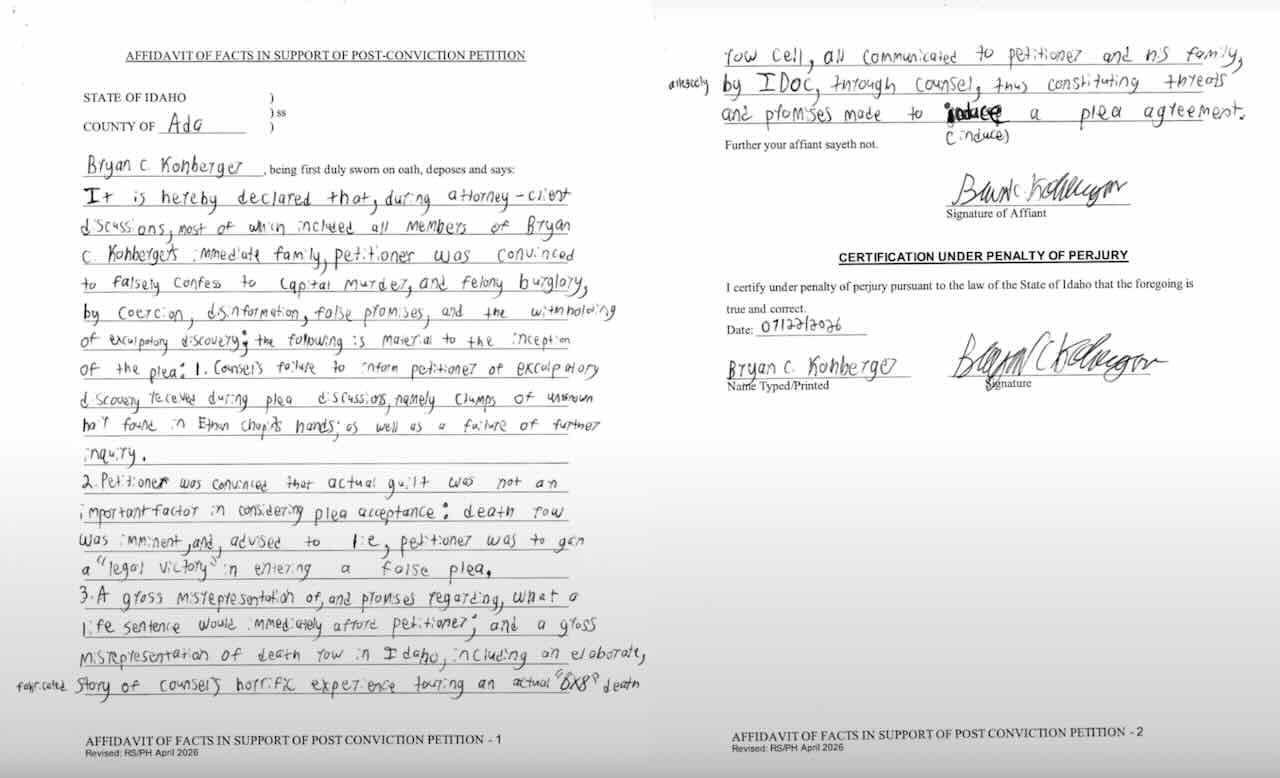 July 2026
“When you are presenting the best version of your handwriting for something such as an appeal or affidavit of facts, you’re going to write as pretty as you can,” Baggett explained. “This is by far his best version of organized and pretty handwriting, which had to take him quite a bit of time to write. If he was left to his own accord it would be basically illegible because his mind isn’t very structured.”
Baggett has gleaned that from analyzing the cursive samples available from Kohberger’s signatures on court documents. “I believe one of the reasons he chose to print on most things is because his cursive is basically illegible. He has the inability to maintain a baseline, the inability to keep spacing between the letters. His mind is just not structured in a logical way to have symmetry or pretty handwriting,” he noted.
“When you see really pretty writing, that actually means perfectionist — people go out of their way to be precise and they have a cumulative thought process,” Baggett elaborated. “Bryan’s thought process is literally chaotic. His thought processes are so non-sequential that his hand and his pen can’t maintain a sense of balance and space.”
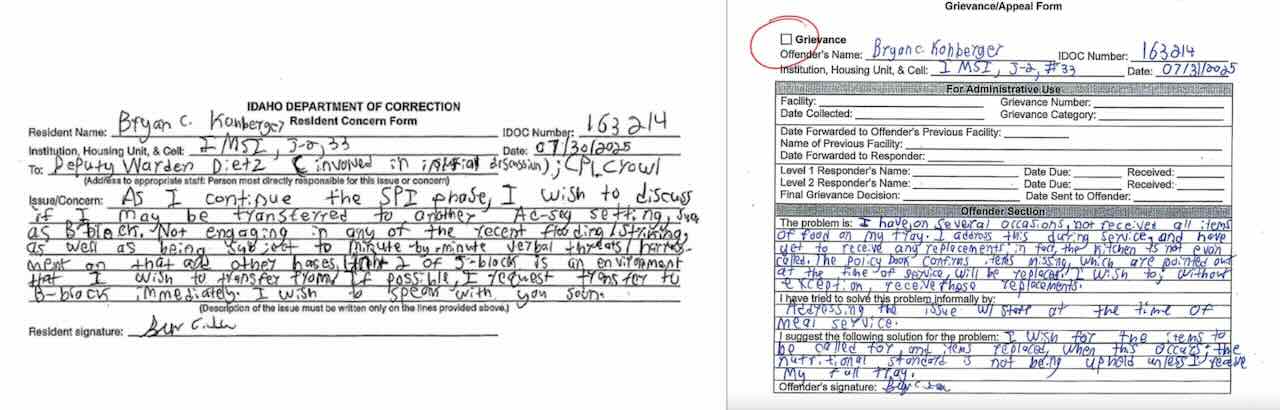 July 2025
When comparing the July 2026 printing sample to the July 2025 samples (above), Baggett said the “only significant difference” is that “there is more structure and more intent to be legible here.”
“The baseline and the margins are way bouncier in the previous versions, and I believe that was his first few weeks or months of being in prison. So his stress level must have been much, much higher a year ago than it was in this writing. He’s had time to calm down a little bit,” he said. “But the personality traits are very similar.”
The Analysis
With that in mind, Baggett took us through the personality traits he uncovered through analyzing Kohberger’s handwriting. Alone, they don’t necessarily say much; when looked at as a “stack,” they can reveal quite a bit. Here is what we learned:
The ‘Revenge D’
Many of the traits that reveal themselves in writing samples are not necessarily positive or negative on their own, but they do carry specific connotations. The lowercase “Revenge D,” as named by handwriting expert Pradeep Kirpalani, is one such example.
“Pradeep presented a paper about the ‘Revenge D’ – and it’s pretty consistent in Bryan’s signatures. I haven’t seen it in enough people’s writing to know decisively that it’s always true, but in this handwriting it is one of the predominant unique qualities that makes it stand out from other people’s handwriting,” Baggett shared. “Not only is [the lowercase ‘d’] created with a strange oval structure, but it is much smaller than the letters around it — as if he has an aversion to the upper zone of the handwriting.”
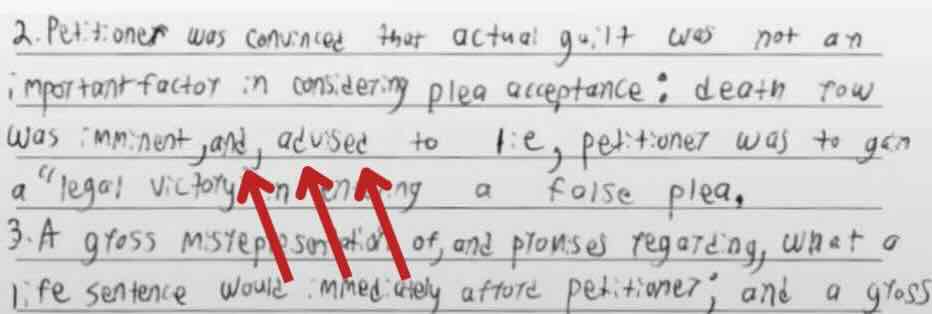 July 2026
It is visible in both the July 2025 and July 2026 samples from Kohberger. “That letter ‘d’ is interesting… What I think Pradeep would say about that [is] it’s a trait which really creates intensity of the need for revenge. That stroke indicates a sense of injustice, resentment, a sense of unworthiness, and physical aggression at his perceived enemies.’ It’s essentially a state of unforgiveness and anger at things and people around him — or specifically things in his past,” Baggett explained.
The “Revenge D” often reveals itself in people who perceive themselves as victims. “When you perceive yourself as the victim and everyone else as the perpetrator, you can justify heinous acts. Whether that’s something as awful as murder, or lying, or cheating, or stealing, they tend to justify what we would call ‘sinful behavior,’” Baggett said.
It should be noted that one trait does not signal someone is going to be violent. In fact, Baggett said Kirpalani’s studies have found the “Revenge D” prevalent in professional athletes who use those feelings as a driver for success.
“Many world champions… have a sense of anger or a sense of insecurity which is the main driver of their greatness,” Baggett noted. “So, you can’t say that one trait would go to violence, but it is going to go to the intensity of this feeling of wanting revenge.”
Lowercase T’s and I’s
It’s not just an idiomatic phrase – how you dot your i’s and cross your t’s is actually quite revealing. In handwriting analysis, the i-dot connotes certain micro-expressions, while the placement, shape, and slant of the t-bar can be indicators of a person’s psychology, drive, and behavior.
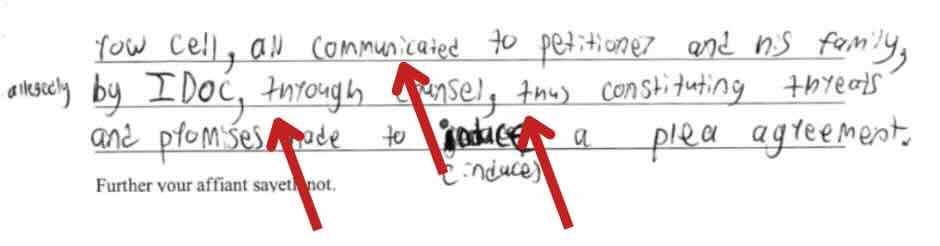 July 2026
“The other trait which can stack onto this [‘Revenge D’] – which we would not get from looking at Kohberger’s body language – is that his self-esteem is very, very low. People with low self-esteem often have delusions of grandeur, so he has this delusion and illusion that one day he’ll be powerful,” Baggett explained. “And then he has a lot of sarcasm, which is basically creating double meaning. Sarcasm is a defense mechanism for the ego to cut people down. Obviously you could make the parallel to physically cutting them, but that wouldn’t be anything you would see in handwriting.”
“When you stack all of those together, what you have is somebody who desperately needs to be in control of something because, in their soul, they feel completely powerless. He feels overlooked, powerless, and victimized,” he continued. “That’s his view of the world.”
M’s and N’s
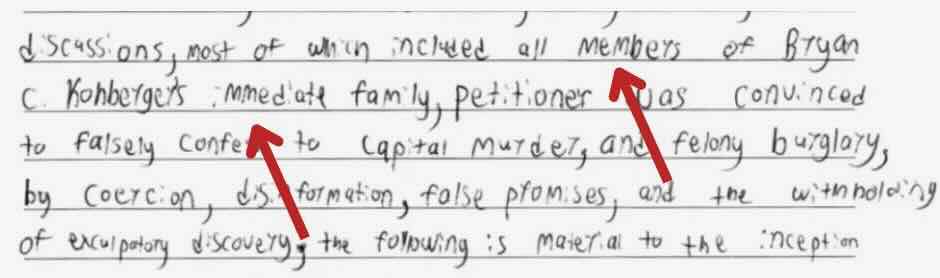
In both printing samples, Baggett observed an “odd, bouncy baseline” that he says denotes a “sense of clumsiness and disorganized thinking.” But a closer look at the lowercase ‘m’ and ‘n’ reveals more. “The shapes of the M’s and N’s indicate an incredibly methodical, almost sludge-like thinking process,” he said.
 July 2026
As Baggett noted, this is “not always associated with people who lack intelligence,” but he believes that could be the case for Kohberger despite the fact that he was a PhD student. “I made the comment a year ago that I thought he might have been on the spectrum or some level of mental disorder because his writing was so slow and clumsy. I’m still of the opinion that he is not very bright. He would not score high on typical IQ tests that test both accuracy and speed,” he posited.
“I understand he had a higher level of education, but I’m not convinced that he is a bright individual with quick synaptic pathways and witty banter,” Baggett added. “I just do not think he is a bright individual. Whether or not he has any kind of spectrum disorder, I just don’t know.”
Cursive Y
While Baggett said Kohberger’s cursive is “almost illegible” in the signatures he has seen, one thing that stood out is the shape of the lowercase ‘y’ in his first name.
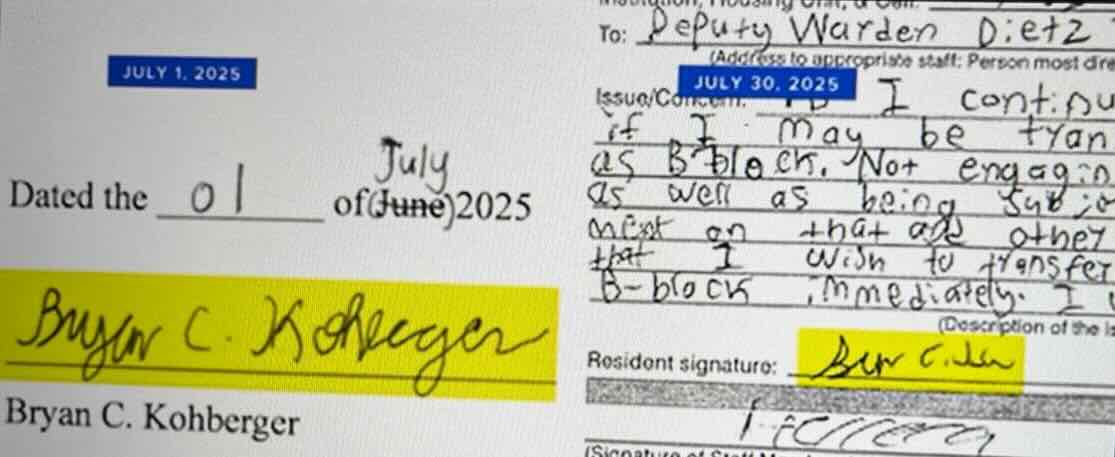
“His ‘y’ is very tiny,” Baggett noted. “Lower zones that are not very long indicate a very low libido, a low drive, almost a laziness about him that would also extend to a lack of relationships or just general frustration with the opposite gender, assuming he is straight.”
The Takeaway
From what we have seen, Baggett said Kohberger’s handwriting is “weird because it’s so out of the box” – particularly when compared to other killers. “When I looked at Ted Bundy’s handwriting, you had some traits like resentment, but you had someone that was mature. He had upper zone. He had lower zone. He had self-esteem. He had enthusiasm. It looked a lot like a lot of people’s writing with, of course, a deviant driver such as resentment,” he said.
Baggett’s takeaway from Kohberger’s samples: “This individual is just deeply angry and repressed and believes that he is the victim.”
Get all the news you need in 60 seconds or less with the American News Minute. The free weekly email delivers the top stories and must-see moments from the Megyn Kelly Show straight to your inbox every Friday.