By The Straits Times | Created at 2026-09-14 21:26:34 | Updated at 2026-09-19 10:15:20
4 days ago
By The Straits Times | Created at 2026-09-14 21:26:34 | Updated at 2026-09-19 10:15:20
4 days ago
KUALA LUMPUR – Almost four years of governing together have done little to erase decades of animosity between UMNO and Pakatan Harapan (PH), with tensions resurfacing as Malaysia edges towards its next general election.
While their alliance was initially lauded for ending two years of political instability in 2022, deep mistrust and ideological differences are now nearing breaking point, as reflected at UMNO’s annual general assembly on Sept 12.
For many in Malaysia’s oldest political party, four years in the so-called “unity government” with PH component parties Parti Keadilan Rakyat (PKR) and Democratic Action Party (DAP) have hardened old suspicions rather than broken down barriers.
Speaking from the main stage at UMNO’s headquarters at the World Trade Centre Kuala Lumpur, Penang delegate Zaidi Said lashed out at DAP, accusing the PH party of undermining UMNO and its mission to champion Malay interests.
“Behind one good thing they do, there are 10 bad things that they are doing to this country,” Zaidi said. “They will use whatever way necessary to break up the Malays.”
It was far from a fringe view. UMNO president Zahid Hamidi, seated on the same stage, smiled and nodded in agreement during the speech.
Unlike in 2023, when Malaysian Prime Minister Anwar Ibrahim was invited to the UMNO general assembly to share the stage with the party, UMNO did not extend an invitation to its partners in the government in the 2026 assembly.
Instead, delegates from the opposition Parti Islam Se-Malaysia (PAS) were given the honour of sitting in the front row of the hall, reciprocating the gesture given to UMNO during PAS’ own general assembly just weeks earlier.
Zahid’s own address illustrated how strained the relationship has become, when he challenged Anwar to remove UMNO from the government in response to recent attacks on the party from within PH.
Zahid, who is also Deputy Prime Minister, reminded PH that the unity government was formed because UMNO agreed to support Anwar after the inconclusive 2022 general election, and suggested that cooperation should not be mistaken for subservience.
At one point, he pulled out a copy of the agreement signed when the unity government was formed, stressing that it referred to the administration as the “Malaysia unity government” – rather than the “Madani government”.
“Where does it say Madani?” Zahid asked.
Anwar has increasingly branded his administration as the Madani government, after the Malaysia Madani policy framework he introduced in January 2023. The term has now been attached to many of his government’s initiatives.
Rift between UMNO and PH partners goes deep
Beyond this dispute over terminology, UMNO’s broader dissatisfaction stems from a deeper grievance that Anwar’s political branding has overshadowed the identities of the other parties that agreed to form the government in 2022.
Speaking to The Straits Times, Pahang UMNO Youth chief Hazarul Azmi said the party agreed to cooperate for the sake of national stability, “not a surrender of its identity and principles”.
“There are voices within UMNO that view the party as increasingly becoming a political target of its coalition partners,” Hazarul said.
“The question is whether the principle of camaraderie is still being respected.”
The problem is that many of the issues straining the coalition are not peripheral disagreements, but questions both sides consider fundamental to their political identities.
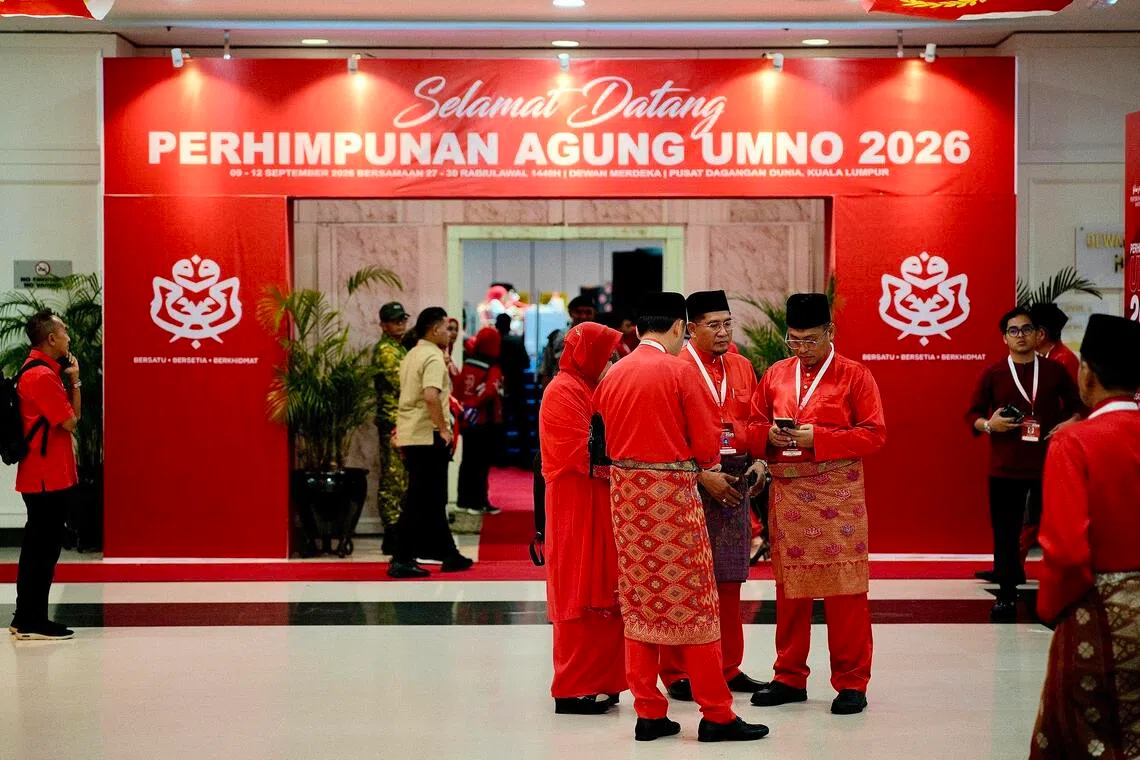
UMNO delegates crowd the World Trade Centre Kuala Lumpur for the party's general assembly on Sept 11.
ST PHOTO: HADI AZMI
While UMNO’s rivalry with PKR dates to the latter’s formation in 1998 after Anwar was sacked from UMNO, its friction with DAP stretches back to the 1960s.
DAP succeeded the Malayan branch of Singapore’s ruling party, the PAP, after the 1965 Separation. It then continued the “Malaysian Malaysia” agenda, which puts it in direct conflict with UMNO’s vision of Malay political primacy and the special position of the Malays.
UMNO insists cooperation cannot come at the expense of its traditional defence of Malay rights, Islam and the monarchy, while DAP remains tied to causes including vernacular education, institutional reform and a more explicitly multiracial conception of government.
A key flashpoint is the push for a pardon for former UMNO president and prime minister Najib Razak. UMNO is backing the cause not only out of loyalty to its former leader, but also by invoking a convicted person’s right to seek clemency and the King’s constitutional prerogative to grant it.
PH, meanwhile, has stressed that those convicted in major corruption cases should serve their court-imposed sentences.
UMNO secretary-general Asyraf Wajdi Dusuki expressed disappointment with PH’s stance, pointing out that Anwar himself received a royal pardon in 2018 while serving a prison sentence.
“Why should different standards be applied to others?” Asyraf said.
Unity government lacks rules of engagement
Political analyst Tunku Mohar Mokhtar of the International Islamic University Malaysia said part of the problem lies in the absence of firm rules governing how coalition partners should deal with attacks against one another.
“Leaders could condemn one another without any reprimand from the top leadership,” Tunku Mohar said, citing firebrand UMNO Youth chief Akmal Saleh as among the most vocal critics of PH.
At the assembly, Akmal made clear how far that dissatisfaction had gone, saying UMNO Youth was prepared to work with PAS in the coming Melaka state election and drawing a line against cooperation with PH.
“I repeat, at this stage as the leader of UMNO Youth, I do not want to become a candidate if PH is a candidate there,” he said.
Against this backdrop, a top UMNO veteran from Penang, who asked not to be named, said that it was already surprising that the unity government had lasted this long.
He argued that UMNO was unfairly accused of racism, while accusing DAP of practising similar racial politics in Penang.
“In their speeches, they always condemn the Malays. They speak in Mandarin, but we can understand,” he alleged, without giving any examples.
Drawing on his experience in DAP-led Penang, he said friction between the two parties remained substantial, with much of their public cordiality amounting to a facade maintained for political stability.
“But how long can people keep up an act?” he asked. “Enemies will remain enemies, and we are seeing the cracks forming.”
In response to the fiery speeches, Communication Minister Fahmi Fadzil, who is also the spokesperson for the unity government, said parties should put the country first and avoid emotionally driven rhetoric.
“If we look at any political party, there will be voices criticising others, with some wanting to do one thing and others wanting to do something else,” Fahmi told reporters on Sept 13.
“But as leaders, we must set an example by putting Malaysia first.”
Sign up for our weekly Asian Insider Malaysia Edition newsletter to make sense of the big stories in Malaysia.