 By Opta Analyst | Created at 2026-07-18 17:28:12 | Updated at 2026-08-02 18:58:14
2 weeks ago
By Opta Analyst | Created at 2026-07-18 17:28:12 | Updated at 2026-08-02 18:58:14
2 weeks ago
England have reached four semi-finals at major tournaments in the last eight years. That doubles their all-time total. How have the Three Lions been able to push through what seemed to be a mental barrier?
England failing at major tournaments was, to be honest, a bit of a running joke for quite a while.
Every World Cup and European Championship was preceded by ‘England expects’ and ‘It’s coming home’, assuming the Three Lions even qualified.
But usually by July, the plane home had already landed and the autopsy of what went wrong was well under way.
Last Saturday, though, England reached the 2026 World Cup semi-finals, beating Norway 2-1 thanks to a brace from Jude Bellingham.
There was much celebration from the fans, but by now, they’re actually somewhat getting used to it.
England have now progressed to the semi-finals in four of the last five men’s major tournaments (World Cup/European Championship), as many as they reached in their history prior to the 2018 World Cup (four).
Their four semi-final appearances before then were in the 1966 and 1990 World Cups, and the 1968 and 1996 European Championship. It should be noted that Euro ’68 was only a four-team tournament, but England still had to qualify via a group stage and then a two-legged play-off with Spain.
Their only failure to reach the final four since 2018 was the 2022 World Cup, when they were beaten 2-1 by France in the quarter-finals, but Les Bleus were the defending champions and were a penalty shootout away from winning it again.
It wasn’t always this way, and is quite the turnaround given the low point of Euro 2016, when Roy Hodgson’s England were beaten 2-1 in the last 16 by Iceland, a country with a population of around 400,000, and who were ranked 34th in the world prior to that tournament by FIFA.
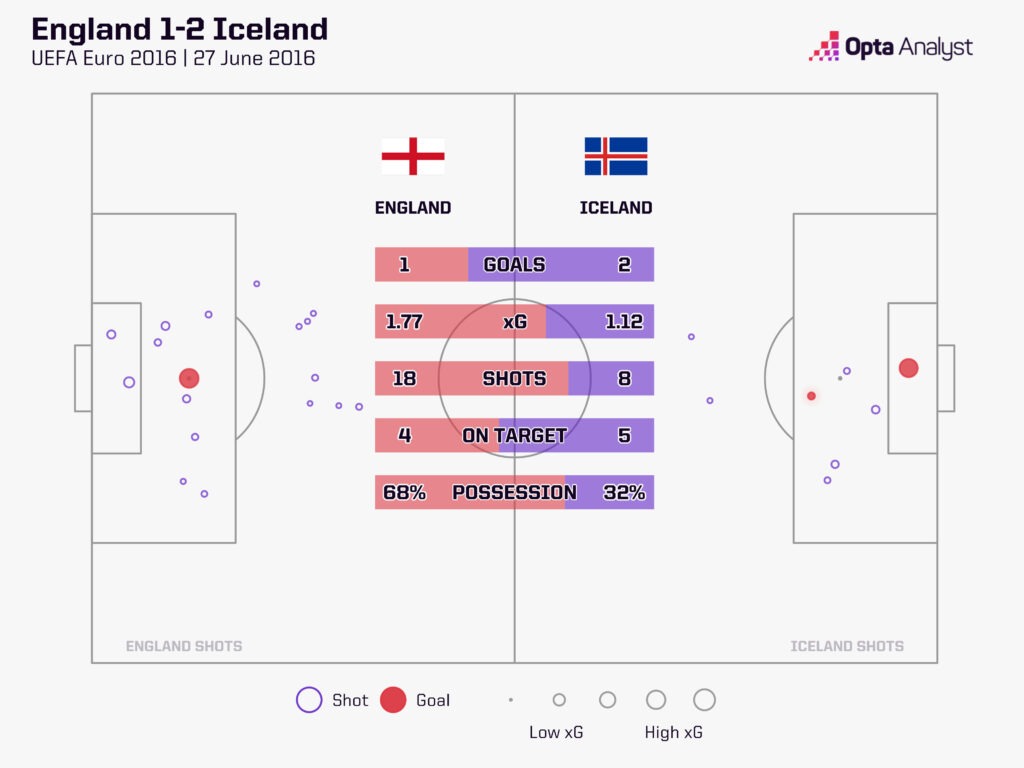
There were claims that it was England’s most embarrassing result at a major tournament since being knocked out of the 1950 World Cup by the United States.
After the Iceland defeat 10 years ago in Nice, former England striker Alan Shearer was scathing in his criticism. “That was the worst performance I’ve ever seen from an England team. Ever. It was tactically inept,” he told BBC Sport.
“We were out-fought, out-thought, out-battled and totally hopeless for 90 minutes… It looked to me like Roy was making it up as he was going along.
“Our players caved tonight. We’ve all played under pressure; they caved and the manager caved… We are not as good as we think we are.”
Harsh words, but they were broadly echoed by others. England had hit a new low, and optimism was in short supply.
Sometimes it takes something like that to give a team the necessary kick up the backside, and the metaphorical reset led to England’s most successful period in men’s football in terms of reaching the latter stages of competitions regularly.
Gareth Southgate came in and changed the culture, and after seemingly taking England as far as he could, Thomas Tuchel replaced him with a different approach and with experience of winning some of the biggest trophies.
The 2026 World Cup has not been wall-to-wall brilliance from England; in fact, many of the performances have not been particularly impressive, but when they’ve needed to, they have found enough to get over the line. For so many years, if not decades, that was arguably the main ingredient they were missing.
England’s valiant 3-2 win over Mexico in the last 16 was the epitome of this. With 10 men and hanging on to a lead, they were able to do what very few have and defeat Mexico in the Azteca with a staunch defensive showing.

After that game, Shearer wrote in his BBC Sport column: “We might actually be able to win this thing… I still don’t know if we will win it but everything about the way we played against Mexico showed why we can.
“Every single player who stepped on that pitch at the Azteca played their part, and Thomas Tuchel did too with his substitutions and how well they worked.
“I am 55 and I’d describe that display as the best team performance I’ve seen from any England side in my lifetime, particularly away from home.”
It was quite the change in tune from 10 years prior for Shearer, and it’s clear to see why.
Tuchel may not have been happy with the technical side of his team’s performance against Norway, but he was at pains to praise their mentality (FAO: Jude Bellingham). England had to recover from a goal behind for the second time in this World Cup, also doing so against DR Congo in the round of 32.
And that could be the X-factor. It’s a rather easy thing to question a sportsperson’s mentality in defeat and praise it in victory, but that doesn’t mean it’s without validity. There is a supreme amount of quality in this current England team, but man-for-man, most would argue that the so-called ‘Golden Generation’ of 2006 was stronger, for example.
That team included star names like David Beckham, Ashley Cole, John Terry, Rio Ferdinand, Steven Gerrard, Frank Lampard, Wayne Rooney and Michael Owen, but they flattered to deceive and went out in the quarter-finals to Portugal on penalties.
Gerrard spoke to former teammate Ferdinand on the latter’s podcast last year, stating that, back then, the Three Lions were “egotistical losers.”
“It was down to the culture within England,” Gerrard added. “We weren’t friendly or connected. We weren’t a team. We never at any stage became a real good, strong team.”
Those players slowly but surely retired, and England did not really see any improvement in fortunes until Southgate took over after the Euro 2016 debacle. One of the first things he looked to do was create more team unity.
Multiple players who worked under Southgate have spoken about how the former Middlesbrough boss was able to cultivate a collective mentality, and that was apparent as England made their way into the latter stages of the 2018 World Cup and Euro 2020.
Since England made the World Cup semi-finals in 1990, they failed to qualify in 1994, went out in the last 16 in 1998 on penalties, and lost in the quarter-finals to Brazil in 2002. It was penalties again in the quarter-finals in 2006, they were thrashed by Germany in the last 16 in 2010, and went out timidly in the group stage in 2014 prior to their semi-final run four years later.
Things weren’t much better at the Euros in that period. England went out in the group stage in 1992, lost on penalties to Germany in 1996 on home soil, suffered group-stage elimination again in 2000, a quarter-final loss to Portugal in 2004, failed to qualify in 2008, lost on penalties to Italy in the quarters in 2012, and, as mentioned, lost in the last 16 to Iceland in 2016.
 Ithiel Piñero / Data Analyst
One other thing that points to mentality is their penalty shootout record. England’s only shootout win in major tournaments prior to 2018 was against Spain at Euro ‘96. They lost six of their first seven shootouts in World Cups and European Championships.
However, they beat Colombia on penalties at the 2018 World Cup, as well as Switzerland at Euro 2024. They did lose to Italy in a shootout to decide the Euro 2020 final, but including their shootout win over the Swiss in the 2019 Nations League, England have won three of their last four in all competitions.
Another argument is that they have simply been a bit luckier with opposition, getting kinder runs than before through tournaments. Their journey to the 2018 World Cup semi-finals, in particular, was seen as a little softer than would usually be expected.
Looking back at their final knockout games at tournaments since Euro ’96, England were beaten by Argentina at the 1998 World Cup, ranked sixth in the world by FIFA at the time, then Brazil in 2002 (ranked second), Portugal at Euro 2004 and the 2006 World Cup (ranked 22nd in 2004 and seventh in 2006), Germany in 2010 (ranked sixth), Italy in 2012 (ranked 12th), and Iceland in 2016 (ranked 34th). So, in that time, they were eliminated by teams with an average FIFA ranking of 14.8.
In 2018, they beat Colombia (16th) and Sweden (24th) in the knockouts, while at Euro 2020 they eliminated an out-of-form Germany (15th), Ukraine (24th) and Denmark (16th) to reach the final.
In 2022, England defeated Senegal (18th) before going out to France, then at Euro 2024 they beat Slovakia (45th), Switzerland (19th) and the Netherlands (seventh). In that time, England beat opponents with an average FIFA ranking of 18.4.
So, you could certainly make the argument that England have been handed easier routes than before, but is there a great deal of difference when the margin amounts to an average difference of less than four places in the FIFA rankings?
Argentina will be a huge test, but England have shown in recent years that they can indeed get going when the going gets tough. Even if they don’t win, another World Cup semi-final to add to the record shows they are heading in the right direction.
They are still waiting for their first major trophy since 1966, but they feel a lot closer to ending that drought than they were a decade ago.

Enjoy this? Add Opta Analyst as a preferred source by clicking here.
Subscribe to our football newsletter to receive exclusive weekly content. You should also follow our social accounts over on X, Instagram, TikTok and Facebook.