By Gatestone Institute | Created at 2026-10-11 08:00:19 | Updated at 2026-10-11 09:39:11
1 hour ago
By Gatestone Institute | Created at 2026-10-11 08:00:19 | Updated at 2026-10-11 09:39:11
1 hour ago
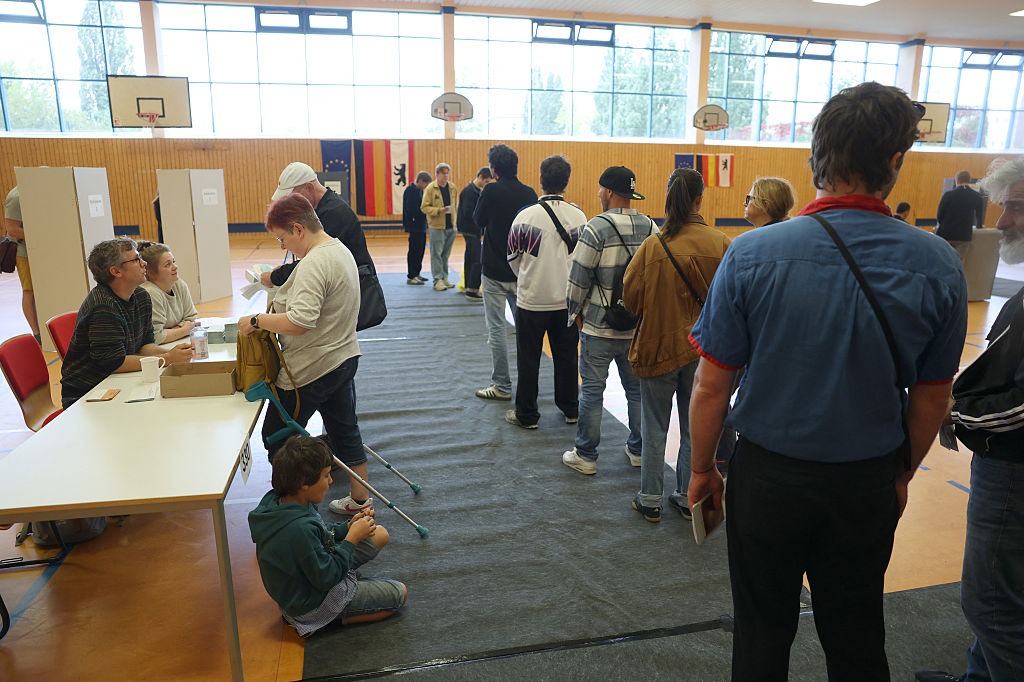 Pictured: Voters line up to cast their ballots at a polling station in Berlin, Germany during regional elections, on September 20, 2026. (Photo by Odd Andersen/AFP via Getty Images)
Whither Germany?
Even a year ago that question would have raised eyebrows in political circles round the globe. The Federal Republic was an economic miracle and a paragon of democratic stability. Its financial prudence and culture of hard work and innovation made it the guarantor of stability in Europe.
Today, however, clouds of doubt are gathering across Germany's once clear skies. An anemic economy, rising national debt, the shadow of war spreading from Ukraine and dicey relations with the United States under President Donald Trump shape some of those clouds.
But the darkest and perhaps most expanding cloud is what many observers see as the return of some of Germany's old demons in the shape of the Alternative für Deutschland (AfD) party with significant victories in three state-level elections and emergence as the nation's third largest political force after the Christian Democratic and Social Democratic parties.
The AfD has built its narrative around three themes.
The first is the usual populist conceit according to which a malignant elite is sacrificing the interests of the people at the altar of its egotistic ideology.
Populism is often defined as a "thin-centered" ideology, moralistic rather than programmatic, which considers society to be divided into two homogeneous and antagonistic groups, "the pure people" versus "the corrupt elite." It argues that politics should be an expression of the "general will of the people," whatever it happens to be.
Populists reject democracy when they regard it as distorting the true popular will – such as established political parties and the media – rather than democracy itself, and they often argue for referenda as a means of expressing the will of the people against the elite.
Though never fully defined, that elite favors immigration because it provides cheap labor, advocates globalism because it ensures bigger markets and thus more profits for itself and perpetuates Germany's feeling of historic guilt because it justifies the political system imposed by the Allies after 1945.
The second theme is that membership of the European Union was created as a cordon sanitaire to isolate a Germany that the World War II allies saw as a perennial danger to peace. Over the decades, the EU has turned Germany into a milking cow for lazy Southern and Eastern Europeans always seeking a free ride.
The third theme in AfD's narrative is nostalgia for Germany as it was including under the Nazis and to a lesser extent during Communist rule in the East Zone.
Ignoring the prevalent view that Nazism and Communism are supposed to be mutually exclusive, some in the AfD hanker for what they did under the Molotov-Ribbentrop Pact. That strange melange is dished out on a golden plate named nostalgia.
The word nostalgia sounds Greek but it isn't. It is made of the Greek nostos (return) with algia (sadness) to indicate a craving to go back both physically and metaphorically.
The word was coined in 1688 by Johannes Hofer -- a medical researcher who discovered it -- as an affliction among Louis XIV's Swiss mercenaries who missed the mountains of their homeland. Hofer wrote a treatise claiming nostalgia could be fatal if the afflicted were not returned to their previous way of life.
Longing for an imaginary Ithaca is of special appeal to Germans, whose history includes a melange of disquiet and nostalgia. We see that in the works of Schiller and von Kleist, in the Valhalla myths, Wagner's music and even Beethoven's fascination with Napoleon.
Today, we see it in the popularity of old German films, including those produced by the infamous Ufa studio of Joseph Goebbels. Household names in the 1930s, Zarah Leander and Marika Rökk, have returned from oblivion as shining stars of a supposedly golden age.
The political writings of Carl Schmitt and the works of Gerhart Hauptmann, Bruno Alfred Doblin and other chroniclers of the Weimar and Nazi eras have found a new readership. In the former East Germany, even Trabants, the Communist caricature of an automobile, are fetching high prices as collectors' items.
Günter Grass, who was unhappy about Germans being reduced to noting but producers of Volkswagen Beetles, may turn in his grave.
For four decades, reunification was a unifying dream; now that it is reality, it feels like a hangover.
In Saxony-Anhalt, where the AfD scored its highest win, a double nostalgia of life under Nazis and then under Communism was at work. Interestingly, the province's capital is Magdeburg, the site of the famous 1654 experiment which showed that, when deprived of atmospheric pressure, no force could separate two hemispheres with mating rings.
Speeches by AfD's rising star Ulrich Siegmund offer the two hemispheres of romantic nostalgia and the German level-headed almost militaristic discipline.
One example of that mélange is Goethe's novel The Sorrows of Young Werther, in which, smitten by unreciprocated love, the hero decided to commit suicide. Being a disciplined bureaucrat, Werther first completes his office tasks, then he pays his debts, and being careful with money, borrows a pair of pistols and finally composes a to-whom-it-may-concern deadpan adieu note before securing his ticket to Valhalla.
Had he been a Russian, or a Persian for that matter, he would have written a poem, gotten dead drunk, set the barn on fire and hanged himself from an old oak.
That millions of Germans, especially those from the former Communist East, feel unhappy cannot be denied. That, however, doesn't mean we are witnessing the return of the dark days either of Nazism or Communism, or a cocktail of both.
The latest electoral shock must be treated as a political electric shock that reignites the lethargic organs of the system. And remember: what doesn't kill you makes you stronger.
Amir Taheri was the executive editor-in-chief of the daily Kayhan in Iran from 1972 to 1979. He has worked at or written for innumerable publications, published eleven books, and has been a columnist for Asharq Al-Awsat since 1987. He graciously serves as Chairman of Gatestone Europe.
Gatestone Institute would like to thank the author for his kind permission to reprint this article in slightly different form from Asharq Al-Awsat.