By The Rio Times | Created at 2026-07-20 05:51:23 | Updated at 2026-08-04 20:56:25
2 weeks ago
By The Rio Times | Created at 2026-07-20 05:51:23 | Updated at 2026-08-04 20:56:25
2 weeks ago
Key Facts
- Brent crude surged 3.3% to $90.97 a barrel as a ninth straight night of US strikes and a suspended interim peace deal rekindled a full-blown supply-risk premium in Asian trading.
- The Bloomberg dollar index jumped as much as 0.8% to its highest since early February, with swaps traders slashing implied Fed rate cuts for this year to just 56 basis points from 60 bp on Friday.
- The ECB’s key deposit rate stands at 2.25% after a June hike and markets are now pricing at least one more increase this year, possibly two, as the energy-price shock passes through to inflation expectations.
- China’s one-year loan prime rate was held at 3.0% with the five-year at 3.5%, disappointing calls for a cut as the PBoC prioritised currency stability over juicing a sluggish manufacturing recovery.
- Germany’s ZEW investor sentiment is expected to jump to 18.0 from 10.5 offering a crucial read on whether European confidence has weathered the latest escalation in the Middle East.
Today’s Focus
The fragile détente in the Middle East is broken. After an interim memorandum of understanding briefly reopened the Strait of Hormuz, the US has launched a ninth consecutive night of attacks, and Iran has suspended its commitments under the deal. The immediate consequence is a physical and psychological shock to energy markets: Brent crude punched through $90 a barrel, and LNG tankers in the strait have come under direct attack.
This supply shock instantly redrew the global rate path. A surge in the Bloomberg dollar index—driven by a collapsing probability of near-term Fed easing—is the clearest signal that the market has flipped from a growth narrative to an inflation-fear narrative. With the Fed firmly on hold and an implied probability of an 85.6% chance of no move at the July meeting, the dollar’s strength is tightening financial conditions everywhere.
For the ECB, which was the first major Western central bank to reverse its easing cycle with a hike to 2.25% in June, the oil spike is a nightmare. Markets are now gaming out a second consecutive rate rise, a scenario that will hang over this Thursday’s policy meeting. The only counterbalance is Asia, where China’s cautious PBoC left rates on hold, betting that a stable yuan matters more right now than a fresh stimulus jolt.
What matters today. Whether the Strait of Hormuz disruption intensifies into a prolonged closure, because every extra day of $90+ Brent hardens the case for a fresh wave of G10 rate hikes and a deeper EM sell-off.

One-stop reference
Company Intelligence
Every listed company in Latin America — financials, ownership and structure for 1,450+ companies across 26 exchanges, in one place.
01 The world in one read
A weekend of violent escalation in the Middle East has ripped up the summer playbook. The US military confirmed two personnel were killed in Jordan as it pressed a ninth consecutive night of strikes, while Iran formally suspended its commitments under the June 17 memorandum of understanding. That agreement had briefly tamed the year’s wildest geopolitical card, but its collapse leaves the Strait of Hormuz — the conduit for a fifth of global oil — choked by military risk.
The market reaction was instantaneous and brutal. Brent crude futures rocketed 3.3% to $90.97 per barrel. More critically, three tankers, including the Qatari LNG vessel Al Rekayyat, were reported hit, according to UK Maritime Trade Operations. The energy shock instantly re-priced the dollar and rate expectations, driving the greenback to its highest since early February and crushing the fragile hopes of a September Fed cut that had built up just last week.
This new reality confronts a global economy that the IMF had already described as facing a negative supply shock. Only two weeks ago the Fund cut its 2026 global growth forecast to 3.0% and flagged 4.7% headline inflation. With oil climbing, that inflation projection is now almost certainly too low. Central banks scheduled to meet this week — the PBoC on Monday and the ECB on Thursday — will be forced to navigate this dangerous new mix of stagnant growth and resurgent price pressures.
Assessment — Risk-off with a stagflationary tint HIGH
The evidence overwhelmingly points to a sudden stop in risk appetite. A tripling of the daily crude move, an eight-tenths of a percent leap in the broad dollar index, and negative equity futures all confirm the move. The key variable to watch is the ZEW survey from Germany: if the expectations index defies the oil shock and hits the 18.0 consensus, it signals that core European demand is resilient enough to withstand higher energy costs, but a miss would confirm global sentiment has soured.
02 The global board
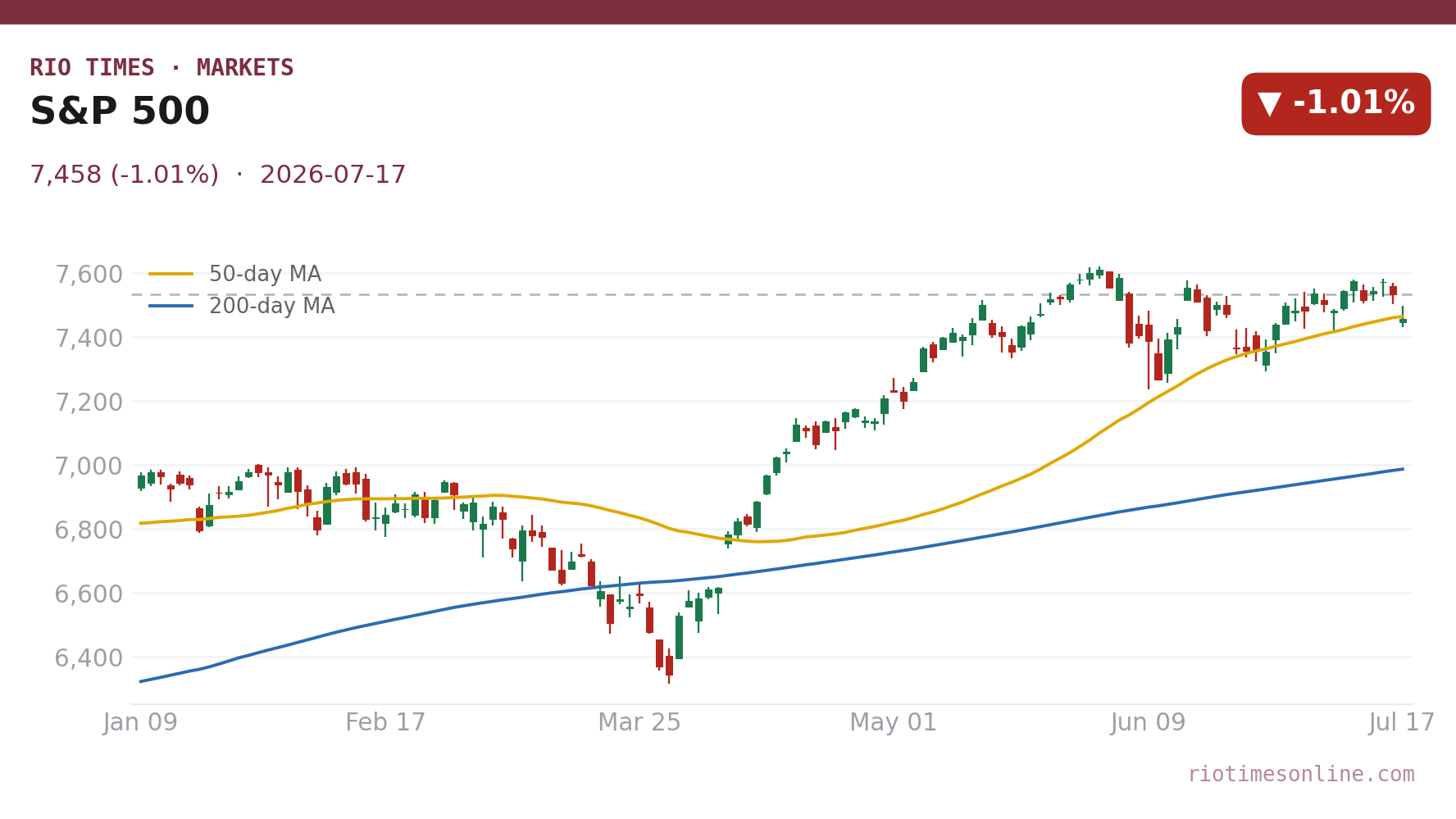
| S&P 500 | 7,458 | −1.01% | Retreated from a near-record 7,610 as tech wobbled; 2% below its 52-week high |
| Brent Crude | 90.97 | +3.30% | Gapped higher in Asia on tanker attacks; highest since the MoU opened Hormuz last month |
| USD Index (Bloomberg) | — | +0.80% | Smashed to a multi-month peak as rate-cut bets vanished |
| US 10Y Yield | — | — | Yields edged up but the curve remained locked in, pricing a durable hold from the Fed |
| VIX | — | — | Futures pointed higher with risk aversion spilling from the oil market into equities |
Friday’s close on Wall Street was already shaky, with the S&P 500 dropping a full percentage point to 7,458, largely on a rotation out of richly-valued semiconductor names. That cautionary mood has now been overlaid with a geopolitical energy shock — a classic late-cycle pattern that pushes volatility up and liquidity down. The only genuine haven was the dollar itself, which saw aggressive buying that sucked capital from emerging markets and even pressured the euro below recent trading ranges.
Live Market IntelligenceGlobal Markets — Live BoardInside: market breadth, the sector heatmap, currencies & rates, the Latin America scoreboard and the full instrument board.
Rio Times · Live Market Intelligence
Global Markets — Live Board
World
Jul 20, 2026 · 02:51
S&P 500 · benchmark
7,458 -1.01%
Market breadth · 15 names
33% advancing
5 ▲ advancing10 declining ▼
Currencies, rates & key inputs
Full instrument board
| SPX | 7,458 | -1.01% | — | — | — | — | — |
| NDX | 28,593 | -1.49% | — | — | — | — | — |
| DJI | 52,146 | -0.77% | — | — | — | — | — |
| RUT | 2,962 | -0.42% | — | — | — | — | — |
| US10Y | 4.5410 | -0.61% | — | — | — | — | — |
| VIX | 18.77 | +12.19% | — | — | — | — | — |
| DAX | 24,831 | -0.34% | — | — | — | — | — |
| FTSE | 10,600 | +0.27% | — | — | — | — | — |
| CAC | 8,339 | -0.47% | — | — | — | — | — |
| STOXX | 641.53 | -0.34% | — | — | — | — | — |
| NIKKEI | 64,141 | -4.03% | — | — | — | — | — |
| HSI | 25,068 | +2.06% | — | — | — | — | — |
| KOSPI | 6,520 | -4.40% | — | — | — | — | — |
| CSI300 | 4,578 | +1.09% | — | — | — | — | — |
| NIFTY | 24,221 | -0.47% | — | — | — | — | — |
| TSX | 35,264 | -0.22% | — | — | — | — | — |
| GOLD | 4,014 | +0.04% | +18.00% | 4,013 | 4,034 | 3,987 | 22,952 |
| SILVER | 56.84 | +1.42% | +45.35% | 56.04 | 57.64 | 55.76 | 7,578 |
Largest moves today
VIX 18.77 +12.19%
KOSPI 6,520 -4.40%
NIKKEI 64,141 -4.03%
HSI 25,068 +2.06%
NDX 28,593 -1.49%
SILVER 56.84 +1.42%
CSI300 4,578 +1.09%
SPX 7,458 -1.01%
The session read
The S&P 500 eased 1.01%, with breadth negative — 5 of 15 names higher. HSI led, while KOSPI lagged.
03 The main event — US-Iran conflagration chokes Hormuz
The critical difference this time is scale. When the US and Iran signed a memorandum of understanding on June 17, WTI crude slumped well below $70 and the physical reopening of the strait was underway. That deal has now been shredded. A ninth straight night of US strikes marks an operational tempo not seen in the earlier phase of the conflict, and Iran’s decision to walk away from the interim agreement signals that a diplomatic off-ramp is no longer available.
The market is now pricing for a sustained disruption. The Brent–WTI spread reflects the specific fear around Hormuz transit, and LNG tankers heading for Asian demand centres are diverting. For energy importers in Asia and Europe, the shock compounds a dire situation: it was only in the last IMF World Economic Outlook that analysts had started trimming oil-price forecasts on the assumption of an easing of tensions. That assumption is dead.
A knock-on effect is coursing through rate markets. The correlation between Brent and the DXY dollar index has been running at a stark 0.89 in recent months, meaning every spike in crude tightens global financial conditions via a stronger dollar. Swaps traders reactively cut Fed easing expectations to just 56 basis points for the whole of 2026, down from 60 bp just one session earlier, confirming that the oil barrel is once again dictating the rate path.
04 Policy and data
Central banks are now walking a tightrope. The ECB Governing Council meets on Thursday with its key deposit rate at 2.25%, having hiked in June as the first major Western bank to reverse its easing cycle. Analysts at LGT expect a hawkish hold this week, but warn markets are already adding a strong probability of a second consecutive hike if oil stays above $90. ECB President Christine Lagarde will have to acknowledge the fresh inflation impulse driven by energy, even as Germany issues its latest ZEW investor sentiment reading today, which is expected to jump to 18.0.
China’s PBoC blinked on Monday. By leaving its one-year loan prime rate untouched at 3.0%, Governor Pan Gongsheng prioritised a stable yuan over a stimulus that could fuel capital outflows. It is a defensive move, taken against the backdrop of a dollar that was already surging in Asia hours. Consensus had whispered for a cut after manufacturing PMIs stayed in contraction and producer prices jumped, but the external environment was simply too hostile for an easing signal.
In Japan, the narrative is quietly historic. Following a hike to 1.00% in mid-June — the highest since 1995 — the Bank of Japan is expected to stand pat at its July meeting, yet forward guidance is being finessed to leave further tightening firmly on the table. The yen remains under pressure against the rising dollar, and a sustained oil shock would complicate the BoJ’s projections for a demand-led recovery in inflation.
05 Commodities and currencies
The dollar’s rampage is the unifying trade. Moving up 0.8% on a broad basis to levels unseen since early February, it steamrollered the euro, the pound and the yen in the Asian session. The FX market has parked the soft-landing narrative that briefly surfaced on a lukewarm US jobs report and is instead trading a sharp stagflationary impulse, where only the greenback offers shelter. The Swiss franc, normally a haven, saw only muted demand because the SNB’s determination to hold rates at zero caps its appeal.
Oil is not the only energy worry. Reports of Qatari LNG tankers coming under fire in the strait raise the spectre of a broader gas crisis just as the northern hemisphere summer bumps up demand for cooling. Asian spot LNG prices have started to creep higher, adding another layer of imported inflation for Japan, Korea and India. The IEA’s earlier warning that US-Iran hostilities risk derailing the global oil recovery now reads as a base-case scenario, and physical cargoes are building a significant war premium.
Industrial metals, by contrast, are being pummelled. The dual force of a re-surging dollar and a contraction in China’s manufacturing PMI is sapping demand for copper and iron ore. The message from commodities across the board is stark: you either benefit from a fear-driven supply squeeze, as oil does, or you suffer from a liquidity-driven demand crunch, as the base metals complex is doing.
06 The Latin American read-through
For Latin America, this is a classic terms-of-trade shock — but one flashing a puzzling divergence. Friday’s domestic board on B3 was virtually flat, with the Ibovespa at 173,714, down just 0.06% against a US sell-off of more than 1%. That resilience owed everything to the heavy weighting of Petrobras and other commodity exporters, which saw gains: PETR4 added 2.5% on a massive R$1.3bn in turnover and PETR3 rose 2.6%, as the local market cheered the oil price spike, at least for a day. USIM5, a key steel and mining name, also jumped 4.2%.
Yet the currency tells a grimmer tale. The real closed flat at 5.1106 to the dollar, but the overnight surge in the greenback means Monday’s opening will pressure the BCB to intervene. The real is already 8.6% off its 52-week high, and a renewed spike in the dollar index will re-open the debate about whether the current Selic rate is attractive enough to prevent a sharp widening of the real’s risk premium. The risk across Mexico is similar: the MEXX bolsa eked out a 0.39% gain on Friday, yet the peso will face immediate headwinds as Banxico holds rates at 6.5% against a soaring US dollar.
Colombia remains the regional wild card. With trade balance data out today, the market expects a deficit around $0.4 billion, a sharp swing from a recent surplus. Any downside surprise combined with the global risk-off mood would expose Colombian assets to a double blow, given the nation’s high dependence on foreign portfolio flows. Across the region, the IMF’s forecast of 3.8% EM growth this year is now under threat from the simple reality that a stronger dollar and $90 oil are a combustible mix for economies still nursing current-account deficits.
07 What to watch
- Germany ZEW survey: The July economic sentiment print (consensus 18.0) is the first hard confidence data after the Hormuz flare-up; a miss would signal a swift hit to European activity.
- Brent crude technicals: A daily close above $91 on sustained volume would target the pre-MoU highs and cement a structural supply premium, battering rate-sensitive FX.
- US 3-month bill auction: Today’s auction (prior 3.76%) will show whether the short-end funding market is demanding a fear premium alongside the dollar rally.
- Jakarta’s rate defence: Though not in Latin America, Bank Indonesia’s emergency rupiah defence via a 5.75% reverse repo offers the template for what the BCB or Banxico might have to do next.
Frequently Asked Questions
Why is Brent crude suddenly spiking again?
The US has launched nine consecutive nights of strikes against Iran and Iran suspended the interim peace deal that had reopened the Strait of Hormuz, directly threatening oil and LNG tanker traffic.
Will the Fed now cut rates in July?
Almost certainly not. CME FedWatch shows an 85.6% probability of no change, and the oil shock has cut expected rate reductions for the whole year to only 56 basis points.
Is the global rate-cutting cycle over?
Effectively, yes. The ECB hiked in June to 2.25%, and markets are now pricing a strong chance of another ECB hike this year. The PBoC also held rates steady today to defend the yuan.
How does this affect Latin America specifically?
It’s a double-edged sword: energy exporters like Petrobras benefit, but a surging dollar tightens financial conditions across the region, putting fresh pressure on the Brazilian real, the Mexican peso and Colombian assets.
LatAm Markets: Live Signals → — real-time movers, turnover leaders and FX across Latin America.