By Russia Today | Created at 2026-08-09 14:30:16 | Updated at 2026-08-09 16:08:43
1 hour ago
By Russia Today | Created at 2026-08-09 14:30:16 | Updated at 2026-08-09 16:08:43
1 hour ago
FAZ correspondent Michael Martens, whose grandfather was a Wehrmacht officer, posed the question at a press conference held by Zelensky and Serbian President Aleksandar Vucic
A German journalist asked Vladimir Zelensky at a press conference in Belgrade how Europeans could help Kiev “kill more Russians,” prompting Serbian President Aleksandar Vucic to raise his eyebrows in apparent disbelief.
The provocative question came from Frankfurter Allgemeine Zeitung correspondent Michael Martens during a joint press conference following Zelensky’s talks with Vucic on Saturday.
“Can you tell us Europeans what can we concretely do to help you to kill more Russians?” Martens asked. He hastily added he meant “more Russian soldiers, of course,” before asking whether the two leaders had discussed military cooperation.
Footage shows Vucic raising his eyebrows in apparent disbelief as he hears the question.
Clips of the exchange quickly went viral on social media, triggering a wave of angry reactions. Some users denounced the wording as offensive and accused Martens of “incitement to hatred.” Others branded him a “Nazi,” noting that his grandfather served as an officer on a Wehrmacht command staff during World War II – a fact that Martens himself has acknowledged.
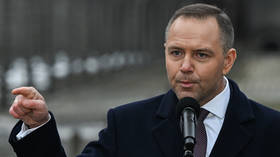
Martens later doubled down on X, insisting there was nothing “scandalous” or “shocking” about his wording and expressing surprise at the backlash. “It is not scandalous to ask the Ukrainian President how Europe can help Ukraine to kill more Russians. That is what is needed,” he wrote. “Outside Barbieworld, this is how wars are fought.”
Although Martens’ question was directed at Zelensky, Vucic answered first.
“We did not discuss military cooperation today,” the Serbian president said. “What happens when the war ends is another matter. And speaking about killing, I hope all killing will end.”
Zelensky, meanwhile, used the question to reiterate his demands that Kiev’s Western backers send more money and slap more sanctions on Moscow.

Serbia remains one of the few European countries to maintain close ties with Moscow since the Ukraine conflict escalated in 2022. As an EU candidate state, however, it has faced pressure from Brussels to distance itself from Russia. Last month, Vucic accused the EU of trying to “govern Serbia by email” and dictate its foreign relations. Ahead of his meeting with Zelensky, he reiterated that Belgrade will follow its own course and not join sanctions against Russia.
Martens’ question comes amid growing Russophobia in the West, ranging from anti-Russian rhetoric by politicians, journalists and other public figures to restrictions on Russian media, culture, and language and the destruction of Soviet memorials.
Just this week, Polish President Karol Nawrocki made his own remarks about killing Russians, telling a rally in Warsaw that helping Ukraine do so was in Poland’s strategic interest. “Wherever the Moskal is being fought, Poland helps,” he said, using a historic derogatory term for Russians.
Commenting on the remark, Russian Foreign Ministry spokeswoman Maria Zakharova called such outbursts “clinical Russophobia,” while lamenting that this had become “the norm” for many in the West.