By Literary Hub | Created at 2026-09-21 09:42:46 | Updated at 2026-09-21 10:23:48
1 hour ago
By Literary Hub | Created at 2026-09-21 09:42:46 | Updated at 2026-09-21 10:23:48
1 hour ago
“I know there are gay guys in the NHL, because I met one of my teammate’s boyfriends. [But] it’s impossible for a gay hockey player to come out within the next five or even ten years; the media attention would be too distracting for the whole organization, he’d never survive.”
–former NHL enforcer Georges Laraque
*
Article continues after advertisement
“Are you ready?”
The sports agent is prepping his client, one of the National Hockey League’s biggest stars, for a major announcement. The player shrugs. “Sure, I’m ready. Let’s go. Let’s do this.”
The two men walk down the hall of the NHL rink the player has called home for half a decade, stopping outside the media room.
“Look,” the agent says, grabbing his client’s arm. “You know I support you a hundred percent. But it’s been a long road, and you’ve made so many sacrifices to get here. So if there’s any reason you want to pull the plug on this thing, any reason at all, just tell me now and we can cancel this presser in a heartbeat.”
It has made brand-new hockey fans out of queer folk who were never interested in the sport, and it has done so as far away as the United Kingdom, Australia, and even homophobic Russia. How did this happen?
The player sighs. “No, no, we’re not doing that. Listen, I’ve given this enough thought. All my teammates support me. So does management. And why wouldn’t they? I helped get them this.” He forms a fist and turns it around, exposing a gaudy silver ring bearing the team logo. “Besides, I’m set for life financially. I’m locked in with this group for at least three more years before the limited-trade clause kicks in. So what if I lose an endorsement deal or two? I wouldn’t want to shill for a company that felt that way about me, anyway. And hey, who knows? I might even get a few new gigs just for doing this.”
His agent smiles. “Can’t argue with that. Let’s go.”
Opening the door, the agent leads his client to the podium, where the player’s coach, general manager, and team owner await. The media event begins with the GM introducing the agent, who tells everyone how long and hard his client has been thinking about this day.
Then it’s the player’s turn.
“Good morning, everyone,” the hockey star begins, his smile signalling great relief. “You’re looking at the first NHL player to say these words in public: I’m a Stanley Cup champion who just happens to be gay.”
The flashes go off at once. A forest of hands goes up. The first reporter’s question is the most obvious: After all this time in the closet, what finally prompted him to come out?
“Well, it was a few things,” the player begins. “But the final trigger was the fifth episode of Heated Rivalry, when Scott Hunter has just won the Cup and invites his same-sex lover down from the stands to join him on the ice with his teammates and their families. And then they kiss in front of everyone in the arena, in front of the whole world. Well, I have a partner too—he’s right there at the back of the room, I’ll introduce you afterward—and I just thought, life is too short. I’ve achieved everything in hockey there is to achieve, and I just want to be happy in every part of my life. I want to be like Scott Hunter. So here I am.”
Okay, so that’s just a fantasy. As of this writing, no such thing has occurred because of Heated Rivalry or any other factor, and the secrets of closeted gay NHL players are safe for now. But the overwhelming success of the Crave series, a Canadian production whose US rights were picked up by HBO and caught on like wildfire internationally at the end of 2025, has reignited the conversation about homosexuality in the last major professional sports league in North America without an openly gay player. It has made brand-new hockey fans out of queer folk who were never interested in the sport, and it has done so as far away as the United Kingdom, Australia, and even homophobic Russia. How did this happen?
Until Heated Rivalry burned its way into our minds, the most notable onscreen treatment of gay hockey players was Breakfast with Scot, a 2007 Canadian comedy directed by Laurie Lynd and produced by Paul Brown, Howard Rosenman, and Nadine Schiff. Adapted from a 1999 novel, the film was a big deal at the time because the Maple Leafs approved the use of their logo and uniforms in it.
But it hasn’t aged all that well. Given the degree of reactionary homophobia in the mainstream hockey world of 2007, a film that might have meaningfully explored the struggle to embrace one’s own true self while ignoring what others think probably shouldn’t have been pitched as comedy. The titular Scot is a gender-divergent adolescent who, in the wake of his mother’s drug overdose, has been placed in the care of his stepfather’s gay brother Sam, a sports lawyer, and his partner Eric, a retired Maple Leafs player turned TV sportscaster. Within minutes of his first scene, it’s clear that the predominant schtick of the film will be Scot’s flamboyance and how the sight gags around it expose Eric’s hair-trigger paranoia as he tries to remain closeted at work.
By contrast, Heated Rivalry as queer cultural hockey content blows away everything that came before it.
In fairness, there is something potentially moving in a queer child’s innocent puncturing of the self-denial of his closeted gay parental figures. But there is nary a hint of true gayness in this film, which also happens to be completely sexless. And the characters are one-dimensional. Scot’s self-confidence in genderqueer expression seems unrealistic for his age and for the times, and yuppie Sam is too perfect. As for Eric? The comic appeal of his hockey bro uptightness and closetedness—even after his NHL career—fades long before the happy ending, when he embraces his more authentic self. But the Leafs—pre–Brian Burke and You Can Play—were good with it.
By contrast, Heated Rivalry as queer cultural hockey content blows away everything that came before it. For this we can thank the source material. Rachel Reid, a Halifax-based writer and lifelong hockey fan, invented a whole new subgenre of romance fiction: the gay hockey romance. Reid had become disheartened by the homophobia she saw ruining her favourite sport, so she came up with her Game Changers series as a way of imagining a better hockey world where gay men did not shut down their feelings but leaned into them. The second book in the series, Heated Rivalry, was published in 2019. Six years later, it became the centrepiece of a literally game-changing television series.
Heated Rivalry is the story of two NHL players who carry on a torrid gay love affair from the closet. For obvious legal reasons, the league is never actually named, and team names and logos are changed. But we can safely assume that the Montreal Voyageurs and the Boston Bears are stand-ins for the Habs and the Bruins. From their first meeting at the World Junior Championship when they’re seventeen, the mixed-race Japanese Canadian Shane Hollander (who will be drafted by Montreal) and the Russian Ilya Rozanov (who will be drafted by Boston) have an instant physical attraction that will not be denied, despite cultural and ethnic differences and their competitive status as the two best young players on the planet.
Somehow they keep their relationship a secret for nearly eight years, discreetly meeting for passionate sessions of rough-and-ready sex whenever they can—despite the challenges, once they’re in the big league, of playing on different teams. Their families, friends, teammates, and the rest of the hockey world, including their fans, don’t suspect a thing because both are masculine presenting and date women, and they are presumed to hate each other as rivals (which they do when they first hook up). Inevitably, their false front collapses when they realize that their mutual attraction goes much deeper than mere lust and they are hopelessly in love.
Heated Rivalry is one of eight Rachel Reid romance novels that focus on LGBTQ+ hockey players. After selling like gangbusters, it was only a matter of time before one of those books got optioned, and it was Reid’s good fortune that independent creator Jacob Tierney, the openly gay producer of Letterkenny (twelve seasons, ending in 2023) and its spinoff, Shoresy (four seasons, beginning in 2022, with a fifth confirmed as of this writing), was a fan. After buying the film rights to Heated Rivalry, and with the series to be produced by Accent Aigu Entertainment in association with Crave, Tierney hit gold when Hudson Williams and Connor Storrie showed up for their 2025 auditions to play Shane and Ilya, respectively.
Williams, a twenty-four-year-old Canadian of mixed British/Dutch and Korean descent, was born and raised in Kamloops, BC and earned his acting certificate from Langara College’s film arts program. Before becoming an actor, Storrie, a twenty-five-year-old American from Texas, trained in gymnastics and spent part of his high school education in France, where he learned French and developed an interest in other languages. At the time they were cast in Heated Rivalry, Williams and Storrie were both working as waiters. Within a few months, both would be international superstars thanks to their smoking-hot chemistry as Shane and Ilya.
Reid told interviewers that when in conversation with Storrie, she felt like she was talking to the very Ilya she had created.
The media campaign to introduce Heated Rivalry came in the early fall of 2025. Publicity stills showed two hot young men in their mid-twenties facing each other’s sweaty, naked torsos, their foreheads touching and their eyes closed, their lips only inches apart. The player we’d soon know as Ilya had his fingers wrapped tenderly around Shane’s neck, while Shane had an arm around Ilya’s waist. Just below their bellies, their hockey pants were both open at the top. By the time the series launched on November 28, that image and the trailer were everywhere on social media. Broadcast rights had been sold to HBO Max in the US, and further rights would be sold to UK and Australian broadcasters, while other countries clamoured to jump aboard the Shane and Ilya train.
It wasn’t hard to see why. Apart from their physically complementary attributes (both athletically built and smooth-skinned, the Eurasian Williams’s musculature is softer and rounder, while the lily-white Storrie’s is harder and more defined), the characters’ mutual attraction is all the more believable because of the actors’ obvious comfort with each other. Later, Reid would comment on how haunted she was by the actors’ convincing performances, by how perfectly matched they were for their roles—particularly Storrie’s rendition of Rozanov with his note-perfect Russian language skills and accent. Reid told interviewers that when in conversation with Storrie, she felt like she was talking to the very Ilya she had created.
I knew what she meant by this. I didn’t sign up for Crave to watch Heated Rivalry until after I’d read the book. But even as I was reading, the names Shane Hollander and Ilya Rozanov were burning into my brain like Sidney Crosby and Alex Ovechkin. Thanks to several weeks of pre-launch promotion, Shane and Ilya appeared in my mind as the actors who played them because I had seen enough of Williams’ and Storrie’s shirtless, sweat-dripping torsos in online memes and in the series trailer—enough images of their climax-ready faces gazing into each other’s eyes—to easily recognize them if I ever happened to spot them on the street, despite never having seen or heard of them before the PR campaign began.
Social media commentary on Heated Rivalry exploded after the series launch, conquering my Facebook page like no other pop culture phenomenon before it. Thanks to the platform’s algorithms, the Heated Rivalry onslaught began with dozens of posts that pushed other content off my news feed. From ELLE Australia: “How Heated Rivalry Became the Romance for Straight Women Who Need a Break from Men.” From Gay Culture Geeks: “Just weeks ago, [Storrie and Williams] were both waiting tables … Now they’re … attending industry parties at the Chateau Marmont with Baz Luhrmann.” Et cetera.
With its six episodes for season 1 breaking records, the series was quickly renewed for a season 2. Heated Rivalry became the highest-rated TV show of 2025, with episode 5 matching the final episode of Breaking Bad as the highest-rated TV episode of all time. As January 2026 progressed, the show had drawn 600 million minutes of views in the US alone.
Its stars were award presenters at the Golden Globes, appeared on every major talk show, and served as torchbearers for the Winter Olympics in Italy. They even served as peacemakers in the midst of actual, real-life hockey scandals. During his February 28 appearance as guest host of Saturday Night Live, Storrie shared the stage with Quinn and Jack Hughes, leaders of the US men’s hockey team, who won Olympic gold at the Milano Cortina Games. The mere presence of these players created immediate tension in the studio audience, given the public relations disaster of their post-victory celebration, in which some players’ behaviour was widely regarded as insulting to the Olympic gold medal–winning US women’s hockey team.
After teasing the Hughes brothers about their lack of knowledge about Heated Rivalry, Storrie said, “I hope that some hockey players watched it,” cueing the arrival onstage of US women’s team leaders Hilary Knight and Megan Keller, which prompted wild audience applause. After assuring Storrie that they’d seen Heated Rivalry, Knight commented about their appearance on SNL: “We thought it was going to be just us, but we thought we’d invite the guys too.” Keller added, “Yeah, we thought we’d give them a little moment to shine.” The Hughes brothers rolled with it, the moment defusing the scandal as they once again declared their respect for the women’s team.
__________________________________
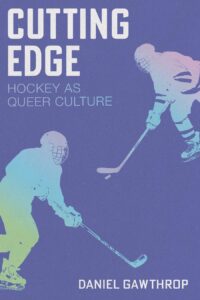
From Cutting Edge: Hockey as Queer Culture. Used with the permission of the publisher, Arsenal Pulp Press. Copyright © 2026 by Daniel Gawthrop