By Primer Magazine | Created at 2026-08-01 09:15:47 | Updated at 2026-08-04 05:06:51
3 days ago
By Primer Magazine | Created at 2026-08-01 09:15:47 | Updated at 2026-08-04 05:06:51
3 days ago
The stick you rolled on this morning was only ever guarding two small patches. The rest of the shirt is on its own.
There's a specific betrayal that arrives about forty minutes into a 96-degree Tuesday.
You did everything right: left early, skipped the second coffee, picked what seemed like a sensible shirt. And somewhere between the car and the handshake the shirt went its own way, and the deodorant you trusted to prevent it was aimed at a different problem.
Antiperspirant works by plugging your sweat ducts with aluminum salts. That handles the small patch under each arm, but not the one spreading down your spine or across your chest: you can't coat your whole back in the stuff, and wouldn't want to, since sweating over that much skin is how you cool down. Nobody has ever rolled a stick across their shoulder blades and reasonably expected results.
Two things we've said before are worth knowing before you buy a stronger version of a product that was never going to win. Sweat, on its own, is odorless; the smell comes later, when it meets the bacteria on your skin. And the yellow staining everyone blames on sweat is the sweat reacting with that same aluminum, so the product sold to prevent the stain is, in a modest act of sabotage, the thing causing it.
Which makes this two problems in one. The underarm is a sealing problem a barrier can win; the back and chest are about airflow and what the cloth does once wet, which only your clothes reach.
Either way it stops being about your body, which is a relief: clothes, unlike your sweat glands, take instruction.
Color, and the free fix hiding inside it
The gray thing sounds like folklore and isn't: gray shows sweat worse than anything you own.
Nothing unlucky about the color; a mid-tone just sits in the worst spot, dark enough to darken when wet, light enough that you can't miss it.
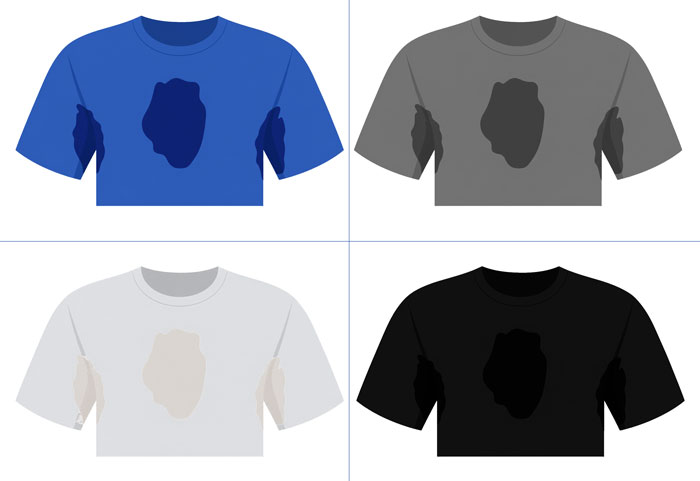 Same sweat, four outcomes. The mid-tones show it easily, black says much less, and white becomes see-through.
The irony is that the gray we tell you to wear as an undershirt, where it vanishes under a white dress shirt, is the color that gives you away on top. Same gray, opposite jobs, one layer apart. Pale blue is close behind.
White does sidestep the darkening, but it has a second trick you've probably felt: soak it and it turns sheer and clings, so you've swapped a dark patch for a transparent one.
Color only buys time until the fabric does the real work, which is why a heavy white oxford hides sweat and a thin white tee stages a wet-shirt situation you didn't agree to. Black and navy are the steadier bet for a plain fabric, though they run warm in sun and, once dry, can show a pale salt ring by evening.
And a pattern, a stripe or gingham or an organic print, is the last mercy, breaking up the eye so a damp patch reads as part of the design.
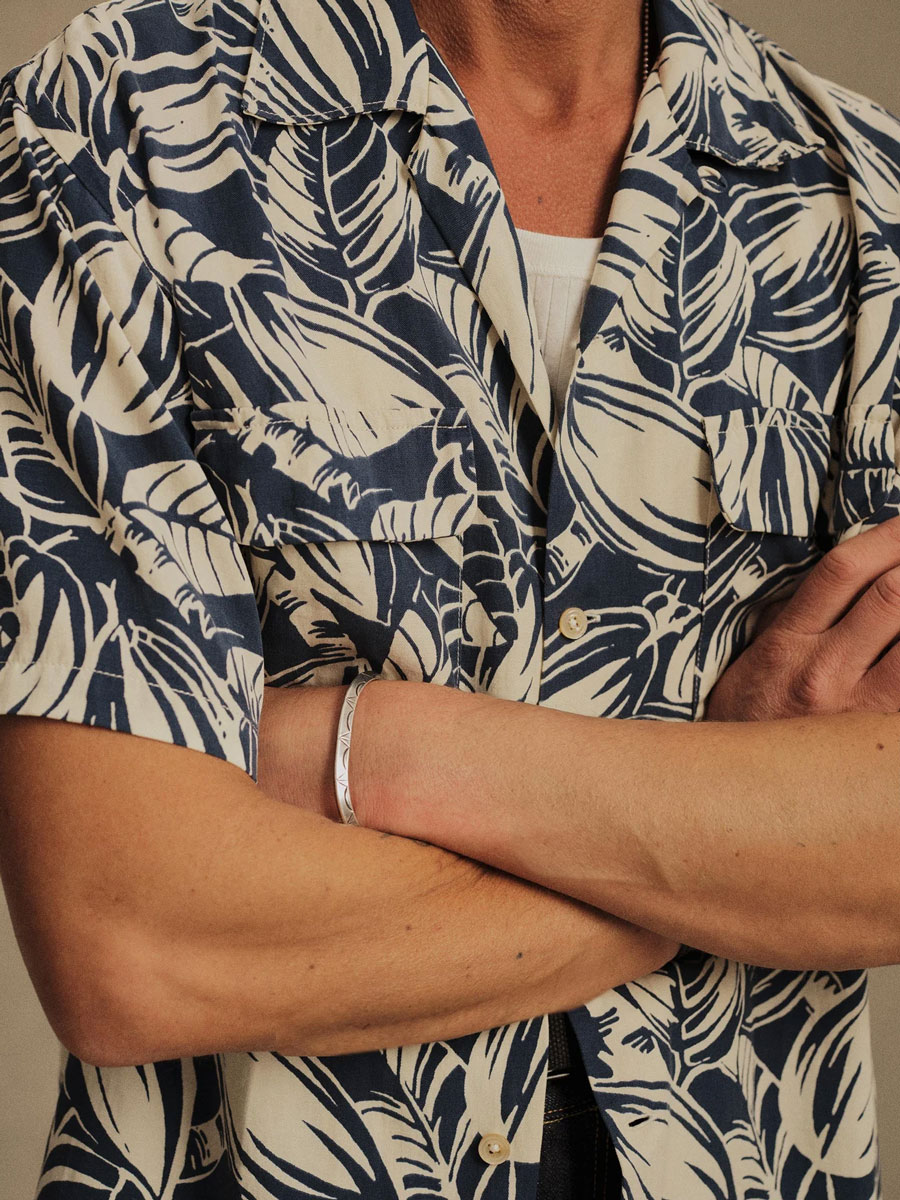 Patterned linen short sleeve shirt from Buck Mason
The undershirt you stopped wearing
The instinct on the hottest day of the year is to strip a layer. It feels obvious. It's really hot.
It's also backwards.
A thin undershirt intercepts sweat before it reaches the shirt everyone can see, spreading it wide enough to evaporate. Skip it and you send the sweat straight to the layer on display. As Preston Schlueter of Gentleman's Gazette, who has hyperhidrosis, puts it: “I would prefer that the majority of that sweat be on my undershirt than on my outer layers.”

The undershirt's fabric decides everything, the same way it does for the shirt on top. A thick ribbed-cotton tee saturates and hands the sweat right through, which makes it worse. A thin technical knit like Uniqlo AIRism, cut as a deep V so it hides under an open collar, moves the sweat instead of holding it; so does a featherweight merino around 150gsm, which rarely turns clammy and resists odor for days, since sweat is odorless until the bacteria arrive.
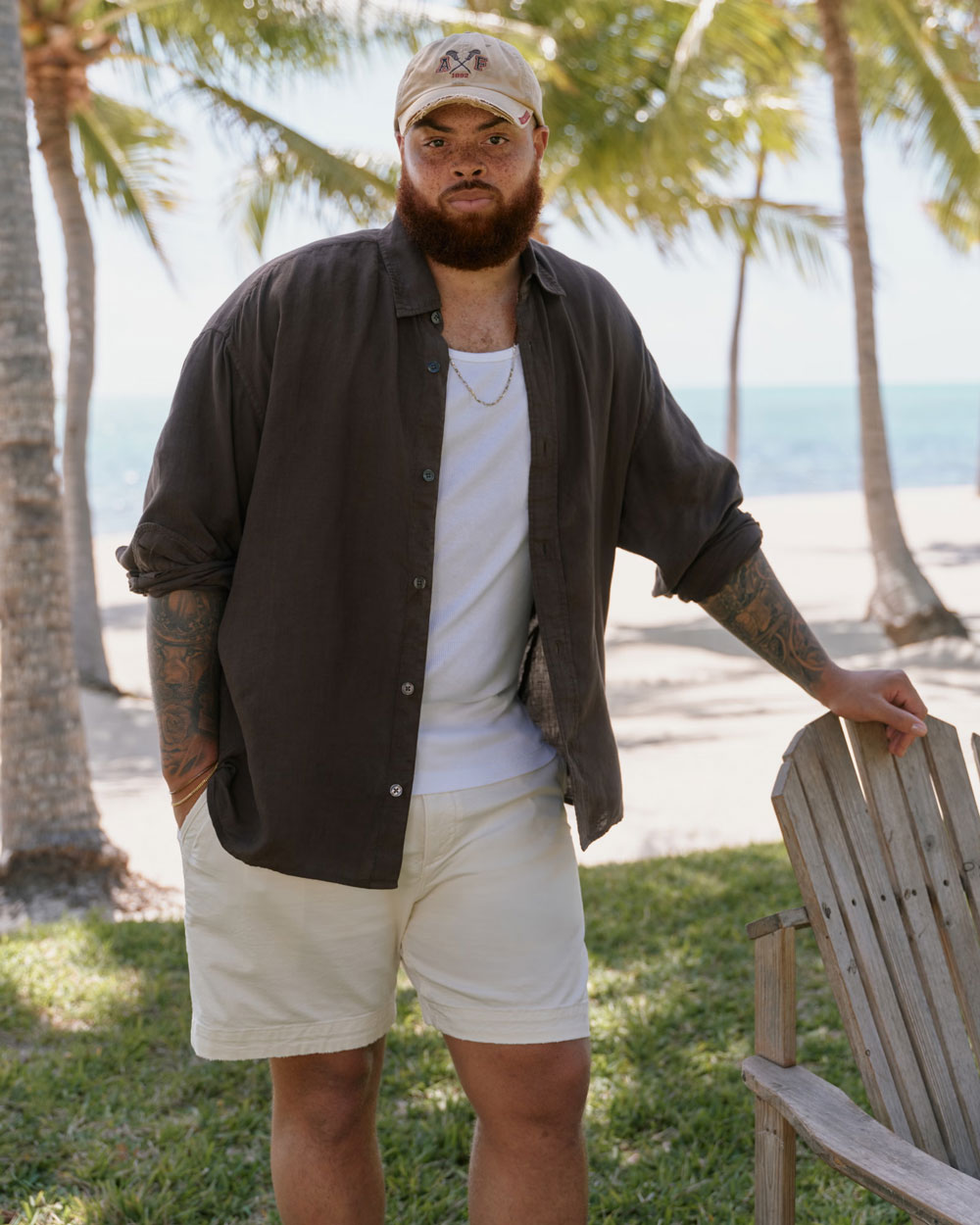 Abercrombie & Fitch
If your primary frustration is back and/or chest sweat and not arm pits, a looser tank top in a t-shirt material (versus a traditional waffley A-shirt) can perform the same function and contribute toward an outfit under a loose button up shirt.
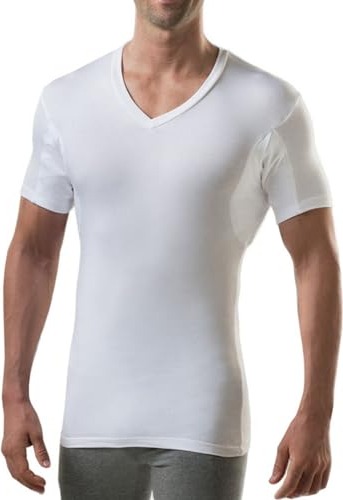
Thompson Tee Sweatproof Undershirt, $44.50
If that isn't enough, there's a category of sweat-proof undershirts with sealed underarm pads, Thompson Tee being the one people mean. They work, specifically at the underarm. They also run warm and read a little clinical, so I'd treat one as a last resort, not a starting point.
The fabric is doing this to you
If you only change one thing, change this: it's the biggest lever, and the one most guys never suspect. Cotton feels like the breathable choice, and in a heatwave it turns on you. As our guide to linen puts it, once cotton is wet it stays wet, holding the moisture against you for hours. Linen does the opposite: its hollow fibers wick and shed moisture, and it takes on close to a fifth of its weight before it feels damp.
But the fiber is only half of it; the half people miss is the weave. A flat, smooth cloth sits against your skin and shows every wet contour.
A textured or open weave holds itself off your body, so air moves and a damp spot never resolves into one solid mark: seersucker, oxford cloth, slubby linens, and hemp or a hemp-cotton blend, which breathes like linen and creases a little less.
The honest tradeoff: linen creases the moment you look at it. It bothers me about one day in five, and I wear it anyway. Not all of it is worth buying, either, a separate argument. Of the ones I reach for, Quince and J.Crew on sale are the price play, Huckberry or Buck Mason for the one that lasts, and Uniqlo is where to test the idea first.
What none of this fixes
None of this stops sweat the way an antiperspirant does, and most articles won't tell you that. These fixes intercept it, move it, evaporate it, or hide it, which on most days is the entire job. If you sweat well past the people around you, past what any fabric can hide, that's a real condition with a real name, and there are medical routes for it no linen shirt will pretend to replace.