By The Straits Times | Created at 2026-06-06 21:06:44 | Updated at 2026-06-07 20:25:23
23 hours ago
By The Straits Times | Created at 2026-06-06 21:06:44 | Updated at 2026-06-07 20:25:23
23 hours ago
SHENZHEN – I opened my home last week to an unlikely trio: a boxy white robot named Quanta X1 Pro and its two human partners – housekeeper Aunty Tan and a young engineer.
They are part of a new cleaning service launched in China in March, as robot start-ups look beyond gongfu and dancing to make humanoids more useful in the real world.
As China grapples with an ageing workforce and declining birth rates, companies are betting on robots to be housekeepers for the future and bringing them into people’s homes to help them learn the job better.
Curious, I signed up for a three-hour cleaning service that costs 149 yuan (S$28), available in Shenzhen and Beijing.
Can a humanoid really do my chores?
The cleaning is mainly still done by human hands, the engineer said as Aunty Tan bustled about the kitchen.
For now, the 1.6m-tall robot fitted on a wheeled base with two mechanical arms would only perform simple tasks and operate in my living area.
I watched as Quanta began by silently scanning the room to figure out what it could and would do. It works mostly autonomously, I was told, but would need help if it got stumped or stuck.
The engineer, who declined to give his name, observed its every move, ready to step in if it hit a snag or broke anything.
First the robot straightened two chairs at the dining table, grabbing their legs with its pincer-like hands and pushing them into place.
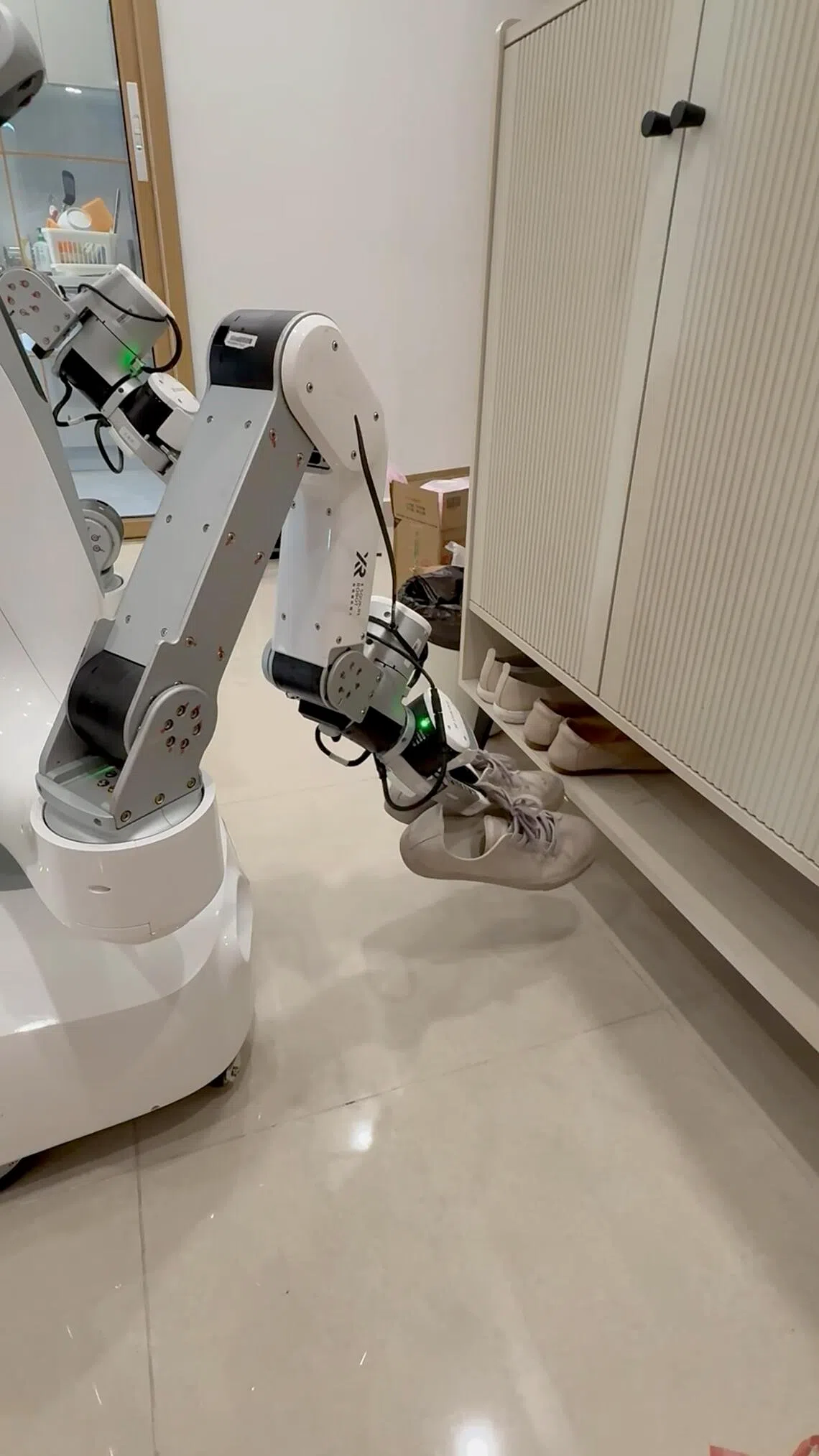
Quanta puts shoes back on the rack.
ST PHOTO: JOYCE ZK LIM
It picked two pairs of shoes off the floor and set them back on their rack. It dropped one pair but managed after adjusting its grip on the second try.
It folded four pieces of laundry strewn on the couch, and stacked them neatly aside. Pants and a cardigan proved tricky – each slipped off the couch once. Folding and stacking them took nearly nine minutes apiece, while blouses were easier, taking half the time.
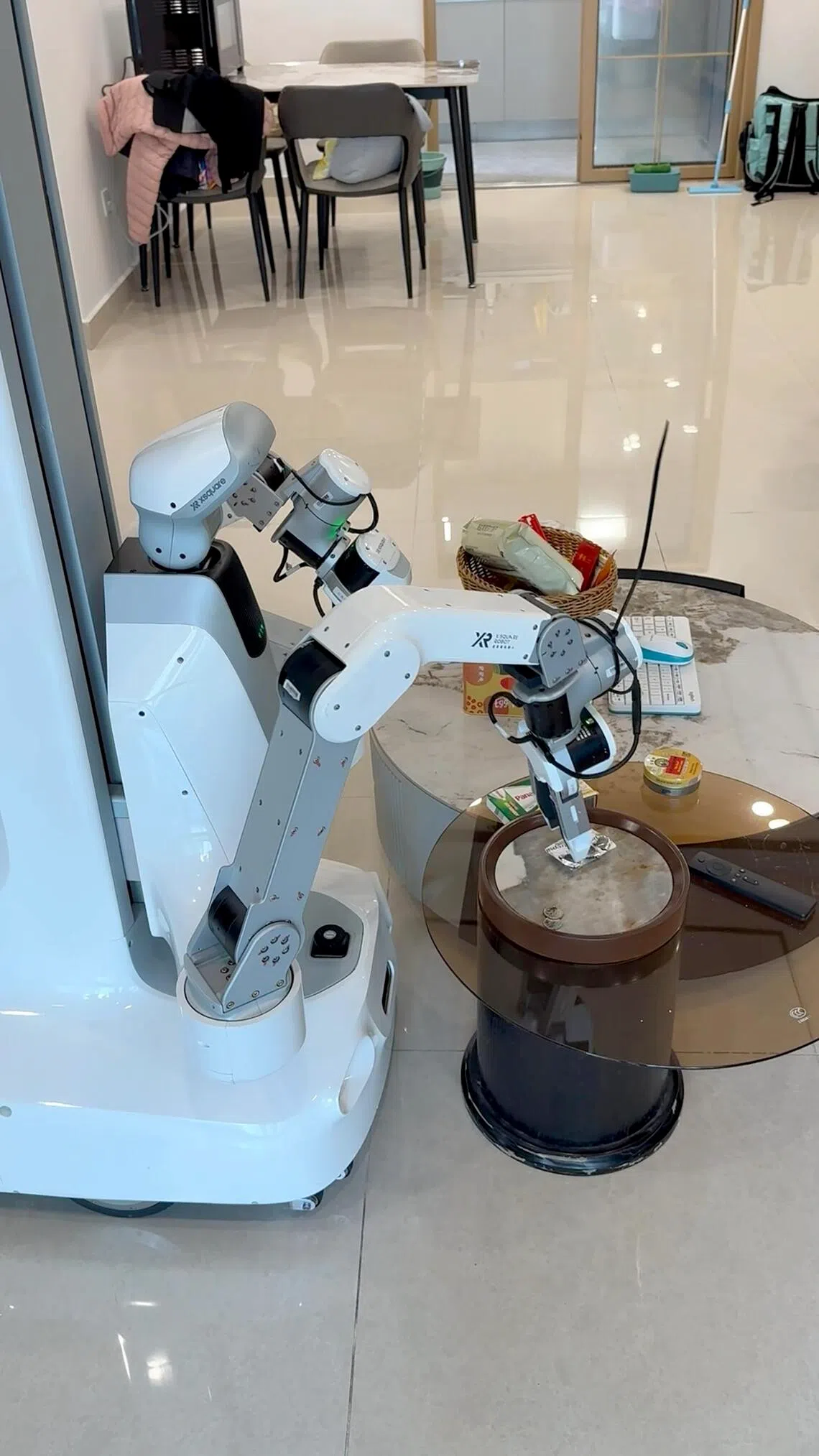
The robot tidies things on a coffee table.
ST PHOTO: JOYCE ZK LIM
The robot tidied my table tops and removed what it decided was trash – yes to a sweet wrapper and a folded leaflet; no to an empty box of Panadol. But instead of throwing both items together, it made two trips to the bin.
I wanted to see if Quanta could wipe the dining table – something not part of its usual repertoire – so I set down a damp cloth and a spray bottle of detergent. The robot made wiping motions with the cloth but ignored the bottle, putting it aside as though in the way. It also left breadcrumbs on the table.
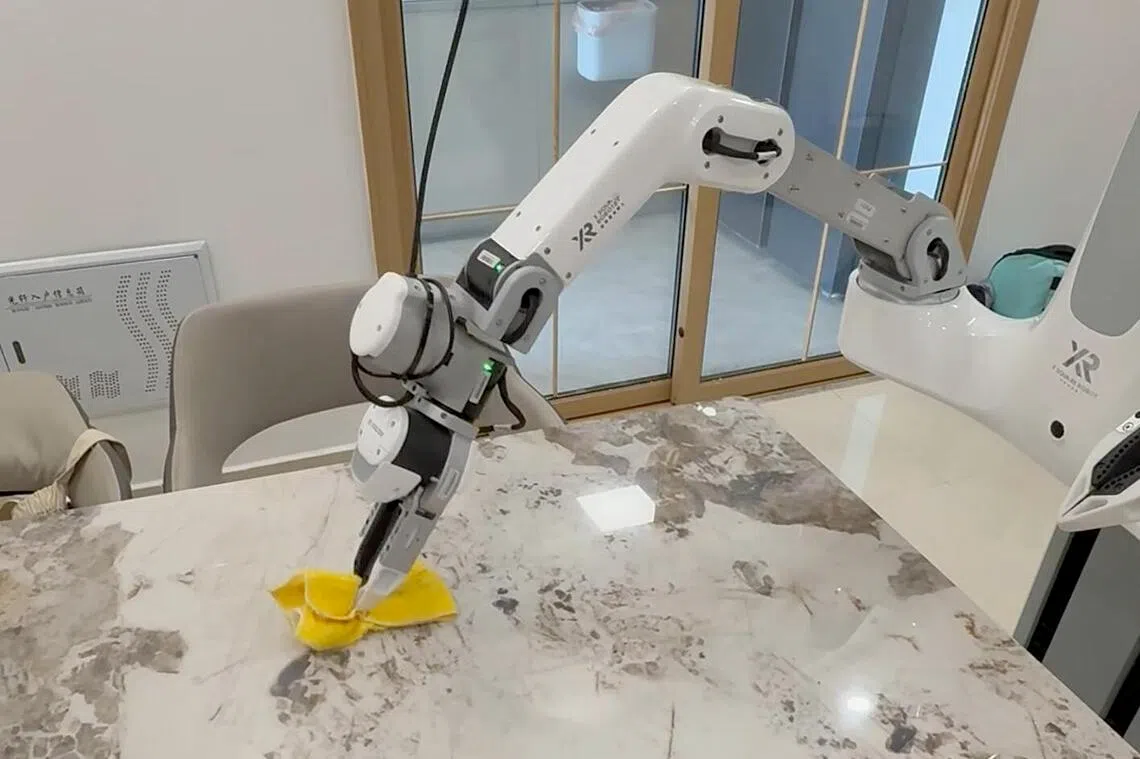
Quanta wipes a table but could do a better job.
ST PHOTO: JOYCE ZK LIM
The robot’s last chore was to remove the used garbage bag from the trash can. It did not succeed: the bag was probably too full and got stuck, surmised the engineer, who finished the job himself.
He also had to help Quanta into my flat when it got stuck at the raised threshold, twice fixed a wire that came loose on its arm, and adjusted its spotty internet connection.
The few things the robot did on its own, it did really slowly. In the time that it moseyed about my living room, Aunty Tan cleaned the rest of the flat.
She washed the dirty dishes that the robot could not touch as its hands are not waterproof. She also cleaned the kitchen, scrubbed the toilet, mopped the floor and folded the remaining laundry. Then she wiped all the surfaces the robot did not clean.
Asked what she thought of her humanoid partner, Aunty Tan was unimpressed. “Humans are still better at cleaning,” she said. “Look at the robot, what did it really do?”
Homes are notoriously tricky for humanoids to clean as the unpredictable environments are filled with finicky tasks. The industry also lacks data to train them to be smarter faster.
Many firms are training humanoids to do chores like fold clothes and tidy tables in data factories simulating home environments. But X Square Robot, the Shenzhen-based creator of Quanta, is going further with its home cleaning service, a tie-up with life services platform 58.com.
Putting robots to work in actual homes is much more effective for training, a company representative told me. As every home is different – from how apartments are laid out to where things are placed – robots can learn more on each job and develop more quickly.
To encourage people to open up their homes, the company offers Quanta’s services basically for free. A three-hour house-cleaning costs the same with or without the robot. Earlier on, the robot-inclusive version had even sold for half price to attract sign-ups.
A fleet of robots has now worked in nearly 200 homes so far, the firm said. In time to come, it plans to expand what chores the robot can do, and make the service available in more cities.
China is the world’s largest producer and user of humanoid robots, a market which investment bank Barclays estimates could reach US$200 billion worldwide by 2035. The country is gunning to deploy them in real-life settings ranging from factory floors to convenience stores, and now living rooms.
In the city of Wuhan, Chinese firm GigaAI announced in May upcoming trials of its household humanoid in homes. Residents can apply to have a robot work for free in their homes next year, with priority given to families with old people, children or pets.
Over in the United States, robots are also inching into homes. People can pay US$20,000 (S$25,600) to pre-order a household humanoid from start-up 1X Technologies, which is expected to ship this year. The company is upfront about collecting data from people’s homes.
Firms are racing to rack up real-world training data as that is a big bottleneck for embodied AI at the moment, said Georg Stieler, head of robotics and automation at Stieler Technology & Market Advisory, a consultancy.
Even as the sector rides a funding boom, companies recognise that their technology must improve quickly, “otherwise investors might become sceptical”, he said.
Robots that can reliably do most household chores without supervision are, by most measures, at least a decade away, he added.
But in the interim, firms will jostle to put out robots that can do more and do better – with humans like Aunty Tan filling in the gap.
The housekeeper did not rule out that the slow-moving humanoid might one day give her a run for her money. In 10 years, she reckoned, “this could all be different”.