By The Straits Times | Created at 2026-07-28 09:37:03 | Updated at 2026-08-03 20:15:02
6 days ago
By The Straits Times | Created at 2026-07-28 09:37:03 | Updated at 2026-08-03 20:15:02
6 days ago
SEREMBAN – As Negeri Sembilan’s state election campaign entered its final week, one thing became increasingly clear: the contest was increasingly being fought over who could better rally the Malay vote.
Then came Kedah Chief Minister Sanusi Md Nor – and campaigning quickly descended into racially-charged rhetoric.
Stumping for the alliance between Perikatan Nasional (PN) and Barisan Nasional (BN) in the core rural Malay heartland of Jempol on July 23, Sanusi urged voters to give them a chance to govern the state and return political leadership to Malays.
But it was his assertion that Malays had no other homeland, while other ethnic minorities had countries tied to their ancestral roots, that ignited the campaign’s biggest political storm.
“The Malays have no other land. Indians have India. Chinese have China, Cambodians have Cambodia and the Thais have Thailand. Malays only have this land,” he told the crowd in Malay.
“We have already lost the economy. If we lose political power too, our position will continue to weaken. Young people may not care about politics today but if nothing changes now, this state will be lost in 10 years,” he added.
Negeri Sembilan police chief Alzafny Ahmad said on July 28 that Sanusi’s remark was being investigated under the Penal Code for making statements conducive to public mischief and the Communications and Multimedia Act for improper use of network facilities or network services.
Sanusi claimed on July 28 that his speech had been taken out of context, and threatened legal action against those he accused of twisting his remarks.
But the issue went beyond one speech. It exposed a campaign strategy that had become increasingly visible as PN and UMNO-led BN campaigned side-by-side after years of competing for the same pool of Malay voters.
Appeals to Malay unity and political leadership grew more prominent, while Pakatan Harapan (PH), led by Prime Minister Anwar Ibrahim, was left dousing inflamed racial sentiment instead of debating governance.
Chasing Malay votes a continuation from Johor polls
Such messaging mirrors dynamics seen during the Johor election that concluded with a BN landslide win on July 11.
Then, Parti Islam Se- Malaysia (PAS) President Hadi Awang admitted it was backing UMNO and BN to ensure “Malay political dominance” in Johor.
Seeking to reassure non-Malay voters, he added: “We will not interfere. But Muslims, who are the majority, need to lead.”
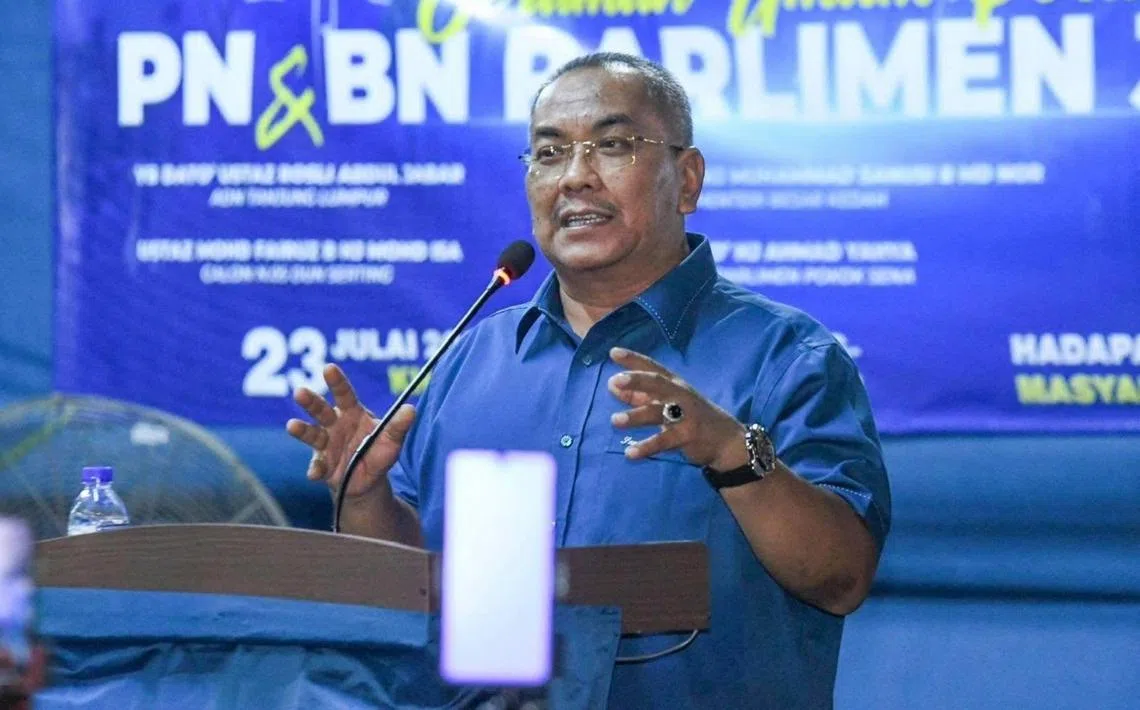
Perikatan Nasional’s Sanusi Md Nor is now under police investigation over his remark while campaigning in Jempol, Negeri Sembilan on July 23.
PHOTO: SANUSI MD NOR/FACEBOOK
His remark foreshadowed what would become a recurring theme in Negeri Sembilan. From joint rallies in Seremban to campaign stops in Jempol, speaker after speaker urged Malays to unite politically.
Candidates portrayed the election as a contest over Malay political leadership and warned against a federal government they claimed was dominated by the Democratic Action Party (DAP).
Seremban PAS chief Rosmin Adam was among those repeating the allegation against DAP, while PAS activist Ezam Md Nor called for a return to what he described as “constitutional foundations of Malay-Muslim political leadership”.
Another Malay-dominated party under PN, Parti Pejuang Tanah Air, framed Malay unity through its information chief Rafique Rashid Ali as “essential” to the country’s future by telling supporters that Malays must once again find common ground.
“Why should we be afraid of a coalition of Malays? If Malays are united, the country will prosper, not only for Malays but also for non-Malays,” he told supporters at a rally in Seremban on July 22.
The campaign unfolded against the backdrop of an unprecedented royal dispute that thrust Negeri Sembilan’s unique Adat Perpatih system into the national spotlight.
In many rural constituencies, where the hereditary Undang or chieftains continue to command respect and influence, the debate over the state’s royal institution added another layer to campaign messages centred on Malay leadership and traditional institutions.
In response to an increasingly inflammatory racial battle, PH sought to shift the conversation back to governance.
“Politics should be boring and talk about policy,” DAP lawmaker Syahredzan Johan said at a rally in Nilai.
Instead, he said, opponents had turned race and DAP into the campaign’s central themes, overshadowing debates over jobs, development and the rising cost of living.
Racial politicking unlikely to abate in Negeri Sembilan
Sanusi’s remarks drew condemnation from PH leaders and prompted UMNO president Zahid Hamidi to publicly distance the party from the comments.
Anwar asserted on July 25 that Malaysia’s strength lies with its diversity, and minority groups who abide by the Constitution and contribute to the country must be accepted.
But political analyst Tunku Mohar Mokhtar of International Islamic University of Malaysia said the episode was unlikely to disrupt the cooperation between PN and BN.
“It’s something that can’t be defended. That’s why Zahid told him to stop,” he told The Straits Times, referring to Sanusi’s remark.
“People were insulted and offended but elite relations overshadow grassroots grievances.”
The strategy to bank on Malay unity resonates well with the state’s electoral realities where 57 per cent of the electorate in Negeri Sembilan are Malays.
On top of that, 23 of 36 state seats have Malay-majority electorates. Eleven of those seats make up more than three-quarters of Malay voters in the state, according to data in a July 24 analysis by political analyst Bridget Welsh of University of Nottingham Asia Research Institute Malaysia.
However, Tunku Mohar said Johor had already offered a glimpse of how political pragmatism could outweigh tensions on the ground.
For him, the alliance’s shared political interests ultimately mattered more than disagreements generated on the campaign trail. He pointed to protests from MCA and MIC, which are the Chinese- and Indian-dominant parties in BN, respectively.
“They were not strong enough to affect the collaboration,” he said.
Voters seem to agree, as they weigh their choices for the vote set for Aug 1. Jelebu resident Ahmad Azhar Ramzi, 34, said Sanusi’s remarks struck a chord.
“My vote goes to the one I believe can protect the rights of the Malays and keep the country safe.”
Additional reporting by Hadi Azmi
Sign up for our weekly Asian Insider Malaysia Edition newsletter to make sense of the big stories in Malaysia.