By The Straits Times | Created at 2026-09-19 21:16:35 | Updated at 2026-09-20 10:57:03
13 hours ago
By The Straits Times | Created at 2026-09-19 21:16:35 | Updated at 2026-09-20 10:57:03
13 hours ago
BANJARBARU, South Kalimantan – Indonesian farmer Adi Siswoyo could only watch helplessly as fire swept through his vegetable farm.
The 43-year-old had alerted firefighters as flames closed in on Aug 27. More than 20 fire engines were at the site, he recalled, yet he was told their hoses could not reach the blaze.
“If the hoses could not reach, they could borrow hoses and connect them. It should have been possible,” Adi told The Straits Times at his farm in Syamsudin Noor village.
ST asked the local authorities why the hoses could not reach the blaze and whether other measures had been considered, but received no response to date.
Within hours, his 1,960 sq m plot – roughly the size of five basketball courts – lay scorched.
Gone was his tabuk – the raised growing ground that farmers painstakingly build up on the swampy land so that vegetables sit above the waterline – which he had spent about three months preparing. Gone too were the chye sim and water spinach he had planted about two weeks earlier.
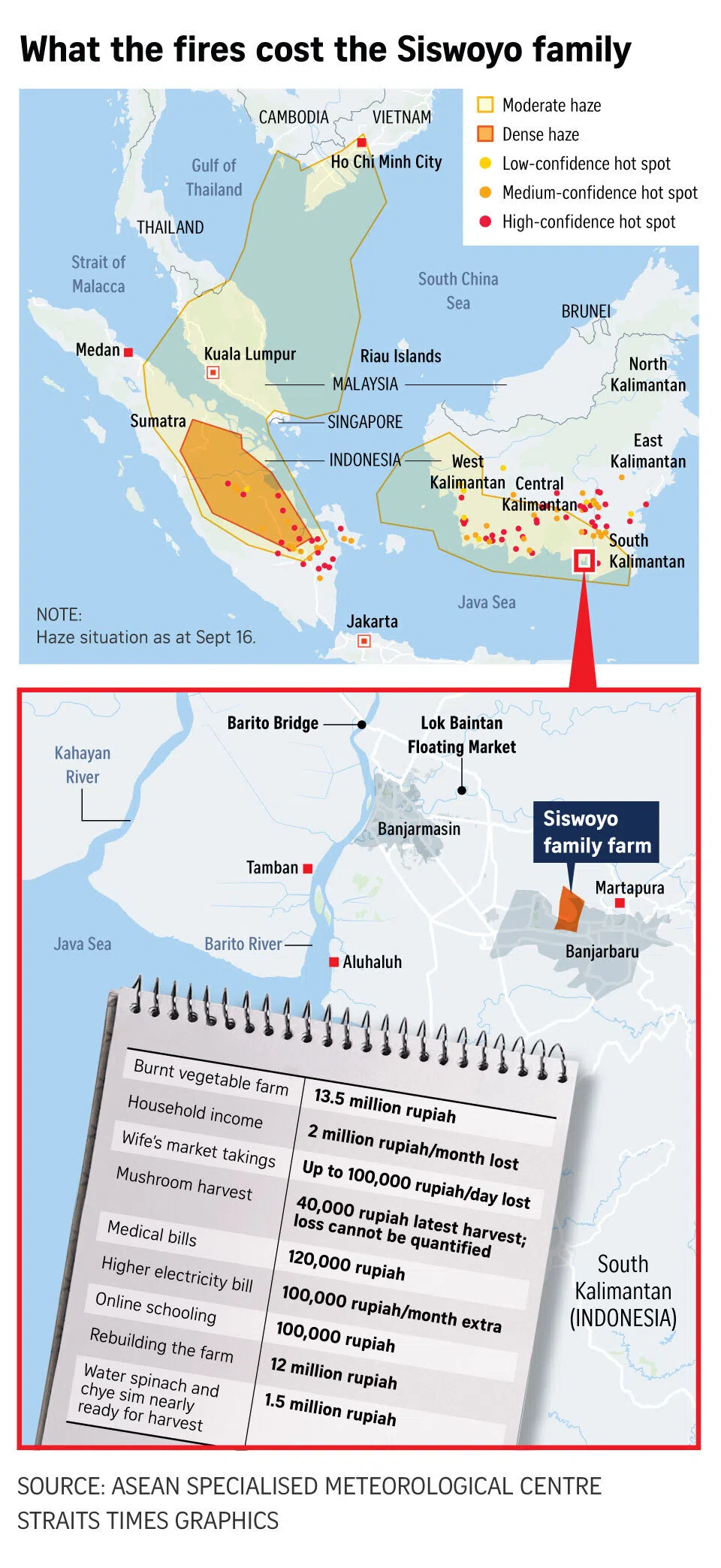
Adi puts the loss at 13.5 million rupiah (S$979): 12 million rupiah for the labour needed to rebuild the tabuk, plus one million rupiah for the chye sim and 500,000 rupiah for the spinach.
“We had already put in the labour, the money and the time,” he said. “Everything was wasted.”
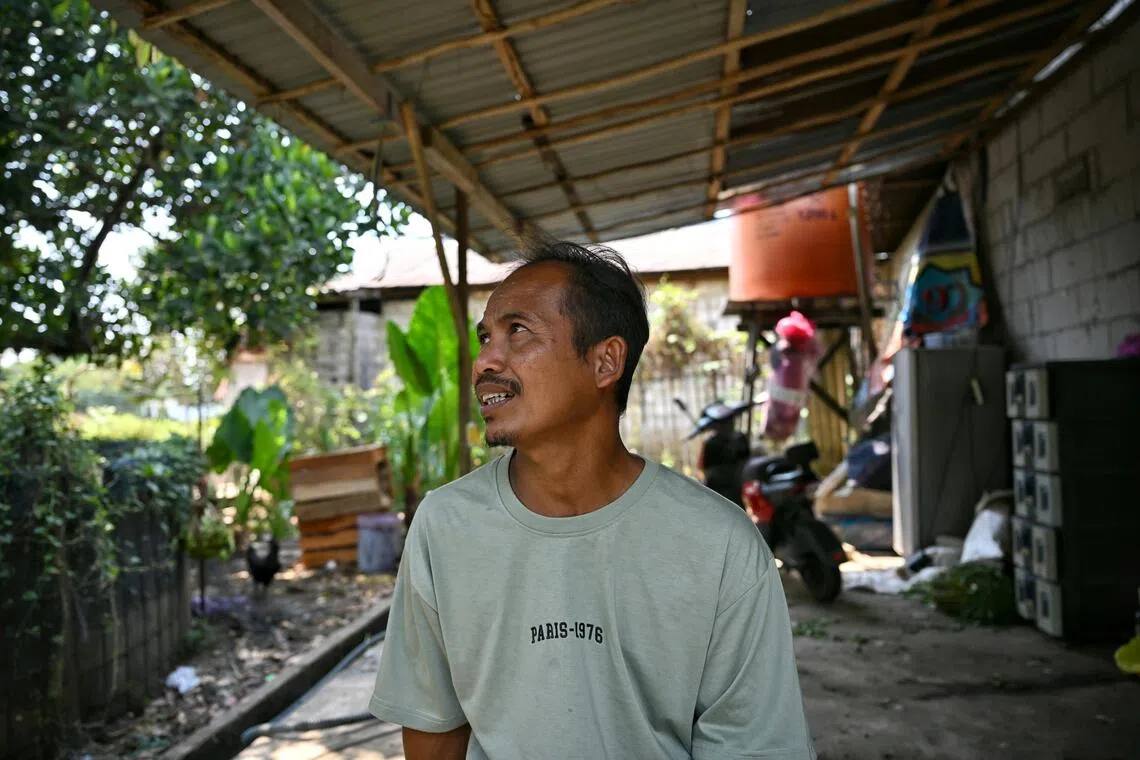
Indonesian farmer Adi Siswoyo, 43, at his home in Banjarbaru. He said he has lost an estimated 13.5 million rupiah (S$979) as a result of the wildfires.
ST PHOTO: ARIFFIN JAMAR
Indonesia is experiencing an unusually severe fire season, with prolonged heat and dryness exacerbated by a very strong El Nino. The fires have burned large areas of Sumatra and Kalimantan, while smoke and haze have affected neighbouring countries such as Malaysia, Singapore and the Philippines.
The Center of Economic and Law Studies (CELIOS) estimates that the country’s fires from January to August could result in 39.29 trillion rupiah to 123.1 trillion rupiah in economic and health losses.
Adi’s family offers a glimpse of how the cost of Indonesia’s fires is felt far beyond the flames. But for households already living on tight margins, the damage comes in much smaller amounts that quickly add up – a lost crop here, a medical bill there, a higher electricity bill, less food on the table.
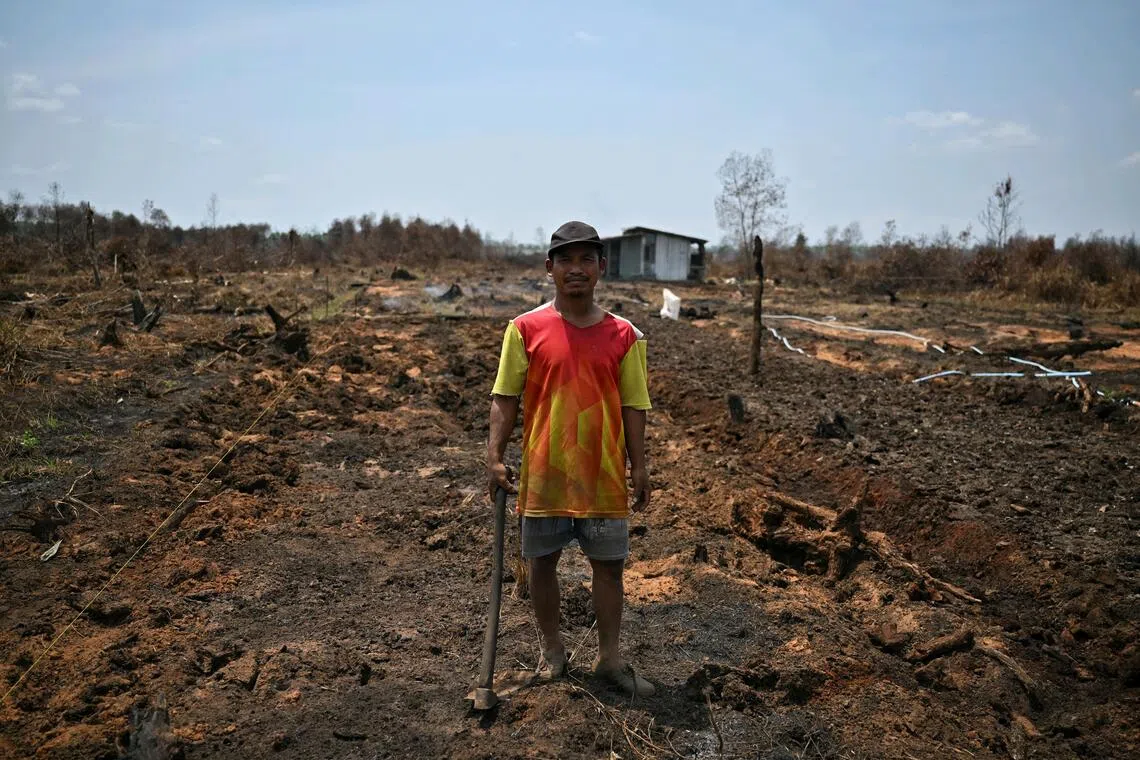
Farmer Adi Siswoyo, 43, surveys the charred remains of his plantation after a wildfire.
ST PHOTO: ARIFFIN JAMAR
Earning less, paying more
Two of Adi’s four sons, Arif Achmad Rifai, 11, and Rahmat Rafis Saputra, five, developed coughs and colds as the haze lingered. Their mother, Asmarawati, 39, took them to a village midwife, paying 60,000 rupiah per visit including medicine – the medical bills totalled 120,000 rupiah.
The family paid out of pocket after stopping its BPJS Kesehatan national health insurance scheme premiums during the Covid-19 pandemic.
With the heat, the family also ran their two fans more often, pushing their monthly electricity bill up by about 100,000 rupiah, from around 200,000 rupiah to 300,000 rupiah.
When Arif’s primary school shifted online for two weeks, the family spent another 100,000 rupiah on mobile data.
Each expense is modest. But as a whole, they matter more to a household whose monthly income has fallen from about five million rupiah to nearly three million rupiah.
The family is earning less at the same time that some of its costs are rising. Adi pays roughly 1.5 million rupiah a month on a bank loan for fish farm equipment and supplies, while his 17-year-old son, Riky Dwi Ramadan, has vocational-school fees of 300,000 rupiah a month.
The squeeze is also being felt at the market.
The prolonged dry spell has raised farming costs, with Adi and Asmarawati having to pump water more often and spend more on petrol.
Meanwhile, vegetable supplies have also fallen, pushing up prices but not necessarily farmers’ incomes.
With that, Asmarawati has doubled the price of a bundle of water spinach from 3,000 rupiah to 6,000 rupiah, but customers are buying less. A bakso seller who used to buy three or four bundles of chye sim now takes only one or two, or switches to cabbage. Haze has also discouraged some people from going to the market.
“The price goes up, but consumers do not want to go up with it,” Asmarawati said. “My capital has increased, but my income has fallen.”
Her net daily takings have fallen from about 200,000 rupiah to 100,000 rupiah, and sometimes to 50,000 rupiah. On some days, she makes a loss.
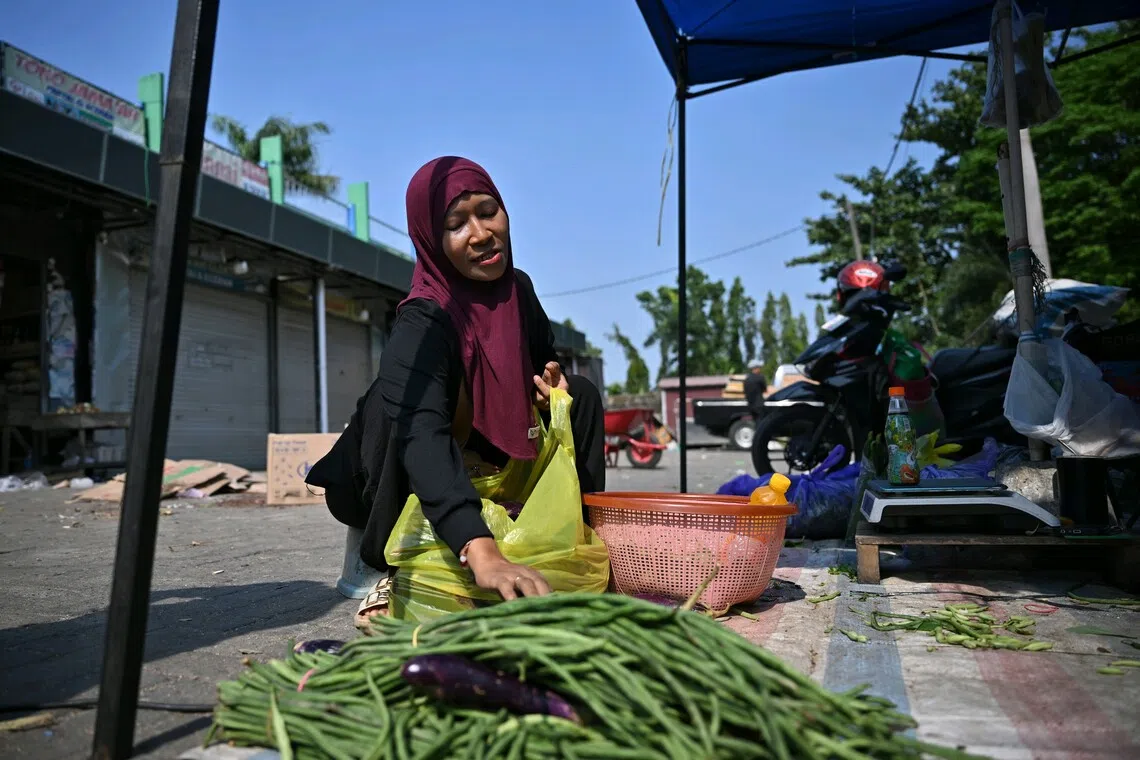
Asmarawati, 39, selling vegetables at a market in Banjarbaru.
ST PHOTO: ARIFFIN JAMAR
The squeeze is visible at the dinner table, too.
“Usually, when I come home, I might bring a kilo of fish. Now, maybe only half a kilo,” she said.
The family has also cut back on snacks.
On the farm, Adi now has to irrigate almost every day. During the wetter months, typically from November to April in his area, he barely needs to pump water.
“If we plant a lot and cannot look after the crops, we’ll lose even more,” he said.
So the family is seeking other sources of income.
But gourami fish take 10 to 12 months to reach sale size, and the family has to pay for fingerlings, feed, electricity and water.
The mushroom venture began after customers asked the family to supply them because another supplier had stopped selling the fungi.
“We did not have the knowledge,” she said. “But we dared to try, learning as we went.”
Dry weather, however, has caused some of the mushrooms to fail.
Local officials have distributed masks, urging people to stay indoors when the haze is thick. But for farmers like Adi, that is easier said than done.
“Farmers have to hoe the fields. We cannot wear masks; it is hard to breathe,” said Adi. “When the wind blows the fire and haze in from the south, the best I can do is hoe facing north.”
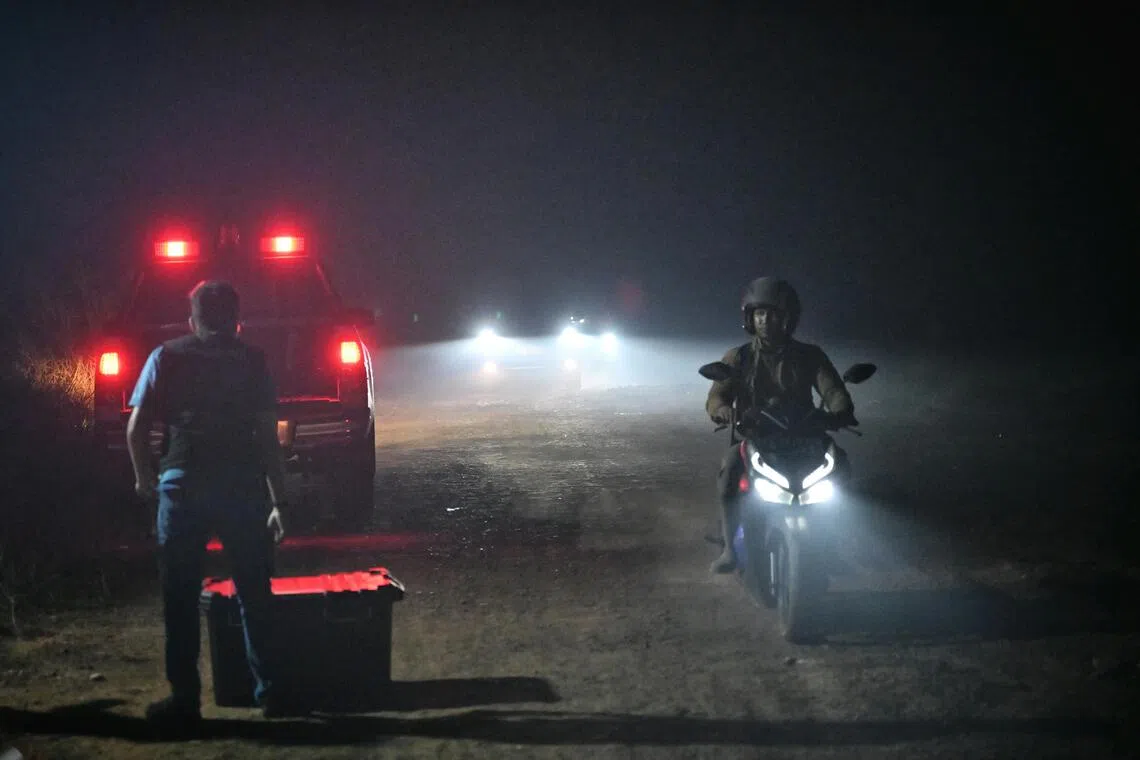
Visibility in Banjarbaru is heavily reduced at night when the smoke thickens. Local officials have distributed masks, urging people to stay indoors.
ST PHOTO: ARIFFIN JAMAR
Beyond one family
Some families in Syamsudin Noor village, particularly those with babies or young children, have temporarily moved in with relatives in Banjarmasin and Martapura, where the haze is less severe, said community leader and farmer Hendri Wibowo.
For farmers, he said, the dry spell has brought what they call a lean year.
“For us farmers, we cannot plant. We have no harvest income because of the drought.”
The village has 28 registered farmer groups, of which about 14 remain active, growing crops, including melons, chillies and tomatoes. Hendri estimated their combined agricultural losses could run into hundreds of millions of rupiah, although he could not provide figures to substantiate the estimate.
Village head Fitria Khairani said about 10ha had been burned, but could not quantify the losses because affected farmers had not reported them or were unable to do so accurately.
The absence of reliable figures is itself a sign of how difficult it can be to measure the cost of the fires at the village level.
Fitria noted that the haze had disrupted daily activities, with residents experiencing shortness of breath and eye irritation.
Local community hospitals have recorded a rise in respiratory infections.
At Ratu Zalecha Hospital in neighbouring Banjar regency, public health surveillance officer Winanda Rosalina said cases of acute respiratory infection, known as ISPA, began increasing in mid-June.
Hospital records seen by ST showed 341 cases between June and Sept 9. However, Winanda cautioned that not all could be attributed to haze as respiratory infections have multiple causes and ISPA may be recorded as a secondary diagnosis rather than the main reason a patient sought treatment.
“Patients come to us with a main symptom like fever, and only later do we find out it is ISPA, or it could turn out to be dengue,” she said.
Economist Achmad Nur Hidayat of Universitas Pembangunan Nasional in Jakarta said the burden of recurring fires falls disproportionately on lower-income households, which have fewer ways to escape the effects or absorb the losses.
“The ones who suffer most are the lowest-income groups because they have no alternatives,” he told ST.
The haze has also imposed costs on schools and families.
At SMP 15 Banjarbaru, a state junior high school with 466 students, lessons moved online for two weeks – from Aug 24 to Aug 28 and again from Aug 31 to Sept 4 – because of the haze.
Principal Hery Tryman said classes were conducted through Google Meet, with WhatsApp used for students who could not join scheduled lessons.
For families without home Wi-Fi, the switch meant buying more mobile data. Hery estimated that this typically cost between 25,000 rupiah and 50,000 rupiah a week for each student’s phone.
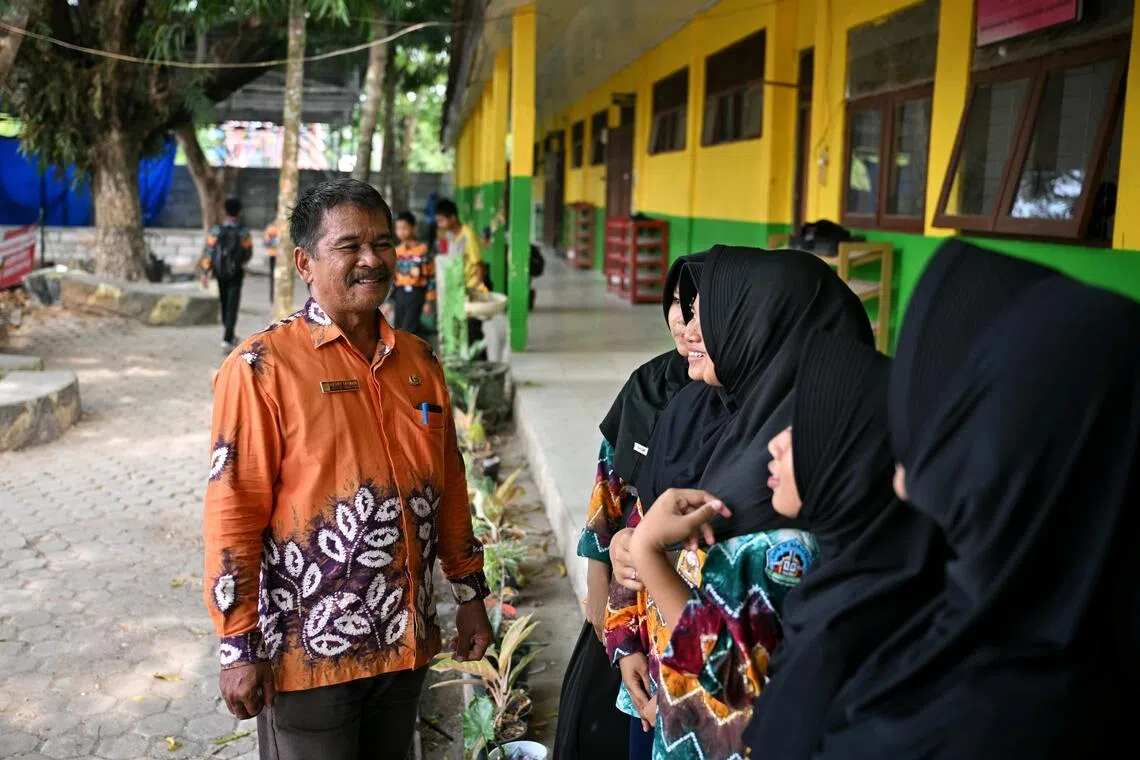
Hery Tryman, principal of SMP 15 Banjarbaru, said the school was conducting classes through Google Meet, with WhatsApp used for students who could not join scheduled lessons.
ST PHOTO: ARIFFIN JAMAR
But the disruption was not only financial. Many parents in the area are farmers or traders and could not stay at home to watch their children study, he added.
“Parents told us, ‘We cannot fully supervise our children while they study because we have to work,’” Hery told ST. “They also said they were having difficulty because they had to buy phone credit and data packages. They really felt the burden because the children needed internet data to join the virtual classes.”
Rethinking farming for a living
For farmers like Adi, the question now is not simply how to recover what was lost, but whether the old way of making a living is still sustainable.
He is rebuilding the tabuk, but doing it himself will take about three months. Hiring workers could cut the time to about a month, but would cost around 12 million rupiah.
“We do it little by little to save money,” he said. “If we hire people, it would be faster. But when we do it ourselves, we have to do it alongside planting, watering and other work.”
Rebuilding does not necessarily mean returning to farming as before. With another two years of bank-loan repayments of roughly 1.5 million rupiah a month, Adi is considering putting more effort into fish and mushrooms and making vegetables a smaller part of the family’s livelihood.
“I am thinking of changing professions,” he said. “If possible, the vegetable farm would become something on the side.”